Geekzone: technology news, blogs, forums
Guest
Welcome Guest.
You haven't logged in yet. If you don't have an account you can register now.


809 posts

Ultimate Geek


Topic # 109670 24-Sep-2012 22:20 Send private message

Anyone else here into astrophotography? I'm wanting to get started now I have a DSLR and I keep seeing awesome photos online and am keen to try my hand. I'm still a photoshop noob though unfortunately so I have a while to go yet... I've found plenty of info out there about start trail photos but not much about normal star photography

I was recently in the US and got to take a few cool night photos in the desert. They were only single exposures however (I have the RAWs), but I was wondering if there is much I can do to enhance them and bring out the colours, nebulae, detail, etc and reduce the noise. I've been reading about stacking but you need multiple images of the same scene to do that correct? You can't stack multiple copies of the same file can you? It's the difference in noise between images that makes it work right?

For example what could you suggest to enhance this photo of the Death Valley stars with the glow from Las Vegas in the distance (200 miles away)

Similarly, what about the star field photo?


Create new topic
1732 posts

Uber Geek

Trusted
Telecom NZ

  Reply # 690874 24-Sep-2012 23:00 Send private message

Won't you need to mount the camera to a telescope to start a possibility of nebulae, moon detail, planets, etc?


809 posts

Ultimate Geek


  Reply # 690884 24-Sep-2012 23:43 Send private message

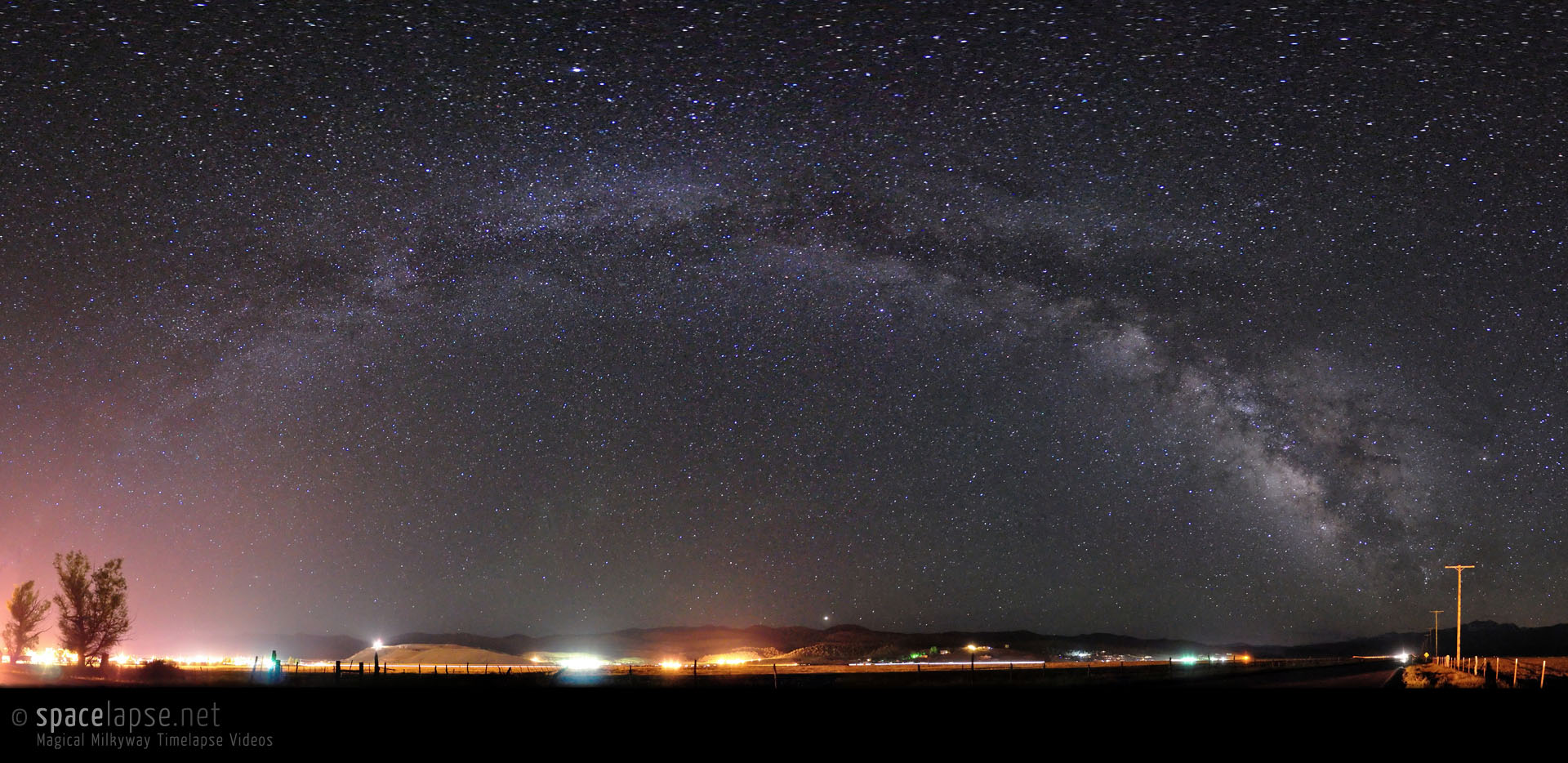
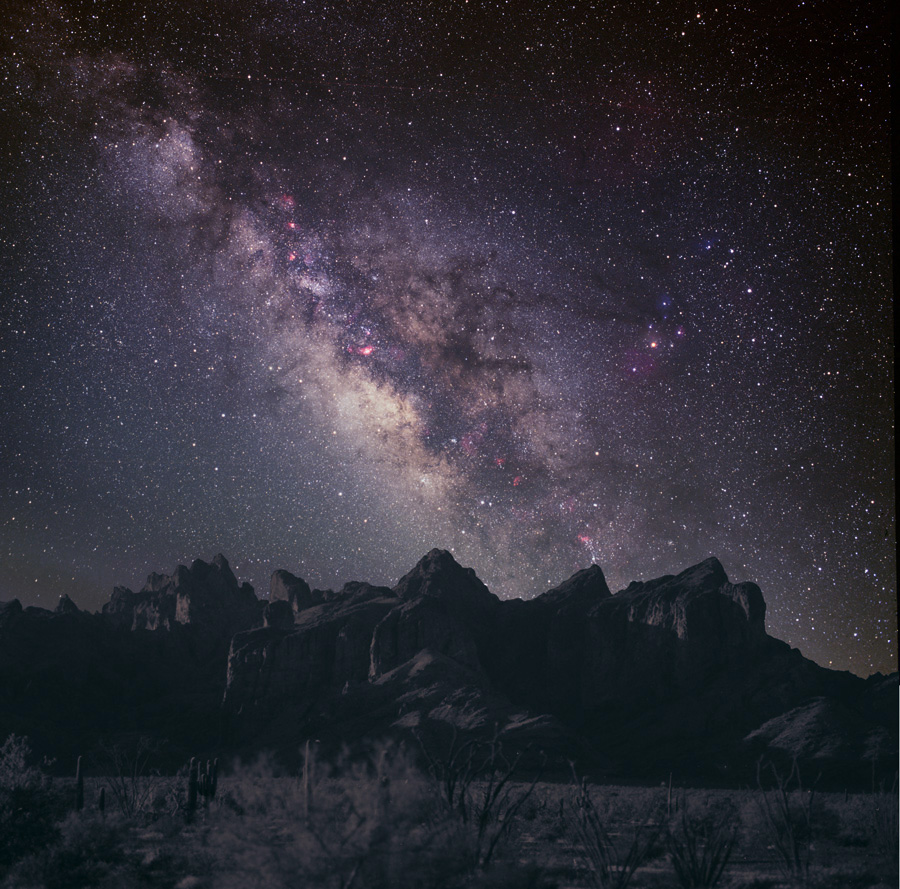
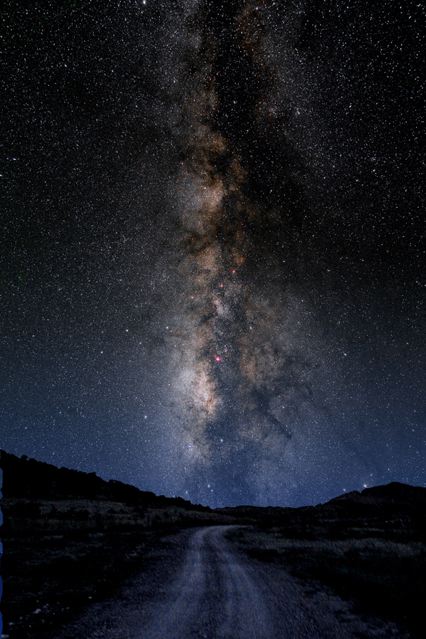
Not at all but im not sure how much I can get out of a single exposure. See the examples below. Im fairly certain however that these are many exposures of the same image stacked together to remove noise and bring out the detail (in addition to many other post processing tweakings)

Im not expecting to get pics quite like this but hope to get more than then untweaked jpegs I posted above!

Nevertheless, none of these are using telescopes or evn big zoom lenses, these are just SLR cameras using wide angle lenses 


809 posts

Ultimate Geek


  Reply # 690886 25-Sep-2012 00:12 Send private message

Some more I just saw. This is the kind of stuff I would love to produce one day


HTPC: Silverstone Crown CW02 case | Asus P5Q-L main board | Intel Dual core E8400 3.0GHz CPU | Thermalright Ultra120-Extreme Passive CPU Cooler | Blackgold BTG3540 TV Tuner & Hauppauge PVR-150 MCE Edition | Asus EN9600GT-Silent Passive GPU | 4GB Supertalent DDR2 800 RAM | 5+TB HDD space | LiteOn DH-401S BD/DVD/CD reader | Corsair HX-520w PSU | 1 single Noctua Silent Case fan | Logitech diNovo Bluetooth Media Desktop | Logitech Harmony 785 Universal Remote | Logitech Wireless Rumblepad 2 | Windows 7 Media Center, MediaBrowser & Arcsoft Total Media Theatre

41 posts

Geek


  Reply # 690892 25-Sep-2012 01:47 Send private message

I'm quite interested, more towards planetary/deep space astrophotography though.
Too expensive for me as a poor student right now...


809 posts

Ultimate Geek


  Reply # 690920 25-Sep-2012 08:23 Send private message

Apparently people get some amazing pics without just point and shoots these days even, but a DSLR is going to be better. A lot of it comes out in the post processing stage

Does anyone have tips on how to enhance these kind of photos?

Here's some more I found


289 posts

Ultimate Geek


  Reply # 690925 25-Sep-2012 08:34 Send private message

I haven't done much since the earthquakes, but a few of my astro shots from a couple of years back can be found here: http://www.astrophotogallery.org/u141-rodm.html

It isn't a cheap hobby, but once you've invested the equipment more or less hold it's value and will keep you amused for far longer than your missus would prefer.

There's plenty of freeware software such as Registax and Deep Sky Stacker that are worth looking at - not sure how they deal with the wide angle shots above, as I generally only shoot through telescopes.


Things are LookingUp....  A photo from my back yard :-)
http://www.astrophotogallery.org/u141-rodm.html 


809 posts

Ultimate Geek


  Reply # 690934 25-Sep-2012 08:52 Send private message

Wow some of those pics are amazing!

Are the stacking programs any use if you only have one exposure though? Aren't they for stacking lots of different photos of the same scene?

What would happen if you stacked loads of the same exact exposure? Surely the noise would also be enhanced as it would be the same in each one? You can stack black photos in there with them too right?

4256 posts

Uber Geek

Trusted

  Reply # 690946 25-Sep-2012 09:17 Send private message

Not sure, but the gut feel is you are talking a stacked/hdr type approach to some of the shots above. Will let google do the walking for me on that one.

You're battling the rotation problem, so as LookingUp says above, you'd need some fancy gear for some styles of shots. Any long exposure, even 1 minute on a static tripod etc will start to blur the stars as traces.

289 posts

Ultimate Geek


  Reply # 690951 25-Sep-2012 09:32 Send private message

Stacking many exposures of the same scene (but different actual shots) has the effect of reinforcing the underlying image, while averaging out the noise, which is generally random. It makes a huge difference with grainy images. In some of my astro photos you'd struggle to make out the underlying image in any single frame, but with 50 or more frames (totally many hours of exposure time) you have enough data to pull the detail out.

The other thing you need to do with long exposures (mine are generally 5-10 mins per shot) is take some dark frames (similar exposure shots with the lens cap on) which can then be subtracted from the image in the stacking program to remove issues due to hot pixels. This works well even on long exposure single shots.

When photographing the sky you've got to remember that we're moving, so the sky will appear to rotate about the south celestial pole. Exposures of any more than 30 sec will start to show star trails unless you have a mount that it also rotating the camera about the same pole.

Finally, I expect that the photos in the original posts are composites, where they've taken a foreground shot and mixed it with their sky shots. The amount of detail / lack of star trails indicates that the sky is made up of many frames that have been stacked, and the only way they'd get this to work with the foreground (remembering that the sky will appear to rotate) is that it's a separate exposure.


Things are LookingUp....  A photo from my back yard :-)
http://www.astrophotogallery.org/u141-rodm.html 


809 posts

Ultimate Geek


  Reply # 690996 25-Sep-2012 10:44 Send private message

OK cool. Yeah I realise that these are composite shots and I'm not planning on getting into buying tracking mounts or anything yet, just wondering what I can do with my camera and tripod at the moment. I was lucky enough to be in Death Valley a few weeks ago and got a bunch of pics but they are all single exposure (30 seconds).

Would I just stack a single copy of the image with a black photo (lens cap on)? I guess there are other tweaks I can do in PS but since the star fields are so detailed I didn't know how I'd separate the grain/noise form the fainter stars...

What are the basic kinds of editing techniques or filtering that people might play around with to enhance these apart from stacking? Would the built-in noise reduction tools in PS help?

540 posts

Ultimate Geek

Trusted

  Reply # 691026 25-Sep-2012 11:33 Send private message

Asmodeus: OK cool. Yeah I realise that these are composite shots and I'm not planning on getting into buying tracking mounts or anything yet, just wondering what I can do with my camera and tripod at the moment. I was lucky enough to be in Death Valley a few weeks ago and got a bunch of pics but they are all single exposure (30 seconds).

Would I just stack a single copy of the image with a black photo (lens cap on)? I guess there are other tweaks I can do in PS but since the star fields are so detailed I didn't know how I'd separate the grain/noise form the fainter stars...

What are the basic kinds of editing techniques or filtering that people might play around with to enhance these apart from stacking? Would the built-in noise reduction tools in PS help?


There's a reasonably good beginner's guide here: http://www.astropix.com/HTML/I_ASTROP/TOC_AP.HTM


809 posts

Ultimate Geek


  Reply # 691045 25-Sep-2012 11:56 Send private message

Awesome, thanks for that. Lots to read!

289 posts

Ultimate Geek


  Reply # 691056 25-Sep-2012 12:06 Send private message

If you're just doing a single frame, some cameras have built-in noise reduction where they'll do their own dark frame subtraction.

The key with a manual dark frame subtraction is to make sure that the dark frame image you record has the same ISO value and exposure time, and is ideally done at the same temperature, so that it gives you the same effect of inconsistent pixels as your original image has. You might be able to generate a better dark frame by taking several and stacking them, as that averages out any random noise, as this is what most astro photographers do.

Also, if your image suffers from vignetting (light in the middle / dark at the corners) or some other form of brightness gradient, a light frame subtraction can also be used. An easy way to get one is to set your camera up the same as it was when you took the main images, with the same zoom, and stick it in front of a good LCD monitor set to a fully white screen. That the image will be out of focus is perfect - you're not trying to shoot the pixels on the monitor, you're trying to record brightness variations in your lens system. The likes of Deep Sky Stacker will use such images to adjust out the gradients inherent in the system. (Pros use a special light box, but I've had good results with an LCD monitor)

The key is to experiment with different settings, as it's all a bit of a learning curve.


Things are LookingUp....  A photo from my back yard :-)
http://www.astrophotogallery.org/u141-rodm.html 

289 posts

Ultimate Geek


  Reply # 691059 25-Sep-2012 12:07 Send private message

Forgot to mention that unlike a dark frame, a light frame doesn't need the same exposure time or ISO as the original image. It can be a quick snap.


Things are LookingUp....  A photo from my back yard :-)
http://www.astrophotogallery.org/u141-rodm.html 


809 posts

Ultimate Geek


  Reply # 691271 25-Sep-2012 18:07 Send private message

OK cool, good stuff. Will be a bit tricky getting the same temperature dark framw as even at 11pm in Death Valley it's still close to 30 degrees! I could always put the camera in a box in the sun or something though I guess

Create new topic


Twitter »
Follow us to receive Twitter updates when new discussions are posted in our forums:


Follow us to receive Twitter updates when news items and blogs are posted in our frontpage:


Follow us to receive Twitter updates when new jobs are posted to our jobs board:


Follow us to receive Twitter updates when tech item prices are listed in our price comparison site:


News »

Trending now »
Hot discussions in our forums right now:

Sky outbid for EPL rights (Premier League Pass discussion)
Created by JonnyCam, last reply by Benoire on 19-Jun-2013 23:03 (234 replies)
Pages... 14 15 16


Slingshot Global Mode announced
Created by freitasm, last reply by driller2000 on 19-Jun-2013 23:38 (47 replies)
Pages... 2 3 4


Orcon Genius Go discussion
Created by freitasm, last reply by ptinson on 19-Jun-2013 21:22 (46 replies)
Pages... 2 3 4


Condenser Dryer: anyone has one?
Created by joker97, last reply by graemew on 18-Jun-2013 21:08 (31 replies)
Pages... 2 3


I am been sued - HELP!
Created by BaaaaD, last reply by CYaBro on 20-Jun-2013 00:24 (59 replies)
Pages... 2 3 4


Slow YouTube Response
Created by SneakerPimps, last reply by mercutio on 18-Jun-2013 21:34 (23 replies)
Pages... 2


Suggestions for good Windows FTP client please?
Created by freitasm, last reply by myfullflavour on 19-Jun-2013 23:27 (22 replies)
Pages... 2


Anyone else watching paint dry?
Created by gnfb, last reply by DravidDavid on 19-Jun-2013 19:53 (40 replies)
Pages... 2 3


Geekzone Jobs »
Most recent NZ jobs in technology:

Website needed
Posted 19-Jun-2013 22:38

Solution Architect - Pre-Sales element!
Posted 19-Jun-2013 22:38

Senior Business Analyst
Posted 19-Jun-2013 19:38

Java Developer
Posted 19-Jun-2013 19:38

RF Tester
Posted 19-Jun-2013 19:38

Motivated Systems Administrator
Posted 19-Jun-2013 19:38

Senior ASP.Net Developer
Posted 19-Jun-2013 19:38


Geekzone Live »
Try automatic live updates from Geekzone directly in your browser, without refreshing the page, with Geekzone Live now.

Are you subscribed to our RSS feed? You can download the latest headlines and summaries from our stories directly to your computer or smartphone by using a feed reader.

Alternatively, you can receive a daily email with Geekzone updates.