
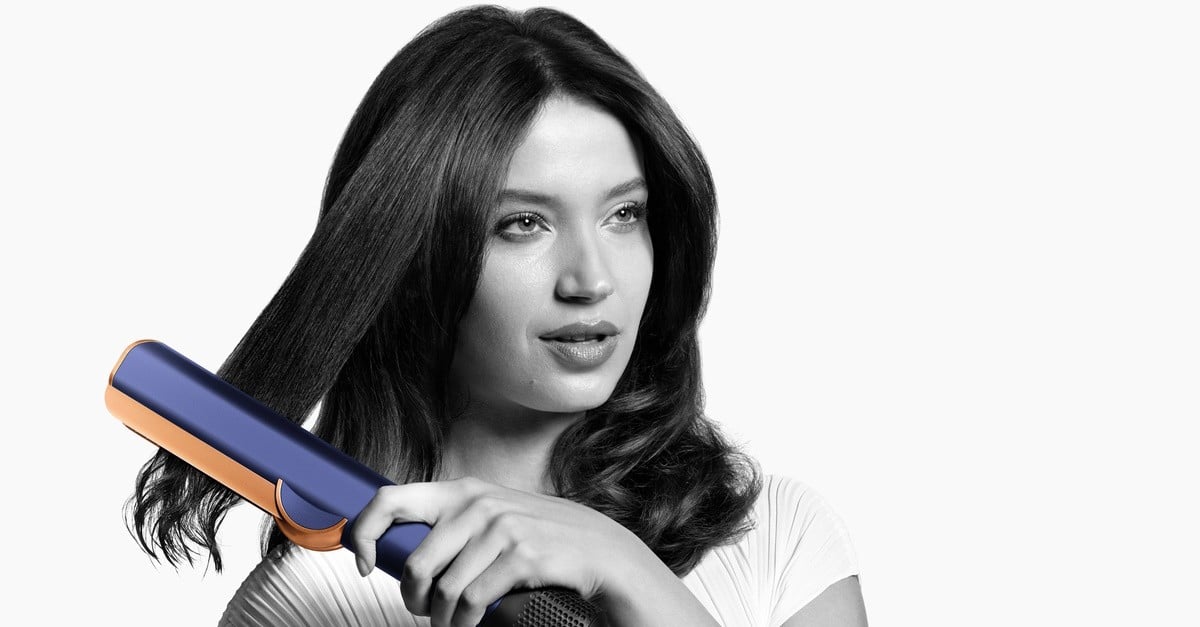
Dyson has unveiled the Dyson Airstrait straightener – wet-to-dry straightening with air, without hot plates or heat damage.
Engineered for multiple hair types, stylers can achieve a naturally straight style, with body and movement, whilst maintaining the strength and healthy look and feel of their hair. The hair tress is contained by two arms, from which a precisely angled high-pressure blade of air is forced downwards and into the hair, simultaneously drying and straight styling, with one machine.
“Having a strong understanding of how to manipulate and realise the potential of powerful airflow is fundamental to the performance of the Dyson Airstrait straightener. This expertise, which we’ve gained over the last 25 years, is what has enabled us to deliver our first wet-to-dry straightener with no hot plates and no heat damage. Delivering the ease-of-use that people love about straighteners but with high-velocity air blades, saves time, maintains hair strength and achieves an everyday natural straight style.” James Dyson, Founder and Chief Engineer.
Along the arms of the machine are two 1.5mm apertures. Airflow is accelerated through these apertures, creating two high-velocity downward air blades. Projected at a 45° angle, they converge to form one focused air jet, creating the downward force to straighten hair as it dries, with control. This directional airflow helps align the hair strands for a smooth and shiny finish.
Dyson has been researching the science of style for over a decade. It invested half a billion pounds to expand and accelerate research and technology development across the beauty category. Engineers have studied everything from the structure of hair to airflow dynamics whilst understanding thermal, mechanical and chemical damage – and the subsequent effects on hair health.
To change your hairstyle, hydrogen bonds within each hair strand must be broken and reset to hold a new shape. This can be done with heat or moisture. Styling with powerful airflow from wet results in less need for high heat, creating less frizz and flyaways and protecting natural shine.
When hair is wet, water naturally weakens these bonds. In this state, the bonds are more elastic and can be reset as the hair dries without using extreme temperatures. By using the optimum level of heat and controlled airflow, we’ve found a way to style hair with less damage. Styling with air allows for the creation of straight styles whilst maintaining volume and movement. Once hair is dry and aligned, the bonds are reset differently, locking the new style in place.
The Dyson Airstrait straightener is powered by the Hyperdymium motor – specifically engineered to be at the heart of Dyson’s Hair Care technologies. It is small, light and powerful enough to generate the airflow needed to dry and straighten hair simultaneously from wet. A 13-blade impeller spins up to 106,000rpm, propelling over 11.9 litres of air through the machine per second. This generates up to 3.5kPa of air pressure, enough to straighten hair as it dries. At 27mm, the motor is small enough to fit in the handle – with no sacrifice on power.
Like the rest of the Dyson hair care range, the Dyson AirstraitTM straightener features an intelligent heat control. Glass bead thermistors measure the airflow temperature 30 times per second to prevent heat damage and protect hair’s natural shine. This data is sent to the microprocessor which regulates the heating element, ensuring airflow doesn’t exceed the temperature required.
The Dyson Airstrait straightener has ‘Wet’ and ‘Dry’ styling modes and a ‘Cool’ mode to set the style. The ‘Wet’ and ‘Dry’ modes are pre-set with the specific heat and airflow combination for the best results. In ‘Wet’ mode, choose among three heat settings of 80°C (175°F), 110°C (230°F), and 140°C (285°F). In ‘Dry’ mode, choose between 120°C (250°F) or 140°C (285°F) or a top-up “boost”. For airflow control, there are two-speed settings, low flow and high flow, as well as a cold shot and root drying mode.
The Dyson Airstrait straightener will be available in New Zealand in 2024. Pricing to be confirmed.


