
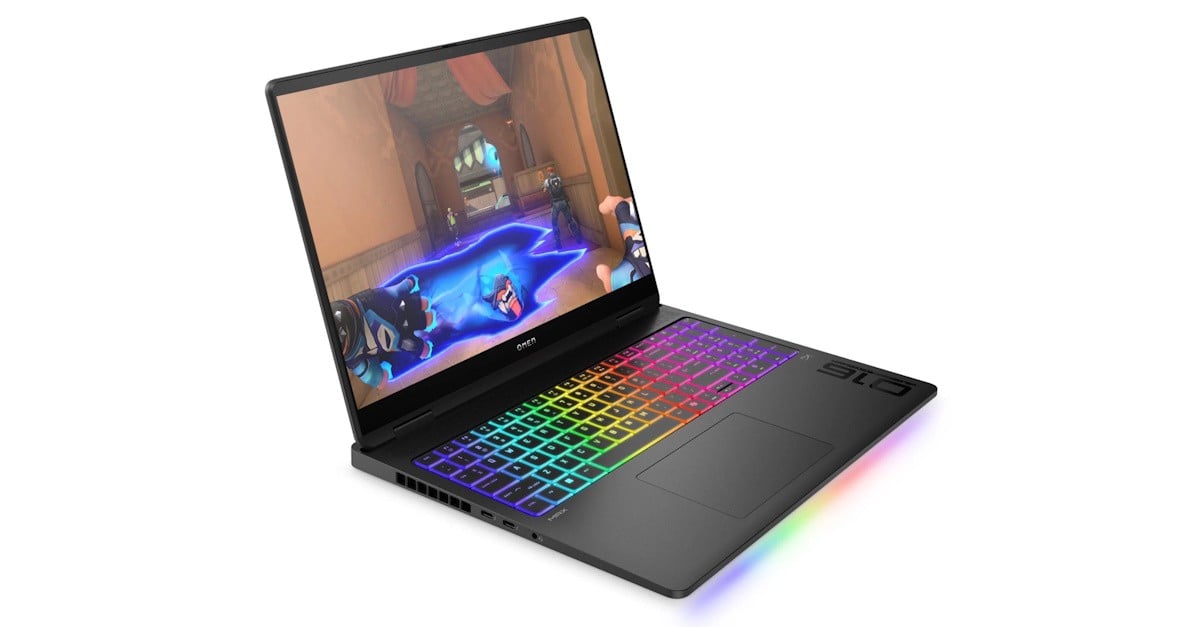
I recently had the opportunity to test drive the HP Omen Max 16 Gaming Laptop, over the holidays. Bundled with the laptop I also had a series with HyperX peripherals, including the HyperX Alloy Rise 75 wireless mechanical keyboard, the HyperX Cloud III wireless headset and the HyperX Pulsefire Haste 2 wireless mouse.
Since these devices arrived here at the end of 2025, HP has announced a shift in branding, moving the HP Omen gaming series under the HyperX brand, effectively changing the device name to HyperX Omen Max 16.
The Omen Max 16 Gaming Laptop is a beast of laptop, not only in performance but in physical form too. The computer measures 35.6 x 26.9 cm and 2.48 cm at the thickest. At 2.8 Kg (not including the rather large charger) it's just light enough to be portable.
The 16" (WQXGA, 2560 x 1600 pixels) screen is capable of a striking 60 - 240 Hz 3ms response time. With anti-glare and 500 nits, it's something you must see. Images are crisp and come fast.
The full-size RGB-backlit keyboard is nice and well-spaced, thanks to the rather large area available. The keys are nicely spaced and have good travel with nice tactile feedback. You can control the key colours through Windows 11 Dynamic Lighting or using the HP Omen application. Either way, there are plenty effects available if you want to make your gaming sessions even more colourful.
There are plenty of ports for a good number of peripherals, including 2x USB Type-A 10 Gbps ports, an HDMI 2.1 for connecting an external display, and 2x USB Type-C 40 Gbps ports, with USB Power Delivery and DisplayPort 2.1 capable.
For those interested in network performance you can connect the HP Omen Max 16 to your network using a 2.5 Gbps Ethernet RJ45 port, but the Wi-Fi 7 card also provides good wireless connectivity for those harder to connect places.
The 1080p IR camera produces sharp pictures and it can be used for face unlock, which is convenient and secure.
One interesting feature is built-in HyperX Instant Pair feature, which is basically a built-in HyperX adapter, allowing you to connect up to three supported HyperX peripherals (like the ones I received with the laptop), without having to sacrifice a USB port for the wireless dongles. This function worked really well, and it was a nice surprise.
The laptop came with top-of-the-line configuration, including an Intel Core Ultra 9 275GX processor, 32GB DDR5 memory, and an NVIDIA GeForce RTX 5080 card with 16 GB RAM.
The Omen Gaming Hub application constantly monitors your laptop and instantly changes its settings when it notices a game is running. It has automatic optimiser and network management modes, but also allow manual overclock controls.
One of the main changes in the hardware is the additional cooling, brought by a new Tempest Cooling technology. It does provide good results, keeping the system cooler when under stress, like a longer gaming session, but I found out that the active cooling produces a lot of noise. The cooling also generates a lot of heat exhaust (as expected), which can be noticeable if you are gaming in a small room on a warm day.
System responsiveness is amazingly absurd. You don't have to wait for anything, with small programs launching instantly, and larger games feeling significantly faster than on other laptops.
In the official press release they even claim this is the world's most powerful gaming laptop. Did it live up to the expectations?
I have been tracking PassMark numbers since around 2021 and I've seen the incremental changes that happened over these years, on different models.
Almost two years before, I tested the HP Omen gaming desktop, which had a 13933 score placing it at the 98% percentile worldwide. But back then the world score average was 5412. The Omen Max 16 had a score of 12983 (93%) but the world score average increased to 5979.
Normalising these numbers to the current world average, shows that the HP Omen 16 laptop practically matches the desktop of a year ago.
It outperforms the older desktop in CPU and storage, matching it in memory performance. The GPU is the only number that hasn't improved, but I understand the difference between the desktop and laptop discreet GPUs, and the desktop having more GPU memory.
To me, it came down to actual gaming sessions. I tried a few games but always ended up going back to Diablo IV, a game I have enjoyed in the last few years. The fact I could play it with no limitations, at the highest 3D settings and maximum refresh rate was the definitive answer. My daughter adopted the Omen 16 Max after a while, enjoying it enormously on her own sessions, giving me positive feedback about it.
A word on gaming performance though: you should game with the laptop connected to the mains for better performance or change the power settings. If you fail to do this, CPU throttle will be active if running the laptop on batteries, which will make your game lag at some points.


