
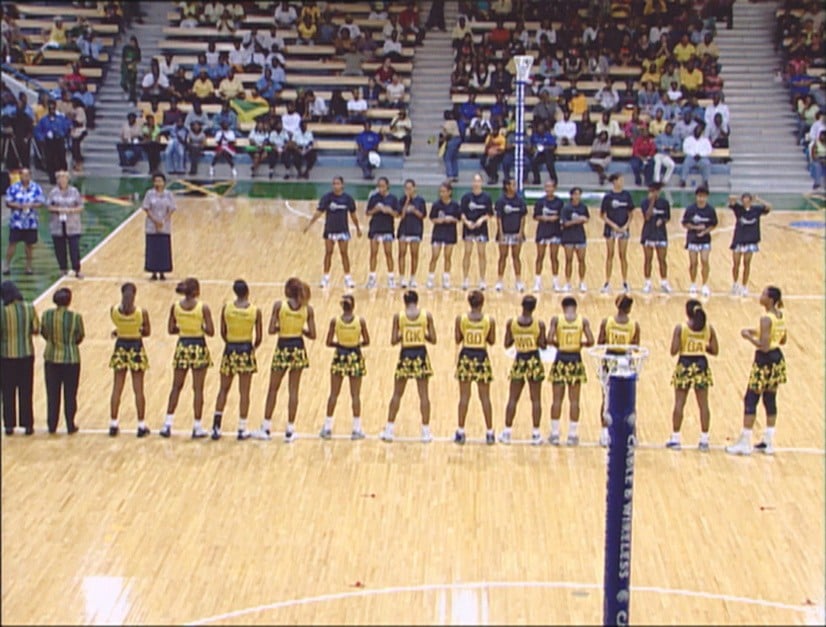
Silver Trak Digital and its specialist archive division, DAMsmart NZ, have completed a landmark recovery and digitisation project, restoring the complete vision record of the 2003 World Netball Championships in Kingston, Jamaica, to broadcast-ready quality and preserving a significant chapter of World Cup netball history that was at risk of being lost.
Founded over ten years ago, DAMsmart has continued to grow and go from strength to strength as an award-winning specialist in audiovisual digitisation, digital preservation and archive management, and has applied its established recovery methodology to the collection. The company works with institutions, broadcasters and content owners across Australia, New Zealand, Asia and the Pacific.
Held at the National Indoor Stadium in Kingston from 10-20 July 2003, the eleventh staging of the Netball World Cup saw 24 teams play 100 matches over 11 days, culminating in New Zealand's Silver Ferns defeating Australia 49 to 47 to claim their fourth world title. Jamaica finished third. The entire tournament was recorded by Television Jamaica (TVJ) on NTSC Beta SP, the broadcast standard of the era in the Americas.
At the conclusion of the tournament, the broadcaster, Television Jamaica, donated the videotapes to Netball Jamaica due to limited storage capacity. Containing recordings of the full games and highlight packages, the tapes were boxed and stored at Netball Jamaica’s team headquarters, the Marva Bernard Chalet in Kingston. They remained there for more than two decades without air conditioning in a tropical climate, resulting in extensive mould growth and, on most tapes, severe sticky-shed syndrome, a condition in which the binder layer degrades and causes the tape to stick to itself and the playback head. Of the 49 tapes restored in this first tranche of digitisation, 12 had snapped.
As earlier digitisation efforts had achieved only limited success and time was running out to save the rapidly deteriorating footage, New Zealand netball archivist Todd Miller worked with Marva Bernard, former President of Netball Jamaica, to have the tapes shipped to DAMsmart NZ in a last-ditch effort to preserve the recordings.
DAMsmart had previously completed similar archival preservation work for Netball New Zealand.
This first batch of digitisation was funded through a Royal Society Marsden Grant awarded to Professor Toni Bruce and Dr Margaret Henley (University of Auckland) as part of their four-year study of the intergenerational historical and cultural significance of netball in the lives of women in Aotearoa. For netball historian Henley, the chance to help preserve this rapidly deteriorating footage was “too important to ignore”, providing an opportunity for their Marsden research to extend beyond academia and “contribute to the safeguarding of international netball heritage”.
The process required each tape to be extensively baked at a precisely controlled temperature, hot enough to kill the mould and soften the hardened glue within the binder, but not so hot as to cause further damage to the already fragile carrier.
After the initial baking process, DAMsmart's specialist technicians took additional manual steps, applying a range of techniques to ensure the tapes could be successfully loaded and played back for digitisation. Then, during digitisation, the content was encoded into PAL.
Once complete, the resulting files were run through an automated quality control process before a human operator manually checked them again, ensuring the recovered vision met broadcast-grade standards.
David Elder, General Manager of Silver Trak Digital NZ, said the result was a credit to the technical depth of the DAMsmart NZ team and its long experience with deteriorating legacy formats.
"This was a project that genuinely sat on the edge of what is recoverable," Elder said. "Twenty-two years in a tropical environment without climate control, with mould and sticky-tape syndrome across most of the collection and a dozen tapes already snapped, is about as challenging as archive work gets. Fortunately DAMsmart NZ has been doing this work for many years and we have the people, the processes and the patience to bring something like this back.”
The recovery of the 2003 World Cup footage is a significant achievement for the global netball community, preserving the visual history of one of the sport's premier events for future broadcast, research and historical reference.
Once funding is secured to preserve the remaining 36 videotapes, World Netball will, for the first time, have access to extensive coverage of the 2003 World Cup across all 24 participating nations. This would enable the broadcaster of the 2027 Netball World Cup in Sydney to draw on rare archival footage of teams such as Hong Kong, which recently qualified for the tournament after last appearing at World Cup level in 2003.
David Elder concluded, “To deliver the complete vision record of a World Championship that was thought to be irretrievable is exactly the kind of result we always strive to deliver. The DAMsmart NZ team did an exceptional job and we are very proud of it."


