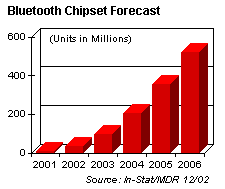
Although the economy has continued to impact the Bluetooth semiconductor market, it will experience high growth, according to In-Stat/MDR. With recent, adjusted outlooks of shipments by vendors, and a gradual expected up tick in the economy in 2003, the high-tech market research firm expects final 2002 chipset shipment figures to surpass 35 million, for a growth rate of about 250%.
However, one of the biggest challenges that the industry still faces is the education of consumers, as the benefits of Bluetooth need to be marketed, rather than the technology itself. “This is no small task,” says Joyce Putscher, a Director with In-Stat/MDR “This means that training needs to occur down to the retail channel level and with wireless carrier sales people.”
In-Stat/MDR also found the following:
Bluetooth chipsets will surge from 10.4 to 510.0 million units from 2001 to 2006, a five-year 118% Compound Annual Growth Rate (CAGR), with silicon revenue rising to over $1.8 billion in 2006.
Mobile phones, PDAs, and headsets have made significant strides this year. Although not a significant volume driver in terms of vehicle units themselves, the hands-free application will provide a driver for many handsets, headsets, and aftermarket car kits. The automotive market is coming on very strong, with the first vehicles to include a Bluetooth option appearing in high-end 2003 models.
Several vendors’ coexistence solutions will be showing up in the market soon, and they will work even if only one device offers the solution. The Adaptive Frequency Hopping profile will be rolled into the upcoming Bluetooth 1.2 version. Bluetooth 1.2 should be at the 0.9 version by the end of January, with final release possibly by March or April 2003.