Security company Airscanner has identified a problem with the way ActiveSync handles requests from password-protected devices. The problem affect Microsoft ActiveSync 3.7.1 and 3.8, and it was tested on Windows XP Professional SP2 and Windows Mobile 2003 Pocket PC.
The risk level is low for denial of service attacks, but it can be elevated to medium for password collection attack.
ActiveSync is Microsoft’s default connectivity program that keeps a desktop PC and a Pocket PC synchronized. It also includes various other features, such as debugging ability, file transfer, etc.
When a Pocket PC device attempts to sync to a PC, it will send three initial packets to the Active Sync program on port 5679.
If the equipment ID value is valid, the PC will respond with a special code. If the equipment ID is not correct, the response will be another code. With this static response, it is trivial to brute force the valid equipment ID value. The reason this is important is because if the value of the correct corresponding PID is sent, a prompt will appear on the PC asking for a PIN value.
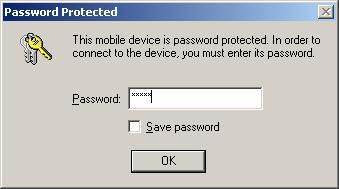
If a target enters a password, the information will be passed back to the remote, requesting client. If a value other than x01 is sent, that value will be XORed with the response to pseudo-encrypt the password. This method of information gathering is possible from over a network and does work over the Internet. From a quick nmap scan, we found about roughly 10 computers with this port open per 50 class C subnets.
Also, if numerous attempts were made to initialize with a PC running ActiveSync, after about four attempts the ActiveSync process freezes.