BitDefender report says Trojans were dominant security problem in 2008
Posted on 29-Jan-2009 08:47
| Filed under: News
: Security
More than 80 percent of malware distributed worldwide in 2008 consisted of Trojans according to the "E-Threats Landscape Report," a security threat study published by BitDefender Lab.
This "E-Threats Landscape Report," the second in a series of security reports, provides an overview of the security threats landscape over the last six months, from July through December 2008, and takes a look at what lies ahead in 2009.
BitDefender's security experts analyzed and examined malware over the second half of 2008, focusing on software vulnerabilities and exploits, different types of malware, as well as countermeasures, cyber crime prevention and law enforcement.
They found that internet users had to cope with approximately 2,000 new and mutated viruses per day, nearly 50,000 phishing attempts per month and more than 1,000,000 hijacked computers that spread bots, rootkits, Trojans and other malware in 2008.
According to this report, web-based e-threats level increased 460 percent on this period, while JavaScript exploitations via SQL injection tripled in volume.
About 75 percent of Trojans included complex updating mechanisms, stealth data download and upload features, as well as spyware and rootkit capabilities.
Spam was also a problem, with plain text comprising 80 percent of e-mail spam, while image spam dropped to only 1.5 percent. However the number of spam e-mails containing infected attachments or linking pages prompting users to download malicious programs increased 400 percent. New spam techniques mimicking newsletters and alerts from news corporations such as CNN, CBS and ABC were introduced.
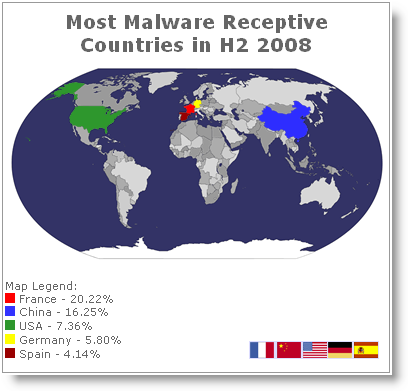
The countries most affected by e-threats included France, China, United States, Germany and Spain.
"The purpose of BitDefender's 'E-Threats Landscape Report' is to provide consistent and useful information to consumers about the malware industry," said Bogdan Dumitru, BitDefender's chief technology officer. "Not only does BitDefender want to educate consumers about what is currently happening in the malware industry, but we also want to provide consumers with guidance about what to expect and how to protect against e-threats in the upcoming year. For example, nearly 45 percent of the e-threats in the wild in 2008 were distributed via e-mail. With this in mind, consumers should make securing e-mail communication a priority in 2009."
Some threat predictions for 2009 from BitDefender's "E-Threats Landscape Report" include the warning that targeted attacks on Web 2.0 applications, namely social networking sites, is expected to increase.