Geekzone: technology news, blogs, forums
Guest
Welcome Guest.
You haven't logged in yet. If you don't have an account you can register now.
Filter this topic showing only the reply marked as answer View this topic in a long page with up to 500 replies per page Create new topic
1 | ... | 105 | 106 | 107 | 108 | 109 | 110 | 111 | 112 | 113 | 114 | 115 | ... | 149
LightbulbNeil
71 posts

Master Geek
+1 received by user: 16


  #3431370 6-Nov-2025 09:40
Send private message quote this post

In Hamilton for the month of October we are down 11% for 2025, compared to October for 2024. But the generation for 2025 to the end of October is only down 1% compared to 2024 to  end of October. So really over all it is very little different over a year. It is intetesting that dirty panels can make up to 2% loss in production. It just depends on the amount of cloudy days in a year.


chimera
563 posts

Ultimate Geek
+1 received by user: 199

ID Verified

  #3431371 6-Nov-2025 09:41
Send private message quote this post

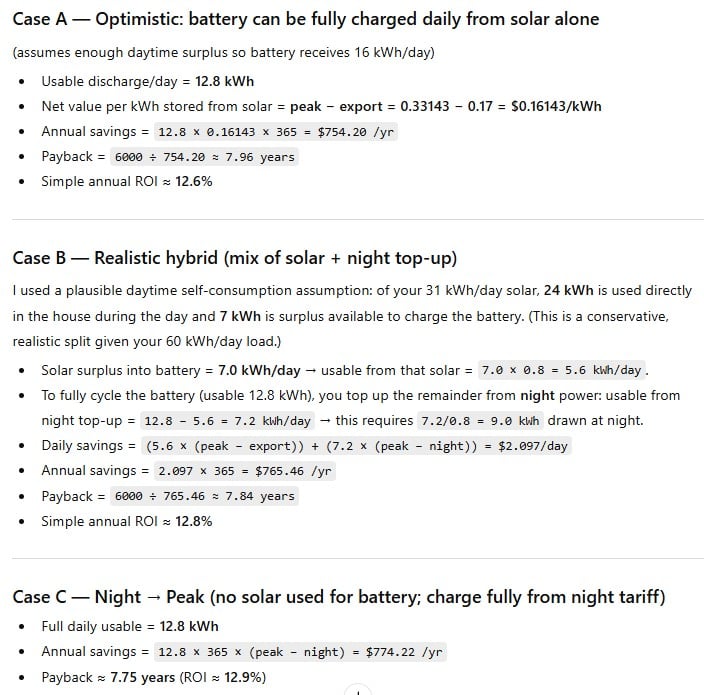
Hence the benefits of battery :-) Why not store the excess and use in peak hours? Perfect time to buy (shameless plug) while the sun is out longer :-)


They are cheap enough now the ROI is pretty good


EG:


My Solar PV is 8.4kW and generates 31kWh per day on average over a year (for a rough idea on average daily production for Auckland, take your PV in kW and multiply by 4)


I'm working numbers below based off a single 16kWh battery (at 80% DoD) for $6k installed.


I'm on Octopus Energy, with rates as follows:


  • Peak = $0.33143/kWh
  • Off-Peak = $0.23943/kWh
  • Night = $0.165715/kWh
  • Export = $0.17/kWh

Hours:


  • Peak hours are 7am til 11am and 5pm til 9pm weekdays
  • Off-peak hours are 11am til 5pm and 9pm til 11pm weekdays plus 7am til 11pm weekends
  • Night hours are 11pm til 7am.


I use night rate to charge the battery although the time varies depending on a set of rules. The time the charge cycle comes on for is controlled using Home Assistant linked to my DEYE inverter. I also use the Solar Forecast integration.


The rules are:


  • If battery SoC% is < 25% OR Solar Forecast < 20kWh then charge for 6 hours
  • If battery SoC% is < 45% OR Solar Forecast < 30kWh then charge for 5 hours
  • If battery SoC% is < 65% OR Solar Forecast < 40kWh then charge for 4 hours
  • Else, charge for 3 hours

My average daily consumption in 60kWh / day (bloody spa, pool and HWC suck the power! Plus having 5 adults doesn't help... and only one of my kids pays board lol!)


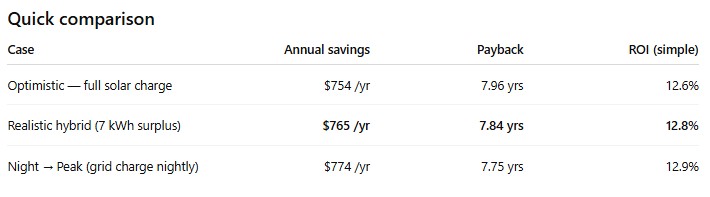
Based on all this information, I've used ChatGPT to calculate ROI%  My strategy is the middle one.


Cheers


wellygary
8813 posts

Uber Geek
+1 received by user: 5297


  #3431419 6-Nov-2025 09:54
Send private message quote this post

  • Export = $0.17/kWh

I simply can't see such generous feed in rates continuing in the future and commercial solar is likely to  drive down feed in prices offered to residential customers 


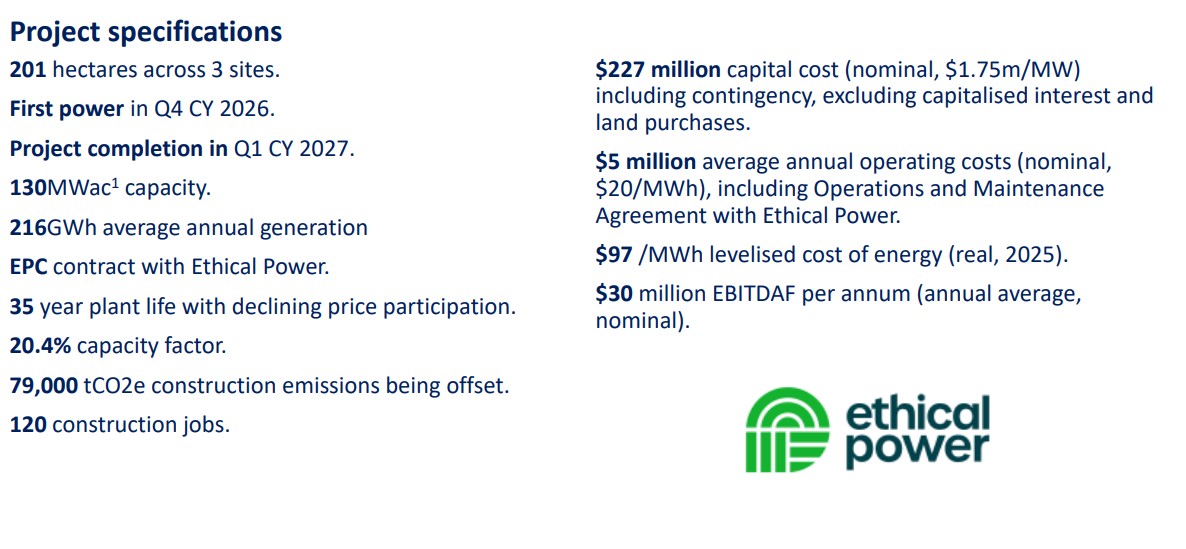
In March Meridian published the numbers for their 130MW Ruakaka solar farm, - Which is the first one I've seen with the total life costs..


they are forecasting that the cost of production over a 35 year period ( including annual maintenance etc) is 9.7c/unit  ($97/MWh) 


https://www.meridianenergy.co.nz/public/Investors/Reports-and-presentations/Investor-presentations/2024/ruakaka-solar-announcement-March-2025.pdf


One assumes that if you scale up even larger ( as many of the newer proposals are) that the unit cost is driven down more,,


chimera
563 posts

Ultimate Geek
+1 received by user: 199

ID Verified

  #3431420 6-Nov-2025 10:01
Send private message quote this post

wellygary:


  • Export = $0.17/kWh

I simply can't see such generous feed in rates continuing in the future and commercial solar is likely to  drive down feed in prices offered to residential customers 


In March Meridian published the numbers for their 130MW Ruakaka solar farm, - Which is the first one I've seen with the total life costs..


they are forecasting that the cost of production over a 35 year period ( including annual maintenance etc) is 9.7c/unit  ($97/MWh) 


https://www.meridianenergy.co.nz/public/Investors/Reports-and-presentations/Investor-presentations/2024/ruakaka-solar-announcement-March-2025.pdf


One assumes that if you scale up even larger ( as many of the newer proposals are) that the unit cost is driven down more,,


Well, that's even more reason to get a battery then :-)


And likewise, I can't see power costs ever coming down further - they will only increase.


CYaBro
4708 posts

Uber Geek
+1 received by user: 1182

ID Verified
Trusted

  #3431421 6-Nov-2025 10:02
Send private message quote this post

wellygary:


  • Export = $0.17/kWh

I simply can't see such generous feed in rates continuing in the future and commercial solar is likely to  drive down feed in prices offered to residential customers 


In March Meridian published the numbers for their 130MW Ruakaka solar farm, - Which is the first one I've seen with the total life costs..


they are forecasting that the cost of production over a 35 year period ( including annual maintenance etc) is 9.7c/unit  ($97/MWh) 


https://www.meridianenergy.co.nz/public/Investors/Reports-and-presentations/Investor-presentations/2024/ruakaka-solar-announcement-March-2025.pdf


One assumes that if you scale up even larger ( as many of the newer proposals are) that the unit cost is driven down more,,


If you're on the Orion network (Canterbury), Ecotricity are paying up to 60c kWh during peak times.


Opinions are my own and not the views of my employer.


HarmLessSolutions
1230 posts

Uber Geek
+1 received by user: 812

Subscriber

  #3431422 6-Nov-2025 10:07
Send private message quote this post

wellygary:


  • Export = $0.17/kWh

I simply can't see such generous feed in rates continuing in the future and commercial solar is likely to  drive down feed in prices offered to residential customers 


In March Meridian published the numbers for their 130MW Ruakaka solar farm, - Which is the first one I've seen with the total life costs..


they are forecasting that the cost of production over a 35 year period ( including annual maintenance etc) is 9.7c/unit  ($97/MWh) 


https://www.meridianenergy.co.nz/public/Investors/Reports-and-presentations/Investor-presentations/2024/ruakaka-solar-announcement-March-2025.pdf


One assumes that if you scale up even larger ( as many of the newer proposals are) that the unit cost is driven down more,,


The fact is though that electricity supply prices are based on the most expensive generation method required to meet demand over any 30 minute period (thanks Max Bradford!), so the plans in place to import LNG and to stockpile coal at Huntly, both for thermal generation, will serve to keep prices high for the foreseeable future. 


All the more reason to do all you can to maximise self consumption of your own generation which offsets otherwise imported electricity at retail price including GST.


https://www.harmlesssolutions.co.nz/


PolicyGuy
1821 posts

Uber Geek
+1 received by user: 1772

ID Verified
Lifetime subscriber

  #3431429 6-Nov-2025 10:30
Send private message quote this post

HarmLessSolutions:


{snip}


Also in our rural location Powerco's grid voltage regulation is crap. We've seen 247V on one phase which was when our installer was connecting our recent 5 kW array, before any export was occurring. In contrast on an overnight EV charge last month (following overcast days) we saw the grid voltage drop to ~224V when the charge started and then down to 221V between 6:00 & 7:00am, presumably when the local dairy farmers were running their morning milking. 


When the solar feed in parameters increase on November 13th I expect the overvoltage situation will only get worse as solar owners are allowed to export at up to 253V (230V + 10%) before inverter throttling occurs. I have recently emailed Powerco, again, about voltage issues but once more have been fobbed off to another department with no answers forthcoming.


Did you use the Complaints form (https://www.powerco.co.nz/contact/complaints) or some other contact address?
I had reasonably good results from using the Complaints system.
One advantage of using the official Complaints process is that you should be able to escalate it to Utilities Disputes (https://www.udl.co.nz/making-a-complaint/complaint-form/ ). I didn't have to do that, but reading your saga on here makes me think you must be getting to that point.


HarmLessSolutions
1230 posts

Uber Geek
+1 received by user: 812

Subscriber

  #3431435 6-Nov-2025 10:53
Send private message quote this post

PolicyGuy:


HarmLessSolutions:


{snip}


Also in our rural location Powerco's grid voltage regulation is crap. We've seen 247V on one phase which was when our installer was connecting our recent 5 kW array, before any export was occurring. In contrast on an overnight EV charge last month (following overcast days) we saw the grid voltage drop to ~224V when the charge started and then down to 221V between 6:00 & 7:00am, presumably when the local dairy farmers were running their morning milking. 


When the solar feed in parameters increase on November 13th I expect the overvoltage situation will only get worse as solar owners are allowed to export at up to 253V (230V + 10%) before inverter throttling occurs. I have recently emailed Powerco, again, about voltage issues but once more have been fobbed off to another department with no answers forthcoming.


Did you use the Complaints form (https://www.powerco.co.nz/contact/complaints) or some other contact address?
I had reasonably good results from using the Complaints system.
One advantage of using the official Complaints process is that you should be able to escalate it to Utilities Disputes (https://www.udl.co.nz/making-a-complaint/complaint-form/ ). I didn't have to do that, but reading your saga on here makes me think you must be getting to that point.


I'm in communication with an engineer in their Distributed Generation section. Our installer has also followed up on this issue, as they have for numerous other customers of there's but don't expect much success to be forthcoming. Incidentally our installer has around half of the 70+ Fronius inverters they've installed showing "grid frequency" (voltage) issues at any given time.


I'll wait until after our export cap and inverter voltage parameters are changed before escalating things to the Utilities Disputes.


I do find it frustrating though that the Electricity Authority Discussion paper active presently bases their proposals on grid supplies being 230V nominal which doesn't appear to be the case for many of us.


https://www.harmlesssolutions.co.nz/


chimera
563 posts

Ultimate Geek
+1 received by user: 199

ID Verified

  #3431651 6-Nov-2025 14:33
Send private message quote this post

A few tips for anyone looking to get a residential Solar setup... 


  • Obviously you're likely to have a specific budget, however that does NOT mean you shouldn't consider a system that can be expanded later (and not all systems can be!!!)


  • With PV panels, roof space real estate is absolutely key

         - Most PV installs will be limited by roof space period (preferably north / north-east facing or north-west facing. Of course, there is the odd house layout that happens to have the perfect single pitch roof facing true north but it's not common!)


         - If you will end up with spare roof space after your install, then spec your inverter to allow for max'ing out panels should you decide to add more later


         - The PV panels can be over-spec'd vs the size of the inverter (in other words generally 20-30% more kW in panels than the kW rating of the inverter, sometimes even higher)


         - Regarding 'solar water heaters', generally speaking you're better off using that roof space for PV panels instead (if you're doing a new build, invest in a heatpump HWC, they're slowing coming down in price)


  • Inverter selection is more important than the PV panels!

         - Don't just buy based on what your solar installer suggests... ask these questions:


               "How many strings can the inverter support?" (strings are a 'series connection of multiple panels'. Eg: you couldn't have say 5 panels on your north facing roof and 5 panels on your east facing roof in the same string (different angle from the sun, so produce different amperage). You might have 3 strings on the roof facing east, and 2 strings on the roof facing west) You need to know this if you have room for expansion, you don't want to have to buy a new inverter because you've maxed out the maximum PV strings it supports and now can't expand your system later on. For example, if you had 20 panels in 2 strings facing north, and had the ability to add say 5 panels facing east later on - but your inverter only supports 2 strings max, then you're outta luck)


               "Can I add a battery later on?" (very important, especially as battery costs come down in price. Perhaps the most typical setup in NZ is 5kW of panels and a grid tied inverter. Invest in a hybrid inverter up front so you can add a battery later on! DEYE inverters for example, have come down in price considerably - and they are very good inverters! Also factor in the SIZ of the inverter [in kW] as previously mentioned so you can expand your PV panels - if that's at all possible)


               "How many amps does the Inverter support?" (I've seen hybrid inverters supporting a maximum of 30A charge/discharge. This is an absolute waste of time (48V x 30A = 1.4kW not enough to even boil a jug) It will take you forever to charge a battery at amps this low from the grid or even from your PV. Consider what you may add in the future, aim for at least 120A charge/discharge or preferably 200A charge/discharge)


               "How much are the batteries per kWh?" (Often I read about people buying solar systems that they rave about until they go to add in a battery - many top-branded manufacturers tie you in to buying their proprietary battery what is often at a ridiculous cost. Personally, DEYE, GoodWe, SoFar and similar are good brand inverters as they don't tie you into their product)


                "What batteries [and protocols] does the inverter support?" (Similar to the last point, some inverters 'speak' their own language [protocol] so that you can only run comm's to their batteries tying you into their systems)


  • Do your own research!

          - As painful as it may seem, you NEED to know the difference between kW and kWh, you need to understand Volts x Amps = Watts, you need to understand watts = energy and why that matters, you need to know what an Inverter with MPPT2+2 vs say MPPT3+1 is, you need to understand your power bill and what your average usage is. You need to spec your own system (ask here, do some research) before even contemplating talking to Solar installer. You need to first reduce your energy consumption at your home FIRST (eg: replace every 50W halogen bulbs with 5W LED) You need to shop around, ask for quotes, compare systems spec'd from one solar installer to the next and ask yourself why they are different. 


To summarise, don't paint yourself into a corner :-)


cddt
1970 posts

Uber Geek
+1 received by user: 1905


  #3431656 6-Nov-2025 14:41
Send private message quote this post

chimera:


you need to understand Volts x Amps = Watts


As a science teacher once told us, this is easy if you can remember the name Ivy Watts. 


My referral links: BigPipeMercury


CYaBro
4708 posts

Uber Geek
+1 received by user: 1182

ID Verified
Trusted

  #3431657 6-Nov-2025 14:43
Send private message quote this post

I also found OpenSolar and created an account, which is free, and was able to play around with our house and solar panel layout, using the specific panels that we'd been quoted.


https://www.opensolar.com/


The quotes I got all had 21 panels on the north facing roof section but with me playing around in OpenSolar I was able to fit 24 panels so I passed that on to the company we went with and that's what they installed.


Opinions are my own and not the views of my employer.


Jase2985
13735 posts

Uber Geek
+1 received by user: 6216

ID Verified
Lifetime subscriber

  #3431728 6-Nov-2025 19:58
Send private message quote this post

dantheperson:


Jase2985:


Pretty much perfect generation in Auckland today, 5 days in and already done 27% of last month.


Still think I'm seeing the inverter throttle due to high voltage, was up around 246-247 when it was exporting between 1230 and 1430.


If possible i'd look to move that load you have starting at 9am to start later in the day so it is still running during the midday peak.  This will help reduce the amount of export you have pushing the voltage up, and reduce the chance of hitting 5kW export limit, so killing two throttle issues with one stone.


In summer i am turning the spa heater down from 5.2kW to 2kW.  It will pull the voltage down less, but for longer to cover most of the midday when overvoltage happens.  It seems to be more in the early afternoon than late morning. I'm guessing this is as everyones water heaters are taking in some of the morning residential production after morning showers.


Funny you say that, i did the exact thing yesterday as the big load, the one from about 9am - 1230pm is the pool pump and heat pump, and with the nicer weather its been at temp in 3-5 hours. The other load you see there for an hour or so is the HWC. The Pool stuff now starts at 11am and the HWC comes on at 930am-11am, so today there was only a teeny bit of power used above the generation. The problem is with the good weather there is no other load to dump the power into so by about 130pm- 2pm i only have a base load of 2kWh, over half of that is the pool pump. so its going to start throttling or export limiting in the next few weeks.


HarmLessSolutions
1230 posts

Uber Geek
+1 received by user: 812

Subscriber

  #3431732 6-Nov-2025 20:12
Send private message quote this post

Jase2985:


Funny you say that, i did the exact thing yesterday as the big load, the one from about 9am - 1230pm is the pool pump and heat pump, and with the nicer weather its been at temp in 3-5 hours. The other load you see there for an hour or so is the HWC. The Pool stuff now starts at 11am and the HWC comes on at 930am-11am, so today there was only a teeny bit of power used above the generation. The problem is with the good weather there is no other load to dump the power into so by about 130pm- 2pm i only have a base load of 2kWh, over half of that is the pool pump. so its going to start throttling or export limiting in the next few weeks.


Sounds similar to our situation. HWC is disabled until about 11:00am by killing the Paladin Diverter until then, which maximises our export during Ecotricity's peak pricing. By 11:00 generation is close to, if not already, being throttled by our 5 kW phase cap. Then the Paladin captures the first 3 kW of generation for a few hours until the Evnex starts charging an EV. By the time our EVs are charged generation has dropped to within 5 kW of our house consumption until day's end. If the EVs are charged we are usually forced into a throttling situation during the afternoon which is frustrating.


Not great to see our 8.2 kW inverter throttling to comply with export caps so looking forward to it being left unrestricted when we increase our export cap to 10 kW next week. The voltage parameter widening happening then will also help reduce wasted generation capacity.


https://www.harmlesssolutions.co.nz/


fastbike
448 posts

Ultimate Geek
+1 received by user: 321


  #3431796 6-Nov-2025 22:07
Send private message quote this post

I've just built a few automation rules to do the following:


  1. At 6am run a rule to bring back the Solcast API values for the two arrays at my site, this is a series of json values with a timestamp and pv estimate at 30 minute resolution (hobbyist = free version)
  2. Then run a rule to pull out the values for the upcoming day and combine them from the two arrays (at 30 min resolution)
  3. Run a rule to see when total combined forecast exceeds PowerCo export limit - store earliest time, latest time and sum the excess total power (NB: approximate as not interpolated)
  4. Figure out battery discharge curve so battery has capacity to store excess solar during the day, send via modbus to inverter every 4 mins (inverter modbus has a 5 min timeout and I bias it for high discharge early on), this discharges the battery between 7am and 9:30am so I get the benefit of export credits before the PV gets going.
  5. Run a rule every 5 minutes to get the solar pv estimate for the next 30 mins, interpolate and calculate the excess power, convert to deciAmps and send to my battery controller via MQTT. This runs between the start of the time period and end, calculated at step 3.


Here's the chart from yesterday, I think the dip in the middle was the car charger doing a short top up.


Image


Otautahi Christchurch


chimera
563 posts

Ultimate Geek
+1 received by user: 199

ID Verified

  #3431992 7-Nov-2025 22:51
Send private message quote this post


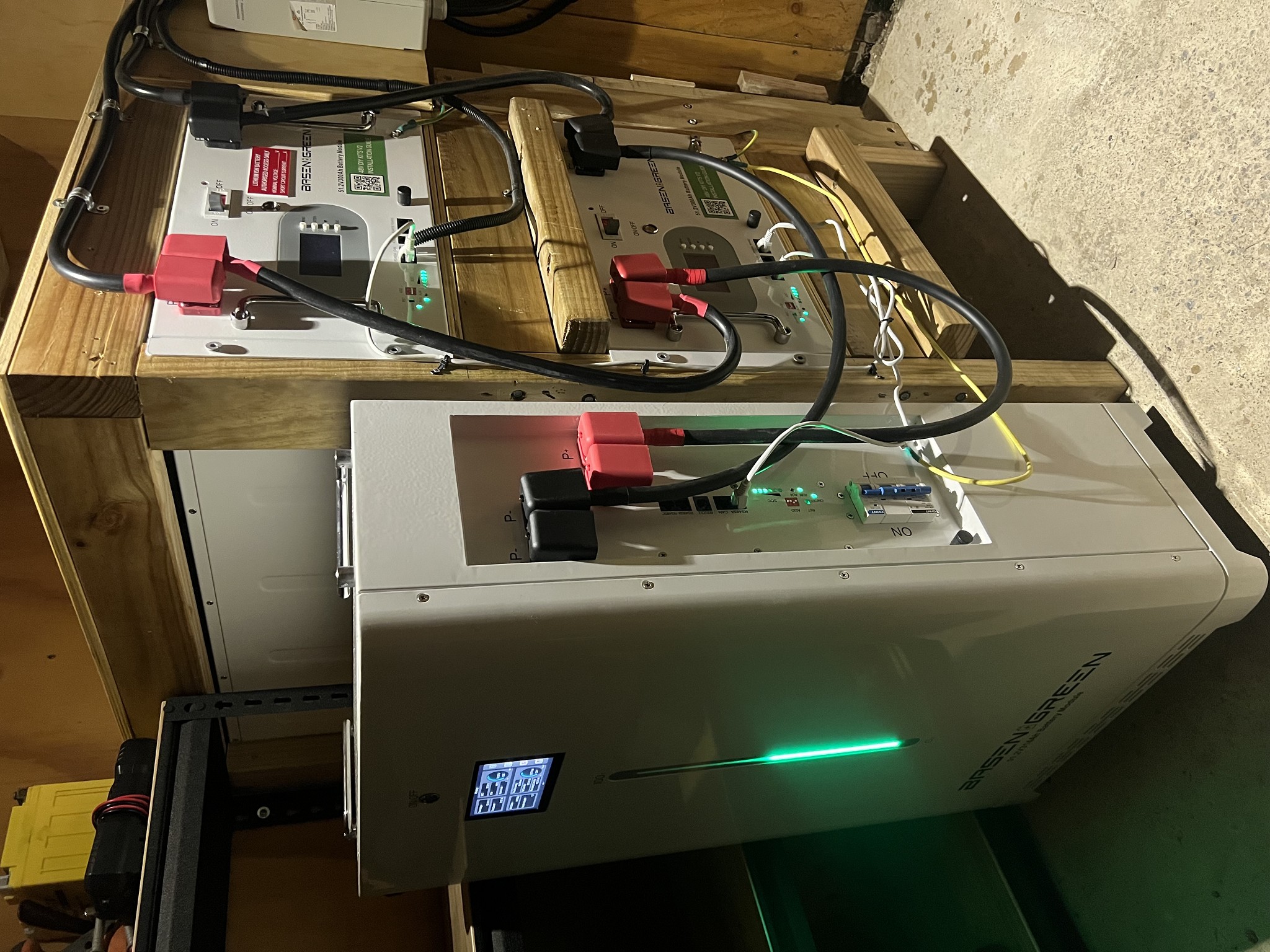
46.3kWh of LiFePO4 battery! 


1 | ... | 105 | 106 | 107 | 108 | 109 | 110 | 111 | 112 | 113 | 114 | 115 | ... | 149
Filter this topic showing only the reply marked as answer View this topic in a long page with up to 500 replies per page Create new topic


Geekzone Live »

Try automatic live updates from Geekzone directly in your browser, without refreshing the page, with Geekzone Live now.


Are you subscribed to our RSS feed? You can download the latest headlines and summaries from our stories directly to your computer or smartphone by using a feed reader.