Geekzone: technology news, blogs, forums
Guest
Welcome Guest.
You haven't logged in yet. If you don't have an account you can register now.
Filter this topic showing only the reply marked as answer View this topic in a long page with up to 500 replies per page Create new topic
1 | ... | 109 | 110 | 111 | 112 | 113 | 114 | 115 | 116 | 117 | 118 | 119 | ... | 149
insane
3325 posts

Uber Geek
+1 received by user: 1006

ID Verified
Trusted
2degrees
Subscriber

  #3447541 27-Dec-2025 22:01
Send private message quote this post

So I've summarised this thread as I'm certainly not going to read all.113 pages...


Is it fair to conclude that DEYE, GoodWe and Fronius are indeed good options? Have had a good long chat with my mate ChatGPT and been advised I should be looking for a 8.5 to 9.5KW of panels and a 5KW inverter for simplicity of connecting to the grid vs a larger inverter and CT clamps and to pay no more than $16k to make it viable?


I'm in Auckland and with Heatpumps and Pool heating going and would be looking to self consume 70% (4-5kw peak through as long of a period of the day as possible).


Does it sound realistic or is ChatGPT hallucinating that it's possible to achieve?


timmmay
20860 posts

Uber Geek
+1 received by user: 5350

Trusted
Lifetime subscriber

  #3447544 27-Dec-2025 22:20
Send private message quote this post

In Australia they recommend or perhaps enforce that you can have no more than 30% more power from panels than your inverter can handle. So if you have a 10kw inverter you can't have more than 13kw of panels. We have 9.1kw of panels, something like 6kw facing north 3kw facing west, 6kw inverter that peaks at 6.5kw. We sometimes push 6kw to the grid, and if we had a larger inverter I'm pretty sure we could do 9kw some of the time.


In your place I'd probably go for a slightly larger inverter, unless your panels are pointed so you're pretty sure you won't exceed that. 5kw is too small. 6 - 7.5kw would be better. You can manage not going over an export limit with a timer on your hot water, I use a shelly with a contactor. About 6 months ago in Wellington we paid $15,200 for 6kw Sigen plus the 9kw of panels.


insane
3325 posts

Uber Geek
+1 received by user: 1006

ID Verified
Trusted
2degrees
Subscriber

  #3447546 27-Dec-2025 22:40
Send private message quote this post

Yeah I did get the impression there was a standard 20-30% overcommitment allowed from my research and some old quotes I got years ago from Harrison's and Zen Energy. I'm not interested in Peak output as I'm looking to self-consume all of it, or as close to that as I can, so that also means splitting the panels across the roof faces so I get longer generation hours. Looking back at an old quote one option had a 7.4kw Hauwai inverter, but I'm not sure whether they still operate in NZ or are allowed to - and I seem to recall you need special permission to connect up an inverter >5kw


I have gas hot water and hob. If heatpump hot water units were priced similarly to overseas id give up the gas too, but sadly prices here are ultra inflated so I'll be sticking to gas at least until the Rinnai infinity konks out.


Thanks for the price comparison, it's starting to sound plausible :)


HarmLessSolutions
1230 posts

Uber Geek
+1 received by user: 813

Subscriber

  #3447547 27-Dec-2025 23:12
Send private message quote this post

insane:


[snip]Looking back at an old quote one option had a 7.4kw Hauwai inverter, but I'm not sure whether they still operate in NZ or are allowed to - and I seem to recall you need special permission to connect up an inverter >5kw


[snip]


We have an 8.2 kW Fronius inverter on one of our phases. Prior to Powerco increasing their export cap per phase from 5 kW to 10 kW we had to have that inverter throttled to comply with the 5 kW cap by way of a CT clamp on our mains. If your lines company is still limiting export to 5 kW/phase then that would be your likely strategy.


https://www.harmlesssolutions.co.nz/


timmmay
20860 posts

Uber Geek
+1 received by user: 5350

Trusted
Lifetime subscriber

  #3447548 27-Dec-2025 23:13
Send private message quote this post

I think inverters above 5kw are standard, no special permissions required. I think they can be set to export no more than 5kw, so if you generate 7kw and use 3kw that's 4kw export. Mine seems to export a little above 5kw even though it's not meant to, no idea why. 


kangaroo13
87 posts

Master Geek
+1 received by user: 90


  #3447549 27-Dec-2025 23:52
Send private message quote this post

Nothelen:


>Grid-tie could be an option but only as a last resort.


What's the motivation to go fully off-grid?  I've thought about this as an option down the track (currently no battery, but thinking of how to specify a future battery).  Howeever,  I'd end up much worse off overall, as - at least at the moment - the FiT is reasonable in NZ (17c/kWh).  You're likely better staying grid-tied and selling summer excess into the grid, and also avoiding the need to size your battery large enough to cover the worst-case scenario of many consecutive bad weather days in the middle of winter.


LightbulbNeil
71 posts

Master Geek
+1 received by user: 16


  #3447551 28-Dec-2025 01:12
Send private message quote this post

insane:


So I've summarised this thread as I'm certainly not going to read all.113 pages...


Is it fair to conclude that DEYE, GoodWe and Fronius are indeed good options? Have had a good long chat with my mate ChatGPT and been advised I should be looking for a 8.5 to 9.5KW of panels and a 5KW inverter for simplicity of connecting to the grid vs a larger inverter and CT clamps and to pay no more than $16k to make it viable?


I'm in Auckland and with Heatpumps and Pool heating going and would be looking to self consume 70% (4-5kw peak through as long of a period of the day as possible).


Does it sound realistic or is ChatGPT hallucinating that it's possible to achieve?


When I was researching 3 yeras ago and got a system in October of 23, I went with the largest system to give me the most power in Winter.  So ended up with a 15kw 3 phase. My view was to add the batteries at a later date. Currently I am not seeing a battery being cost effective. Our system will pay for itself in about 4 years time from now. Batteries , 3 x 8kw one for each phase will take over 12 years to pay back maybe. The battery will only save us maybe $800 to $950 max in a year. I have no interest in looking at the meter every day or night or what ever and trying to get the most by using a battery down and recharge over the cheap offpeak rates etc. 


We have 5kw East, North and West. This time of year until shading hits the roof, on a sunny evening at 6pm, will still be making 9-10 kwh. In winter on a good day, it will make 40kwh,(10kwh more)  than our daily useage of 30kwh . A battery would be an advantage in winter, but will need around 64kwh to cover the 2 or 3 days in a row of low generation. On a bad winters day, we will make as low as 7kwh for the day.


With Meridian, we sell enough from Novemebr to end of February to cover all the line charges and the winter bill, with some credit still by the end of October. So at the end of October, we draw down from the Meridian account for the bottle gas bill for 2026.


We have a Fronius inverter and our house has 3 phase power with a fairly equal loading over all 3 phases sort of. 


Everyones needs are different, so no one solution works for everyone. It is quite a task to sort through quotes and panels and inverters and battery ready systems, or batteries that already have an inverter in them etc. Then where to best have the inverter and bank of batteries etc.


When we got our system in, it did cost more than an 8kw setup in October 2023, but the payback was looking at 6,5 years or so compared to 10 years for the 8kwh setup. 


I can't advise on price of systems etc. But certainly do look around for different brands etc and explore a few other configurations as there maybe a better or long term, a  more effective option that you may not have thought of .


fastbike
450 posts

Ultimate Geek
+1 received by user: 324


  #3447554 28-Dec-2025 09:02
Send private message quote this post

insane:


So I've summarised this thread as I'm certainly not going to read all.113 pages...


Is it fair to conclude that DEYE, GoodWe and Fronius are indeed good options? Have had a good long chat with my mate ChatGPT and been advised I should be looking for a 8.5 to 9.5KW of panels and a 5KW inverter for simplicity of connecting to the grid vs a larger inverter and CT clamps and to pay no more than $16k to make it viable?


I'm in Auckland and with Heatpumps and Pool heating going and would be looking to self consume 70% (4-5kw peak through as long of a period of the day as possible).


Does it sound realistic or is ChatGPT hallucinating that it's possible to achieve?


ChatGPT will make shit up to fill in the gaps in it's model - and not tell you which bits are real and which are fabricated so be  careful :)


As others have said each situation is different so you optimal solution will be different to the members that have offered advice, however look for the themes around tariffs, winter imports vs summer exports, house heating (full electric vs gas/wood), water heating, EV  etc.


We are just completing one year with our full system. We are a fully electric house using heatpumps for space heating, with a legacy solar thermal system that does most of the hot water in summer.


I started by building a spreadsheet model with actual consumption and estimated solar PV at 15 minute resolution. I used a nearby PV installation whose owner kindly shared actual production values which I then scaled to account for size, tilt and orientation and time of year (using NIWA solarview data). This allowed me to input various power co tariffs and Meridian came out on top. We locked in a 5 year contract with a 17c FIT and a low daily fixed charge.


So we got cracking and got some quotes - I will summarise by saying I was underwhelmed. I then contacted another company I had used for a different project that also do PV - they were happy for me to provide some sweat equity but they were too slow to come back after the initial site visit (principal had health issues) so I finally found a local contractor that was happy for me to do all mechanical work and he did the electrical/certification.


So 14 months ago we had 12kW of PV with a 3 phase 10kW Solis hybrid inverter. This provided most day time power with the surplus being exported, so we ended up with  monthly credits after the night time (off peak) and evening (peak) usage was deducted from the exports. Modelling for this part showed a payback of 5 years although one year in the actual performance is well ahead of the model so will payback in 4 years.


As I had done the mechanical side, supplying all of the gear, I had left over panels so in Dec 24 I moved to part 2 of the project which was another 14 panels on a stand alone garage with Enphase micro inverters to account for the less than optimal aspect of the site. The modelling showed a 9 year payback which fitted my criteria. Actual performance in the one year shows a payback of just over 8 years which is partly due to the higher cost of the micro inverters.


Once this was out of the way I started revisiting batteries as I was interested in avoiding peak tariff usage in winter for the cloudy days and evening use of oven and heatpump. The other driver was to capture excess solar exports as Meridian have a 10kW limit on exports under the plan I'm on so rather than throttling the output a battery provides a way to capture the excess and export it later in the day.
I did a lot of research and fortuitously had installed the HV version of the Solis inverter. One of the reasons we had specified the Solis was because it had 4 independent MPPT inputs which we required due to the curvature in our house roof. At the time I had not thought about the battery LV vs HV aspects. 
I had become aware of the Battery Emulator project which provides a way to reuse EV batteries for stationary storage so after more investigation and planning we selected a 40kWh Leaf battery (87% SoH, so about 34kWh usable capacity) and got that installed. The advantage of the HV interface is the battery is safely positioned well away from the house (10m away in an enclosure on the back of a masonry garden wall) and only requires 10mm^2 cables, with LV this would not be possible.
The modelling showed a payback of about 8 years as the battery provides most winter peaktime running being charged overnight from cheap rates, and also allows more exporting in summer as it absorbs the excess PV production. I have some automation setup to handle the export / surplus PV harvesting side of things.


We have just doubled the battery capacity as I managed to score a second battery almost identical to the first at a very good price. Likely this has pushed the payback beyond 10 years but it provides gross capacity of 68kWh and we can now scale the use of the battery between 20-80% SoC so it will last many decades as it is only being minimally cycled.


Good luck with your planning and installation.


Otautahi Christchurch


fastbike
450 posts

Ultimate Geek
+1 received by user: 324


  #3447555 28-Dec-2025 09:08
Send private message quote this post

LightbulbNeil:


When I was researching 3 yeras ago and got a system in October of 23, I went with the largest system to give me the most power in Winter.  So ended up with a 15kw 3 phase. My view was to add the batteries at a later date.


I would second this. Many installers start by looking at your roof, size out the PV they can install and then specify an inverter which is 80% of the installed PV.


Rather my advice is to look at the typical winter time load and get an inverter that can handle this and then install as many panels as you can fit, panels being the cheapest part of the system.
I installed a 10kW inverter (that is the rating of the AC side so self use and exports) but in hind sight a 12 or 15kW inverter would have been better even though I only have 12kW of PV (no more room on the roof without going outside the zones that can carry the wind/gravity loads)


Otautahi Christchurch


Jase2985
13739 posts

Uber Geek
+1 received by user: 6220

ID Verified
Lifetime subscriber

  #3447558 28-Dec-2025 10:28
Send private message quote this post

insane:


So I've summarised this thread as I'm certainly not going to read all.113 pages...


Is it fair to conclude that DEYE, GoodWe and Fronius are indeed good options? Have had a good long chat with my mate ChatGPT and been advised I should be looking for a 8.5 to 9.5KW of panels and a 5KW inverter for simplicity of connecting to the grid vs a larger inverter and CT clamps and to pay no more than $16k to make it viable?


I'm in Auckland and with Heatpumps and Pool heating going and would be looking to self consume 70% (4-5kw peak through as long of a period of the day as possible).


Does it sound realistic or is ChatGPT hallucinating that it's possible to achieve?


You know my pool setup rather well, and I also have solar, 10.3kw panels with a 8kw Fronius inverter.


We turned the heat pump for the pool on, on the 11th of October, and it took 4 days to heat. 


October we self consumed 73% of 1000kwh
November we self consumed 60% of 1380kwh
So far in December we have self consumed 65% of 1272kwh


Peak summer the pool hardly needs to be heated, so in Jan/Feb it might heat for a couple of hours during the day then the rest of the power gets exported or dumped into the EV.


We also have an EV which is normally charged at night, on cheaper rate electricity, but in the summer months I have it trickle charging during the day to lower the voltage in the house as ive been having high voltage issues which lowers export.


i would start be working out how many panels/kw's you can fit on your roof, what your load is, then size the inverter from that. If you can put 10-10kw of panels, then you would need a 8kw inverter. IMO a 5kw inverter is just too small these days, and you should be looking for minimum 6kw, ideally 8kw.


When picking an inverter consider future batteries, the Huawei, and Fronius are both high voltage battery (300-600v) systems, and the batteries for this are more expensive. But there is the future option of using packs from EV's with them, should regulations allow. Most other brands are lower voltage 40-60V and the packs are more plentiful and cheaper.


insane
3325 posts

Uber Geek
+1 received by user: 1006

ID Verified
Trusted
2degrees
Subscriber

  #3447579 28-Dec-2025 14:06
Send private message quote this post

HarmLessSolutions:


We have an 8.2 kW Fronius inverter on one of our phases. Prior to Powerco increasing their export cap per phase from 5 kW to 10 kW we had to have that inverter throttled to comply with the 5 kW cap by way of a CT clamp on our mains. If your lines company is still limiting export to 5 kW/phase then that would be your likely strategy.


Thanks this helps to explain the CT clamps I've been reading about, and now it all makes sense :)


LightbulbNeil:


When I was researching 3 years ago and got a system in October of 23, I went with the largest system to give me the most power in Winter.


....  With Meridian, we sell enough from November to end of February to cover all the line charges and the winter bill, with some credit still by the end of October. So at the end of October, we draw down from the Meridian account for the bottle gas bill for 2026.


We have a Fronius inverter .... Everyones needs are different, so no one solution works for everyone...


When I looked at the maths, you don't get much for selling back, and it's certainly not enough to offset the added system cost i.e diminishing returns after a point, but I like the idea of thinking about it over the course of a year and not just month by month


fastbike:


LightbulbNeil:


When I was researching 3 years ago and got a system in October of 23, I went with the largest system to give me the most power in Winter.  So ended up with a 15kw 3 phase. My view was to add the batteries at a later date.


I would second this. Many installers start by looking at your roof, size out the PV they can install and then specify an inverter which is 80% of the installed PV.


Rather my advice is to look at the typical winter time load and get an inverter that can handle this and then install as many panels as you can fit, panels being the cheapest part of the system.
I installed a 10kW inverter (that is the rating of the AC side so self use and exports) but in hind sight a 12 or 15kW inverter would have been better even though I only have 12kW of PV (no more room on the roof without going outside the zones that can carry the wind/gravity loads)


Thanks for your lengthy insights, appreciate you taking the time to write that all up. In subsequent chats, ChatGPT was helpful in coming to that same conclusion so I think that's indeed the right way to look at it :)


insane
3325 posts

Uber Geek
+1 received by user: 1006

ID Verified
Trusted
2degrees
Subscriber

  #3447585 28-Dec-2025 14:48
Send private message quote this post

Jase2985:


You know my pool setup rather well, and I also have solar, 10.3kw panels with a 8kw Fronius inverter.


We turned the heat pump for the pool on, on the 11th of October, and it took 4 days to heat. 


October we self consumed 73% of 1000kwh
November we self consumed 60% of 1380kwh
So far in December we have self consumed 65% of 1272kwh


Peak summer the pool hardly needs to be heated, so in Jan/Feb it might heat for a couple of hours during the day then the rest of the power gets exported or dumped into the EV.


We also have an EV which is normally charged at night, on cheaper rate electricity, but in the summer months I have it trickle charging during the day to lower the voltage in the house as ive been having high voltage issues which lowers export.


i would start be working out how many panels/kw's you can fit on your roof, what your load is, then size the inverter from that. If you can put 10-10kw of panels, then you would need a 8kw inverter. IMO a 5kw inverter is just too small these days, and you should be looking for minimum 6kw, ideally 8kw.


When picking an inverter consider future batteries, the Huawei, and Fronius are both high voltage battery (300-600v) systems, and the batteries for this are more expensive. But there is the future option of using packs from EV's with them, should regulations allow. Most other brands are lower voltage 40-60V and the packs are more plentiful and cheaper.


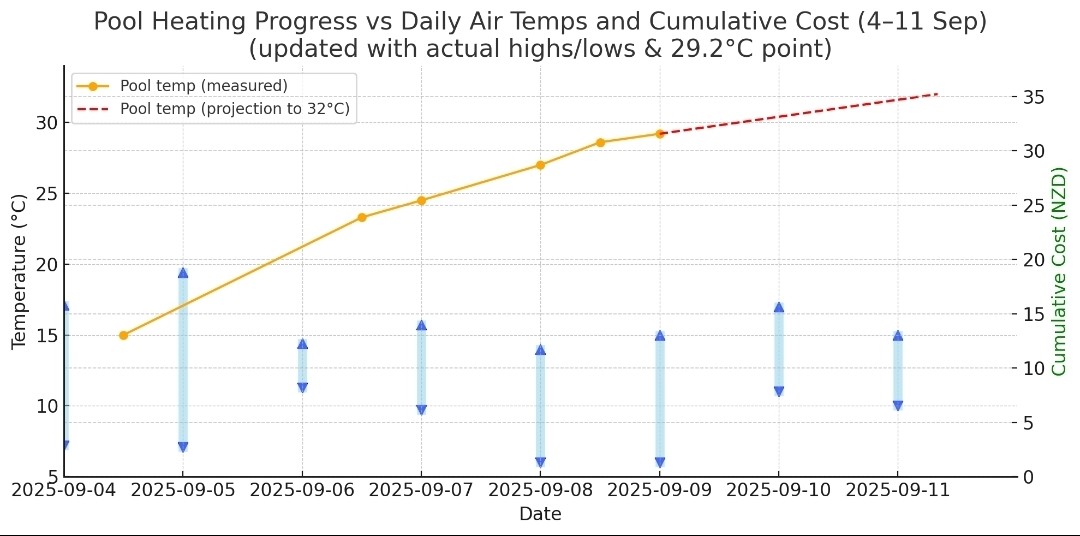
Thanks you've been super generous with all the info you've shared! Heat-up this year took about a full week, but that's because we've been running 32+ degrees as our youngest needed it warm to last any meaningful length of time in the water. I've dropped it down to a bone chilling 30.5 and as you say, the heat pump hasn't been running very much at all.


Some of the $$ values might not be accurate.


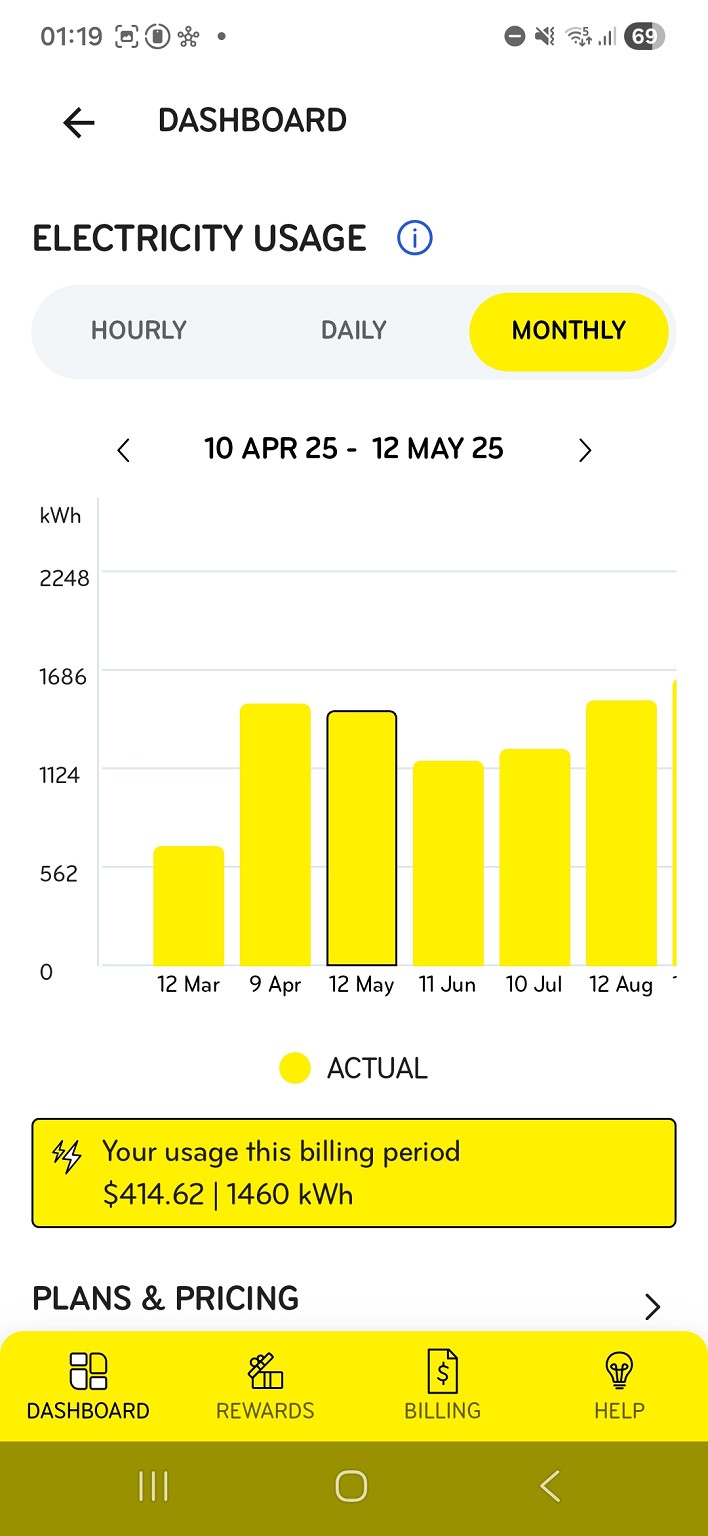
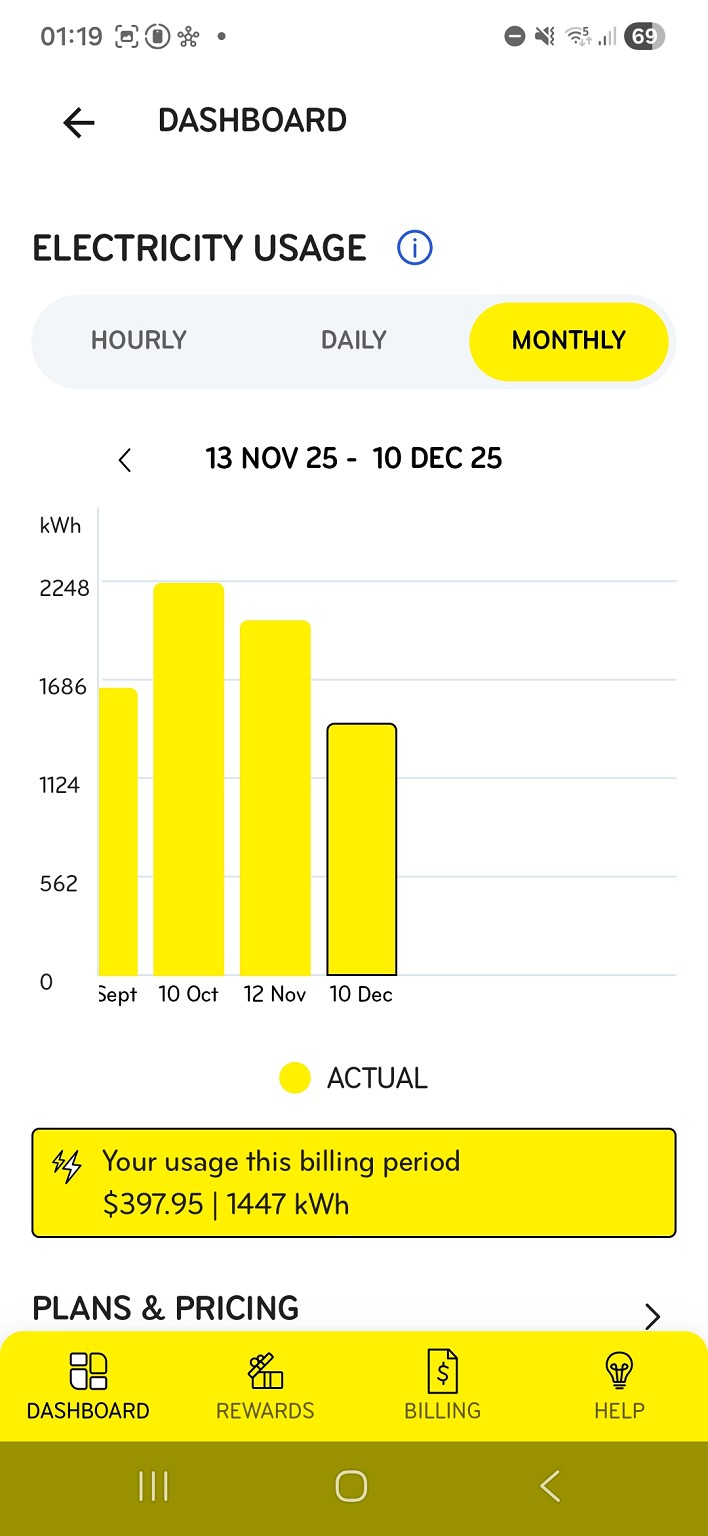
Each power bill has been ~$400+ and while the pool isn't heated in winter, the house heat pumps are getting a good workout 24/7.


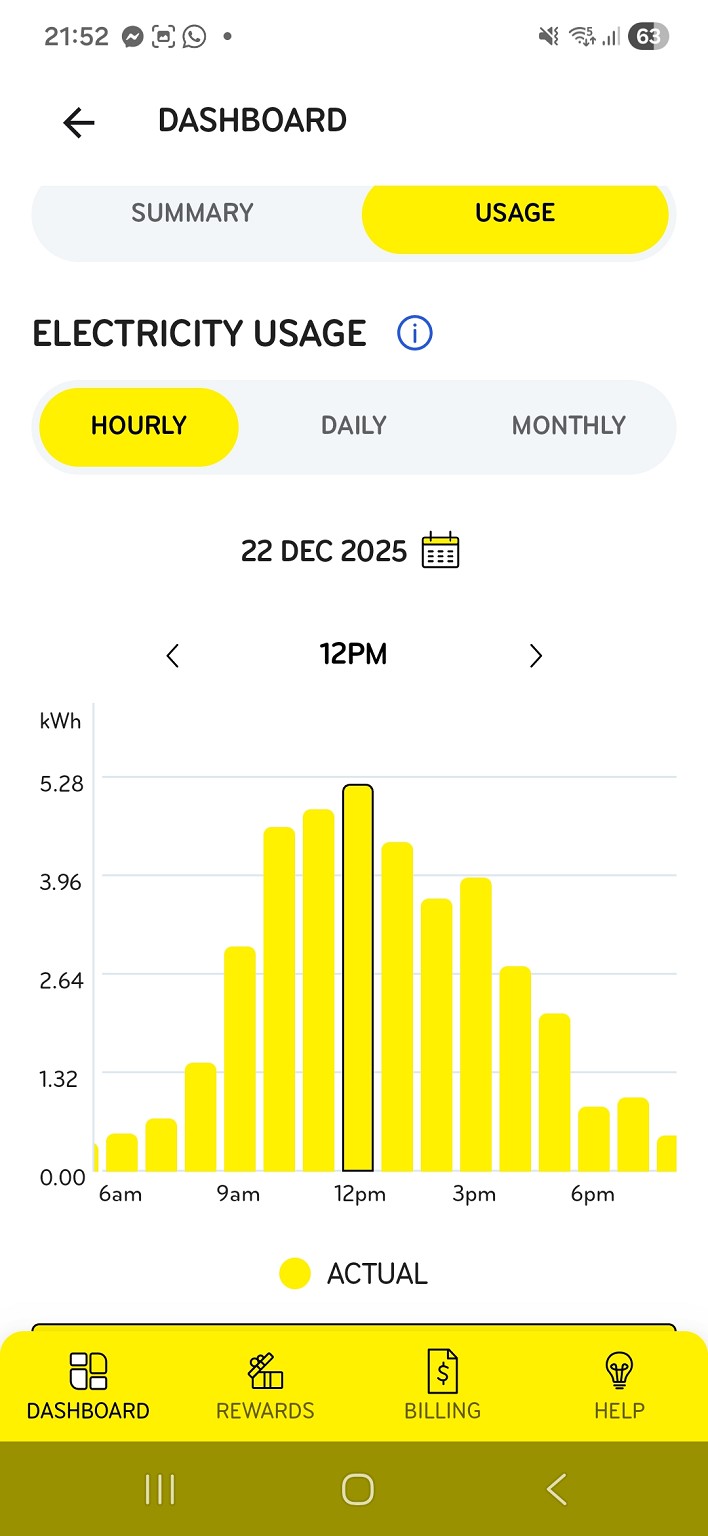
Here's a snapshot of a fairly typical day in December when both the house heatpumps and pool heatpumps were running - so this is why I was thinking that that AI guestimate of 8.5-9.5kw of PV sounded reasonable. I think I could get 25 panels on the roof and get a fairly good even coverage throughout the day to keep generation above usage.


I might need to get some smart automation going i.e If PV output is below XX by YY time of day, run pool punps etc later in home of sun, and if no sun by ZZ time, just run for minimal hours. 


timmmay
20860 posts

Uber Geek
+1 received by user: 5350

Trusted
Lifetime subscriber

  #3447594 28-Dec-2025 16:01
Send private message quote this post

In December with our 9kw panels we will generate about 1500kwh, and export about half of it. That $135 credit will pay the daily connection fees and have a little left over as credit. By March or April if we're lucky we might have a credit that lasts a month towards winter power, maybe not quite. 


insane
3325 posts

Uber Geek
+1 received by user: 1006

ID Verified
Trusted
2degrees
Subscriber

  #3447597 28-Dec-2025 16:32
Send private message quote this post

That's pretty good going, for me I've still got a mortgage so regardless of how I'm funding it I have to factor in the cost of capital. Looking back it was all looking really positive a few years back when interest was really low, but as rates started to raise to where they are today my net benefit after 'lending' costs, I'm only just over $100 a month in the green after I also factor in a inverter replacement after 10 years.


I'll ignore the annoying cost of also needing to re-roof first, as I have to do that regardless, and must do it before installing solar.


Of course there's the intangible gain of having a new toy to play with and integrate into HA etc. Will probably fly unnoticed until Mrs Insane can't put the dryer on until the sun is bright enough 😎


timmmay
20860 posts

Uber Geek
+1 received by user: 5350

Trusted
Lifetime subscriber

  #3447601 28-Dec-2025 17:17
Send private message quote this post

My Sigen inverter integrates with HA using mod bus which sends data every second. I wish I'd gotten Ethernet to the inverter. 


1 | ... | 109 | 110 | 111 | 112 | 113 | 114 | 115 | 116 | 117 | 118 | 119 | ... | 149
Filter this topic showing only the reply marked as answer View this topic in a long page with up to 500 replies per page Create new topic


Geekzone Live »

Try automatic live updates from Geekzone directly in your browser, without refreshing the page, with Geekzone Live now.


Are you subscribed to our RSS feed? You can download the latest headlines and summaries from our stories directly to your computer or smartphone by using a feed reader.