


insane:
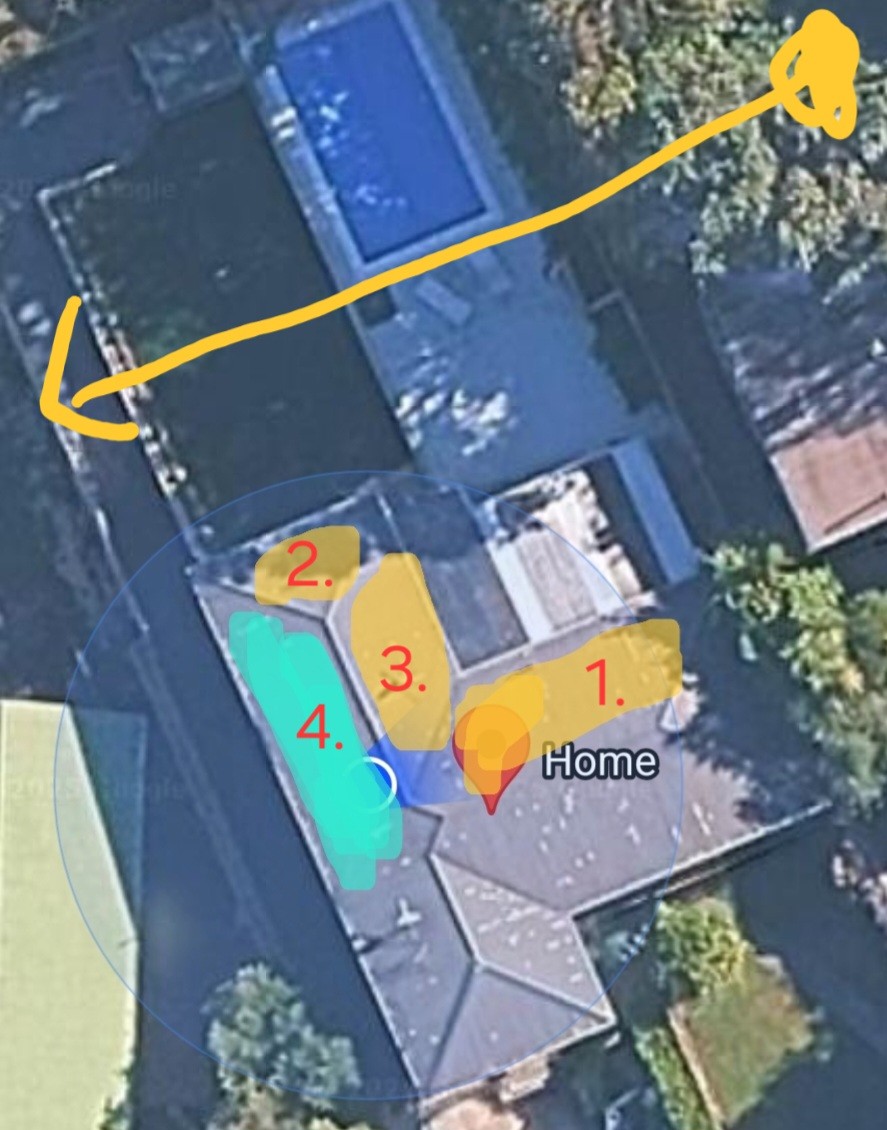
North is straight up, and in summer the roof gets full sun from 8:30ish, but in winter there's shading on the East end of it until around 11am (neighbours have massive trees that we've pruned once before). Harrison's and Zen both suggested some Tygo optimisers, but that was before I thought about adding panels on the West face to get late afternoon sun and prolong the generation duration, so if that was in play they might have suggested different inverters
The West face is a two story drop, so I imagine that's extra fall protection or scaffolding so perhaps why that was not suggested originally.
I'd be thinking twice about whether the expense and effort of putting panels on a WSW facing (30 degree sloping?) roof is justified. They're not going to see much sun for a good part of the year.
You're aiming for close to 10 kW of panels as I understand it. I would think the roof pitches coloured yellow would be able to accommodate that much capacity?
The WSW (#4) gets plenty of sun from what I've seen, it's also completely unobstructed. The ridgeline between #4 and #3 shades part of #1 and #3 in the late afternoon, although by then the sun is weaker.
Having #1 and #2 together makes sense if the shading can be managed or avoided through optimisers or placement.
Yeah 10k of PV sounds optimal, but my main mission is 5kw of generation for the longest hours possible. Unless it makes more sense to get a battery to fill in the non peak periods.
The yellow arrow is the direction the sun moves through the day.
@insane - as @fastbike said - the NIWA SolarView tool is very useful. Free for non-commercial use.
I've made up a an Excel workbook that calculates solar collection, and plots the daily profiles for each month, based upon the NIWA data. It is currently configured to up to 3 faces, in an arbitrary location in Christchurch. You could easily add additional faces if needed (though your 1 & 2 can be treated as one face, ignoring shade from local trees etc., which the NIWA tool cannot assess anyway).
You need to go to the NIWA SolarView website and generate tables for the location, facing and tilt of your panels, then cut/paste the 'mhr' data into the relevant sheets. This will help you assess whether investing in panels on the WSW face is worth it, vs - for example, squeezing more panels on the other faces, or opting for higher output (more expensive) panels on those faces. Take particular note of the winter performance.
https://docs.google.com/spreadsheets/d/1zGh3STUEOO_yqriGtf0kd31AbZ-Mxl-L/edit?usp=drive_link&ouid=111583397876606779406&rtpof=true&sd=true
(this was generated in Excel, but may not work perfectly in Google Sheets - PM me if you want a direct copy of the XLS file)


 ID Verified


 Trusted
