Geekzone: technology news, blogs, forums
Guest
Welcome Guest.
You haven't logged in yet. If you don't have an account you can register now.
Filter this topic showing only the reply marked as answer View this topic in a long page with up to 500 replies per page Create new topic
1 | ... | 124 | 125 | 126 | 127 | 128 | 129 | 130 | 131 | 132 | 133 | 134 | ... | 149
HarmLessSolutions
1230 posts

Uber Geek
+1 received by user: 813

Subscriber

  #3461676 15-Feb-2026 15:34
Send private message quote this post

Jase2985:


Those places were never designed for solar, if they were, they would have had mono pitch roofs to align to the north. Fundamental design flaw.


There were a few installation hurdles on that project. Initially the sparky connected the whole complex onto the same phase which then became an issue for the solar functionality. Designing something of that type around solar optimisation didn't enter the discussion I by the comments I heard.


https://www.harmlesssolutions.co.nz/


LightbulbNeil
71 posts

Master Geek
+1 received by user: 16


  #3461686 15-Feb-2026 16:09
Send private message quote this post

Other factoes come into play with the outer surrounding of your home. EG, is there a big hill that shades the property in the early afternoon? Is there a good clean line of sight for sunrise? Can you change where the TV arial is located , so its not shading or interferring with panels?  As many North facing is good, and as many West facing is only good if you have a clean line of sight to sunset. If you have a clean line of sight to sunrise, then ustilising the long East facing slope is also very effective. My advice is to get as many panels as you can, to assist in Wnter production. Summer is the easiest to generate energy. Winter on cloudy days is where have alot more panels pays off. Overcast days, the orientaion is not so important. If you get alot more panels, and split evenly between North East and West will give you the best Winter production for the duration of the short daylight hours. Smaller systems take longer to pay off compared to a very large system, that does cost more and has more benefits. The hardest part is the finiacing for larger systems, like a 15kw system. You could get 10 panels West, 10, North and 10 East. That is what we have, and we now get credit that helps to pay back the system even earlier.


Also look at what is going to shade your system like Council trees that have lots of leaves in the summer and may shade the roof early in the afternoons for example. In ourcase the council trees are now a problem 2.5 years later in the afternoons and they wont trim or reduce the trees heights or replace with more frindly smaller trees either. 


Some areas are limited in what they can export during the day, so a 3phase system may not be a solution in regards to exporting the summer excesses. At the moment batteries, are still too expensive for the return etc.


Most days, our 15kw system is generating a peak of 12-13kw due to clouds or lower sunintensity days. On a few days we do see 15kw generation but that is usually only in December or January of exceptional days. On exceptional days, we export about 110kwh. Or could charge a couple of battery cars in a day. We don't have battery cars though.


In Winter, we will make around 40kwh in a day on very good winters days, Late May to early July. But on bad days will only produce as low as 5kw in a day. White frosty panels are not that badly effected for the generation over all. But Moss on the panels is bad news.  


Our winter usage per day is about 20 to 32 kwh per day.  If we had a 60kwh battery could be almost self suffecient through winter as well, but 60kwh of battery is very expensive.


Keep looking at ideas, and there is some software out there, that allows you to play around with the panles on your roof to look at the orientaion of panels etc.


Newer panels are also makeing more per panel, so needs less for the same KWh of generation. Some have technology that reduces the effects of shading on that string or connection of panels and that all helps too.


Neil


Lally:


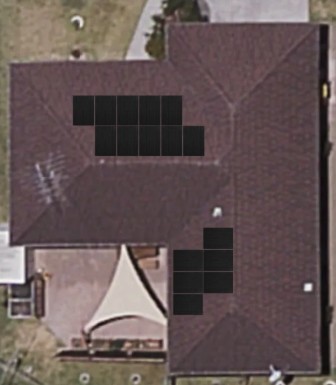
Hi all, revisiting this for 2026, my house is north facing and wondered (where I need your help) if this is the most efficient use of my roof for panel placement. Originally got 2 quotes (last Feb 2025), 1st was a 10 panel day system (10 at the top) and then a 16 panel system, shown below. I want to install as many panels as I can efficiently and wondered if this could not have been done a little better?


sudo
409 posts

Ultimate Geek
+1 received by user: 117


  #3461794 16-Feb-2026 08:59
Send private message quote this post

Does anyone know of capping that will hide the ugly conduit. I got a skillion roof (no cavity), so it needs to run up the outside of side of the house.


I was thinking of something like the capping they use for heat pumps.


edit: They also needs to run it along the roof, for about 3 metres. As the solar panels will be located on the opposite side (to avoid tree shadow)


Stu1
1894 posts

Uber Geek
+1 received by user: 489

ID Verified
Subscriber

  #3461869 16-Feb-2026 12:35
Send private message quote this post

sudo:


Does anyone know of capping that will hide the ugly conduit. I got a skillion roof (no cavity), so it needs to run up the outside of side of the house.


I was thinking of something like the capping they use for heat pumps.


edit: They also needs to run it along the roof, for about 3 metres. As the solar panels will be located on the opposite side (to avoid tree shadow)


I ran mine down inside an external wall. No ugly conduit but amazing echo inside the room


dantheperson
226 posts

Master Geek
+1 received by user: 63


  #3461948 16-Feb-2026 18:38
Send private message quote this post

kangaroo13:


Twincamr2:


Yeah, the AC coupled battery is a bit of a head scratcher for me. They've assured me it's a good fit and the efficiency loss will be minimal. I assume it's their only option beyond the powerwall. Are there any other problems we might have? 


  Just seems strange to pay for a hybrid inverter, and then specify an AC-coupled battery.  It seems you could either save by specifying a simpler inverter, or benefit from the extra efficiency of a DC-coupled battery system.  


The issue with Fronius Gen24 Hybrid inverters is that you have to pay close to $1K to software unlock the hybrid feature, so that negates any cost advantage over an AC coupled system needing it's own battery inverter.  Then it only works with BYD batteries which for reasons unknown are stupidly expensive, at least compared to 48V batteries. 


Jase2985
13739 posts

Uber Geek
+1 received by user: 6220

ID Verified
Lifetime subscriber

  #3461958 16-Feb-2026 19:24
Send private message quote this post

dantheperson:


kangaroo13:


Twincamr2:


Yeah, the AC coupled battery is a bit of a head scratcher for me. They've assured me it's a good fit and the efficiency loss will be minimal. I assume it's their only option beyond the powerwall. Are there any other problems we might have? 


  Just seems strange to pay for a hybrid inverter, and then specify an AC-coupled battery.  It seems you could either save by specifying a simpler inverter, or benefit from the extra efficiency of a DC-coupled battery system.  


The issue with Fronius Gen24 Hybrid inverters is that you have to pay close to $1K to software unlock the hybrid feature, so that negates any cost advantage over an AC coupled system needing it's own battery inverter.  Then it only works with BYD batteries which for reasons unknown are stupidly expensive, at least compared to 48V batteries. 


They don't ONLY just work with BYD, there are many high voltage batteries that they work with. They just aren't as common and as you mentioned they aren't as cheap as they need more electronics etc to care for the higher voltages etc. whether its justified i don't know.


dantheperson
226 posts

Master Geek
+1 received by user: 63


  #3461961 16-Feb-2026 19:54
Send private message quote this post

Jase2985:


dantheperson:


The issue with Fronius Gen24 Hybrid inverters is that you have to pay close to $1K to software unlock the hybrid feature, so that negates any cost advantage over an AC coupled system needing it's own battery inverter.  Then it only works with BYD batteries which for reasons unknown are stupidly expensive, at least compared to 48V batteries. 


They don't ONLY just work with BYD, there are many high voltage batteries that they work with. They just aren't as common and as you mentioned they aren't as cheap as they need more electronics etc to care for the higher voltages etc. whether its justified i don't know.


I heard you cant get the LG ones anymore and ive never seen the new fronius ones in nz, so that just leaves BYD


https://www.fronius.com/en/solar-energy/installers-partners/products/all-products/storage-units/compatible-batteries


Or do you mean the build your own DIY options with the dali emulator?


Paul1977
5171 posts

Uber Geek
+1 received by user: 2192


  #3462159 17-Feb-2026 11:13
Send private message quote this post

Twincamr2:


Hi All,


Quick couple of questions... I've had a quote for solar and it's not very clear. There's only four line items as below:


  • AIKO INFINITE 480W ALL BLACK ULTRA X 18 = 8.64 KW.
  • FRONIUS PRIMO 8.0 GEN24 SINGLE PHASE UPGRADABLE HYBRID INVERTER
  • GIVENERGY 13.5KWH AC COUPLED PREMIUM BATTERY SOLUTION
  • Fronius Smart Energy Meter 63A-1

The total is $36k. I've had a several other quotes which are a bit cheaper, but they all spec other, perhaps less established, brands. 


Is there anything missing from the quote that I should question? Is that a reasonable deal (I'm in Auckand)? Can anyone recommend another company who could quote on similar gear (I won't touch Tesla)?


Not sure your reasoning for not touching Telsa. But doing the numbers the ROI on a battery just doesn't add up for us. It looks OK when the supplier punches the figures into their ROI tools, but that doesn't paint the full picture. The figures below are based on the best rates I could find and our specific power usage patterns.


It looks like 24 Aiko 480W panels and 10kW Fronius inverter with no battery could reduce our yearly power bills by $2,500 from an install cost of around $22,000 giving an ROI of 8.8 years ($22,000/$2,500).


Change to 24 Aiko 480W panels and Powerwall 3 (13.5kW battery with built-in 10kW inverter) could reduce our yearly power bills by $3,000 from an install cost of around $33,000 giving an ROI of 11.7 years ($35,000/$3,000).


At a glance, that looks pretty good - only 3 years added to the ROI and then bigger savings. BUT we'd actually only be gaining an additional $500 saving per year for an additional $13,000 spend. So the true ROI for the battery component is actually 26 years ($13,000/$500), which would be beyond the reasonable life expectancy of the Powerwall 3. It took me a bit to get my heads around how that maths works (because looking at it one way looks great, but looking at it the other way looks terrible), but I'm pretty sure I'm correct.


The calculations would probably be similar for a non-Tesla battery,


richms
29109 posts

Uber Geek
+1 received by user: 10225

Trusted
Lifetime subscriber

  #3462161 17-Feb-2026 11:19
Send private message quote this post

You are also getting the fact you have a battery which with weather getting worse has value of its own.


Can't really go running a portable generator overnight when there is a storm. And the cost of a fixed one is well above what a battery costs, even tho it gets you more and for longer I think that a battery is a good mid point to keep just essentials running when the grid fails because of old trees being hit with new weather.


Richard rich.ms

CYaBro
4708 posts

Uber Geek
+1 received by user: 1182

ID Verified
Trusted

  #3462165 17-Feb-2026 11:30
Send private message quote this post

Yea if we didn't have a battery we would be using some power from the grid during the day today and yesterday, and many days this summer, so that would put monthly power bills up again.


It's 11:30am and we've only generated 1.8kWh of solar so far, from 10.8kW of panels.
By this time on a sunny day the battery would be about full and hot water heating and EV charging (If it's at home)


Opinions are my own and not the views of my employer.


mark0x01
13 posts

Geek


  #3462175 17-Feb-2026 11:40
Send private message quote this post

Looking at making the solar leap in Canterbury.


Quoted for 21 x 470W panels


8kW inverter and 2 x 10.1 kWh battery's


All up $29995


looks a reasonable deal.


Have gas for hot water, and use average of 5900 kWh a year, so might get to a $0 bill, althought this week is not a good example of solar potential.


Home Assistant sensor shows less than 35 kWh per day peak use last winter.


With a bit more battery I could charge overnight and have enought battery to get right through a winter day.


The choice of power co looks to be important.


I also have added an old leaf to the transport mix for local use.


Any tips or suggestions?


sen8or
1898 posts

Uber Geek
+1 received by user: 1403


  #3462182 17-Feb-2026 11:59
Send private message quote this post

With gas hot water and using 6k kwh per year, that looks overkill for a system. I'm guessing your total elec bill for 12 months is about $2k? +/-? If so, thats a long payback period assuming a 100% power savings?


HarmLessSolutions
1230 posts

Uber Geek
+1 received by user: 813

Subscriber

  #3462189 17-Feb-2026 12:21
Send private message quote this post

sen8or:


With gas hot water and using 6k kwh per year, that looks overkill for a system. I'm guessing your total elec bill for 12 months is about $2k? +/-? If so, thats a long payback period assuming a 100% power savings?


An 8 kW system operating optimally will generate up to ~1,200 kWh/month in summer and less than half of that in winter (or about 11,000 kWh/year). Self consuming 50% of that will be difficult with no HWC to help soak up 'excess' generation. The real calc's for ROI for batteries involve the differential between FIT vs import cost at time of consumption allowing for time shifting generation by the battery. Resilience from grid outages is another aspect altogether based on what value you place on inconvenience caused by lack of supply.


https://www.harmlesssolutions.co.nz/


Paul1977
5171 posts

Uber Geek
+1 received by user: 2192


  #3462191 17-Feb-2026 12:26
Send private message quote this post

CYaBro:


Yea if we didn't have a battery we would be using some power from the grid during the day today and yesterday, and many days this summer, so that would put monthly power bills up again.


It's 11:30am and we've only generated 1.8kWh of solar so far, from 10.8kW of panels.
By this time on a sunny day the battery would be about full and hot water heating and EV charging (If it's at home)


Sure, but on a sunny day without a battery you would be exporting more. Then on a day/night plan you can often have a night import rate that is essentially the same as your export rate - you then heat your water and charge your car at night and you are essentially using the grid as a free battery.


Where a battery really helps is in the morning after the night rates ends, but before you are generating solar. And then in the evening after you've stopped generating but before the night rates kick in. And, of course, you can top the battery up over night at the lower rates to use during the day in winter.


But, unless my maths is wrong, a battery for my usage just doesn't make financial sense (and that's without an EV or electric water cylinder). Peoples power usage varies, so I'm not saying a battery never makes sense. I just encourage people to do as thorough calculations as they can, because the basic ROI calculators can be misleading.


Paul1977
5171 posts

Uber Geek
+1 received by user: 2192


  #3462193 17-Feb-2026 12:31
Send private message quote this post

HarmLessSolutions:


An 8 kW system operating optimally will generate up to ~1,200 kWh/month in summer and less than half of that in winter (or about 11,000 kWh/year). Self consuming 50% of that will be difficult with no HWC to help soak up 'excess' generation. The real calc's for ROI for batteries involve the differential between FIT vs import cost at time of consumption allowing for time shifting generation by the battery. Resilience from grid outages is another aspect altogether based on what value you place on inconvenience caused by lack of supply.


Agreed. For areas where power outages are frequent then you need to factor in what that resilience is worth to you. We've been our place 5 years and I can't recall a single unplanned outage, and have had only one short planned outage. So for me it's not a factor I assign much value to.


1 | ... | 124 | 125 | 126 | 127 | 128 | 129 | 130 | 131 | 132 | 133 | 134 | ... | 149
Filter this topic showing only the reply marked as answer View this topic in a long page with up to 500 replies per page Create new topic


Geekzone Live »

Try automatic live updates from Geekzone directly in your browser, without refreshing the page, with Geekzone Live now.


Are you subscribed to our RSS feed? You can download the latest headlines and summaries from our stories directly to your computer or smartphone by using a feed reader.