Geekzone: technology news, blogs, forums
Guest
Welcome Guest.
You haven't logged in yet. If you don't have an account you can register now.
Filter this topic showing only the reply marked as answer View this topic in a long page with up to 500 replies per page Create new topic
1 | ... | 127 | 128 | 129 | 130 | 131 | 132 | 133 | 134 | 135 | 136 | 137 | ... | 150
HarmLessSolutions
1237 posts

Uber Geek
+1 received by user: 829

Subscriber

  #3462478 18-Feb-2026 08:33
Send private message quote this post

sen8or:


I assume a solar install includes setting up of your house to optimise solar energy?


For now, we use about 65% low rate / night rate energy. HWC only comes on at night, washing / dishwasher put on overnight where possible etc. The HWC is controlled by the meter (I think), but I assume that this is changed when we switch to solar for a different meter (with export). Are things like HWC programmable from the new meter / inverter?


We can readily change power use on some things (washing / dishwasher) but as we work during the day, day time use is negligible otherwise and being in Christchurch, heating is necessary usually from April / May through to July/August (not all the time but most mornings and evenings).


Thanks


Sen


HWC consumption is typically >30% of a home's electricity demands. They are also a storage device so essentially can be regarded as a battery storing your generation as heat until such time as it is needed. The most effective way to do this is by including a HWC diverter as part of your solar set-up, which unlike a simple timer won't draw from the grid when a cloud moves over your panels.


Having had solar on two properties over the past 14 years I know that most homes will struggle to self consume >50% of their solar generation even when charging an EV under manual control. It is important to realise that your exported generation typically loses half or more of its value when exported. Solar diversion of EV charging and HWC heating is the key to maximising self consumption which is the optimum way to maximise ROI, without the added expense of batteries. Manual control is a hassle most people can't be bothered with and is ultimately nowhere near as effective in getting the best return on your solar investment.



https://www.harmlesssolutions.co.nz/


kangaroo13
87 posts

Master Geek
+1 received by user: 90


  #3462483 18-Feb-2026 08:45
Send private message quote this post

HarmLessSolutions:


sen8or:


I assume a solar install includes setting up of your house to optimise solar energy?


... Are things like HWC programmable from the new meter / inverter?


...


HWC consumption is typically >30% of a home's electricity demands. They are also a storage device so essentially can be regarded as a battery storing your generation as heat until such time as it is needed. The most effective way to do this is by including a HWC diverter as part of your solar set-up, which unlike a simple timer won't draw from the grid when a cloud moves over your panels.


Look at options like SunStash diverter or a Catch smart relay to automatically control the hot water circuit to co-incide with available solar energy with off-peak grid as the back-up.  They cost around $500-$1000 (the Catch relay can take the place of a separate power meter) - so in most instances should pay for themselves within a few years by helping to maximise self-consumption.


EgorNZ
64 posts

Master Geek
+1 received by user: 23


  #3462490 18-Feb-2026 09:03
Send private message quote this post

HarmLessSolutions:


HWC consumption is typically >30% of a home's electricity demands. They are also a storage device so essentially can be regarded as a battery storing your generation as heat until such time as it is needed. The most effective way to do this is by including a HWC diverter as part of your solar set-up, which unlike a simple timer won't draw from the grid when a cloud moves over your panels.


Having had solar on two properties over the past 14 years I know that most homes will struggle to self consume >50% of their solar generation even when charging an EV under manual control. It is important to realise that your exported generation typically loses half or more of its value when exported. Solar diversion of EV charging and HWC heating is the key to maximising self consumption which is the optimum way to maximise ROI, without the added expense of batteries. Manual control is a hassle most people can't be bothered with and is ultimately nowhere near as effective in getting the best return on your solar investment.


HWC diverters can be expensive for what they are, but I agree they're worthwhile for solar installs without batteries.


In theory 180L of water heated to 65C has an energy capacity of over 10kWh, which is comparable to a home battery. But as energy storage it is obviously much less versatile; there are only so many showers you can take or other uses for hot water in a day. If you don't cycle through 180L of hot water daily then the usable capacity is going to be much less than this figure. And it's a storage device that's constantly leaking energy through heat loss.


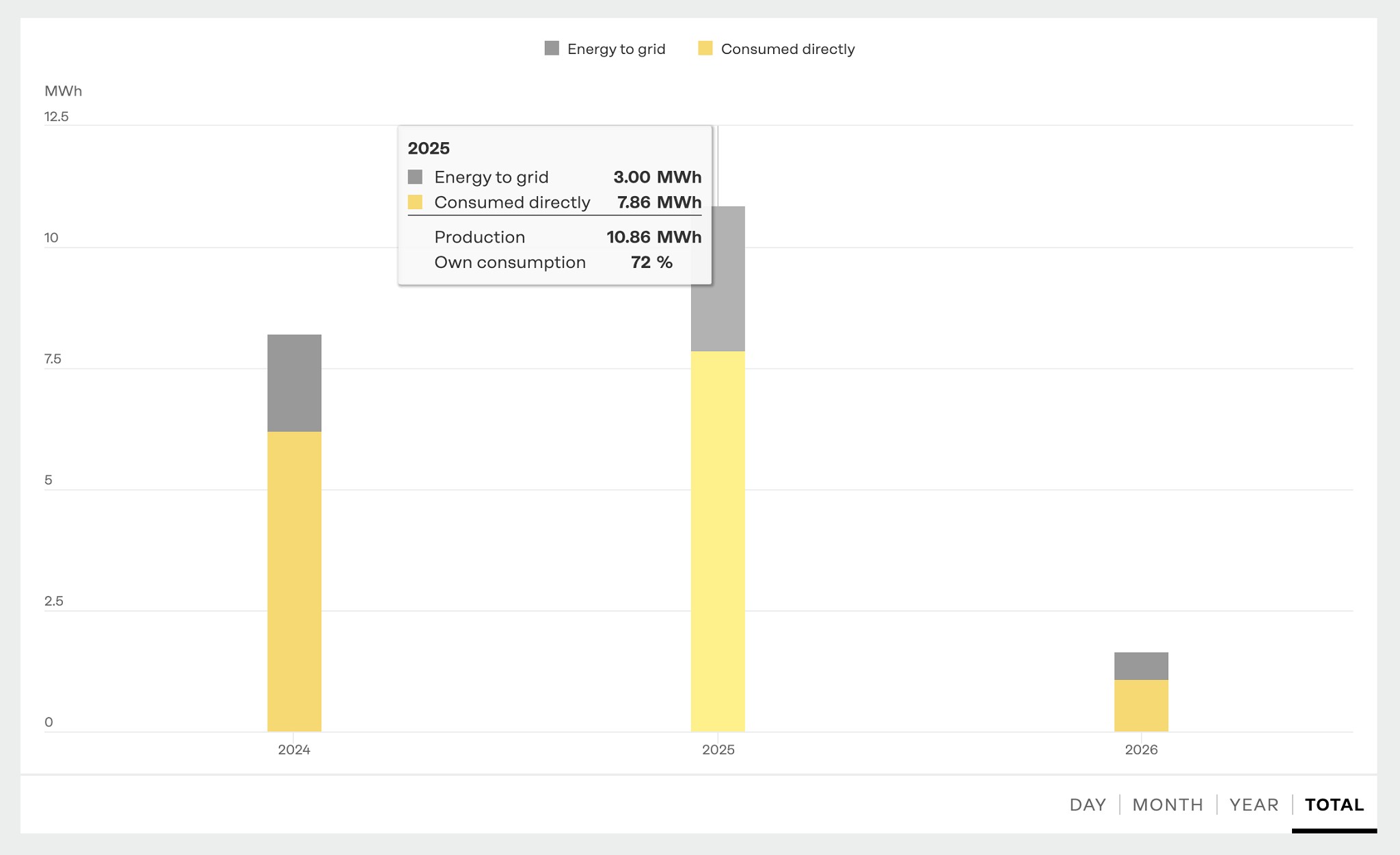
When you do have a battery, the added value from HWC diversion is reduced.


With a battery and without HWC diversion, I average 70-80% self consumption:


HarmLessSolutions
1237 posts

Uber Geek
+1 received by user: 829

Subscriber

  #3462492 18-Feb-2026 09:07
Send private message quote this post

kangaroo13:


HarmLessSolutions:


HWC consumption is typically >30% of a home's electricity demands. They are also a storage device so essentially can be regarded as a battery storing your generation as heat until such time as it is needed. The most effective way to do this is by including a HWC diverter as part of your solar set-up, which unlike a simple timer won't draw from the grid when a cloud moves over your panels.


Look at options like SunStash diverter or a Catch smart relay to automatically control the hot water circuit to co-incide with available solar energy with off-peak grid as the back-up.  They cost around $500-$1000 (the Catch relay can take the place of a separate power meter) - so in most instances should pay for themselves within a few years by helping to maximise self-consumption.


In our case we're running a Paladin diverter. It's worked admirably for the past 4 years and will force a grid feed if HWC temperature is under 40 degrees to protect from Legionnaires risk, which is a rare occurrence here. It tracks export very closely so HWC feed is usually within 50W of your generation, up to the rating of your HWC element (i.e. 3 kW)


Also ditch any 'ripple control' on your HWC as solar input should take precedence without corruption from lines company's demands.


https://www.harmlesssolutions.co.nz/


kangaroo13
87 posts

Master Geek
+1 received by user: 90


  #3462503 18-Feb-2026 10:26
Send private message quote this post

HarmLessSolutions:


... tracks export very closely so HWC feed is usually within 50W of your generation, up to the rating of your HWC element (i.e. 3 kW)


... It is interesting to note that actual consumption may vary from the HWC rating.  We have a 3kW cylinder, but it actually consumes ~3.3kW, which I put down to high voltage (about 243V typically) - it is just a resistive heating element, so greater V leads to higher P = V^2/R.  This can effect the configuratoin of any HWC control system.


EgorNZ


HWC diverters can be expensive for what they are, but I agree they're worthwhile for solar installs without batteries.


Traditionally they can be - and I've had solar install companies quote $1500+ and tell me they aren't worth it vs a simple timer switch. 


But, there are economical options. 


Catch Relay costs about AU$500, and also takes on the role of the power meter.  See video here:
https://www.youtube.com/watch?v=eNEjfihfo_E&t=858s


Suitable for installations where you expect your peak solar most days will be above the HWC power rating.  I have a house with one of these - works well, particularly in summer.


SunStash - a Kiwi company - also does a very affordable diverter, ~NZ$650  Particularly suitable for a smaller installation, where the excess solar struggles to exceed the HWC power rating on many days.  I'm doing a second install on a smaller property (less roof & thus fewer panels), and I've opted for one of these.


With some effort and skill, you can also roll your own with a controllable relay and something like Home Assistant running on a Raspberry Pi - which is very affordable and gives you very sophisticated control and monitoring capabilities, including ability to respond to solar predictions for the day ahead by using online databases.  But that's quite a project in itself (I have a work colleague who went down this road, and he also supplements his power cost savings by buying/selling power on a time-of-use electricity plan using those predictions)  


Paul1977
5171 posts

Uber Geek
+1 received by user: 2192


  #3462645 18-Feb-2026 14:37
Send private message quote this post

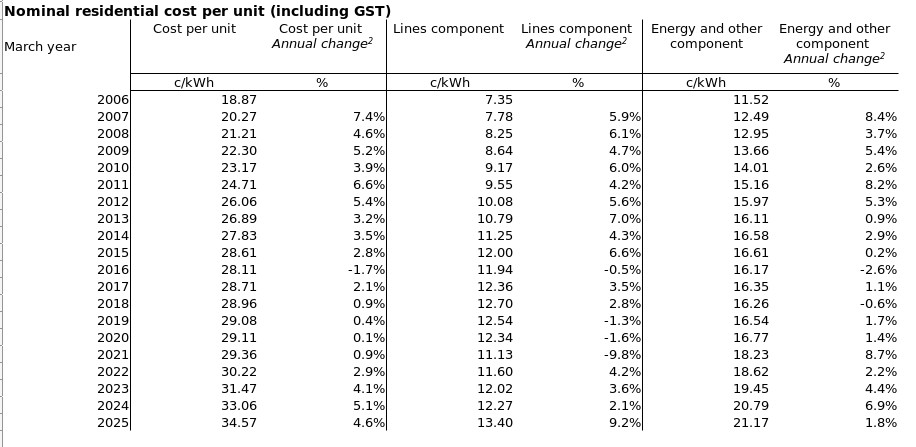
PowerEdge inadvertently quoted me Vector pricing instead of Orion pricing, so that changes the picture a bit. Puts PowerShop back in the running, but they do seasonal pricing and their new pricing for 1 April 2026 - 31 March 2027 isn't available yet. Makes it hard to compare to companies that I can lock in a 2 year rate with.


What do you think would be a reasonable assumption for increases per annum? E.g. 4%, 5%, etc?


MikeAqua
8036 posts

Uber Geek
+1 received by user: 3827


  #3462676 18-Feb-2026 15:35
Send private message quote this post

EgorNZ:


HWC diverters can be expensive for what they are, but I agree they're worthwhile for solar installs without batteries.


In theory 180L of water heated to 65C has an energy capacity of over 10kWh, which is comparable to a home battery. But as energy storage it is obviously much less versatile; there are only so many showers you can take or other uses for hot water in a day. If you don't cycle through 180L of hot water daily then the usable capacity is going to be much less than this figure. And it's a storage device that's constantly leaking energy through heat loss.


When you do have a battery, the added value from HWC diversion is reduced.


With a battery and without HWC diversion, I average 70-80% self-consumption:


We looked at this for our new build.  (noting we haven't actually built it yet and this is all design not reality).  In the end we settled on batteries.  Surplus solar first charges the batteries and when they are full the set point goes to max 933C) on the pool heater (it will run during daylight hours about 8 months of the year). 


With a heat pump HWC it might be possible to automatically increase the set point.  Ditto house A/C.  Ideally, you'd have a bunch of gear you could tell to do useful stuff that uses electricity.  Chill the freezer a little more, run a defrost cycle if one is due.  Pump water if you have bore or river intake, or run irrigation.  Delayed start on the dishwasher and dryer on sunny days.  Charge the cars/bikes/boat.


Beyond that, if I wanted to store excess solar as heat, I'd consider a sand battery.  I'm not sure if they're available in NZ yet, but there are grid scale and domestic units in Europe.  They store heat for months.


Mike


fastbike
458 posts

Ultimate Geek
+1 received by user: 336


  #3462771 18-Feb-2026 19:18
Send private message quote this post

Paul1977:


PowerEdge inadvertently quoted me Vector pricing instead of Orion pricing, so that changes the picture a bit. Puts PowerShop back in the running, but they do seasonal pricing and their new pricing for 1 April 2026 - 31 March 2027 isn't available yet. Makes it hard to compare to companies that I can lock in a 2 year rate with.


What do you think would be a reasonable assumption for increases per annum? E.g. 4%, 5%, etc?


I've seen 5% mooted, how much of that is line vs unit charge I do not know 


Otautahi Christchurch


dantheperson
226 posts

Master Geek
+1 received by user: 63


  #3462802 18-Feb-2026 21:50
Send private message quote this post

fastbike:


Paul1977:


What do you think would be a reasonable assumption for increases per annum? E.g. 4%, 5%, etc?


I've seen 5% mooted, how much of that is line vs unit charge I do not know 


The transmission component of the fixed charge is expected to add $5 to your montly bill every year through to 2030, but there are large regional variations within that average figure - see the link: https://www.comcom.govt.nz/regulated-industries/electricity-lines/understanding-how-changes-to-lines-charges-may-impact-your-electricity-bill/#jump-link-4


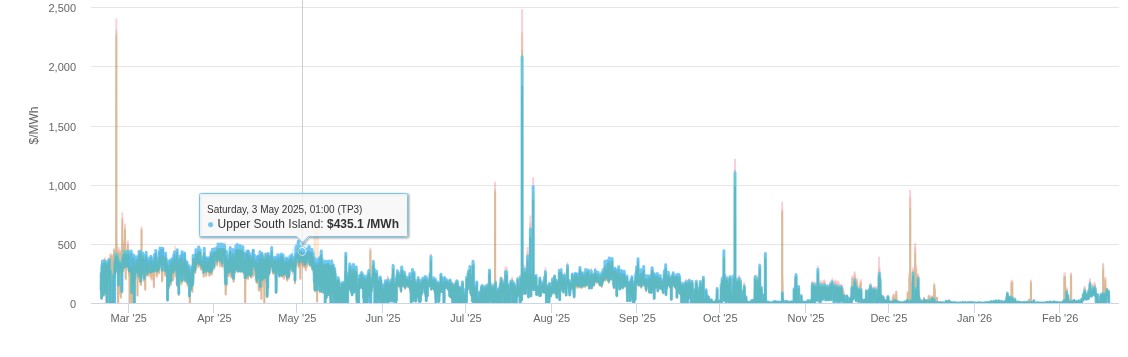
Then you have generation costs on top, and the new LNG tax coming too.  Wholesale spot unit costs have been bloody low the last 5 months or so. You'd hope there wouldnt be large unit cost increases this year, but before then they were getting very high again.


Retail price trends:


https://www.mbie.govt.nz/building-and-energy/energy-and-natural-resources/energy-statistics-and-modelling/energy-statistics/energy-prices/electricity-cost-and-price-monitoring

The only way is up


Lipex666
445 posts

Ultimate Geek
+1 received by user: 8

Trusted

  #3462806 18-Feb-2026 22:36
Send private message quote this post

sen8or:


I assume a solar install includes setting up of your house to optimise solar energy?


For now, we use about 65% low rate / night rate energy. HWC only comes on at night, washing / dishwasher put on overnight where possible etc. The HWC is controlled by the meter (I think), but I assume that this is changed when we switch to solar for a different meter (with export). Are things like HWC programmable from the new meter / inverter?


We can readily change power use on some things (washing / dishwasher) but as we work during the day, day time use is negligible otherwise and being in Christchurch, heating is necessary usually from April / May through to July/August (not all the time but most mornings and evenings).


Thanks


Sen


We have been on solar only a few months with no batts installed.  We went with the Libby see https://www.myenergi.com/nz/eddi-power-diverter/. Didn’t think it was two expensive.

The app we use to track our solar as well.  


Basically ripple control for HWC is turned off the eddi on works when there is excess solar and we find that in a very short amount of time our HWC is at full temp.  Your have full auto plus manual control boost if needed.  In fact our water actually seems hotter.


We find the HWC only two of us will stay hot 2 - 3 days.  For us it works as 2 adults and we are home working so all washing etc is done during the day.


"The only way to learn some- thing is to do it"

dukezoid
74 posts

Master Geek
+1 received by user: 15


  #3462943 19-Feb-2026 08:11
Send private message quote this post

Paul1977:


mark0x01:


Yes, charge from grid is a bust with Electric Kiwi Movemaster, overnight rate at 0.2888c and best export is peak time @0.23c, so just losing money there.


MainPower now approves up to 10kW for single phase installations, so not an issue here.


GST is a bummer too. At least we don't pay tax on exports (yet).


Doesn't look too rosy the deeper I look.


Plus if they only give the 23c export during peak (which they define as weekdays 7am-9am & 5pm-9pm), then it's essentially meaningless isn't it? How much solar generation will be happening then? It's only11.5c export when you will actually be generating. They have a low daily fee, but their peak import rate is very high @$0.5927 where I live.


PowerEdge is looking like it might be best for me. Very high daily fee, but for my usage still looks like the best value.


Surely one shouldn’t need to remain on standard user once have solar installed!? Import should be very small with an adequately sized array.


dukezoid
74 posts

Master Geek
+1 received by user: 15


  #3462962 19-Feb-2026 09:03
Send private message quote this post


Look at options like SunStash diverter or a Catch smart relay to automatically control the hot water circuit to co-incide with available solar energy with off-peak grid as the back-up.  They cost around $500-$1000 (the Catch relay can take the place of a separate power meter) - so in most instances should pay for themselves within a few years by helping to maximise self-consumption.


Budget option: $20 TOMZN 63A 1P+N WIFI Smart Switch Energy


https://www.aliexpress.com/item/1005005566304770.html


Have installed four of these for myself and friends / family. Flawless operation over 2 years.


Can flash with Tasmota, requires soldering: https://www.elektroda.com/rtvforum/topic3938206.html


EgorNZ
64 posts

Master Geek
+1 received by user: 23


  #3462963 19-Feb-2026 09:10
Send private message quote this post

dukezoid:


Budget option: $20 TOMZN 63A 1P+N WIFI Smart Switch Energy


https://www.aliexpress.com/item/1005005566304770.html


Have installed four of these for myself and friends / family. Flawless operation over 2 years.


Can flash with Tasmota, requires soldering: https://www.elektroda.com/rtvforum/topic3938206.html


That's a relay, I'd question if it is safe to use with the resistive load of a HWC. Lots of photos around of smart relays burning out when driving HWC loads.


BlargHonk
176 posts

Master Geek
+1 received by user: 131


  #3462965 19-Feb-2026 09:17
Send private message quote this post

dukezoid:


Look at options like SunStash diverter or a Catch smart relay to automatically control the hot water circuit to co-incide with available solar energy with off-peak grid as the back-up.  They cost around $500-$1000 (the Catch relay can take the place of a separate power meter) - so in most instances should pay for themselves within a few years by helping to maximise self-consumption.


Budget option: $20 TOMZN 63A 1P+N WIFI Smart Switch Energy


https://www.aliexpress.com/item/1005005566304770.html


Have installed four of these for myself and friends / family. Flawless operation over 2 years.


Can flash with Tasmota, requires soldering: https://www.elektroda.com/rtvforum/topic3938206.html


You are putting something from AliExpress in your switchboard?


dukezoid
74 posts

Master Geek
+1 received by user: 15


  #3462966 19-Feb-2026 09:22
Send private message quote this post

EgorNZ:


dukezoid:


Budget option: $20 TOMZN 63A 1P+N WIFI Smart Switch Energy


https://www.aliexpress.com/item/1005005566304770.html


Have installed four of these for myself and friends / family. Flawless operation over 2 years.


Can flash with Tasmota, requires soldering: https://www.elektroda.com/rtvforum/topic3938206.html


That's a relay, I'd question if it is safe to use with the resistive load of a HWC. Lots of photos around of smart relays burning out when driving HWC loads.


Pardon, yeah not suggesting these for diverter-style (constant switching) operation. Just timed operation e.g. across peak solar hours and/or off peak import hours.


63A rated and tear down comments suggest relay is of decent quality. We’ve not had any issues.


1 | ... | 127 | 128 | 129 | 130 | 131 | 132 | 133 | 134 | 135 | 136 | 137 | ... | 150
Filter this topic showing only the reply marked as answer View this topic in a long page with up to 500 replies per page Create new topic


Geekzone Live »

Try automatic live updates from Geekzone directly in your browser, without refreshing the page, with Geekzone Live now.


Are you subscribed to our RSS feed? You can download the latest headlines and summaries from our stories directly to your computer or smartphone by using a feed reader.