Geekzone: technology news, blogs, forums
Guest
Welcome Guest.
You haven't logged in yet. If you don't have an account you can register now.
Filter this topic showing only the reply marked as answer View this topic in a long page with up to 500 replies per page Create new topic
1 | ... | 156 | 157 | 158 | 159 | 160 | 161 | 162 | 163 | 164
sen8or
1948 posts

Uber Geek
+1 received by user: 1450


  #3495500 26-May-2026 13:42
Send private message quote this post

Just did a d/load of ours for the 25 days in May - 


Best Solar - 44.44kwh


Worst Solar - 2.24Kwh


Average - 26.074 Kwh


This is covering an average of 58% of our Load Consumed (average of about 45kwh)


I have used Genesis's "power shout hours" to their maximum advantage this month, importing from grid during peak for HWC and manually charging the battery, so on days like today, not only do we get our HWC / Heating sorted for free from the grid, our battery gets charged from the grid too. Ofcourse, these power shout hours are limited (we have accumulated them over a year or 2) so its not exactly a replacement, but a nice bonus of having a battery.


I have similar theoretical production to Paul1977 but panels aligned differently, not quite as efficiently during winter.


fastbike
527 posts

Ultimate Geek
+1 received by user: 404


  #3495501 26-May-2026 13:48
Send private message quote this post

Paul1977:


timmmay:


Sounds about right, depending on capacity. In winter we save about that much per month, in summer we get bills less than $50 most months even though we use air conditioning quite a bit - less usage, more generation, much more export.


Our capacity is higher than yours I think - 11.76kW panels on 10kW inverter. But, of course, none of it is apples to apples. Since we use a lot of power during peak times this lessens the savings because of the differential between import and export. If we were able to do more aggressive time shifting our savings would be more.


Best day this month (3rd May) we generated 47.38kWh, worst day (21st May) only 2.55kWh.


Will be interesting to see how it averages out over a full year. 


If you can't move peak loads then a battery becomes more viable. I'm of the age where I want the heatpump on at 5pm, rather than wait until 9pm.


To compare to your May data, on 3rd May we generated 43kWh (1st May 45) and 21st May 2.9kWh. We are located in Chch with 11.8kW panels and 10kW 3 phase inverter. Panels face 346 degrees (slightly off true North) and run between 23 and 12 degrees in 3 rows so the tilt is not optimal for the winter.


I changed power providers at the end of May '24 as Meridian were increasing their prices so moved to Contact (and then back to Meridian in Oct 24 for their 5 year solar deal) so it's a bit hard for me to share consumption figures but here goes:


Pre solar


Meridian 19/5/24 to 30/5/24   303 Day  301 Night


Contact 31/5/24 to 27/6/24  767 Day  741 Night


Contact 28/6/24 to 30/7/24  874 Day  815 Night


Post Solar (with battery added March 25)


Meridian 11/5/25 to 10/6/25   19 Day  690 Night


Meridian 11/6/25 to 10/7/25   59 Day  1093 Night


So we are importing quite a bit less (due to solar) and almost importing nothing during peak hours (the battery charges at night)


Some plans give 3 free hours which would be useful with a battery, is that an option ?


Otautahi Christchurch


Paul1977
5229 posts

Uber Geek
+1 received by user: 2221


  #3495504 26-May-2026 14:11
Send private message quote this post

fastbike:


If you can't move peak loads then a battery becomes more viable. I'm of the age where I want the heatpump on at 5pm, rather than wait until 9pm.


To compare to your May data, on 3rd May we generated 43kWh (1st May 45) and 21st May 2.9kWh. We are located in Chch with 11.8kW panels and 10kW 3 phase inverter. Panels face 346 degrees (slightly off true North) and run between 23 and 12 degrees in 3 rows so the tilt is not optimal for the winter.


I changed power providers at the end of May '24 as Meridian were increasing their prices so moved to Contact (and then back to Meridian in Oct 24 for their 5 year solar deal) so it's a bit hard for me to share consumption figures but here goes:


Pre solar


Meridian 19/5/24 to 30/5/24   303 Day  301 Night


Contact 31/5/24 to 27/6/24  767 Day  741 Night


Contact 28/6/24 to 30/7/24  874 Day  815 Night


Post Solar (with battery added March 25)


Meridian 11/5/25 to 10/6/25   19 Day  690 Night


Meridian 11/6/25 to 10/7/25   59 Day  1093 Night


So we are importing quite a bit less (due to solar) and almost importing nothing during peak hours (the battery charges at night)


Some plans give 3 free hours which would be useful with a battery, is that an option ?


Our systems are very closely specced, and I'm also in Chch. Main difference is our panels are split half NNE (26.2 degree pitch) and half WNW (20 degree pitch). It appears our generation looks about right then, so appreciate that data thanks.


I'm like you, if I'm cold at 5pm then that's when the heat pump is going on! 


All my (ChatGPT assisted) calculations said a battery just wasn't going to make financial sense for us (and that was done on the basis of no time shifting), and we've never had issues with outages so backup power isn't something we put any real value on. Once we have a full year of data post solar install I'll revisit the idea though, as I'll no longer be relying on assumptions around generation.


EDIT: Ours is single phase.


timmmay
20923 posts

Uber Geek
+1 received by user: 5395

Trusted
Lifetime subscriber

  #3495588 26-May-2026 16:53
Send private message quote this post

Paul1977:


Best day this month (3rd May) we generated 47.38kWh, worst day (21st May) only 2.55kWh.


We have 9kw panels 6kw inverter, north and west facing panels, best day so far in May is 32kwh. Best day that I recall seeing in summer was about 62kwh.


Loismustdye
952 posts

Ultimate Geek
+1 received by user: 256

Trusted

  #3495593 26-May-2026 17:41
Send private message quote this post


Asking here for some thoughts we as received some new info from another installer regarding an install.


Basics are: 2A/2C, no one home during day, no EV, modern insulated double glazed 220 sqm home, 2 existing HPs (soon to be 3). Gas hot water and cooktop (these are staying for the time being due to cost). Not considering batteries at this point as they can be added later and not convinced on the roi just yet. House is mono pitch with the decline running from not quite NW to SE with a (crudely measured) slope of 7 degrees.


Both proposals include install and panels tilts of 10 degrees up towards the NW (from poor SE facing), panels are 555W.


 Previous year electricity use was 5900kWh, however the 2 heat pumps weren't in use till after winter and weren't utilised a lot over summer so I would expect this to rise over the year to be more representative of a standard user or not far off.


Currently on contact’s 3 hours free nightly which we make use of to roughly 20-25% of our usage (Able to run dryer, dishwasher, washing machine and heat pump during these times).
HW heating and the cooktop were via natural gas (based on last years gas usage excluding gas heating this will likely still be around $100-$130/month).


Lowest combined energy bill was $300 over feb (400kw electric), highest was $526 in August (600kw electric and using gas heating).  


1: 20 panels 11.1kW total power, 10kw sigen inverter $21,600. Annual Electricity bill after export/use = $350, monthly combined energy bill around $150/month  


2: 14 panels 7.7kW total power, 6kW Sigen inverter $16,300. Annual Electricity bill after export/use = $866, monthly combined energy bill around $200/month  


Initially I was Leaning into the former with 20 panels as my thinking is more = better in the long term, however considering the total cost of the 3 year term (bank green loan) and combined energy usage over the term (for ease ignoring price rises) the 14 panel option still comes in around $3k cheaper, and we can use the difference to go towards replacing the gas infinity as it will be near 20 years old by that point; means I’m thinking more about the smaller array.  


All subject based to which power provider we choose if we go forward (Any recommendations for palmy nth region?) With no battery I imagine the buyback rate is of more importance followed by our import cost (for peak etc) 


do these options and my subsequent reasoning seem reasonable? 


HarmLessSolutions
1260 posts

Uber Geek
+1 received by user: 875

Subscriber

  #3495600 26-May-2026 18:35
Send private message quote this post

timmmay:


Paul1977:


Best day this month (3rd May) we generated 47.38kWh, worst day (21st May) only 2.55kWh.


We have 9kw panels 6kw inverter, north and west facing panels, best day so far in May is 32kwh. Best day that I recall seeing in summer was about 62kwh.


Best day this month was May 1st with 63.23 kWh (with 26 kWh exported), with 1219 kWh for May so far. Good going for early winter thanks to the fine weather. Summer sees up hitting 100kWh on clear days. (15.35 kW of panels feeding 13.2 kW of inverters over two phases).


Currently basking in 30 degree days here in UK's early summer 😎


https://www.harmlesssolutions.co.nz/


timmmay
20923 posts

Uber Geek
+1 received by user: 5395

Trusted
Lifetime subscriber

  #3495660 26-May-2026 21:57
Send private message quote this post

@Loismustdye I would always go for more panels. You could reduce the inverter spec a bit, the only time you get full power output is a couple of hours around midday in summer. 10 degree pitch is very low, winter you probably won't get all that much generation, I'd see if you can get more pitch on them - not that I'm an expert. Our roof is 35 degrees or so north and in winter I think our output would be higher if we had them on a bit more of an angle, and in summer there's so much light and the sun is pretty much straight up so it matters much less. More pitch on the panels means they need to be spaced further apart though.


Paul1977
5229 posts

Uber Geek
+1 received by user: 2221


  #3495709 27-May-2026 09:48
Send private message quote this post

Loismustdye:


Asking here for some thoughts we as received some new info from another installer regarding an install.


Basics are: 2A/2C, no one home during day, no EV, modern insulated double glazed 220 sqm home, 2 existing HPs (soon to be 3). Gas hot water and cooktop (these are staying for the time being due to cost). Not considering batteries at this point as they can be added later and not convinced on the roi just yet. House is mono pitch with the decline running from not quite NW to SE with a (crudely measured) slope of 7 degrees.


Both proposals include install and panels tilts of 10 degrees up towards the NW (from poor SE facing), panels are 555W.


 Previous year electricity use was 5900kWh, however the 2 heat pumps weren't in use till after winter and weren't utilised a lot over summer so I would expect this to rise over the year to be more representative of a standard user or not far off.


Currently on contact’s 3 hours free nightly which we make use of to roughly 20-25% of our usage (Able to run dryer, dishwasher, washing machine and heat pump during these times).
HW heating and the cooktop were via natural gas (based on last years gas usage excluding gas heating this will likely still be around $100-$130/month).


Lowest combined energy bill was $300 over feb (400kw electric), highest was $526 in August (600kw electric and using gas heating).  


1: 20 panels 11.1kW total power, 10kw sigen inverter $21,600. Annual Electricity bill after export/use = $350, monthly combined energy bill around $150/month  


2: 14 panels 7.7kW total power, 6kW Sigen inverter $16,300. Annual Electricity bill after export/use = $866, monthly combined energy bill around $200/month  


Initially I was Leaning into the former with 20 panels as my thinking is more = better in the long term, however considering the total cost of the 3 year term (bank green loan) and combined energy usage over the term (for ease ignoring price rises) the 14 panel option still comes in around $3k cheaper, and we can use the difference to go towards replacing the gas infinity as it will be near 20 years old by that point; means I’m thinking more about the smaller array.  


All subject based to which power provider we choose if we go forward (Any recommendations for palmy nth region?) With no battery I imagine the buyback rate is of more importance followed by our import cost (for peak etc) 


do these options and my subsequent reasoning seem reasonable? 


Downsizing the solar in order to add significant additional power usage (in the form of electric water heating) doesn't sound like a good long-term approach. In fact (if roof space permits) I'd go higher than 11.1kW on a 10kW inverter. I haven't read this entire thread, but from what I have read no one seems to be saying the wish they had installed a smaller system.


Is the 10 degree tilt the final angle of the panels? Or is it offsetting the -7 degree slope by 10 degrees, resulting it the panels being at 3 degrees?


kangaroo13
106 posts

Master Geek
+1 received by user: 101


  #3495722 27-May-2026 10:40
Send private message quote this post

Paul1977:


Loismustdye:


...


1: 20 panels 11.1kW total power, 10kw sigen inverter $21,600. Annual Electricity bill after export/use = $350, monthly combined energy bill around $150/month  


2: 14 panels 7.7kW total power, 6kW Sigen inverter $16,300. Annual Electricity bill after export/use = $866, monthly combined energy bill around $200/month  


...


Downsizing the solar in order to add significant additional power usage (in the form of electric water heating) doesn't sound like a good long-term approach. In fact (if roof space permits) I'd go higher than 11.1kW on a 10kW inverter. I haven't read this entire thread, but from what I have read no one seems to be saying the wish they had installed a smaller system.


Yes - Sigen inverters can handle up to 100% oversized arrays.   Particularly with your non-ideal panel tilt, throwing up more panels would likely give you best RoI compared to a larger inverter.  From a quote about 6mths ago, incremental cost of additional panels was about $400ea, installed.  Payback on this increment is likely to be significantly quicker than the base system.  A little bit of clipping in summer is no concern.  Focus on getting sufficient generation in winter.


Loismustdye
952 posts

Ultimate Geek
+1 received by user: 256

Trusted

  #3495927 27-May-2026 17:56
Send private message quote this post

@Paul1977 @timmmay yes the panel tilt is to offset the roof pitch as it’s 7 degrees in the wrong direction, giving us a 3 degree tilt in the good orientation. I think it’s because their panels are large (1x2m) and we are in a medium to high wind zone - too much tilt might cause issues with the prevailing winds. 


@kangaroo13 I’m going to check to see if they could bung another couple panels up and check the cost.


ultimately would I be right in saying that due to the suboptimal roof position more panels (for summer export) to offset winter costs is the way to go?


fastbike
527 posts

Ultimate Geek
+1 received by user: 404


  #3495928 27-May-2026 18:23
Send private message quote this post

Loismustdye:


@Paul1977 @timmmay yes the panel tilt is to offset the roof pitch as it’s 7 degrees in the wrong direction, giving us a 3 degree tilt in the good orientation. I think it’s because their panels are large (1x2m) and we are in a medium to high wind zone - too much tilt might cause issues with the prevailing winds. 


@kangaroo13 I’m going to check to see if they could bung another couple panels up and check the cost.


ultimately would I be right in saying that due to the suboptimal roof position more panels (for summer export) to offset winter costs is the way to go?


My experience is that for optimal design you size the inverter to cover normal max loads (and reconfigure your loads so you flatten the peaks out), not max max loads. Then provide at least as much panel capacity as the AC rating of the inverter, and if space and $$ allow then increase above this by at least 20% - panels are normally the cheap part of the system.


This means you import less power overall and if you can flatten out peak use or defer it to a solar powered, or battery provided, power source then effectively it becomes free to run.


To give an example we have a double oven (2@ 3kw), a HWC with double elements (2@ 3kW), a heat pump that can draw 4kw on full noise (has two indoor units) and other smaller loads.


So our max max load would be all of that running together i.e. 16kW ! Instead I use some automation that keeps total max load below 10kW which is the AC size of our inverter (DC will go to 16kW), we managed almost 12kW of panels on the roof which has a good north facing orientation and positive tilt.


We also run a smaller setup on the garage which faces slightly south of due west, apart from the 6 weeks before and after the winter solstice it performs OK. You can use the Niwa SolarView tool to play around with the percentage difference between your roof and an "optimal" roof for your site to see how it will underperform.


Finally be wary of using very large panels - solar quotes australia ran an interesting blog entry on them a year or so back. They are better suited for solar farms not domestic installations.


Otautahi Christchurch


LightbulbNeil
80 posts

Master Geek
+1 received by user: 26


  #3495986 27-May-2026 19:48
Send private message quote this post

Fastbike, A very interesting read about commercial panels on a residental roof.  When we designed our house, asked for the roof to be reinforced to take the wind loading for it to be covered in Panels. 


Then chose the commercial panels over the residential ones at the time, mainly because we could get 15kw with 3 arrays of 10 panels which made for a tidier install for us.


Now of course there are residental sized panels that put out more than 500 watts per panel these days, this was back in Oct of 23.


We sized our system from trying to use the least amount of imported power in Winter.  Our actual powerdraw at any time since we have installed our system was testing the induction cook top at full power on all 4 elements. That made the house power draw to 7.5 kw, 0.5kw was already being used, and was still used when I turned the induction cook top off. 


We have 4 heatpumps in total, 1 @ 4.5kw rated, 1 @ 3.5kw rated, 1 @2.5kw rated and 1 @ 1.5kw rated. If they were to all run at max power would use combined 3.5kw. But they are on low fan speed 24/7and set to 20c for winter and 24c in Summer, except for the hobby room one, it stays set at 20c year round.


Now we are looking at a battery to utilise the solar better than we have been, particularly in winter when there is power cuts likely again this year. At this stage we are getting 16kw/h battery and will see how that goes. May get a second one and go to 32 kw/h if we find that the 16 is not enough. Initially we plan on having 8kw as a reserve to keep lights and the fridge going if the power does go out in the area. In general that will keep our house ticking along for 8 hours or there abouts.


The battery is more for a convienince at this stage rather than a have too. But if the power goes out, we have no hot water, as it is on instant gas hot water. We may add more panels for the winter time to aid in charging the batteries , but will wait and see how much we need to import to charge tha batteries on bad days.


I like reading about different setups as well, and how people are solving their particular issues too. On average so far , our system generates about 19.7 MW/h a year and we self consume only 21% of that. So the battery will allow us to self consume a significant amount more of the roof top generation.


Neil


dantheperson
234 posts

Master Geek
+1 received by user: 65


  #3495994 27-May-2026 20:22
Send private message quote this post

Stu1:


Why are batteries so expensive here, this is depressing seeing the cost in AU


You just got to shop around.  AU is a bigger market, with greater solar penetration. More providers, greater competition, more transparent pricing.


2599 AUD ex for 9kWh 'contractor pricing only'  = 3159 NZD = NZD 351 per kWh


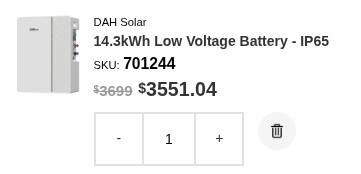
DAH Solar 14.3kWh  retail pricing NZD3511 inc  = 3052 ex = NZD 213 per kWh


https://tradedepot.co.nz/14-3kwh-low-voltage-battery-ip65/


kangaroo13
106 posts

Master Geek
+1 received by user: 101


  #3495995 27-May-2026 20:23
Send private message quote this post


Loismustdye:


...


ultimately would I be right in saying that due to the suboptimal roof position more panels (for summer export) to offset winter costs is the way to go?


Same outcome, but different reason.


I'd size your array to ensure adequate winter performance.  Make sure you can cover your biggest loads on a poor to middling winter's day, and ideally even 'break even' financially on a typical winters day.    More than likely this means you'll get a bit of clipping on good summer days, but that shouldn't be a major concern.  Panels are the cheap part of the system, so getting good utilisation of your inverter and good self-consumption rates in winter is likely a higher priority.


With your very flat pitch: effectively 3 degrees, vs about 30-35 "ideal", your panels are going to be putting out well below their nominal rating over winter - so you'll need to bung up a whole lot more.


At the moment we are in a fortunate position of reasonable feed in tarrifs in New Zealand (despite what some in the government say ... look across the ditch where you're lucky to get a few cents, whereas here we can get 17c or more per kWh).  But, don't bank on this lasting.  I wouldn't build your "business case" on creating credits from summer excess to cover winter costs.  Feed in tarrifs are likely to fall once solar uptake increases.  


Size for winter, and bank the credits from summer's excess while they last.


wired
193 posts

Master Geek
+1 received by user: 72


  #3495997 27-May-2026 20:47
Send private message quote this post

When designing an electrical system, it is rare that you would design for all equipment on full load at the same time. If you don’t have actual data, you can use the diversity factors specified in the wiring code asnzs 3000. For example, it assumes that only a proportion of all the lights are turned on at once, and the same for the oven etc. These factors are not definitive and should be customised, but they are a good starting point.


There is an online calculator with examples and explanations available at https://www.jcalc.net/maximum-demand-calculator-as3000#singleDomesticExample .


This helps to avoid oversizing things like the mains cable. In practice since cables come in fixed sizes, a standard size would normally be installed rather than doing calcs for every house but it can be helpful for solar/battery designs.


1 | ... | 156 | 157 | 158 | 159 | 160 | 161 | 162 | 163 | 164
Filter this topic showing only the reply marked as answer View this topic in a long page with up to 500 replies per page Create new topic


Geekzone Live »

Try automatic live updates from Geekzone directly in your browser, without refreshing the page, with Geekzone Live now.


Are you subscribed to our RSS feed? You can download the latest headlines and summaries from our stories directly to your computer or smartphone by using a feed reader.