Geekzone: technology news, blogs, forums
Guest
Welcome Guest.
You haven't logged in yet. If you don't have an account you can register now.


View this topic in a long page with up to 500 replies per page Create new topic
1 | 2 | 3 
elpenguino
3579 posts

Uber Geek
+1 received by user: 2943


  #1652746 18-Oct-2016 10:44
Send private message


For the OP , 'flange' meaning there is a thing you make and bury in the concrete with the top poking out. The gate post then bolts to it.


As an example here's a road side structure being installed while already attached to its' flange (this is a bit different in that the bolts are designed to snap off when hit by a car)


Strong as feck.


Most of the posters in this thread are just like chimpanzees on MDMA, full of feelings of bonhomie, joy, and optimism. Fred99 8/4/21


Sidestep
1019 posts

Uber Geek
+1 received by user: 567

Lifetime subscriber

  #1652843 18-Oct-2016 13:22
Send private message

You don't need to overthink it.. That 600 square 500mm deep foundation should do it.


Three years ago we concreted in a bunch of 6m IP camera poles out in the bush.
Dug some holes roughly 1m deep and 500x600mm, mixed the concrete at 6:1 in a standard contractors size mixer, 6 or so wheelbarrows per hole.


We used M20 threaded stainless rod and nuts to hold the 400x500mm 12mm base plates down, tacked onto 10mm rebar bent into a rough rectangle to keep them located.


Very roughly surfaced the concrete, leveled up the poles using stainless washers as spacers then grouted the surface before bolting the plates down.


The 150x150 steel poles have remained upright in very strong (170km/h) winds, salt spray, the shock loading of a large tree falling against one, and a 100kg mate shimmying up them occasionally to clean the lenses.
Rough as, but would have been simple to make them look nicer, and easily strong enough to swing a 3m galv steel gate off.


simon14
1889 posts

Uber Geek
+1 received by user: 44

Trusted

  #1652889 18-Oct-2016 14:05
Send private message

Best practice would be to cut out a hole in current concrete pad, dig a hole and concrete in the post.


You could get away to bolting it to the concrete slab but it likely won't last.


hattrick123

71 posts

Master Geek
+1 received by user: 3


  #1657514 25-Oct-2016 15:23
Send private message

elpenguino:


For the OP , 'flange' meaning there is a thing you make and bury in the concrete with the top poking out. The gate post then bolts to it.


As an example here's a road side structure being installed while already attached to its' flange (this is a bit different in that the bolts are designed to snap off when hit by a car)


Strong as feck.
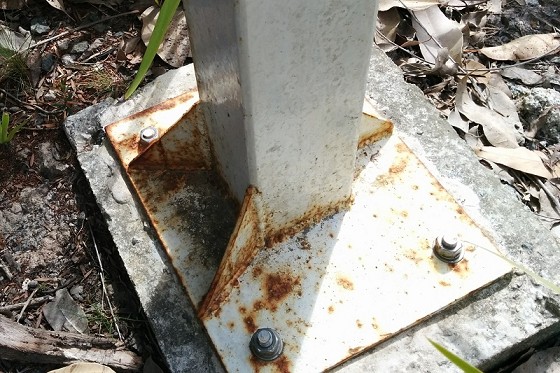


again thanks for all the advice. 


where would I get a flange post to put in the concrete like the pic above? would I just get a local welder to make me one up? 


"if in doubt add more concrete". Does this mean that if I only made up enough concrete to fill half the hole, would it be okay to add more concrete later? I mean is this noticably less stronger than pouring the concrete all in one go? Just want the hole to be big enough for enough concrete to hold this gate. 


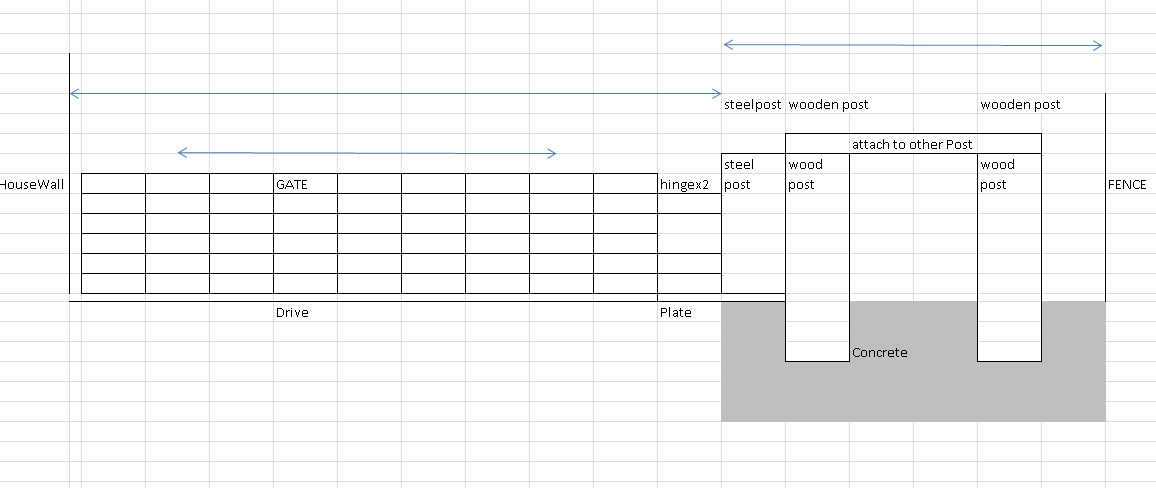
I am thinking at this stage, although the above flange might be better, to set stainless steel rods in the concrete. Bending them at the bottom so they don't turn. I hope to achive this using a wooden template to hold the rods in position when pouring the concrete. As further strengthening, I then want to put a wooden post beside this so I can then bold the top of the post to this wooden post. this wooden post would be at least 1/3rd of the wooden post height in the ground.


here is a rough image of what I am thinking, I am even thinking of a second wooden post, but I may be over over engineering it.


Click to see full size


Fred99
13684 posts

Uber Geek
+1 received by user: 10018


  #1657601 25-Oct-2016 17:56
Send private message

Unless the fence post supplier is able to provide one, then you'd need to get it fabricated and probably galvanised.


Stick with the bent threaded rod embedded in a concrete pad minimum 400x400x600D into good soil - deeper if it's peaty or loose and held in position as the concrete sets using a ply template as some have suggested above,  or pour the pad then use threaded rod epoxied in as others have suggested - probably 150mm, or concrete screws say 12x150mm.  What size are the holes in the flange? 


DarthKermit
5346 posts

Uber Geek
+1 received by user: 3317

Trusted

  #1657714 25-Oct-2016 20:47
Send private message

It's important to remember that concrete has great compression strength, but little tensile strength. If you put too much pulling force on concrete it will crack and break. That's why concrete structures under any tensile load have steel inside them; to give them strength.


A heavy gate probably will pull against the concrete over time and break it.


Shop now for Lego sets and other gifts (affiliate link).
mclean
584 posts

Ultimate Geek
+1 received by user: 182

Subscriber

  #1657940 26-Oct-2016 09:31
Send private message

Looking at your diagram, your arrangement of two posts tied together with a top rail will not be very stiff.  If you want to tie the post back to something the normal method is to run a strainer from the top of the gate post to the BOTTOM of the second post, or directly to a block in the ground, ie diagonally.  Google search for "gate post strainer".


webwat
2036 posts

Uber Geek
+1 received by user: 145

Trusted

  #1664043 4-Nov-2016 22:22
Send private message

Fred99:


I'm a fan of concrete screws these days - they're easy to remove and replace if you need to, but presumably if they're going to have to be 12mm and long enough to do that job (perhaps 150mm), you'll need an impact wrench to drive them in.  The top of the concrete you'll need to pour will have to be dead flat and level, or you wont get the post plumb unless you pack it under the base flange - which is another reason I'd use concrete screws - then set it up and tighten, check it's plumb, remove the post and grind concrete to adjust as needed - rather than try to pack it.  If it's wonky and you've used chemset anchors, epoxy and threaded rod, or dynabolts that won't come out easily, then it sound like there's plenty of potential to stuff it up and make it very hard to correct, as the bolt threads will be in the way.


It's going to have to be a very solid concrete base based on description of the size and weight of the gate - it's hard to believe that the supplier hasn't specified what's needed.


 Yes the concrete base will need to be substantial to handle that sort of leverage, but I wonder if it also needs to be reinforced? The concrete screws above are stronger than the normal sleeve-anchor "dynabolts", but there is another type of concrete anchor (maybe a wedge anchor?) with a kind of expansion tip thats even stronger. I suspect you will need really big bolts and several of them, and special ones called "rag bolts" might be the things you are looking for to set into the concrete. I'm guessing you will need some kind of rig to hold the flange exactly level while the concrete sets.


BTW, that picture has a flanged pole bolted to a flange base but your scenario is just a flanged post, and if there were big enough rag bolts available then you just have to work out how many and how deep to set them into the concrete.


Rag Bolt


Time to find a new industry!


1 | 2 | 3 
View this topic in a long page with up to 500 replies per page Create new topic


Geekzone Live »

Try automatic live updates from Geekzone directly in your browser, without refreshing the page, with Geekzone Live now.


Are you subscribed to our RSS feed? You can download the latest headlines and summaries from our stories directly to your computer or smartphone by using a feed reader.