|
|
|
Centrifugal force cannot be overcome by our current technology.
Thats why the new Chiron is limited to a top speed.
The limiting factor is Rubber. If it was on casters then we would be fine.
Drag squares with speed.
At 62kph you have 4 x the drag as at 31kph. At 125kph 4x the drag as 62kph At 250kph 4x the drag as 125kph. At 500kph 4 x the drag as at 250kph
Maybe a pencil catamaran with the wheels 95% inside the pencil frame and the joining frame to add a teeny amount of downforce/stability
I'll probably wait for the second version
tdgeek:
Drag squares with speed.
At 62kph you have 4 x the drag as at 31kph. At 125kph 4x the drag as 62kph At 250kph 4x the drag as 125kph. At 500kph 4 x the drag as at 250kph
Maybe a pencil catamaran with the wheels 95% inside the pencil frame and the joining frame to add a teeny amount of downforce/stability
I'll probably wait for the second version
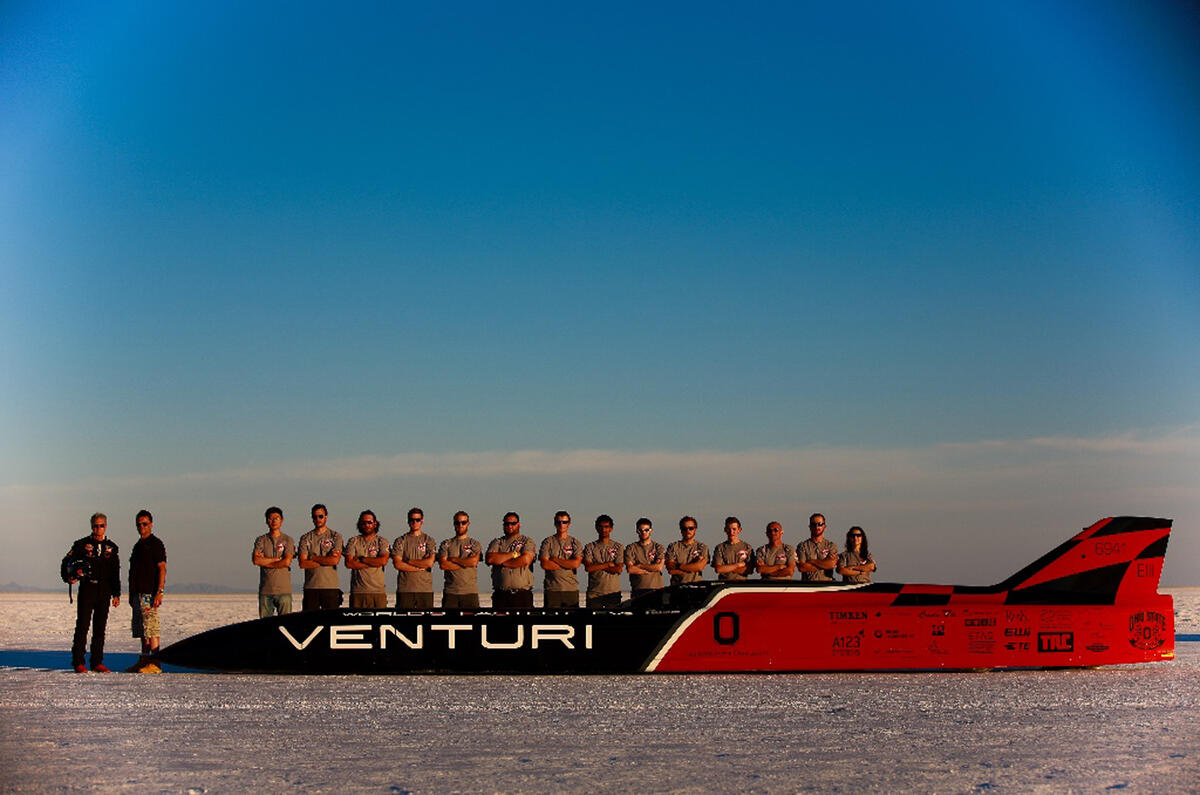
So one of these? Suppose its been done then. 
Put some headlights, tail lights, airbags and a licence plate on that and you're good to go!
Bitch of a thing to parallel park though.
The [2009] land-speed record for a street-legal car is just over 250mph (that's around 400kmh in the new money) and the Eliica team are hoping they'll beat that mark.

[Edit] NB: RH-drive, so should be street-legal in NZ?
kryptonjohn:
Put some headlights, tail lights, airbags and a licence plate on that and you're good to go!
Bitch of a thing to parallel park though.
500 km/h in a Production car? I think the Bugatti Chiron will get close, may 450 - 460.
Surely, the Chiron will be quicker than the Veyron Super Sport. That only managed 428km/h in the hands of the Bugatti Test driver at Ehra Lessien.
In this video from Chris Harris over at Top Gear, he notes that tyre pressures decreases with the cold air rushing past the tyres. The run to 236mph is from about the 5 minute mark.
https://www.youtube.com/watch?v=wO6jaDmJLog
The other thing is the load on the wheel and tyre. When stationery, the tyre dust cap on the Chiron weights 2.5grams, but at 261mph (The Chiron's limited top speed) the same dust cap weighs 16 pounds. Also according to Andy Wallace (Bugatti's current test driver) there isn't currently a tyre that can withstand the G-loading at 300mph.
A link to the Jalponik story referencing Andy Wallace is below
https://jalopnik.com/why-the-bugatti-chiron-probably-wont-hit-300-mph-1796418643
In terms of the Production car, it wasn't that long ago that the 200mph barrier was broken (by the Ferrari F40 in 1987), then in 1998 the McLaren F1 did 240.1 mph.
Why build cars that can do this? Why not?
We've built planes capable of flying for 18 hours straight, we don't really need them, you could still get from Auckland to Doha in a DC-10.
But someone has been given an engineering problem to solve, and they've done it. And these feats of engineering should be celebrated.
And in terms of getting to the top speed of a Chiron or Veyron, as other have said, there aren't many places to do it, but you can have bragging rights at events like Vmax200.
WyleECoyoteNZ:
And in terms of getting to the top speed of a Chiron or Veyron, as other have said, there aren't many places to do it, but you can have bragging rights at events like Vmax200.

*Edited due to formatting kept goign south.
kingdragonfly: I'd really like to see an electric car do it first.
Ah well, electric was the first to 100mph.
I would rather have an electric car with up to 500km range at a reasonable speed.
:)
kingdragonfly: I'd really like to see an electric car do it first.
Sort of like the Americans landing a man on the moon: ultimately an expensive pointless exercise, but still historic.
Perhaps if an electric car needs less cooling perhaps it needs less air scoops, it means less HP needed to reach 500 KPH.
Just a theory.
Are you sure it needs less cooling?
Pushing that amount of electricity around will generate a lot of heat in the batteries, motor(s) and conductors.
Mike
EVs have "on-board efficiency" of around 80% according to Wikipedia. I guess this means that 20% of the battery energy gets wasted as heat. So putting 3000hp out (is that measured at the wheels?) means that 750hp is waste heat.
Wikipedia says ICEs are at best 37% efficient, and typically 18-20%. Let's assume a Bugatti Veyron SS engine is 30% efficient when making 1200bhp. So it must spit out about 2400hp in heat (and noise).
So for a rough approximation I guess that an EV needs about 1/3 the cooling of an ICE car.
frankv:
EVs have "on-board efficiency" of around 80% according to Wikipedia. I guess this means that 20% of the battery energy gets wasted as heat. So putting 3000hp out (is that measured at the wheels?) means that 750hp is waste heat.
Wikipedia says ICEs are at best 37% efficient, and typically 18-20%. Let's assume a Bugatti Veyron SS engine is 30% efficient when making 1200bhp. So it must spit out about 2400hp in heat (and noise).
So for a rough approximation I guess that an EV needs about 1/3 the cooling of an ICE car.
Are those efficiencies the same when the components are pushed to their limits and beyond? How heavy is a 3000hp electric motor and battery going to be compared to the same output ICE?
|
|
|