Geekzone: technology news, blogs, forums
Guest
Welcome Guest.
You haven't logged in yet. If you don't have an account you can register now.
View this topic in a long page with up to 500 replies per page Create new topic
1 | ... | 162 | 163 | 164 | 165 | 166 | 167 | 168 | 169 | 170 | 171 | 172 | ... | 174
Stu1
2046 posts

Uber Geek
+1 received by user: 580

ID Verified
Subscriber

  #3506506 27-Jun-2026 09:33
Send private message quote this post

HarmLessSolutions:


cddt:


"Solar panel efficiency typically drops by 0.3pc to 0.5pc for every degree that a panel’s temperature rises above 25C."


Interesting, didn't know that. I wonder how much hotter than air temp panels get in the full sun? 


I discovered this not long after I imported 5 kW of BP panels from California in 2012. They were on a significant discount which I realised was because they were black, which was shunned by many in that market due to temperature issues. Not a problem for NZ's comparatively cooler conditions, and they actually generated at least 6 kW (rated at 5.1 kW) in mid summer for us.


Is it just the panels over in the UK , does it apply here as well? 


HarmLessSolutions
1292 posts

Uber Geek
+1 received by user: 916

Subscriber

  #3506507 27-Jun-2026 09:40
Send private message quote this post

Stu1:


HarmLessSolutions:


I discovered this not long after I imported 5 kW of BP panels from California in 2012. They were on a significant discount which I realised was because they were black, which was shunned by many in that market due to temperature issues. Not a problem for NZ's comparatively cooler conditions, and they actually generated at least 6 kW (rated at 5.1 kW) in mid summer for us.


Is it just the panels over in the UK , does it apply here as well? 


Heat increases electrical resistance which reduces panel efficiency. I would think that extreme heat will have that effect wherever you are. The prevalence of black panels, and black roofs for that matter, may well be regretted as the climate bites back.


https://www.harmlesssolutions.co.nz/


Stu1
2046 posts

Uber Geek
+1 received by user: 580

ID Verified
Subscriber

  #3506510 27-Jun-2026 09:46
Send private message quote this post

HarmLessSolutions:


Stu1:


HarmLessSolutions:


I discovered this not long after I imported 5 kW of BP panels from California in 2012. They were on a significant discount which I realised was because they were black, which was shunned by many in that market due to temperature issues. Not a problem for NZ's comparatively cooler conditions, and they actually generated at least 6 kW (rated at 5.1 kW) in mid summer for us.


Is it just the panels over in the UK , does it apply here as well? 


Heat increases electrical resistance which reduces panel efficiency. I would think that extreme heat will have that effect wherever you are. The prevalence of black panels, and black roofs for that matter, may well be regretted as the climate bites back.


I can see it happening here as well as we ramp up solar and reduce gas . It’s definitely getting warmer in summers first year I’ve seriously thought about cooling the house down 


mark0x01
35 posts

Geek
+1 received by user: 7


  #3506841 28-Jun-2026 12:40
Send private message quote this post

It might be winter, but that doesn't seem to have made my new solar system ineffective.


Operational for: 21 days, Average Solar output: 16 kWh/day.


The new meter shows 350kWh consumed and 182kWh exported in the last 19 days.


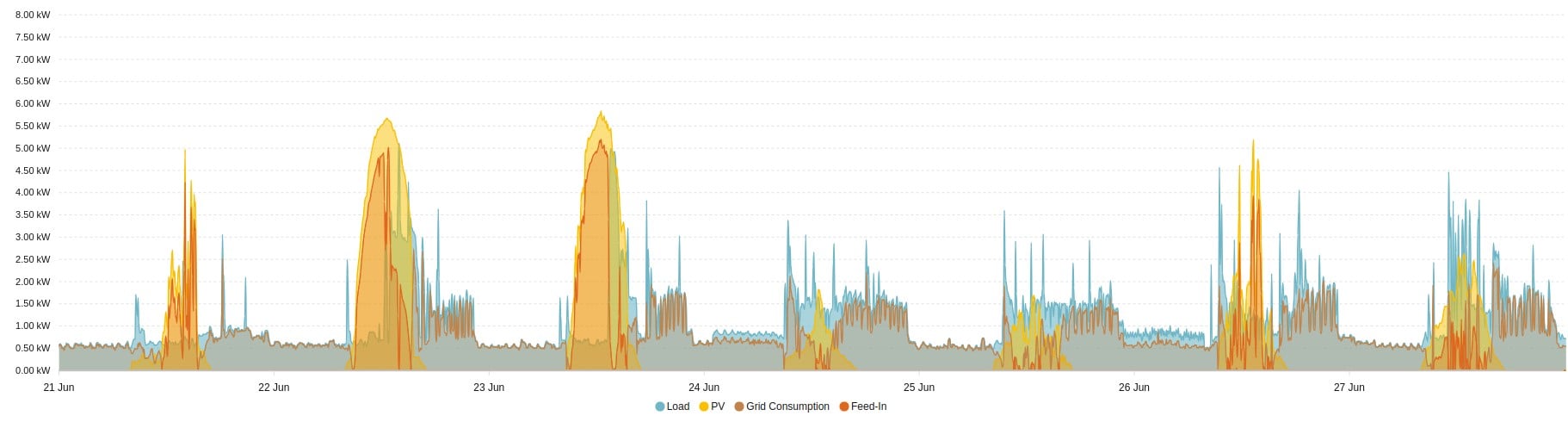
Currently trying to use as much of the more than 6Kw currently being generated as I can. Not bad for 21 x 475W panels


Still a few issues to iron out with the suppler, but it has exceeded my expectations on output so far.


Homeassistant tinkerer and vintage computer enthusiast


pih

pih
686 posts

Ultimate Geek
+1 received by user: 366

Lifetime subscriber

  #3506861 28-Jun-2026 16:54
Send private message quote this post

Long time lurker on this mega thread, I've read every single page... I finally pulled the trigger and paid the deposit on my new system a week ago, and I can barely contain my excitement: it's finally happening! 


I ended up ordering the gold plated version, because at 0% interest, why not? 


  • 30 x 465W Canadian Solar PV (~14kW)
  • 10kW Sigenergy inverter/controller
  • ~9kWh Sigenergy battery 
  • 12.5kW Sigenergy DC EV charger 

North of Auckland, we're not huge electricity users so I'm hoping to wipe out our energy bills for all but maybe a month or two in winter. We're also transitioning from gas hot water to electric, and will finally upgrade to an EV in the coming months.


Total cost $42,700 through PurePower who have been excellent to deal with. Main drivers for us are reduced reliance on an unstable grid where we live (so battery was critical), maximising generation and self-usage, and moving away from reliance on gas and most petrol.


The DC EV unit was about an extra $10k, but I think it will be worth it for the ability to rapidly charge direct from solar during the day with minimal loss and the ability to take advantage of V2L to use the vehicle as additional storage in an emergency.


billgates

4728 posts

Uber Geek
+1 received by user: 698

Trusted

  #3506888 28-Jun-2026 19:32
Send private message quote this post

Congrats @pih. You will be hooked watching the monitoring app for months on end.


Did your installer confirm that the 12kW DC EV unit is $10k extra? I have access to sell Sigenergy systems as well along with variety of other brands but I am only targeting Victron explicitly. Knowing my price for the Sigenergy DC EV charger and a margin I would put on top, $7k is absolute max a customer should be charged. I would expect rest of your system to be around $33k so extra $7k for the EV charger with the silly fees that Vector charges on top for application fees plus scaffolding etc. 


I sell RUiXU 16kWh batteries, Victron & Fronius inverter hardware 


pih

pih
686 posts

Ultimate Geek
+1 received by user: 366

Lifetime subscriber

  #3506893 28-Jun-2026 20:17
Send private message quote this post

billgates:


Congrats @pih. You will be hooked watching the monitoring app for months on end.


Did your installer confirm that the 12kW DC EV unit is $10k extra? I have access to sell Sigenergy systems as well along with variety of other brands but I am only targeting Victron explicitly. Knowing my price for the Sigenergy DC EV charger and a margin I would put on top, $7k is absolute max a customer should be charged. I would expect rest of your system to be around $33k so extra $7k for the EV charger with the silly fees that Vector charges on top for application fees plus scaffolding etc. 


Interesting... Yes I believe that's what they said the additional cost would be but don't have it in writing. Thanks, I'll raise it with them.


lxsw20
3789 posts

Uber Geek
+1 received by user: 2297

Subscriber

  #3506897 28-Jun-2026 20:49
Send private message quote this post

Yeah on the NZ Sigenergy Facebook page, someone mentioned they recently paid around $5500 for the DC charger. I'm sure you'll be stoked with it all once up and running!

I see in other markets Sig have just brought out an AC charger that does V2x, not sure many cars actually support AC V2x though. 


JayADee
2287 posts

Uber Geek
+1 received by user: 542


  #3506953 29-Jun-2026 05:24
Send private message quote this post

We’re looking at solar. Eventually we’ll add an EV. There’s two of us, home all day most days.


We have a free standing double garage with an iron roof that would suit panels better than our house (next choice would be ground)


‘But the garage roof faces east and west with a 10 degree slope.


How much would I be losing putting say 9 panels on each side of the garage roof vs ground mounted facing north?


How bad is a 10 degree slope? Is it a terrible idea having 9 facing each way? 

Any insights appreciated. I’d like to get an idea of what I’m doing before having a solar installer around, we’re a while away from that yet.


fastbike
574 posts

Ultimate Geek
+1 received by user: 436


  #3506954 29-Jun-2026 06:35
Send private message quote this post

JayADee:


We’re looking at solar. Eventually we’ll add an EV. There’s two of us, home all day most days.


We have a free standing double garage with an iron roof that would suit panels better than our house (next choice would be ground)


‘But the garage roof faces east and west with a 10 degree slope.


How much would I be losing putting say 9 panels on each side of the garage roof vs ground mounted facing north?


How bad is a 10 degree slope? Is it a terrible idea having 9 facing each way? 

Any insights appreciated. I’d like to get an idea of what I’m doing before having a solar installer around, we’re a while away from that yet.


The best is a direct north facing site. Having said that  an EW split ia acceptable. You can use the free Solarview tool on the Niwa website to see the difference .  The other thing with EW is an earlier start and later end to power generation at the cost of a lower  overall  output . 


The ten degrees slope is the min recomended  by most panel suppliers, the downsides being a less than optimal slope for winter and more dirt accumulation.  If you have access for cleaning then that can be mitigated. As an aside I cleaned our panels yesterday: 3 rows at 10, 17 and 22 degrees.  The lowest slope had the most accumulated dirt.


One last thing,  you can always use a frame to change the tilt if modeling shows it beneficial. 


Otautahi Christchurch


timmmay
20998 posts

Uber Geek
+1 received by user: 5432

Trusted
Lifetime subscriber

  #3506973 29-Jun-2026 10:54
Send private message quote this post

JayADee:


We’re looking at solar. Eventually we’ll add an EV. There’s two of us, home all day most days.


We have a free standing double garage with an iron roof that would suit panels better than our house (next choice would be ground)


‘But the garage roof faces east and west with a 10 degree slope.


How much would I be losing putting say 9 panels on each side of the garage roof vs ground mounted facing north?


How bad is a 10 degree slope? Is it a terrible idea having 9 facing each way? 

Any insights appreciated. I’d like to get an idea of what I’m doing before having a solar installer around, we’re a while away from that yet.


In summer you'll get good generation near the middle of the day as the sun is really high, not so good earlier and later in the day. In winter my guess is the generation will be relatively poor with both the east / west orientation and having them pretty much flat. Even at 30 degrees on our roof the winter generation is about 30% lower than summer even on very sunny days, I think it's due to the sun being low in the sky.


You can get the panels tilted, but then you have to space them more and will get fewer panels in, but maybe better generation.


In your place I would be looking at other options before doing E / W 10 degrees. I think you would be disappointed with the output much of the year.


sen8or
2034 posts

Uber Geek
+1 received by user: 1531


  #3506976 29-Jun-2026 11:16
Send private message quote this post

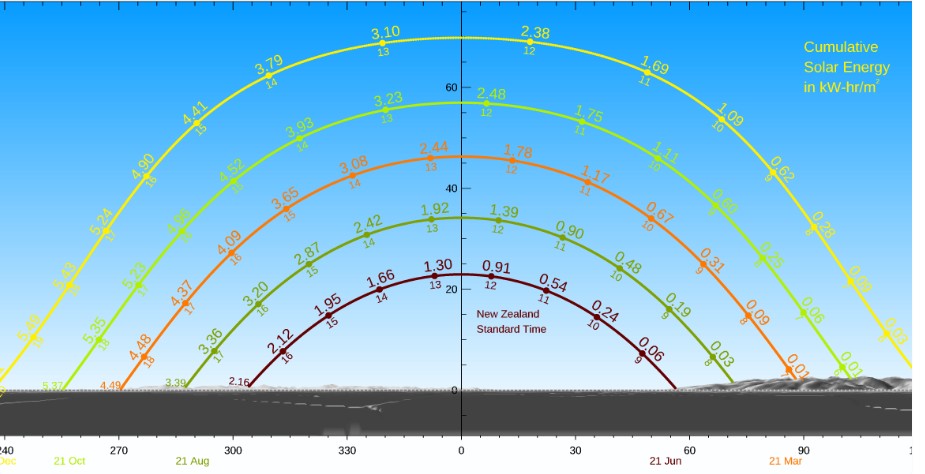
I've done the Niwa solar view on our property, from what I can see it has Months and time of day with then kw/h/sqm but I'm not sure how it relates to panel direction?


Or are the multipliers on the top of each curve something different?


HarmLessSolutions
1292 posts

Uber Geek
+1 received by user: 916

Subscriber

  #3506982 29-Jun-2026 11:35
Send private message quote this post

sen8or:


I've done the Niwa solar view on our property, from what I can see it has Months and time of day with then kw/h/sqm but I'm not sure how it relates to panel direction?


Or are the multipliers on the top of each curve something different?


Chart is based on north facing panels. Numbers above the lines are "Cumulative Solar Energy in kW-hour/m2" as noted.


Bottom line is labelled with azimuth angle (0 = North). Worth noting that in summer the sun rises and falls south of east and west respectively as ends of the October & December lines being beyond 270/West and 90/East.


The vertical line in the centre is the vertical angle above the horizon. In this case the March/Sept orange line crosses this at ~46 degrees indicating that the chart is in terms of Dunedin (at 46 degrees latitude) and therefore panels sloped at 44 degrees (90 degrees minus 46 degrees) would be optimum at the equinox (sun at right angles to them) and increasingly suboptimal approaching summer and winter.


https://www.harmlesssolutions.co.nz/


fastbike
574 posts

Ultimate Geek
+1 received by user: 436


  #3506990 29-Jun-2026 12:21
Send private message quote this post

sen8or:


I've done the Niwa solar view on our property, from what I can see it has Months and time of day with then kw/h/sqm but I'm not sure how it relates to panel direction?


Or are the multipliers on the top of each curve something different?


You input the orientation with true nort, and the panel tilt.


It then shows a chart for selected representative months, with cumulative insulation per m^2 across the day 


Otautahi Christchurch


fastbike
574 posts

Ultimate Geek
+1 received by user: 436


  #3507804 1-Jul-2026 18:49
Send private message quote this post

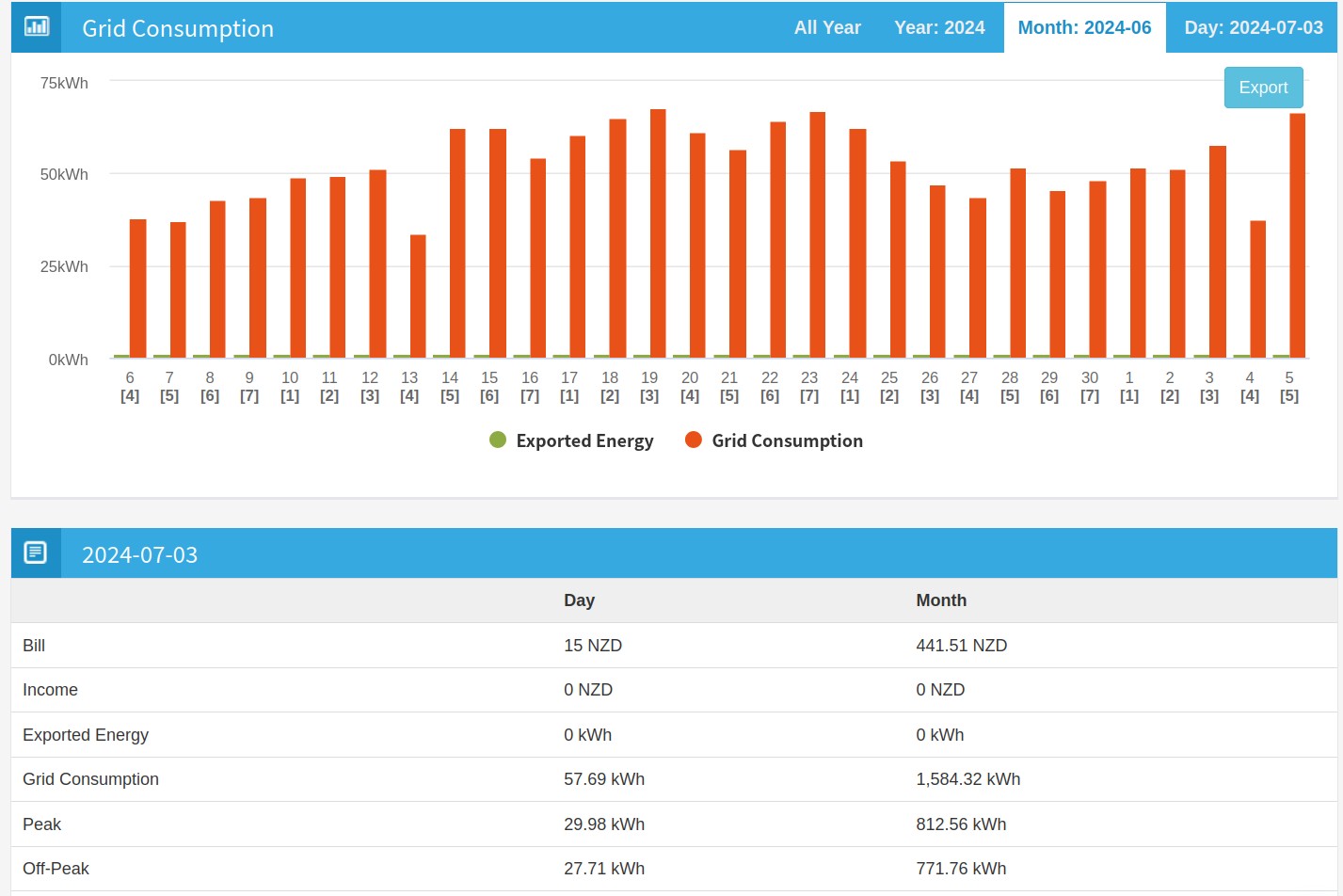
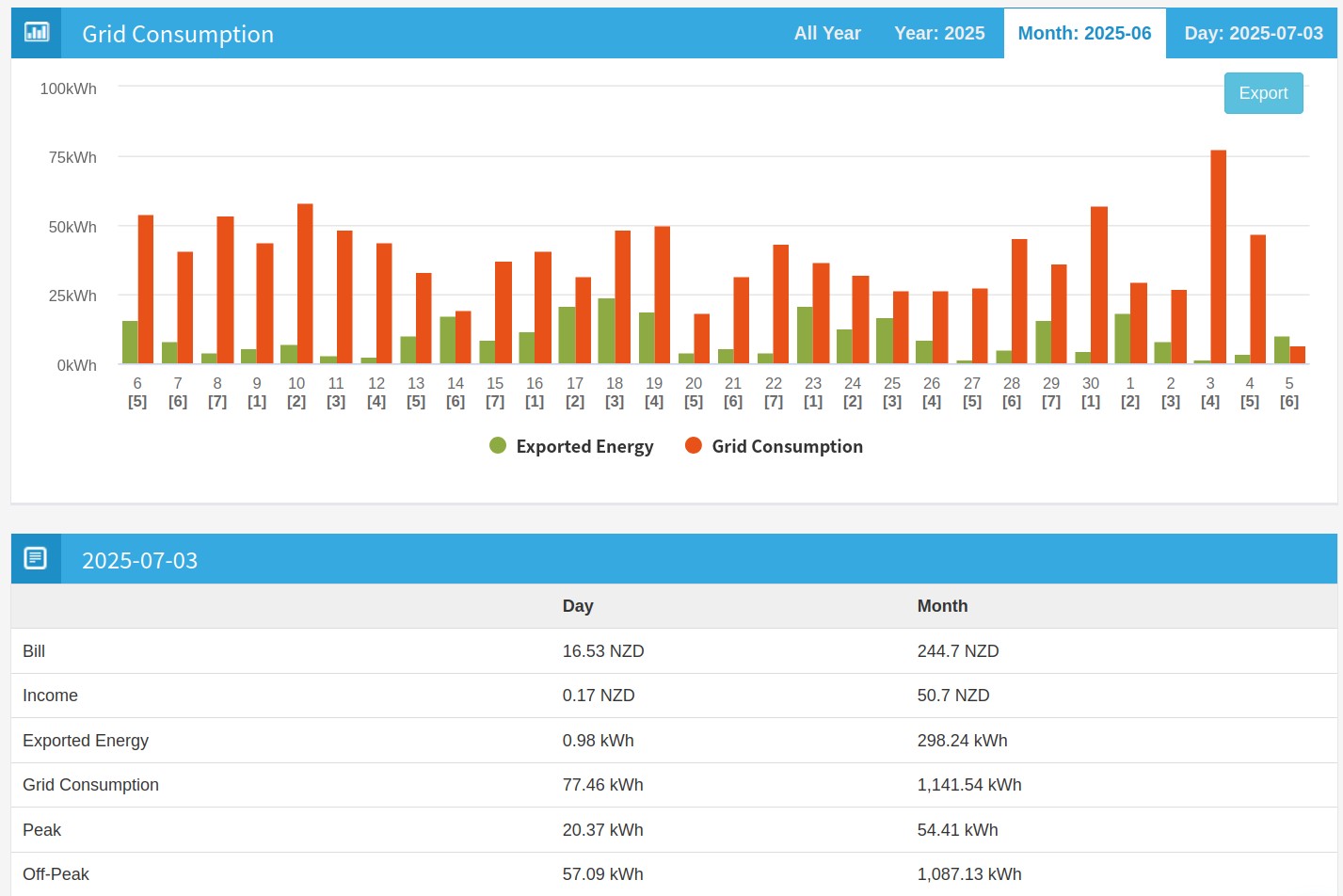
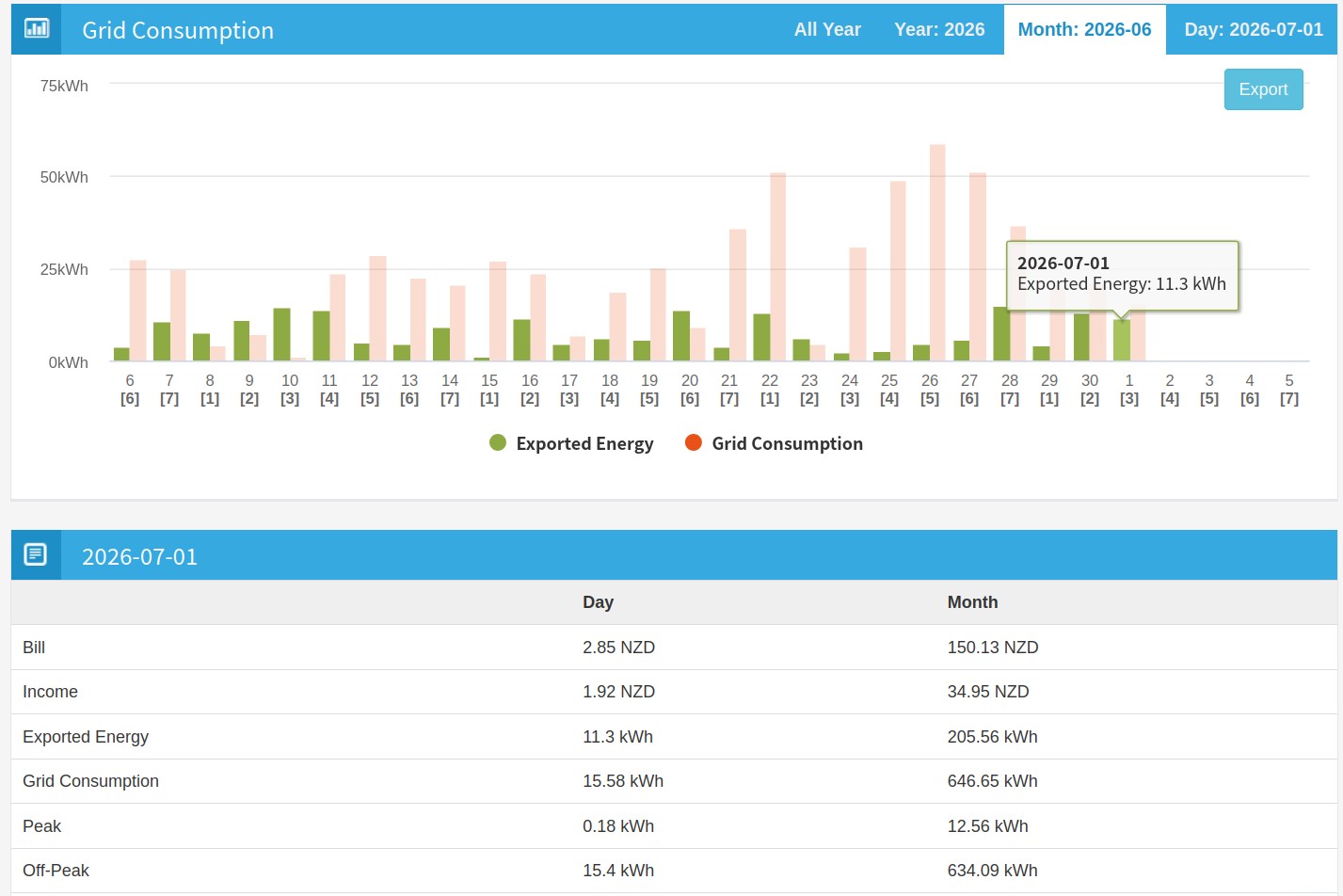
This is quite interesting - we put in an intelligent meter at the meter box in late 2023 - and I've just looked at a comparison of power usage for this time of year for 2024 (no solar), 2025 (solar plus 1 battery) and 2026 (solar plus two batteries).


Here's 2024:


Total power imported 1,584 kWh including peak 812kWh (ignore the bill/income as it is using the current tariff)


Here's 2025:


Total power imported 1,142 kWh including peak 54kWh (same tariff as 2026 and bill includes line charges)


Here's 2026 (4 days short but tracking down):


Total power imported 647 kWh including peak 13kWh 


We are running the heat pumps more than in 2024, and we also now have an electric car since Nov 2024 which we charge about once a month from the grid so maybe 70kWh of imports.


Overall we have pretty much avoided buying peak power (which is good for the problem of NZ peak power demand) and are drawing less than 50% from the grid than we did before the PV/battery installation (which is good for the dry year problem).


I think the decrease in imports compared to last year is because we can store more of our generation during the day to use in the evening, typically only importing in the early morning if a grey day is forecast.


How are other people finding their installations are performing ?


Otautahi Christchurch


1 | ... | 162 | 163 | 164 | 165 | 166 | 167 | 168 | 169 | 170 | 171 | 172 | ... | 174
View this topic in a long page with up to 500 replies per page Create new topic


Geekzone Live »

Try automatic live updates from Geekzone directly in your browser, without refreshing the page, with Geekzone Live now.


Are you subscribed to our RSS feed? You can download the latest headlines and summaries from our stories directly to your computer or smartphone by using a feed reader.