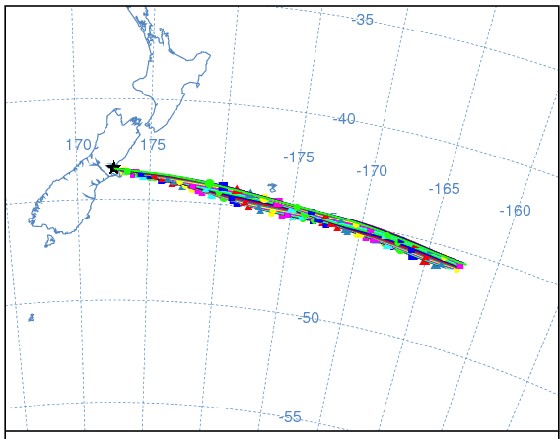
dwl:nickb800: The idea is that the balloons adjust their altitude to take advantage of different winds, provided that there is a counter wind to the westerlys at some altitude, they would cycle from west to east coast
Sorry nickb800 but I'm afraid that the weather doesn't really work like that, especially in NZ. The wind will change with altitude but I think the maximum change may be around 70 degrees and often a lot less. What is a westerly at ground level in Canterbury is still roughly a westerly at high altitude where speeds are often fairly high.
The idea of airborne broadband has been around a long time (ElectricNews.net, 25th July 2002):
"By 2005, people could be receiving mobile phone services, broadband connections and even digital TV from solar-powered airplanes that fly at 65,000 feet. This week, US company SkyTower, a subsidiary of AeroVironment, said it had successfully performed a series of tests in Hawaii of its new technology, a communications airplane called Pathfinder-Plus. Working with NASA and the Japanese Ministry of Telecommunications, SkyTower said it had launched the plane, which climbed to 65,000 feet above Kauai, Hawaii, and transmitted several hours of 3G mobile voice, data and video service to the ground, where it was received on an NTT DoCoMo 3G handset. Data was transmitted at 384 kbps during the test.
Pathfinder-Plus, with its 121-foot wingspan, is no ordinary airplane. The vehicle is unmanned and runs on solar power, which means it needs to land at night. But the company claims that advances in battery technology could give the airplane the ability to stay airborne 24 hours a day, allowing it to fly for six months at a time. The airplane also has a tight turning radius, which in conjunction with low-cost, stationary user antennas, makes the plane appears geostationary from the ground."
Where high altitude winds are less the balloons may be a better idea than these expensive aircraft (which haven't yet been commercially viable).
On the face of it using drones sounds much more feasible than balloons. They could potentially provide good 3G 4G coverage to much wide areas and be less susceptible to the wind.


 ID Verified


 Trusted