|
|
|
Sideface:
mdav056:
...Would I get faster loading on 1000/500 or whatever, ...
No. Save your money. 😐
Agree. Put $75 into a pi for pihole then you can turn that crap off.
I have monitored my connection with SamKnows for the past two years.
Amongst other things, SamKnows automatically tests Website Load Times on multiple sites, 24/7.
In the first year I was on a 200Mbps connection, and in the second year I upgraded to a gigabit connection.
This upgrade made absolutely no difference to my Load Times.
(click to view)
Sideface
Not much difference is not the same as no difference. We definitely get a measurable performance improvement. It's just a question of what we're prepared to pay.
If the difference in price is $10 or less then I'd definitely take it.
In my household it's definitely worth it at $20 because the difference in latency and bandwidth has been noticeable between each upgrade: 100/10 to 200/20 to <900/100. At 500+ down, even with heavy downloading, none of the gamers have complained about the lag they used to get.
We've seen years of metrics that document advantages to users of higher bandwidth technologies. That hasn't changed, e.g. see https://comcom.govt.nz/__data/assets/pdf_file/0021/153543/MBNZ-Autumn-2019-report-13-June-2019.PDF
Netflix streaming is far less likely to fallback to SD, Figure 5: Netflix streaming by technology.
A more limited impact for YouTube but still a difference, Figure 6. YouTube streaming by technology.
Latency clearly improves, Figure 7: Latency by technology
Downstream, there's almost no case to make that gigabit is worth it over 200Mbps. In terms of web browsing/downloads, you never see those speeds outside of local/CDN content, and the real world difference is very low. With P2P the difference is even less, because the vast majority of consumer routers can only route gigabit by using hardware acceleration/cut-through forwarding - which doesn't work for port forwarded traffic (as all P2P traffic is). I actually turned off CTF on my router (effectively limiting me to ~400Mbps) because the tradeoffs it requires weren't worth the speedtest bragging.
Upstream is a completely different story. 20Mbps up (less than a significant proportion of VDSL connections) is just not "ultrafast" in 2019. The fact that most providers don't offer plans with an upstream speed between 20Mbps and 500Mbps is just bizarre. Full credit to Bigpipe for their 100/100 plan, but the fact is that it's an almost unique offering in the NZ market. So, if you don't want to go with Bigpipe, and you want faster than 20Mbps upload speeds, you need gigabit.
200/20 is an ugly and poorly thought out product in my opinion. That kind of lopsided down/up ratio reminds me of the bad old 3.5Mbps/128Kbps days of DSL. It should be 200/100 (or at least 200/50). Then it would be a real, obvious stepping stone to gigabit (and sufficient for 99% of people).
allio:
200/20 is an ugly and poorly thought out product in my opinion. That kind of lopsided down/up ratio reminds me of the bad old 3.5Mbps/128Kbps days of DSL. It should be 200/100 (or at least 200/50). Then it would be a real, obvious stepping stone to gigabit (and sufficient for 99% of people).
It works perfectly to make it so that more people will get the gigabit option, therefore pushing up the average speeds of the network making it look like it was a much better spend when doing that thing about comparing averages between countries.
When you are with internet servers, upload speed counts. When not, save the money.
- NET: FTTH & VDSL, OPNsense, 10G backbone, GWN APs
- SRV: 12 RU HA server cluster, 0.1 PB storage on premise
- IoT: thread, zigbee, tasmota, BidCoS, LoRa, WX suite, IR
- 3D: two 3D printers, 3D scanner, CNC router, laser cutter
allio:
200/20 is an ugly and poorly thought out product in my opinion. That kind of lopsided down/up ratio reminds me of the bad old 3.5Mbps/128Kbps days of DSL. It should be 200/100 (or at least 200/50). Then it would be a real, obvious stepping stone to gigabit (and sufficient for 99% of people).
This exactly. My current VDSL connection is quite good at 65/28. Fibre is now available to me but I find it hard to justify "upgrading" fibre at 200/20! When its only $10/$20 per month to upgrade to Gigabit why wouldn't I? An ideal plan for me would be 200/100 but it's not offered so Gigabit it will be.
Senecio: ... An ideal plan for me would be 200/100 but it's not offered so Gigabit it will be.
Have you considered BigPipe Expert 100/100 Mbps?
Sideface
richms:
If you turn off ipv6 it stops, because its some bad config on their part with how ipv6 works. Not been fixed by them in a long time and when I last complained to them about it was told that ipv6 was a beta thing so not supported. I'll try the command later and see if it helps the thing perform better.
Who's your ISP / who are you referring to as them?
tanivula:
Who's your ISP / who are you referring to as them?
Voyager, but it happens with any ISP that does v6 the way most of them locally do with the prefix stuff that I dont fully understand.
ubiquity have been told of this issue in the past, they need to make it not run the service that chews CPU for a bit, then crashes and restarts constantly when not needed since thats only needed for some other type of v6 that I also dont fully understand.
richms:
ubiquity have been told of this issue in the past, they need to make it not run the service that chews CPU for a bit, then crashes and restarts constantly when not needed since thats only needed for some other type of v6 that I also dont fully understand.
I already posted the solution to you here: https://www.geekzone.co.nz/forums.asp?forumid=49&topicid=258665&page_no=2#2337950
It is an easy fix once you know what you're looking for and a fix I've applied to several Edgerouters and USG's.
Michael Murphy | https://murfy.nz
Referral Links: Quic Broadband (use R122101E7CV7Q for free setup)
Are you happy with what you get from Geekzone? Please consider supporting us by subscribing.
Opinions are my own and not the views of my employer.
mdav056:
I find 100/20 perfectly fine for concurrent streaming of a couple of Netflix connections, RDP, and so on, but I have a question:
On my desktop, which I also use for work, I also run ad blocking and Ghostery, and these seem to slow webpage loading quite a lot. Would I get faster loading on 1000/500 or whatever, or is the slowdown more to do with my cpu (5-year old I5, with 8 GB RAM, SSD storage)?
thanks - m
Thanks all of you who answered this. I'll be saving my money.
m
gml
Hammerer:
Not much difference is not the same as no difference. We definitely get a measurable performance improvement. It's just a question of what we're prepared to pay.
If the difference in price is $10 or less then I'd definitely take it.
In my household it's definitely worth it at $20 because the difference in latency and bandwidth has been noticeable between each upgrade: 100/10 to 200/20 to <900/100. At 500+ down, even with heavy downloading, none of the gamers have complained about the lag they used to get.
We've seen years of metrics that document advantages to users of higher bandwidth technologies. That hasn't changed, e.g. see https://comcom.govt.nz/__data/assets/pdf_file/0021/153543/MBNZ-Autumn-2019-report-13-June-2019.PDF
Netflix streaming is far less likely to fallback to SD, Figure 5: Netflix streaming by technology.
A more limited impact for YouTube but still a difference, Figure 6. YouTube streaming by technology.
Latency clearly improves, Figure 7: Latency by technology
Are you talking about a difference between 100 and Max fibre? There's no evidence in the document you link to, or in the specific examples you quote from that document - to support a real world difference in Netflix, Youtube or latency between 100 and Max fibre.
YOUR specific instance may be different - but the document you link to doesn't support your argument at all.
N
Please note all comments are from my own brain and don't necessarily represent the position or opinions of my employer, previous employers, colleagues, friends or pets.
Hammerer:
We've seen years of metrics that document advantages to users of higher bandwidth technologies. That hasn't changed, e.g. see https://comcom.govt.nz/__data/assets/pdf_file/0021/153543/MBNZ-Autumn-2019-report-13-June-2019.PDF
You got horrible numbers for VDSL and this confirms my guess I had 1,5 years ago. The difference is, with such numbers one could claim for a refund on other places.
- NET: FTTH & VDSL, OPNsense, 10G backbone, GWN APs
- SRV: 12 RU HA server cluster, 0.1 PB storage on premise
- IoT: thread, zigbee, tasmota, BidCoS, LoRa, WX suite, IR
- 3D: two 3D printers, 3D scanner, CNC router, laser cutter
My partner and I recently downgraded from gigabit to 200/20 and haven't noticed the difference. We used to have Gigabit when we had a boarder / flatmate who cared about speed tests for bragging purposes and was paying plenty in rent to cover the higher speed plan.
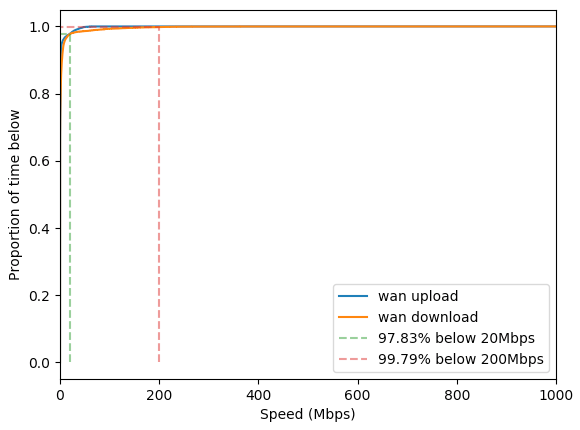
I collected data every minute via SNMP for a couple of months before making the informed decision to switch - this is with 3 adults, 2 of which are heavy gamers with massive Steam libraries, all heavy users of Netflix (one in 4k), Youtube etc and I have some cloud backups.
I found that our download throughput was <200Mbps 99.79% of the time. Upload was more limited by the 20Mbps, exceeding it 2.17% of the time pre-downgrade, so we're talking 16 hours per month that we might be limited by the 20Mbps up.
I was pleasantly surprised to find after switching that the real upload throughput is closer to 24Mbps.

TLDR: Only difference noticed after downgrading to 200/20 is that Steam downloads at 204Mbps instead of 240Mbps.
|
|
|