|
|
|
SaltyNZ:It runs at 16.3A at the blender, and 7.5A at the NZ outlet.
Power is conserved by the transformer. The current steps up by the same proportion as the voltage steps down, so if the voltage steps down across the transformer from 240V to 110V (2.18x) then current steps up by 2.18x. 110V x 16.3A = 1800W. 240V x 7.5A = 1800W.
iPad Pro 11" + iPhone 15 Pro Max + 2degrees 4tw!
These comments are my own and do not represent the opinions of 2degrees.
Step down transformers to change NZ power (230V nominal) to 110V are available, but are big and 10+ kg. also they cost $130 on trademe. (if you brought an isolated one from in NZ retail, with proper approvals etc, it would cost $500+ if you could find one. Jaycar only goes up to 1kW, and that is $459.)
Regarding frequency. Weather it matters is a question of the motor type in the blender.
If it is a universal motor (Typical in blenders etc due to low cost and light weight), then frequency dosn't matter. If it is an induction motor (common in things like drill presses), then the lower frequency will matter, as the motor will spin slower in NZ. This can compromise function, or cause other issues (motor overheating).
In short, a frequency converter would be too expensive to use for a blender.
Step down transformers to change NZ power (230V nominal) to 110V are available, but are big and 10+ kg. also they cost $130 on trademe. (if you brought an isolated one from in NZ retail, with proper approvals etc, it would cost $500+ if you could find one. Jaycar only goes up to 1kW, and that is $459.)
Regarding frequency. Weather it matters is a question of the motor type in the blender.
If it is a universal motor (Typical in blenders etc due to low cost and light weight), then frequency dosn't matter. If it is an induction motor (common in things like drill presses), then the lower frequency will matter, as the motor will spin slower in NZ. This can compromise function, or cause other issues (motor overheating).
In short, a frequency converter would be too expensive to use for a blender.
US outlets are 12A for ongoing loads, 15A for intermittent ones.
Same way they do BS ratings on their step down transformers, if you get a 2000w one there is is really about 800-1000w and will cook on 2000w for any length of time. Something sold here as 2000w will generally be good for 2000w all day and be ok with brief use at well more than that.
They also get away with BS horsepower and wattage ratings over there which is why powertools tend to be rated in amps as well, so you will see a grinder advertised as 5 amps - right beside a 5 horsepower compressor that just plugs into the wall and looks exactly like a 2hp one sold over here. Watts and horsepower are rated at the peak of the motors stroke or some BS like that.
richms:Same way they do BS ratings on their step down transformers, if you get a 2000w one there is is really about 800-1000w and will cook on 2000w for any length of time. Something sold here as 2000w will generally be good for 2000w all day and be ok with brief use at well more than that.

richms:
US outlets are 12A for ongoing loads, 15A for intermittent ones.
Same way they do BS ratings on their step down transformers, if you get a 2000w one there is is really about 800-1000w and will cook on 2000w for any length of time. Something sold here as 2000w will generally be good for 2000w all day and be ok with brief use at well more than that.
They also get away with BS horsepower and wattage ratings over there which is why powertools tend to be rated in amps as well, so you will see a grinder advertised as 5 amps - right beside a 5 horsepower compressor that just plugs into the wall and looks exactly like a 2hp one sold over here. Watts and horsepower are rated at the peak of the motors stroke or some BS like that.
It's called power factor, which is why transformers (and generator) power is quoted in KVA not watts
Not power factor. A 1000w one couldnt power an 850w toaster for more than about 4 toasting cycles without triggering its thermal cut out and making some pretty horrific smells.
Hell, they sell 5000 watt ones that weigh under 20 kgs and have a standard 10a plug on them. Descriptions all say to get twice the wattage of your appliance. Or complete lies as people outside of amazon say.
richms:
Not power factor. A 1000w one couldnt power an 850w toaster for more than about 4 toasting cycles without triggering its thermal cut out and making some pretty horrific smells.
Hell, they sell 5000 watt ones that weigh under 20 kgs and have a standard 10a plug on them. Descriptions all say to get twice the wattage of your appliance. Or complete lies as people outside of amazon say.
If it's marked 1000W and a 850W toaster is frying it then it's markings are lies, BTW a toaster would typically have a power factor of 1 as it's a resistive load only, where as a motors power factor varies (typically) from .6 to .85 depending on load and design.
Please point out to me where you have seen a 5000watt unit with a 10a plug on it.
Voltage conversion aside, what's an AC motor designed for 50 hertz likely to do when it's run at 60 hertz?
DarthKermit:
Voltage conversion aside, what's an AC motor designed for 50 hertz likely to do when it's run at 60 hertz?
typically if its a universal motor such as the type in small appliances they arn't affected by frequency, Induction motors are speed locked to the supply frequency, and as the motor size increases there are heating issues to consider amongst other factors.
gregmcc:
If it's marked 1000W and a 850W toaster is frying it then it's markings are lies, BTW a toaster would typically have a power factor of 1 as it's a resistive load only, where as a motors power factor varies (typically) from .6 to .85 depending on load and design.
Please point out to me where you have seen a 5000watt unit with a 10a plug on it.
All over amazon, just search 220v transformer and admire the BS ratings that put the car stereo industry to shame for their inability to inflate their numbers that bigley.
richms:
gregmcc:
If it's marked 1000W and a 850W toaster is frying it then it's markings are lies, BTW a toaster would typically have a power factor of 1 as it's a resistive load only, where as a motors power factor varies (typically) from .6 to .85 depending on load and design.
Please point out to me where you have seen a 5000watt unit with a 10a plug on it.
All over amazon, just search 220v transformer and admire the BS ratings that put the car stereo industry to shame for their inability to inflate their numbers that bigley.
I was expecting a link to a NZ web site, by pointing out information contained on an overseas web site that is obviously not aimed at NZ you really can't expect much.
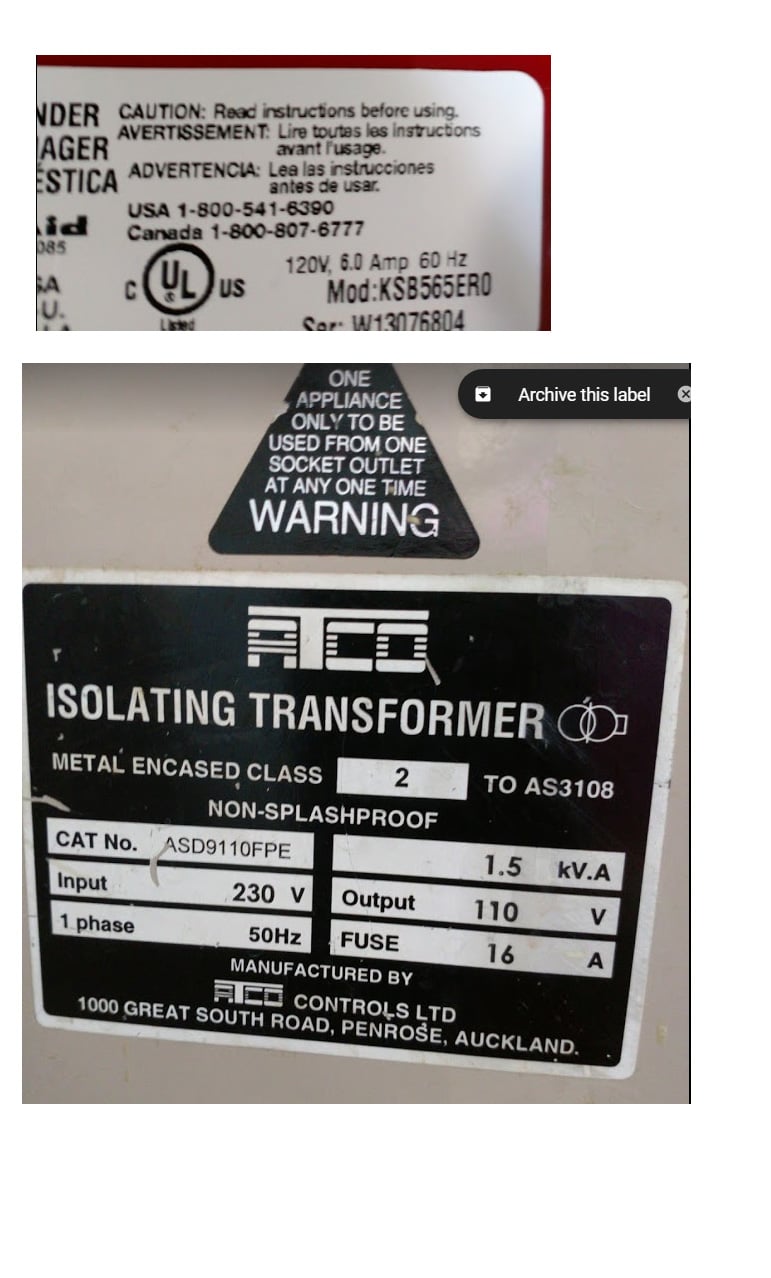
Well just to add a data point. I have this transformer I bought many years ago and I am able to run the Kitchenaid blender with no problem. I also regularly run a Kitchenaid stand mixer (purchased in the US for US$200 versus nearly $1000 here!) and a older Cuisinart food processor.

I recently also purchased a Keurig K55 capsule coffee machine (110V 60Hz) which according to the manufacturer uses
Keurig® home brewers use the most power during their initial startup. When heating for the first time after being off, peak usage is 1,500 watts. If the power is kept on, the brewer will keep the internal tank up to temperature using between 200 – 400 watts when heating. While idle and not maintaining heat, the brewer will use the average electricity of a 60 watt light bulb.
No problem with that either.
I do avoid using two appliances at the same time though.
Staying in Wellington. Check out my AirBnB in the Wellington CBD. https://www.airbnb.co.nz/h/wellycbd PM me and mention GZ to get a 15% discount and no AirBnB charges.
|
|
|