Geekzone: technology news, blogs, forums
Guest
Welcome Guest.
You haven't logged in yet. If you don't have an account you can register now.


phrozenpenguin

868 posts

Ultimate Geek
+1 received by user: 90


#272501 27-Jun-2020 19:15
Send private message

I want to wall mount a TV and have no cables visible - I want to run the cable from the TV, into the internal plasterboard wall, up vertically, into the loft and across to another room. The entry into the other room is fine, but I'm not sure how I can route the wire internally on the wall we hang the TV on. It seems there are horizontal wooden supports in the way (which I assume are structural, but have no idea).


I only need one cable (from Samsung One Connect Box to TV) so do not need power, ethernet etc.


The house is a single storey new build a few years ago, and we have roof access (altho harder near the edges of the house due to the roof pitch).


Would a builder / electrician be used to doing this and be able to do it without removing most of the wall? Or is there a magic tool for DIY?!


Filter this topic showing only the reply marked as answer Create new topic
DarthKermit
5346 posts

Uber Geek
+1 received by user: 3317

Trusted

  #2513739 27-Jun-2020 19:18
Send private message

You need a large drill bit like a spade bit and some extensions. As many extensions as it takes to get through the dwangs. Dwangs are the horizontal pieces of wood between the studs in a wall.


A builder or electrician would have the gear to do this for you.


Dunnersfella
4100 posts

Uber Geek
+1 received by user: 887


  #2513745 27-Jun-2020 19:54
Send private message

A professional aerial installer would be my pick - they specialise in what you're looking to do.


pipe60
129 posts

Master Geek
+1 received by user: 33


  #2513755 27-Jun-2020 20:57
Send private message

Electrician for that job.


Cut the gib and fit something like this.


https://www.rubbermonkey.co.nz/DYNAMIX-Recessed-Entertainment-Box?gclid=EAIaIQobChMI9s-ozs-h6gIVxH0rCh3HmgA2EAQYBSABEgKBHPD_BwE


Then he can drill down from the top plate which is where you need the roof space otherwise take roof iron off to get space.


phrozenpenguin

868 posts

Ultimate Geek
+1 received by user: 90


  #2513757 27-Jun-2020 21:06
Send private message

Thanks. Sounds like I need to finalise the position on the wall and then get a few quotes - and it might be worth speaking to an electrician / builder / aerial installer. If anyone has any recommendations for people in Christchurch then that would be great!


chevrolux
4962 posts

Uber Geek
+1 received by user: 2638
Inactive user


  #2513764 27-Jun-2020 21:46
Send private message

Grab a decent spade bit (25mm minimum), 300mm length.
Drill two holes in the top plate - one is for drilling down, the other to point a torch down.
Attach a couple of your extensions pieces (generally these are 300mm each, unless you got a decent 1m one).
Drill down the next dwang (one should be enough for the height of a tv).
Drop a string, with a weight on the end (or a length of thin chain is really good too)
Go to the wall, cut out your flush box, and pull your string/chain out.
Then just draw down whatever cables you want with the string.

Edit: the torch down the other hole is so you can centre your drill on the next dwang and not end up popping out the gib.
Obviously this plan goes to sh1t if the wall is insulated, or you can't get above it to drill the top plate. In which case, chasing out the gib and plastering is the only option for a tidy finish.

froob
698 posts

Ultimate Geek
+1 received by user: 233

Lifetime subscriber

  #2513791 28-Jun-2020 01:11
Send private message

I think the One Connect cable has quite large plugs on each end, which could make getting it through the wall quite difficult. The other thing it might be worth checking is whether it is legal to put that sort of combined power cable in-wall in NZ.


Move to New Zealand's best fibre broadband service (affiliate link). Free setup code: R587125ERQ6VE. Note that to use Quic Broadband you must be comfortable with configuring your own router.
Sidestep
1019 posts

Uber Geek
+1 received by user: 567

Lifetime subscriber

  #2513792 28-Jun-2020 05:03
Send private message

Hey - I'm doing a similar thing myself.

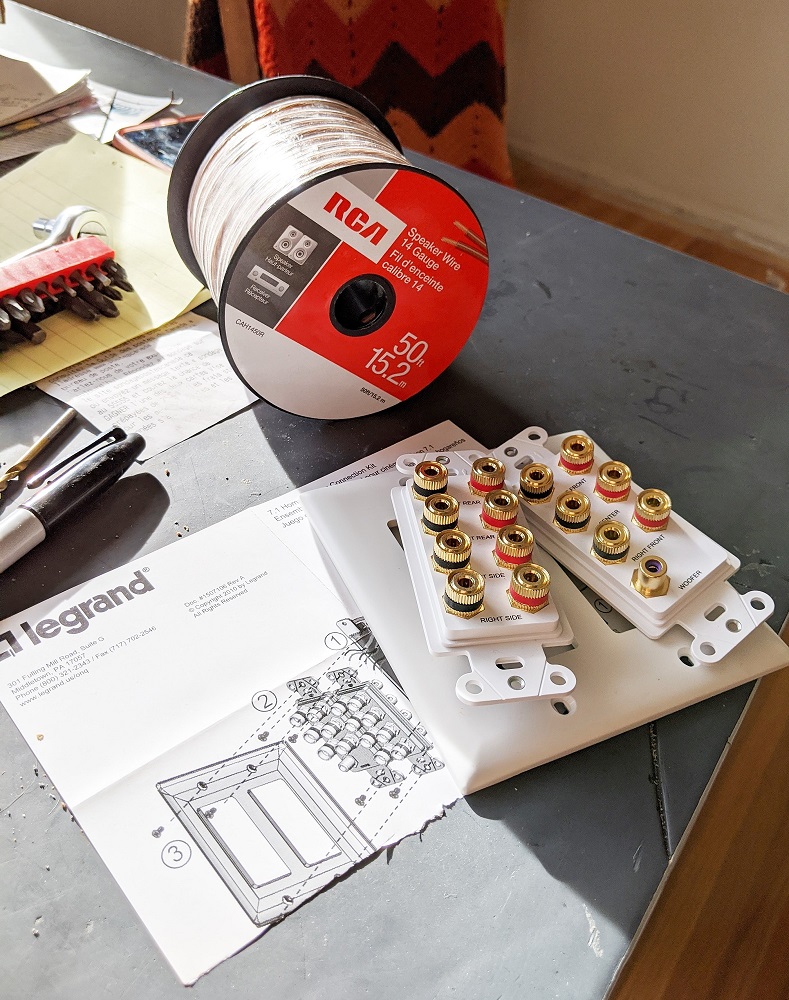
We're installing a Klipsch in-wall speaker system and a 70” TV, a mid-century style console below will hide the receiver, kid's PS4 and woofers, so the HDMI's will go there, a wall-plate with speaker connectors, network outlet etc.
Power cables will run separately (I hate induction) to a surge protector/distribution box mounted under the console.
All cables to be hidden says wife. Everything to maintain a 'period' look - except, obviously, the TV screen..


First: get a decent studfinder – this old (late 50's) house is double-gibbed (1” = 25mm thick), so needed a sensitive one.
Mark out the studs, any exising wiring and where everything goes, use a removable marker if you'll need to get rid of the marks (we're repainting the wall as the speakers have paintable covers)
Check out your viewing/listening angles for correct placement.
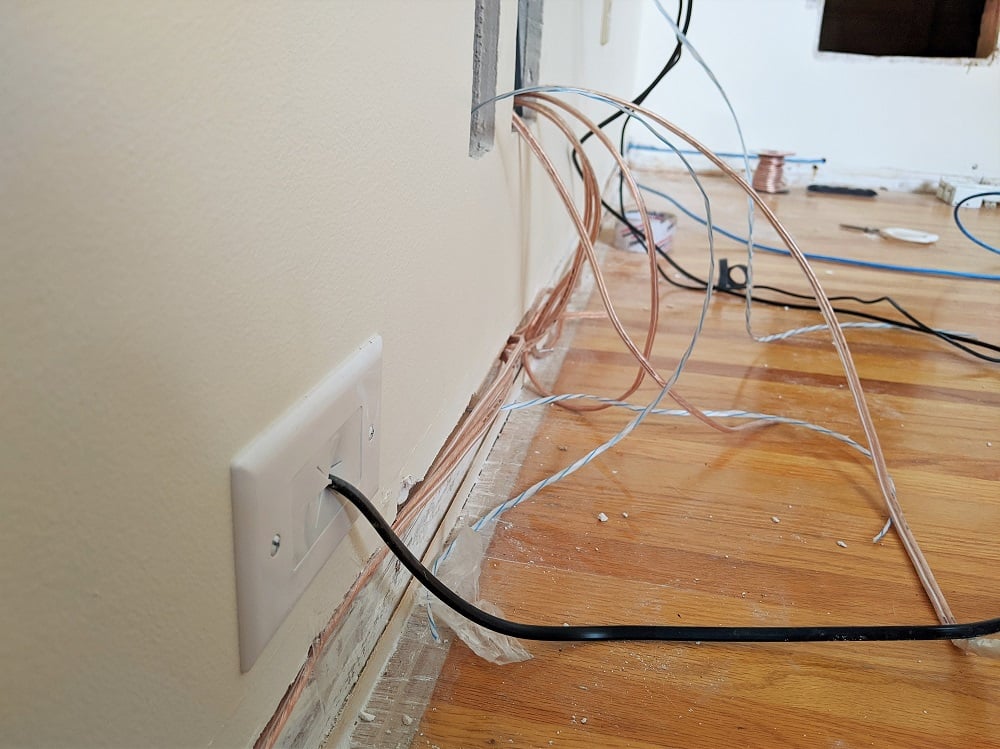
Trace out your cable runs – this house was problematic because there was no chance of a feed from below the floor (steel I beam), or above the ceiling (sprayed in insulation, and right at eaves of house). There's an existing in-wall media enclosure close by that we needed CAT-6 run from, in the end we decided to run that and the speaker cabling in a cut channel behind the baseboard.


To drill down through the (dwangs or nogs in NZ) I brazed up an Irwin Speedbor bit to two detachable extensions – the framing in this house is 60-year-old fir, as hard as concrete and a normal spade bit would just catch on fire. I bet you can buy or hire similar.


Plot twist: We discovered the speakers needed to be returned, so we decided to cut temporary holes just big enough for cover plates.


So for drilling down, holes just big enough for standard outlet boxes are big enough to insert our bit and extensions. Made a bit more complicated because the (external) wall's stuffed with insulation, and a vapor barrier we had to be careful not to tear up (both when cutting the gib out or drilling down) We used a 90 degree drive to do the drilling.
We joined a couple of the kid's glow-sticks together, pushed them down and pulled twine back up as pull-string, ready for cables.


Bung
6734 posts

Uber Geek
+1 received by user: 2928

Subscriber

  #2513794 28-Jun-2020 07:28
Send private message

chevrolux: Grab a decent spade bit (25mm minimum),

Obviously this plan goes to sh1t if the wall is insulated, or you can't get above it to drill the top plate. In which case, chasing out the gib and plastering is the only option for a tidy finish.


Bearing in mind that 25mm is max allowable hole in top plate don't go too much bigger 😀. Apparently the smaller plug on the Samsung One Connect cable is just under 25mm x 13mm so would probably need a 30mm hole. You can get steel reinforcers designed for vent and vacuum pipes if you want to go mad.

I don't know what voltage is involved. I've found a reference to 230W for one tv and DC but not the voltage. In the US they are very whiny about the supplied cable not being UL rated for in wall and Samsung may have already dropped the idea for new sets.

I hope "chasing out" isn't literal. When I removed the hardboard lining at the beach place before gibbing I found the wiring to some wall lights had been chased in ie a groove just big enough for the cable wherever it crossed a dwang or stud and a covering of plaster as thick as the hardboard. A trap just waiting for a picture hook.

chevrolux
4962 posts

Uber Geek
+1 received by user: 2638
Inactive user


  #2513795 28-Jun-2020 08:10
Send private message

Haha yea... the 25mm hole thing... got to be a bit of a realist about that. I would suggest that if a wall is going to fall down because you go a touch larger (32 is a pretty common bit), you've got bigger problems. Common sense prevails here, don't go drilling a 50-odd mm hole in something only 90-100mm wide.

And by chasing out, I mean cutting out a patch of GIB just above the dwang so that you can drill a proper hole in the center of the dwang... this is where your 300mm length bit comes on handy so it's not such an angle.

Frankly, if the OP needs to be told all this, they shouldn't be doing it themselves though.

eracode
Smpl Mnmlst
9336 posts

Uber Geek
+1 received by user: 6213

ID Verified
Trusted
Lifetime subscriber

  #2513800 28-Jun-2020 08:31
Send private message

chevrolux: Grab a decent spade bit (25mm minimum), 300mm length.
Drill two holes in the top plate - one is for drilling down, the other to point a torch down.
Attach a couple of your extensions pieces (generally these are 300mm each, unless you got a decent 1m one).
Drill down the next dwang (one should be enough for the height of a tv).
Drop a string, with a weight on the end (or a length of thin chain is really good too)
Go to the wall, cut out your flush box, and pull your string/chain out.
Then just draw down whatever cables you want with the string.

Edit: the torch down the other hole is so you can centre your drill on the next dwang and not end up popping out the gib.


Last weekend I gave our son a hand with doing almost exactly the same job as the OP's. We basically used the Chevrolux Method and various-length 25 mm drill bits and combinations of bit extensions that I have had for years. These are photos I took prior to the job to send to him to show him the tools we would use and how far we could reach inside the wall. In our case this was far enough but, if necessary, we could have reached a lot further than shown if we had used the two extensions and the extra-long-shank bit.


Not difficult to do yourself if you have the right gear.


Sometimes I just sit and think. Other times I just sit.


Fred99
13684 posts

Uber Geek
+1 received by user: 10018


  #2513856 28-Jun-2020 11:00
Send private message

eracode:


Just a warning about those extensions.  If you buy the cheap ones at Mitre 10  etc - made in China  - the grub screws can't be tightened up enough without stripping threads and you'll possibly (definitely in my case) lose the spade bit forever in the hole.  (I welded a new spade bit in to the cheap extension to finish the job).


Move to New Zealand's best fibre broadband service (affiliate link). Free setup code: R587125ERQ6VE. Note that to use Quic Broadband you must be comfortable with configuring your own router.
Rikkitic
Awrrr
19074 posts

Uber Geek
+1 received by user: 16323

Lifetime subscriber

  #2513909 28-Jun-2020 14:42
Send private message

What is on the other side of that wall? Maybe you could find an easier way of achieving a satisfactory result.


Plesse igmore amd axxept applogies in adbance fir anu typos


afe66
3181 posts

Uber Geek
+1 received by user: 1678

Lifetime subscriber

  #2514016 28-Jun-2020 16:32
Send private message

Also run ethernet cable and possibly 4k compatible hdmi cable cable.

And in either case a draw string for the future.

A.


PS what's your underfloor access like. I put my tv st eye level and going down under the floor was shorter distance than up as I have 10 foot stud. Plus I had already run ethernet cable under the house so I was more familiar with that space. Dont have to worry about putting foot through ceiling

Filter this topic showing only the reply marked as answer Create new topic


Geekzone Live »

Try automatic live updates from Geekzone directly in your browser, without refreshing the page, with Geekzone Live now.


Are you subscribed to our RSS feed? You can download the latest headlines and summaries from our stories directly to your computer or smartphone by using a feed reader.