Geekzone: technology news, blogs, forums
Guest
Welcome Guest.
You haven't logged in yet. If you don't have an account you can register now.


rayonline

1736 posts

Uber Geek
+1 received by user: 51


#284550 29-Apr-2021 15:04
Send private message

We are just toying with the idea of fitting a 2nd heat pump in the corridor so it feeds the heat into the bedrooms.  Since the corridor isn't facing the outer wall, is it possible for the pipes to go higher than the machine into the ceiling and then outside to the outside unit?  


Cheers.  


Create new topic
timmmay
20923 posts

Uber Geek
+1 received by user: 5395

Trusted
Lifetime subscriber

  #2699690 29-Apr-2021 15:18
Send private message

Yes, I have a highwall heat pump set up like that. You would need a pump for the drain water to leave the indoor unit, they can be noisy if you choose the wrong type.


In this case a ducted unit would be more effective, but the price will be from about $11K for a quality unit compared with maybe $4K for a highwall or a bit more for a floor model. If you want individual room temperature control add at least $3K to the ducted price.


Heat does travel around corners and through doorways, but slowly. When we had a highwall in the lounge it took 3-4 hours to heat the bedrooms sufficiently, and that's well insulated bedrooms. We still needed oil heaters in the bedrooms at night.


Dulouz
887 posts

Ultimate Geek
+1 received by user: 384


  #2699699 29-Apr-2021 15:29
Send private message

I've done the hallway thing with a heat pump with limited success. Nice warm hallway, slightly less chilly bedrooms.


Amanon

Batman
Mad Scientist
30047 posts

Uber Geek
+1 received by user: 6235

Trusted
Lifetime subscriber

  #2699701 29-Apr-2021 15:36
Send private message

i've done that. the hallway was hot as a sauna. the bedrooms were colder than the freezer.


no idea why. we had the ceiling insulated. maybe wasn't done correctly?


Kickinbac
483 posts

Ultimate Geek
+1 received by user: 102


  #2699821 29-Apr-2021 19:15
Send private message

The refrigerant pipes can go up, down and sideways, the trouble is making them look attractive.
The indoor unit needs a drain pipe as generates water (condensate) in cooling mode. This is best by gravity but that is below the unit. A condensate pump will pump the condensate up into the ceiling then away to a suitable drain point but they can be noisy/vibrate/click. A pump will add $250-300 to the install price.

Kickinbac
483 posts

Ultimate Geek
+1 received by user: 102


  #2699824 29-Apr-2021 19:22
Send private message

Batman:

i've done that. the hallway was hot as a sauna. the bedrooms were colder than the freezer.


no idea why. we had the ceiling insulated. maybe wasn't done correctly?


Installing heat pumps in hallways is hit and miss. The heatpump can short cycle as the heated air is drawn back into the unit, it senses the room is warm enough and reduces its output.
A way around this is to increase the setpoint higher, say 24 or 25 degrees to overheat the hallway so it spreads to the other rooms. But if it reduces its output you never get the full heating capacity.
The general rule is a heat pump will only efficiently heat the room it is in, if sized correctly.

MadEngineer
4637 posts

Uber Geek
+1 received by user: 2614

Trusted

  #2699842 29-Apr-2021 20:41
Send private message

I suspect a floor mounted unit - if you can fit it - gets around the hallway issue. Mount it like they did with those old gas hall way heaters.


You're not on Atlantis anymore, Duncan Idaho.


Shop now for Dyson appliances (affiliate link).
Elmoz
92 posts

Master Geek
+1 received by user: 22

ID Verified
Lifetime subscriber

  #2699877 29-Apr-2021 22:07
Send private message

We also toyed with the idea of a heatpump in our hallway to try to heat the bedrooms using ‘spill air’ as the sales person described it. We also looked at a ducted heat pump and ended up installing a hi wall in each bedroom with its own outside unit as it was cheaper and less work to be done to install.  Best thing we ever did. Everyone’s happy and no more oil heaters. Spent a bit extra and got WiFi in them too.  Good for when coming home late.  We can warm the place up before we get home.


Kickinbac
483 posts

Ultimate Geek
+1 received by user: 102


  #2699882 29-Apr-2021 22:31
Send private message

Elmoz:

We also toyed with the idea of a heatpump in our hallway to try to heat the bedrooms using ‘spill air’ as the sales person described it. We also looked at a ducted heat pump and ended up installing a hi wall in each bedroom with its own outside unit as it was cheaper and less work to be done to install.  Best thing we ever did. Everyone’s happy and no more oil heaters. Spent a bit extra and got WiFi in them too.  Good for when coming home late.  We can warm the place up before we get home.


Best solution in my opinion. Each room has individual control and those small heat pumps are super energy efficient! Some of the latest 2.5kW units have COP close to 5.

raytaylor
4088 posts

Uber Geek
+1 received by user: 1311

Trusted

  #2700606 2-May-2021 08:35
Send private message

The condensation pumps are small - about the size of a fish tank pump which sits inside a small enclosure next to the heat pump indoor unit. 


When the container fills with water, a float switch turns on the pump and it will pump the water out. 


One thing to be aware of is they fail often. The little foam floating switch will get stuck on its shaft and the pump wont switch on or the pump just stops for assorted random reasons. 


So some ideas to look into would be going through or inside the wall and down. Perhaps you have a bathroom sink or drain pipe in the wall it could go to?
I have seen one which was a floor mount unit - it went though the wall into the bathroom cabinet and drained into the sink pipe. 


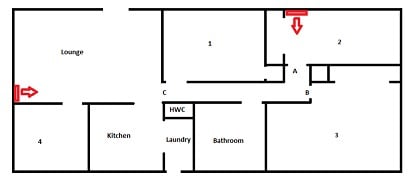
My house is 100m2 and I have one in the lounge positioned to aim across the room into the hallway.
It works well but for the temperature extremes, I have another one in my bedroom which is positioned to aim through the bedroom door out into the hallway and with both going its amazing how warm the house gets very quickly. 

After 15 minutes there is definitely a noticable temperature change as you walk through A and B, but after 40 minutes, the hallway is hotter than my bedroom with the louvers aimed out the door. 

I was originally thinking of getting an air-movement / reticulation fan which are normally positioned above fireplaces. My idea was to simply suck air from the B end of the hallway and return it above the heat pump in the lounge, creating a forced movement of warm air from the lounge, down the hallway to replace it. But ended up going with the second heat pump in the bedroom. 

Underneath our hot water cylinder is a drain too so there was the potential for a unit in the hallway and therefore it could have been positioned next to the hw cupboard door. 


I think just having a second unit at the other end of the house will give such a boost, but air movement is something to watch out for. 


Ray Taylor

There is no place like localhost

Spreadsheet for Comparing Electricity Plans Here


Kickinbac
483 posts

Ultimate Geek
+1 received by user: 102


  #2700651 2-May-2021 10:24
Send private message

There are condensate pumps without a float, generally more reliable. They have two temp sensors and operate when unit is in cooling. They have a run dry pump. Search for miniblue.
https://www.lims-hvac.co.nz/product-page/miniblue-r
They run continuously so the noise is constant, sometimes better than the on & off of a float pump.
I’ve got one installed on the heat pump in my office and while the pump is quiet there is a sucking gurgling noise. That would bother me if I was trying to sleep which I can only do occasionally at work 😝

Create new topic


Geekzone Live »

Try automatic live updates from Geekzone directly in your browser, without refreshing the page, with Geekzone Live now.


Are you subscribed to our RSS feed? You can download the latest headlines and summaries from our stories directly to your computer or smartphone by using a feed reader.