Geekzone: technology news, blogs, forums
Guest
Welcome Guest.
You haven't logged in yet. If you don't have an account you can register now.


View this topic in a long page with up to 500 replies per page Create new topic
1 | 2 
SomeoneSomewhere
1886 posts

Uber Geek
+1 received by user: 1091

Lifetime subscriber

  #3158547 12-Nov-2023 12:31
Send private message

raytaylor:


Bung:


In the 1980s Telecom resisted the PDL modular faceplate idea mixing phone jacks (with rubber boots over wiring) and LV switches because fault staff wouldn't be able to legally access the phone wiring as you'd need electrical registration to open the fitting.


Tangent: Reminds me of just a few years ago when the definition of low voltage AC and DC was changed. Chorus stuck its hand up and said "Hey we have thousands of telephone techs who work with ringing voltages that would no longer comply - they are not doing 3 year electrical apprenticeships" so an exception was made for telco stuff. 


There's a similar issue with long-range speaker lines that usually run at 100Vrms and are stepped down at each speaker. Common in fire, paging, and e.g. supermarket music systems. Again, exemption made.


The hazard with mains isn't just the voltage, though that's a big part of it. The current and fault current mean that there are hazards beyond just shock. 


mb82

227 posts

Master Geek
+1 received by user: 16


  #3158641 12-Nov-2023 14:14
Send private message

tweake:


mb82:


I think the 50mm rule makes usb/socket combos questionable or is that allowed because it is double insulated? I know it is not 240v wire near 5v wire but it is 240v wire near 240-5v step down connections less than 50mm


https://www.bunnings.co.nz/deta-double-power-point-with-3-4a-dual-usb-charger_p0314652


i suspect you will find that all the usb low voltage side is separated and is not exposed out the back. compared to tv connectors which have exposed metal connections at the back, not far from exposed 240v connections on the sockets. 


I am thinking to run conduit over the coax cable into the flush box and then heatshrink the conduit onto the back of the coax connecter. I could even heatshrink over it, then put conduit and another layer of heatshrink


tweake
2664 posts

Uber Geek
+1 received by user: 1141


  #3158643 12-Nov-2023 14:27
Send private message

mb82:


I am thinking to run conduit over the coax cable into the flush box and then heatshrink the conduit onto the back of the coax connecter. I could even heatshrink over it, then put conduit and another layer of heatshrink


whats the situation?


if its a standard wall, then usually its easy enough to cut another flush box in. if you can run conduit is it surface mount?


mb82

227 posts

Master Geek
+1 received by user: 16


  #3158658 12-Nov-2023 15:58
Send private message

tweake:


mb82:


I am thinking to run conduit over the coax cable into the flush box and then heatshrink the conduit onto the back of the coax connecter. I could even heatshrink over it, then put conduit and another layer of heatshrink


whats the situation?


if its a standard wall, then usually its easy enough to cut another flush box in. if you can run conduit is it surface mount?


On second thought I mocked it up and decided it was silly and dodgy a sparky would never do it that way with makeshift conduit. I will mount a flush box on the other side of the beam to where the power point is and mount a stand alone outlet for the coax


gregmcc
2173 posts

Uber Geek
+1 received by user: 836

ID Verified
Trusted
Lifetime subscriber

  #3158659 12-Nov-2023 16:04
Send private message

good idea, a lot of effort, just put in another flush box with the coax socket in it, job done, risk of electric shock reduced


flush box is around $1


plate with 1 mech $5


you will spend more on heat shrink and conduit.


Bung
6736 posts

Uber Geek
+1 received by user: 2929

Subscriber

  #3158712 12-Nov-2023 18:47
Send private message

SomeoneSomewhere:


For your segregation quote, note that we are looking at LV & ELV circuits. HV circuits are e.g. the 11kV running down the street or to a transformer in the building basement. 230V is legally low voltage. So as long as either a) all the LV cables are double insulated, like TPS or extension cords, or b) all the cable is rated at least 450V even if single insulated, we're fine to have them in the same box or conduit. 


EWRB say differently "Under NO circumstances shall Low Voltage (LV e.g., 230 V) sockets, switches or modules be mounted on the same faceplate as components that operate at voltage levels at which telecommunications and data services operate. AS/NZS 3000 requires that all faceplates comply with AS/NZS 3112, clause 3.2 of which prohibits mixing of these voltage levels on the same faceplate."


AS/NZS  3112 3.2 includes tv and radio aerial wiring.


Shop now for Lego sets and other gifts (affiliate link).
SomeoneSomewhere
1886 posts

Uber Geek
+1 received by user: 1091

Lifetime subscriber

  #3158722 12-Nov-2023 19:40
Send private message

I was referring mostly to the given quote, which is about conductors in boxes and conduits, not faceplates. 


That's an interesting interpretation on their part given that 3112 does not cover switches other than those associated with a socket-outlet, and is usually considered a manufacturing standard, not installation. In addition, they have somewhat re-worded it - the original explicitly calls out 'a connecting device for telecommunications wiring, television or radio aerial wiring or other similar wiring systems.'


EWRB's interpretation instead simply says that you cannot have components, and rather than call out the specific services they're saying the voltage level of those services. Plus, 3000 requires that socket-outlets comply with 3112, not faceplates.


Depending on how one interprets voltage level, one could suggest that this outright forbids any ELV equipment sharing a plate with LV equipment, including the ubiquitous USB charging sockets. 


mb82

227 posts

Master Geek
+1 received by user: 16


  #3161061 19-Nov-2023 07:34
Send private message

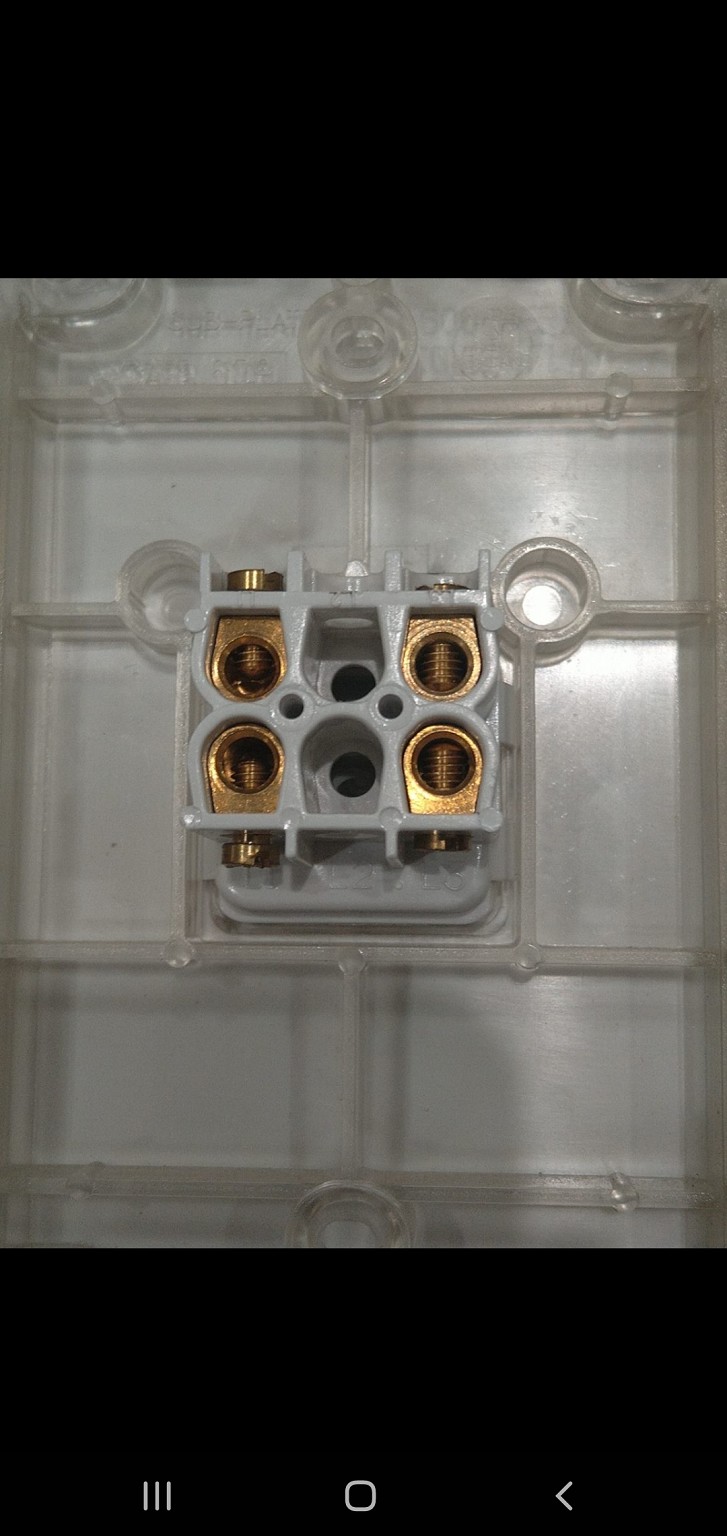
I know it is not high voltage with low voltage but now I have seen a photo of the larger oven switches look at the clearance between the wires


gregmcc
2173 posts

Uber Geek
+1 received by user: 836

ID Verified
Trusted
Lifetime subscriber

  #3161068 19-Nov-2023 08:08
Send private message

mb82: I know it is not high voltage with low voltage but now I have seen a photo of the larger oven switches look at the clearance between the wires


The larger clearance is because some houses the oven is 2 phase 400V, needed to get the insulation rating


BTW 230V/400 is low voltage - over 1000V is high voltage.


tweake
2664 posts

Uber Geek
+1 received by user: 1141


  #3161089 19-Nov-2023 10:54
Send private message

mb82: I know it is not high voltage with low voltage but now I have seen a photo of the larger oven switches look at the clearance between the wires


the question is whats its failure mode. mains shorting across to mains is bad but there is fuses/rcd etc.


if it shorts across to coax or lan/telephone its not always going to draw enough to blow the fuses so it can have potential for shock, plus its going to fry most of that cabling and gear connected to it. especially if they have common wiring.


so there is a lot more separation done between high/low circuits. you can see this in power supplies where they have air gaps cuts into the circuit board to separate one side from another, and use transformers and opto's to get isolated electrical connection.


SomeoneSomewhere
1886 posts

Uber Geek
+1 received by user: 1091

Lifetime subscriber

  #3161114 19-Nov-2023 13:14
Send private message

The centre pair are left open because I assume there is a three-pole version for three phase appliances. Where only two poles are needed, the middle set of contacts and terminals can be omitted. You can see they are marked L1/L2/L3.


Functional switches like this have less onerous requirements for contact gaps because they are not intended to be used to isolate power - you should not rely on one of these to sit between a wire you're touching and live mains. That needs to be a device suitable for isolation like an MCB or a lockable outdoor isolator, or removable links/fuselinks. 


1 | 2 
View this topic in a long page with up to 500 replies per page Create new topic


Geekzone Live »

Try automatic live updates from Geekzone directly in your browser, without refreshing the page, with Geekzone Live now.


Are you subscribed to our RSS feed? You can download the latest headlines and summaries from our stories directly to your computer or smartphone by using a feed reader.