Geekzone: technology news, blogs, forums
Guest
Welcome Guest.
You haven't logged in yet. If you don't have an account you can register now.


neb

neb

11294 posts

Uber Geek
+1 received by user: 10018

Trusted
Lifetime subscriber

#237979 27-Jun-2018 17:26
Send private message

Anyone who's worked with various varnishes and oils knows that they have a limited shelf life once opened, and the more air there is in the container, the quicker they degrade (cure/react/polymerise/whatever the mechanism happens to be). In the US you can get products like Bloxygen which spray a layer of argon gas into the container to protect the contents from oxygen, but over here if you don't have access to a MIG welder or similar as an argon source you're mostly out of luck.


A few days ago I was looking at an air duster and noticed that, despite its name, it's actually a tetraflouroethane (a.k.a. R-134a) duster. Like argon, R134a is denser than air so should form a blanket over the top of the oil/varnish/whatever to slow down curing. I've just filled a nearly-empty bottle of BLO, for which the reaction with air is quite visible, with R-134a, I'll report back in a week or so if further curing has occurred, but apart from that it looks like you can now get a cheap, and above all locally available, Bloxygen substitute to extend the shelf life of your varnishes and oils.



Create new topic
mcraenz
1140 posts

Uber Geek
+1 received by user: 222


  #2045771 28-Jun-2018 21:21
Send private message

Thanks for the tip!


Help me build a better way of doing politics in Aotearoa New Zealand


gzt

gzt
18684 posts

Uber Geek
+1 received by user: 7824

Lifetime subscriber

  #2045777 28-Jun-2018 21:59
Send private message

Nice!

neb

neb

11294 posts

Uber Geek
+1 received by user: 10018

Trusted
Lifetime subscriber

  #2052348 9-Jul-2018 23:49
Send private message

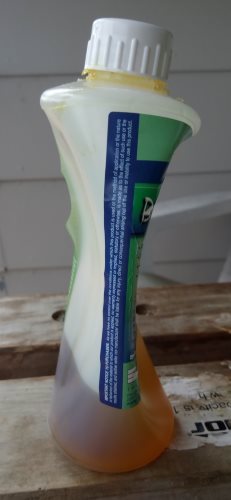
An update on this, here's what it looks like after a few days:


This effect is far more severe than leaving air in there would do, and far quicker too, so I'm guessing the R134a is being absorbed by the BLO? I've refilled it twice with more R134a and it's still creating this vaccuum effect in the bottle (good thing it's plastic), so the air is being displaced but there's an unexpected interaction between the BLO and the R134a. I'll keep refilling with R134a to see how long it goes on for, at some point I'll try it with generic polyurethane varnish to see if there's any interaction there.


kiwigander
231 posts

Master Geek
+1 received by user: 43


  #2052352 10-Jul-2018 00:06
Send private message

If the limiting factor of the shelf life of varnishes and oils is exposure to air (specifically, I would imagine, oxygen), then I propose a much lower tech solution.


Get a bag of marbles, if they'll fit through the neck of your container - glass beads if marbles are too big - and every time you drain off some of the varnish or oil, top up the volume with marbles to drive all the air out of the container.


It may sound daft, but that's what we used to do in the days of chemical photography when expensive developing solutions would tend to go off because of the oxygen in a half-empty bottle.


neb

neb

11294 posts

Uber Geek
+1 received by user: 10018

Trusted
Lifetime subscriber

  #2052357 10-Jul-2018 00:27
Send private message

kiwigander:

Get a bag of marbles, if they'll fit through the neck of your container - glass beads if marbles are too big - and every time you drain off some of the varnish or oil, top up the volume with marbles to drive all the air out of the container.


Most of the substances are quite viscous, think something like treacle, so you'd end up with most of it stuck to the marbles. Also I'm not sure whether you'd want to disperse something like polyurethane like that, it cures from the surface down so after the initial curing you get a protective skin forming that slows down the curing of the main body. Spreading it out thinly over marbles will probably mess up this self-protecting behaviour.

neb

neb

11294 posts

Uber Geek
+1 received by user: 10018

Trusted
Lifetime subscriber

  #2068886 6-Aug-2018 17:33
Send private message

neb: An update on this, here's what it looks like after a few days.


An update on the update: After two more refills of R-134a, it's now fine, the bottle is firmly filled with it and there's been no further change in a month, and no degradation in the BLO. So it just seems that it's very soluble in BLO, all you need to do is saturate the oil and then it'll work as expected.


Shop on-line at New World now for your groceries (affiliate link).
debo
309 posts

Ultimate Geek
+1 received by user: 154


  #2068917 6-Aug-2018 19:32
Send private message

Have you tried LPG. Its heavier than air and most people will already have it. Just remove the hose off the BBQ.

Buster
297 posts

Ultimate Geek
+1 received by user: 164


  #2068950 6-Aug-2018 20:24
Send private message

Have you tried storing the part used container upside down. When the air rises it is rising towards the bottom of the container. If a skin forms at least it isn't near the lid the next time you open the container.


neb

neb

11294 posts

Uber Geek
+1 received by user: 10018

Trusted
Lifetime subscriber

  #2069427 7-Aug-2018 16:57
Send private message

Buster:

Have you tried storing the part used container upside down. When the air rises it is rising towards the bottom of the container. If a skin forms at least it isn't near the lid the next time you open the container.


Yeah, that's an old trick, but it relies on the seal being 100% tight so you don't get any leakage, is difficult to do for anything other than a flat-topped can, and still exposes the material to the air in the can. The nice thing with the gas filler is that there's no air exposure, and you can store the material as you normally do.

Create new topic


Geekzone Live »

Try automatic live updates from Geekzone directly in your browser, without refreshing the page, with Geekzone Live now.


Are you subscribed to our RSS feed? You can download the latest headlines and summaries from our stories directly to your computer or smartphone by using a feed reader.