Geekzone: technology news, blogs, forums
Guest
Welcome Guest.
You haven't logged in yet. If you don't have an account you can register now.


kiwijunglist

2983 posts

Uber Geek
+1 received by user: 135

ID Verified

#239436 17-Jul-2018 16:39
Send private message

Hi


I've got a rangehood with external inline motor and it has 200mm flexible wire ducting.


I am venting it out the eaves however the eaves cavity is very narrow.


I have a 320 x 95 approx rectangular gap the exhaust part of the ducting needs to pass through before reaching the vent in the eaves.


I can't actually reach the gap physically (this is with me lying down on boards inside the attic and reaching my arms out as far as they go)


My thought was to bend about a 1m length of 250 mm ducting into a rectangular 305 x 90 shape pass it through the narrow area and then pull it out a 250mm hole in the soffit and attach a 250mm round vent. 


I thought it was better to upsize to 250mm for the squeeze as the 200mm will loose a lot of cross sectional area when you change it to a rectange. (Area of 305 x 90 = 270 cm2 which is not too far of the 200mm round diameter area of 315 cm2).


My question is:


- What kind of exit vent is best for an eave?


- What direction should the louvres face? (ie do they point towards or away from the house)


- Am I likely to need a damper valve to stop air going the wrong way (I live in a windy area), I could always retrofit this later on.  Normally with a wall facing grill the little louvres can fall down with gravity to prevent the wind going through, but I'm not sure if such a setup exists for an upside grill on the soffit / eaves.


- Where is the best place to buy vents at public prices? I'd need 1m of 250mm vent , a 250 to 200 reducer and the 250 mm external vent cover with fascia.




HTPC / Home automation (home assistant) enthusiast.


View this topic in a long page with up to 500 replies per page Create new topic
 1 | 2 | 3
kiwijunglist

2983 posts

Uber Geek
+1 received by user: 135

ID Verified

  #2057934 17-Jul-2018 17:02
Send private message


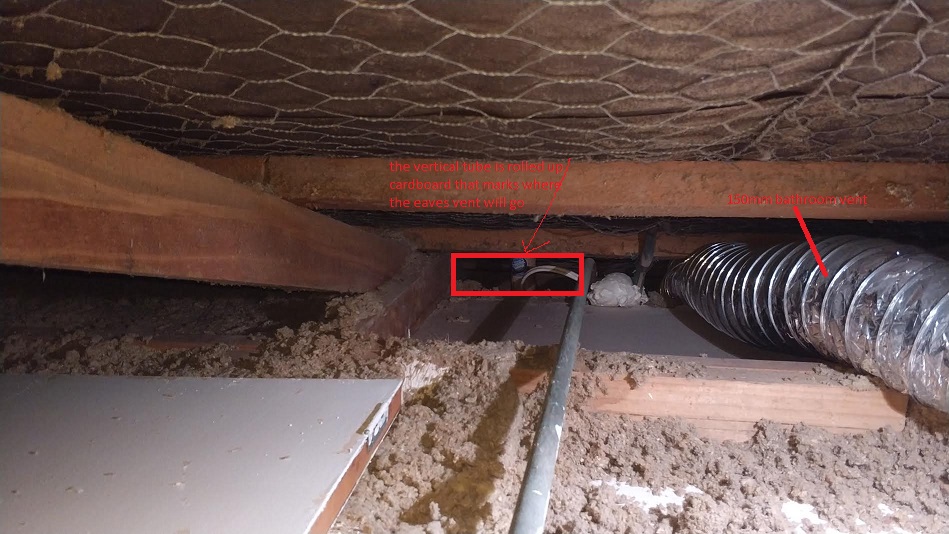
The red box shows the gap I have to work with.  This is the best gap I can find, it is probably wider than 320mm, but it's definitely no more than 100mm high.


You may think that there is a vertical pipe in the way, but this is a bit of rolled up piece of cardboard.  I removed an old copper pipe from the soffit that wasn't going anywhere, and I rolled up the cardboard and stuck it through the hole as a marker to show where I was on the outside of the house.


On the right hand side is the existing 150 mm bathroom vent that is squeezed between the beams (not ideal).


HTPC / Home automation (home assistant) enthusiast.


mdooher
Hmm, what to write...
1443 posts

Uber Geek
+1 received by user: 910

ID Verified
Trusted
Lifetime subscriber

  #2057969 17-Jul-2018 18:32
Send private message

1. just get the normal plastic square one with the louvers going one way.


2. If you don't want to see up the vent when standing on the path then face the louvers in, otherwise face them out, stops grease sticking to the wall


3. don't bother with the one way thingy, it will simply bang in the wind. you only use these if you have a two into one situation


4. Radcliffe/JE Russell electrical


Matthew


Aredwood
3885 posts

Uber Geek
+1 received by user: 1749


  #2057972 17-Jul-2018 18:44

Why can't you just run the vent through the roof? It will be easier than what you are trying to do. And you will get better airflow. As the duct won't be squashed.

edit

Here is a through roof kit.

http://simx.co.nz/product-groups/duct-and-grilles/thru-roof-kits/roof-cowl-kits-with-flashing-tube


kiwijunglist

2983 posts

Uber Geek
+1 received by user: 135

ID Verified

  #2057975 17-Jul-2018 18:57
Send private message

Not keen on hole in roof. worried about leaks. Our roof not entirely straight forward either we have a iron roof with desmateric tiles on top.


HTPC / Home automation (home assistant) enthusiast.


kiwijunglist

2983 posts

Uber Geek
+1 received by user: 135

ID Verified

  #2057976 17-Jul-2018 19:00
Send private message


Sorry that's upside down. I'm in my phone.

In the picture you can see the bathroom vent and the rolled up cupboard that i stuffed into the old copper pipe i just removed.


HTPC / Home automation (home assistant) enthusiast.


Fred99
13684 posts

Uber Geek
+1 received by user: 10018


  #2058029 17-Jul-2018 21:47
Send private message

I had pretty much the same issue as shown in your photo with your existing bathroom vent duct.  I can assure you that for me, there was zero chance of "pushing" it through from the attic, needed to cut the hole for the vent in the soffit and reach through to grab it and pull it through.  I think I used vice grips to grab several "rings" of the steel in it and yanked like hell.   I just used one of the standard square vents about 150x150 - think that was from Mitre 10. Was a bit of a mission to attach the ducting to it, as you've got to pull some extra though to give you something to work with, and in my case cut the damaged section on the end off where I'd munted it with the vice grips.  Works fine - yes it probably restricts airflow a bit, but that doesn't seem to matter much. I did that about 6 years ago, the central part of the vent clips out - I cleaned that a couple of years or so ago, it still looks fine (just checked).  I second the suggestion to avoid the vents with moving flaps.  Neighbours put them in - the clickety-clack noise in the wind was even driving me crazy from 50 metres away - they didn't know WTF it was from until they told me about the problem - and it was far worse for them. 


Stream your favourite shows now on Apple TV (affiliate link).
kiwijunglist

2983 posts

Uber Geek
+1 received by user: 135

ID Verified

  #2058035 17-Jul-2018 21:54
Send private message

Yup that's exactly my current plan on how to do it. Wasn't sure if there is a better way. I was planning to force a section of the ducting into a rectangular shape prior to pulling through.


HTPC / Home automation (home assistant) enthusiast.


Fred99
13684 posts

Uber Geek
+1 received by user: 10018


  #2058037 17-Jul-2018 21:59
Send private message

I tried the old "pre-shaping trick" - and it didn't work for me.  Brute force was needed.


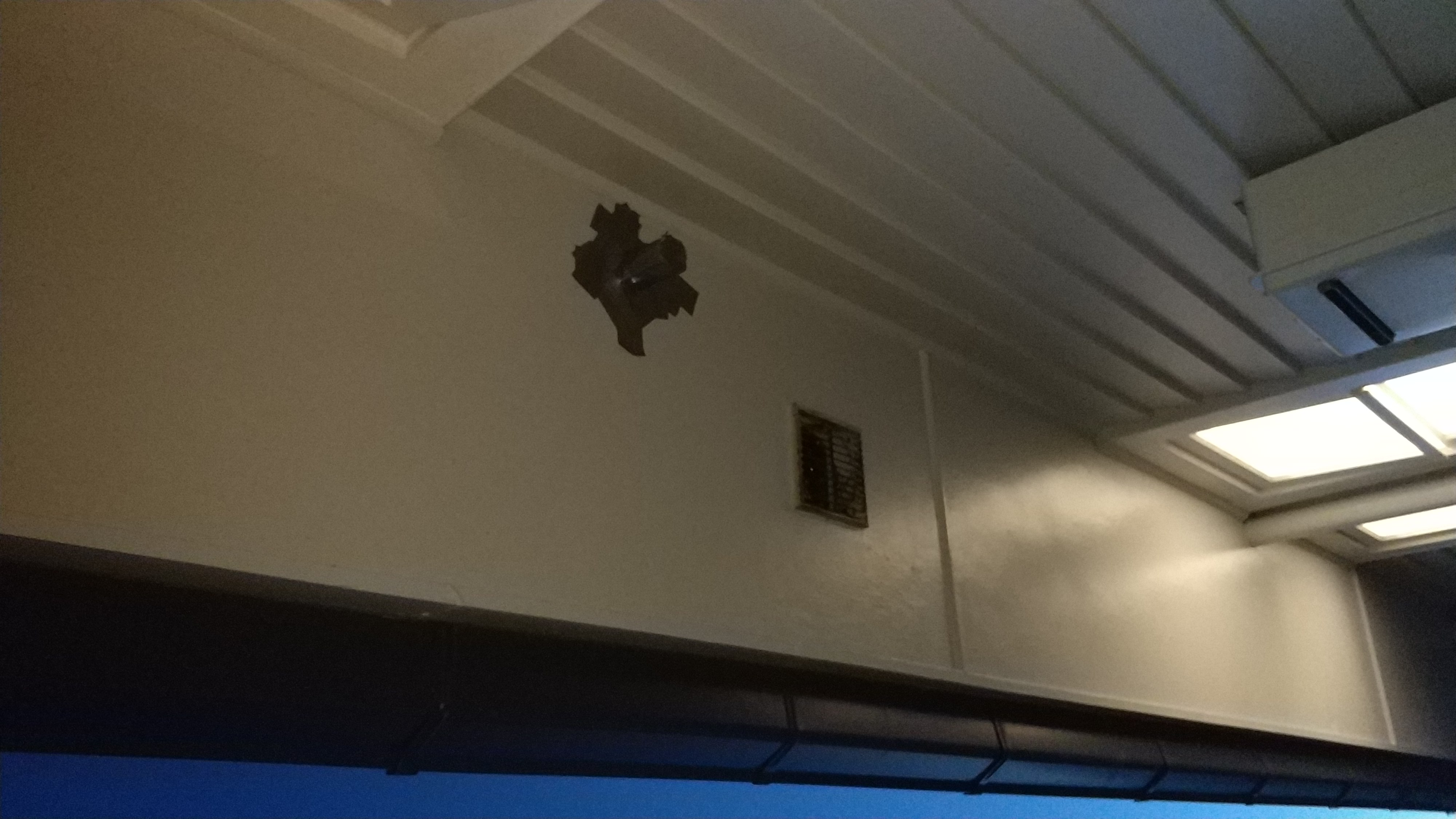
Is this truly the hole you neatly "cut" in the soffit:


?


kiwijunglist

2983 posts

Uber Geek
+1 received by user: 135

ID Verified

  #2058039 17-Jul-2018 22:08
Send private message

Lol. No. That is duct tape.

There was a 40mm hole in the soffit that had a copper pipe in it and the copper pipe had an open end about 1 inch away from the soffit. I think it was part of the old water system that they never bothered to seal up. So today i removed the pipe and rolled up cardboard into a tube so i could visionalise where the hole was inside the attic, and it's pretty much where i want the vent to come out so i plan to enlarge that to the exhaust vent.

I've just placed some duct tape around it to prevent any birds or rodents going through it. Temporary.

Lol. The hole under that tape is 40mm and perfectly round.


HTPC / Home automation (home assistant) enthusiast.


mattwnz
20515 posts

Uber Geek
+1 received by user: 4795


  #2058055 17-Jul-2018 23:17
Send private message

Is your roof hipped, or do you have a gable somewhere, that you can get it going out through a wall? That is one problem with these low pitched hipped roofs, very difficult to get thick pipes to the soffit.  200mm seems wide for a rangehood vent. Is there some way you can get it going out through another wall?


kiwijunglist

2983 posts

Uber Geek
+1 received by user: 135

ID Verified

  #2058065 17-Jul-2018 23:53
Send private message

It's quite a powerful extractor that's why it is using 200mm.


I was wondering if I can just cut a very large square out of the soffit, then glue and screw a overlapping frame around the gap and patch a new piece in after installing the vent.  Would it just be like gibbing a ceiling?


I could possibly go through a wall, but it seems like that would be even more difficult and my wife wont be happy with that.  It would require me entering a room and then exiting the wall next to the ceiling.


The house doesn't have any gables.


I'm not actually sure what the soffit is made of yet, it's 1965 house, so it might be fibre cement board.


HTPC / Home automation (home assistant) enthusiast.


Want to support Geekzone and browse the site without the ads? Subscribe to Geekzone now (monthly, annual and lifetime options).
itxtme
2102 posts

Uber Geek
+1 received by user: 557


  #2058068 18-Jul-2018 00:24
Send private message

kiwijunglist:


I was wondering if I can just cut a very large square out of the soffit, then glue and screw a overlapping frame around the gap and patch a new piece in after installing the vent.  Would it just be like gibbing a ceiling?


Not sure why you would do that, better off using a jigsaw with appropriate blade and cutting the 200mm required for the cover.  I have also done this on two properties and on both occasions I also had to cut the hole on the outside and force the duct through the small gap.  Functionally both were still effective.


Tip: Use masking tape on your jigsaw shoe to stop it marking your nice soffit


mattwnz
20515 posts

Uber Geek
+1 received by user: 4795


  #2058070 18-Jul-2018 00:30
Send private message

kiwijunglist:


I'm not actually sure what the soffit is made of yet, it's 1965 house, so it might be fibre cement board.


Maybe asbestos if it is that old. Many older houses do seem to have that in their soffits.


kiwijunglist

2983 posts

Uber Geek
+1 received by user: 135

ID Verified

  #2058071 18-Jul-2018 00:33
Send private message

wouldn't surprise me, had asbestos in our floor lino.


HTPC / Home automation (home assistant) enthusiast.


MikeAqua
8024 posts

Uber Geek
+1 received by user: 3818


  #2058097 18-Jul-2018 08:31
Send private message

+1 for going through the roof.  Just get a suitably skilled person to install the roof flashing and keep the invoice.


A crude rule of thumb in fluid dynamics is that every 90 degree bend reduces air flow by 25%.


So the first corner reduce your flow to 75% a second to 75%^2.


Mike


 1 | 2 | 3
View this topic in a long page with up to 500 replies per page Create new topic


Geekzone Live »

Try automatic live updates from Geekzone directly in your browser, without refreshing the page, with Geekzone Live now.


Are you subscribed to our RSS feed? You can download the latest headlines and summaries from our stories directly to your computer or smartphone by using a feed reader.