Geekzone: technology news, blogs, forums
Guest
Welcome Guest.
You haven't logged in yet. If you don't have an account you can register now.


BlargHonk

176 posts

Master Geek
+1 received by user: 131


#316109 17-Sep-2024 10:00
Send private message

Our Hot Water Cylinder is 30+ years old and has started to drip. I would really like to free up the cupboard space and move the Cylinder outside. I have spoken to the plumber and he is going to give me a price for a standard electric outdoor cylinder as well as a Rinnai Heat Pump one. He recommended not going for the standard electric as it is likely that the heat losses will be too high in winter. We are located on the Canterbury planes about 30min out of Christchurch. How worried should I be about heat losses from an Outdoor cylinder here? 


I have been digging around on the Rheem and Rinnai websites to try and find if there are min ambient temperatures or heat loss figures but have been unable find anything concrete. No replies from their contact pages yet either. 


I am also not sure about the payback time for a heat-pump HWC with the higher initial cost and 10-15yr lifespan. Especially if I can use a power plan with 3hrs free power on a standard electric cylinder. We currently have Contact with the Good Nights plan (3hrs free power each night). I was wondering what is the best way to use this with a new Hot Water Cylinder? Can you put some kind of timer on the Switchboard? Does the HWC need to be dual element to do this? Any advice would be appreciated. 


Filter this topic showing only the reply marked as answer Create new topic
timmmay
20857 posts

Uber Geek
+1 received by user: 5349

Trusted
Lifetime subscriber

  #3283082 17-Sep-2024 10:14
Send private message

One thought, I put a hot water cylinder into the ceiling space, which has worked well for us. It won't work well for everyone though.

Putting a hot water cylinder outside in that area obviously there's going to be a lot more heat loss than if it was inside the insulated envelope of your house. The cylinder and the pipes would need quite a bit of insulation I would think.

Have you considered instant hot water?


BlargHonk

176 posts

Master Geek
+1 received by user: 131


  #3283086 17-Sep-2024 10:34
Send private message

We don't have a huge amount of space under the roof. I can barely crawl around up there. I am also concerned about what happens if it leaks up there. If a cylinder leaks outside it is much less issue!


I don't want to go Gas mostly for cost reasons. I see natural gas increasing in price significantly more than electricity over the coming 5-10 yrs. 


timmmay
20857 posts

Uber Geek
+1 received by user: 5349

Trusted
Lifetime subscriber

  #3283090 17-Sep-2024 10:43
Send private message

Fair call. When hot water cylinders are in the ceiling a wide tray is put under them, even significant leaks would drain.


Scott3
4176 posts

Uber Geek
+1 received by user: 2990

Trusted
Lifetime subscriber

  #3283114 17-Sep-2024 12:07
Send private message

What you want is Table A5 of AS/NZS 4692.2:2005. This defines the "MEPS" (Minimum Energy Performance Standards) to sell a hot water cylinder in NZ.

Sadly I am not in an engineering consultancy any more so don't have access. And very frustrating that one needs to pay for standards to understand the law: https://www.legislation.govt.nz/regulation/public/2002/0009/latest/DLM108798.html


Generally losses are 1 kWh - 1.6 kWh per day depending on cylinder size, but I am not sure what ambient temp that is defined at for that test, or if MEPS requires a lower ambient temp for outdoor rated cylinders than indoor rated cylinders.


Suggest that ambient temp is perhaps not a big deal. Lets say the cylinder is set to 64c A cold day in Auckland is +6c (a temperature delta of 58 C), and cold day in canterbury might be -4 C (a temp delta of 68 C). So while losses are greater in the colder location, its only about 17%.

Obviously it is ideal if the waste head from the HWC can warm your linen cupboard (and ultimately leak into your house if you live in a colder location), but that does need to be weighed against the usefulness & value of the cupboard space.


One thing to note about moving the cylinder location, is the plumber will likely run a hot water pipe from the new cylinder location to the old location where they will tie into your houses existing hot water piping. This extra run means you need to wait longer for hot water to turn up at your tap's, which means more wasted water and energy (and is less convenient). It impact depends on the length of additional pipe run.


On heat pump HWC. It will use 1/2 to 1/3 of the power, and you need to estimate if you will pay this off over its ~10 year likely lifespan.


On 3hrs free power each night, given you are buying a new cylinder anyway, the optimal setup would be to get a big (300 or 400L) twin element cylinder. Have the electrician wire the bottom element via a timer that you can set up to start a few minutes into your free power hours (can be on the controlled circuit to make you eligible for cheaper power if you lines company offers that). Top element is wired to 24/7 power.

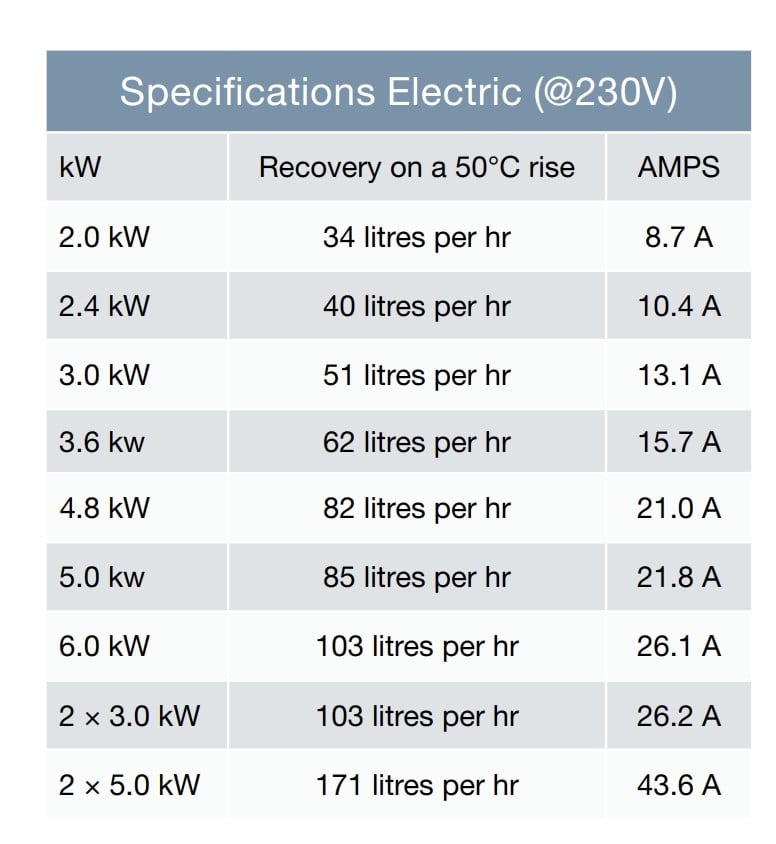
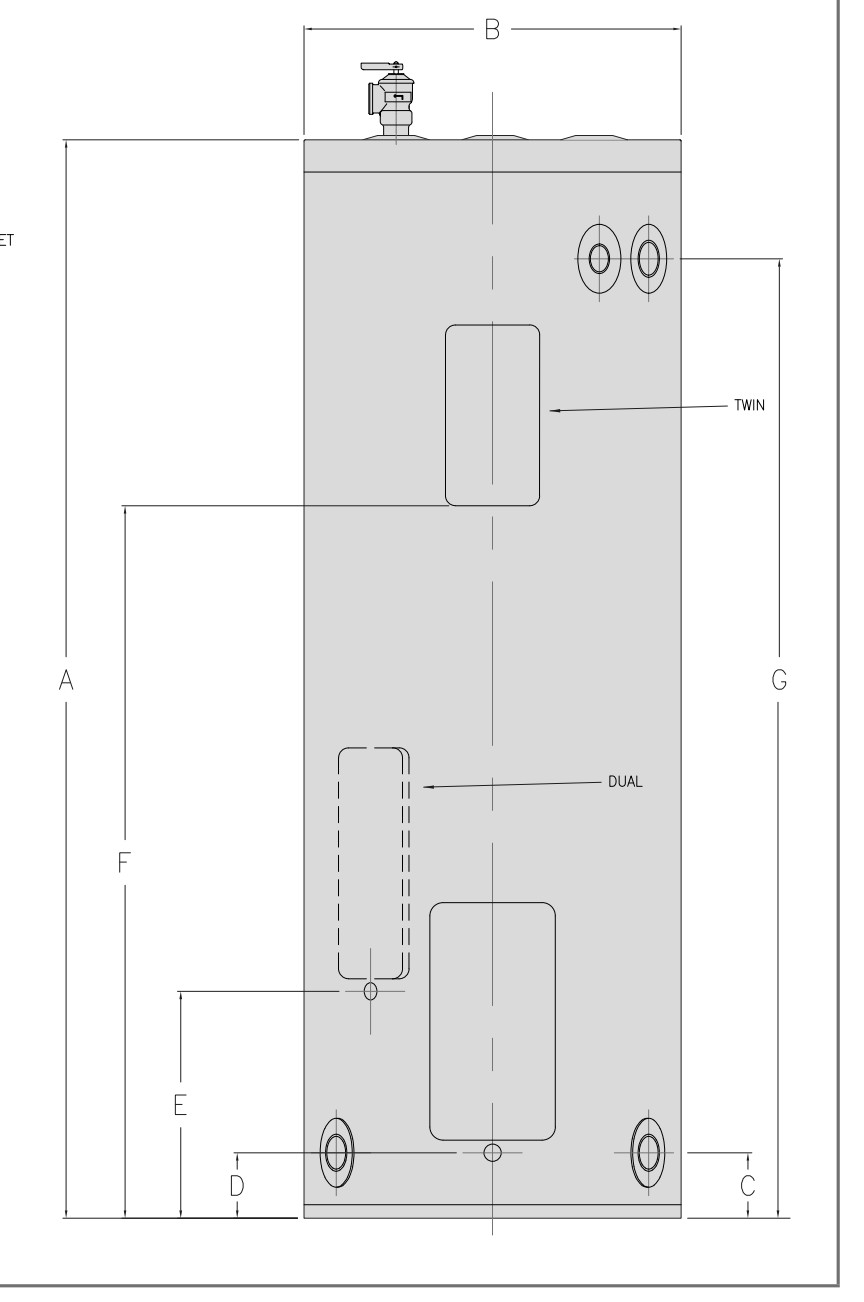
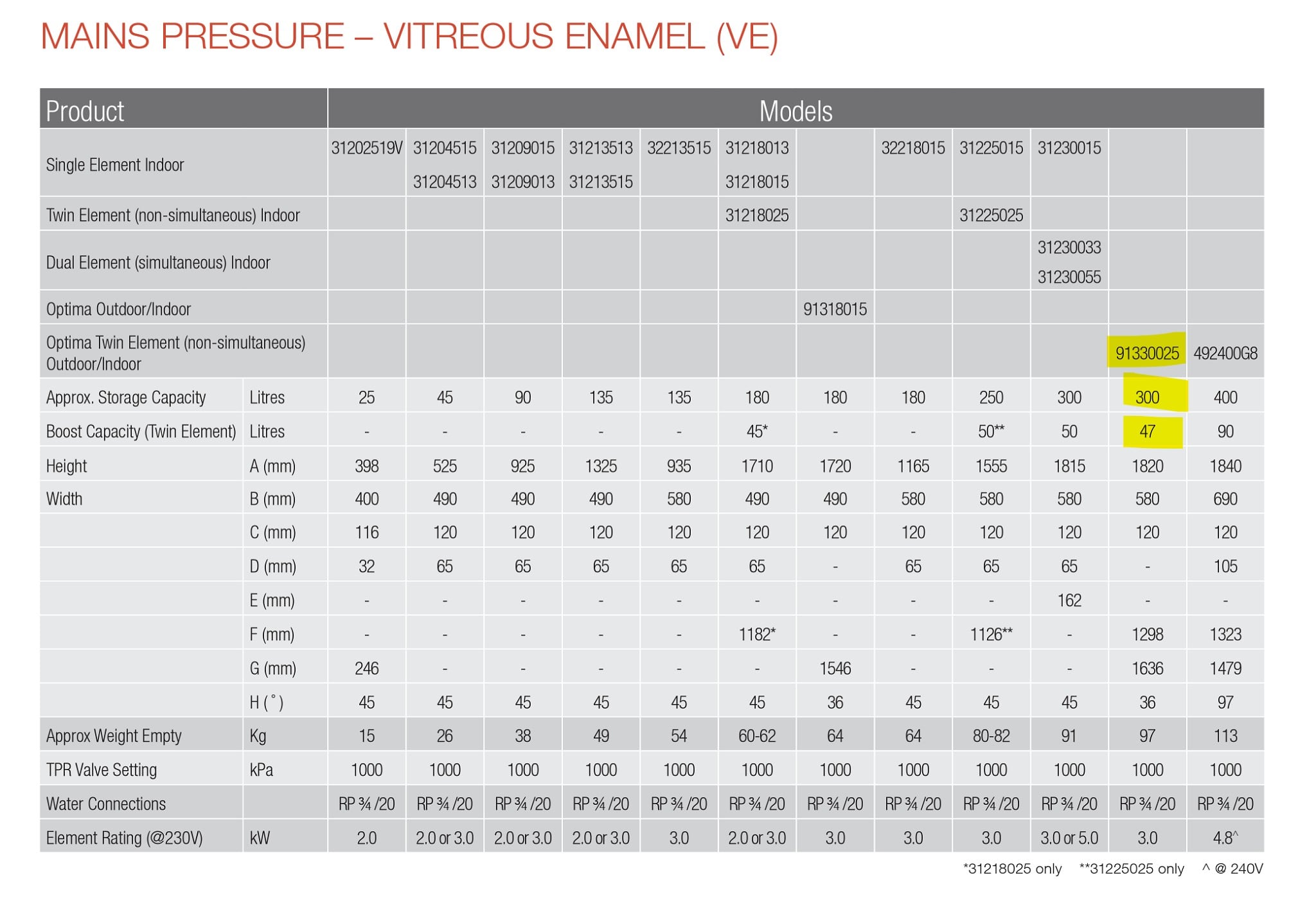
Using the Reheme 492400G8 (400L, twin 4.8kW @ 240v elements) as an example, This means every night your cylinder will be heated so you have 400L of hot water. If you ever drop below 90L hot water remaining the top element will kick in regardless of time and keep the top 90L warm. (leaving 310L cold for the bottom element to heat the next free period). 4.8kW can heat 246L of water @ 50c rise in 3 hours so it won't quite get their, but will be fairly close.


Rheem-Hot-Water-For-Your-Home-Web-Brochure.pdf


Note a typical residual HWC is 3kW, so while 4.8 kW is great for maxing out your free power window, it is a lot of power. Might need to get your electrical capacity checked. My house is only good for ~14kW total.


If you don't want to go twin element, the best bet would be to get a big cylinder and set your timer to start at the beginning of your free power window, and to run for enough hours that you get a full tank of hot water every day, and make it last the day (can turn off the timer if you have guests).

Twin element is great for solar too. Same deal. use a solar diverter or a simple timer so the cylinder heads in peak solar hours, and rely on the boost if that isn't enough.


The above will kill the financials of a hot water heat pump.


BlargHonk

176 posts

Master Geek
+1 received by user: 131


  #3283124 17-Sep-2024 12:23
Send private message

Legend. Posts like this are why I love Geekzone.

The outdoor cylinder will be positioned right outside the bathroom so hopefully the length of pipe won't be too bad.

A big electric outdoor cylinder with dual elements seems like the way to go

SumnerBoy
2079 posts

Uber Geek
+1 received by user: 306

ID Verified
Lifetime subscriber

  #3283129 17-Sep-2024 12:46
Send private message

+1 for a big cylinder with dual elements, especially if you have solar.


I have both elements wired back to contactors and switched by KNX relays (but you could use any home automation style relay). 


I can then build smart logic (using Home Assistant or NodeRED) to switch those relays depending on time of day, solar generator, house load etc etc.


Or revert to a simple schedule as mentioned by Scott. 


Shop now for Lenovo laptops and other devices (affiliate link).
SumnerBoy
2079 posts

Uber Geek
+1 received by user: 306

ID Verified
Lifetime subscriber

  #3283134 17-Sep-2024 12:52
Send private message

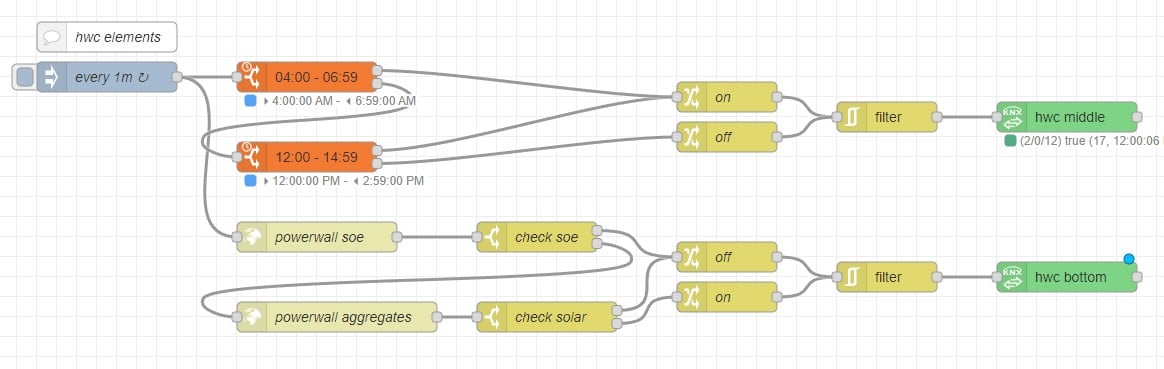
Here is the NodeRED flow I am using currently to control the two elements in my HWC. The middle element is on for 3hrs in the morning to ensure we have hot water for the morning showers. Then another 3hrs in early afternoon, where we should have the best chance of excess solar. This ensures we have enough hot water for the evening.


I also have a Tesla Powerwall, so the bottom element is only turned on if the battery is > 80% charged and we are generating > 3kW of solar. This gives priority to the Powerwall, until it is 80% full, and then starts diverting solar to the bottom element of the HWC. This isn't a "proper" PV diverter but it has the same effect, since if the HWC + house load > solar, any excess needed is supplied by the battery, ensuring we never import from the grid when heating the bottom of the HWC.


If we end up drawing too much from the battery, it will drop below 80% charge and the lower HWC element will be turned off.


Just an example of the sort of thing you can do once you have control of things like HWC elements :)


JessieB
37 posts

Geek
+1 received by user: 7


  #3283331 17-Sep-2024 21:05
Send private message

We have successfully moved our cylinder outside, but under a lean-to. I built a simple plywood enclosure around it, and stuffed it with insulation. I also got a 40amp smart switch put in place, and are on the good nights plan. The smart switch comes on at 9pm and turns off at 3am. Most nights the cylinder thermostat finishes heating by midnight so free hot water most of the time. It would be good to know how long this plan will be available. Is it a marketing gimmick? We were thinking of installing solar but while plans like this are around, it just doesn't make sense. Instead it makes more sense to get an electric car and a fast charger and get free energy for that.


Scott3
4176 posts

Uber Geek
+1 received by user: 2990

Trusted
Lifetime subscriber

  #3283358 17-Sep-2024 22:33
Send private message

BlargHonk: Legend. Posts like this are why I love Geekzone.

The outdoor cylinder will be positioned right outside the bathroom so hopefully the length of pipe won't be too bad.

A big electric outdoor cylinder with dual elements seems like the way to go


There is the potential that the plumber will run the pipe from the outside to the old hot water cupboard is there isn't an easy / viable place to tie in closer.

Also pay attention to element sizes. For maximizing your 3 hours of free power you want big, but this does mean fat wire runs back to the circuit board. 


Handle9
11923 posts

Uber Geek
+1 received by user: 9674

Trusted
Lifetime subscriber

  #3283364 17-Sep-2024 23:41
Send private message

timmmay: Fair call. When hot water cylinders are in the ceiling a wide tray is put under them, even significant leaks would drain.


If the drain isn't full of dust and crap. Don't ask how I know.


timmmay
20857 posts

Uber Geek
+1 received by user: 5349

Trusted
Lifetime subscriber

  #3283372 18-Sep-2024 06:11
Send private message

Handle9:

timmmay: Fair call. When hot water cylinders are in the ceiling a wide tray is put under them, even significant leaks would drain.


If the drain isn't full of dust and crap. Don't ask how I know.


Ahhh, good point.. That'd be worth checking occasionally.


Move to New Zealand's best fibre broadband service (affiliate link). Free setup code: R587125ERQ6VE. Note that to use Quic Broadband you must be comfortable with configuring your own router.
BlargHonk

176 posts

Master Geek
+1 received by user: 131


  #3288195 30-Sep-2024 14:36
Send private message

Just to give everyone a final update on this. We ended up getting the Rheem 300L Optima installed outside the bathroom. It has two 3kW elements with the bottom element connected to a Schneider 15335 Mechanical Timer Switch and the top element on constant supply to top up if required. Cost for the plumbing including removing the old cylinder was ~$4k. The timer switch was around $230.


Looks like I will be pretty much maxing out the 3kw for the free 3hrs based on what we have been using so far. With our usual power rates at 22.77c/kWh x 9kWh it looks like it will save us around $2 per day if this continues. 


Luckily no other plumbing work required inside the house on taps or shower mixer. Shower pressure is now so aggressive that I have installed a 9L/s flow restrictor on the shower hose to make it feel less like a fire hose. 


Thanks everyone for the advice, especially Scott3


Scott3
4176 posts

Uber Geek
+1 received by user: 2990

Trusted
Lifetime subscriber

  #3288247 30-Sep-2024 15:07
Send private message

Sounds like a good outcome.

~$700 Per Year of free power is great going.


Assuming yours is the below, that boost element should kick in a 47L remaining. 


3kW should give you 51 L / hour of gain. So three hours would get you 153L (from a potential maximum amount of cold of 253L).


You can make a decision between:


Just running the 3 hours on the timer, meaning you might potentially have 100L of cold in the tank, and just counting on the boost element to keep you in water if you run low. This approach will maximize your free power (i.e. unheated water from one day can carry over to the next day)


Alternatively you could have your timer over-run the three free hours by 2 additional hours. This will mean you always end up with a fully heated hot water cylinder each night, using your free power first.


The latter option will reduce the odds that you run into your fairly small boost capacity, but will mean cold water from day 1 won't be able to be heated in day 2 if not much hot water was used in day 2.


Of course when you have guests, or a sudden high hot water need you can change the setup to always on so the full 300L is kept warm.


Hope the setup serves you well. (and that free three hours of power plans stick around for decades)


Of course, you hot water setup is now also ideal for a solar PV setup if you ever get one of those. Either swap the timer for a solar diverter, or just set the timer to heat the cylinder in prime solar hours.


BlargHonk

176 posts

Master Geek
+1 received by user: 131


  #3288269 30-Sep-2024 16:29
Send private message

Yeah the idea was to future proof the system as much as possible. I have been going down the Rewiring Aotearoa rabbit hole at the moment.

I figured the system wouldn't fully heat ~250L on the three free hours so I've set it to overrun by 1hr extra until 1am. This should hopefully give a good balance as most week days we won't go near using all of it, but should hopefully be good to go for the weekends. And I can always flick the timer over to always on if we have guests or anything like that.

Thanks again for your detailed advice

Filter this topic showing only the reply marked as answer Create new topic


Geekzone Live »

Try automatic live updates from Geekzone directly in your browser, without refreshing the page, with Geekzone Live now.


Are you subscribed to our RSS feed? You can download the latest headlines and summaries from our stories directly to your computer or smartphone by using a feed reader.