Geekzone: technology news, blogs, forums
Guest
Welcome Guest.
You haven't logged in yet. If you don't have an account you can register now.


johno1234

3379 posts

Uber Geek
+1 received by user: 2857


#303770 8-Mar-2023 13:06
Send private message

https://www.scoop.co.nz/stories/BU2303/S00109/buyer-beware-hybrid-and-plug-in-hybrid-electric-vehicles-fail-to-meet-fuel-efficiency-claims.htm


I think this is expected, but wonder - are the standardised tests for HEV/PHEV/ICE all the same? If so do the ICE test results resemble reality?


My diesel SUV has a claimed 7.4L/100km combined consumption. In reality, driving in a level straight line at 100kph it consumes around 6L/100km, commuting in town it is around 9L/100km, and on a trip from Auckland to Whangamata with motorway, highways and mountain ranges is around 7.0L/100km. So the claimed economy is perhaps optimistic for combined cycle drives but not as far out of whack as Consumer says PHEV are.


Makes me think the manufacturer numbers include more battery powered motion than real life.


View this topic in a long page with up to 500 replies per page Create new topic
 1 | 2 | 3
Dingbatt
6804 posts

Uber Geek
+1 received by user: 3694

Lifetime subscriber

  #3047376 8-Mar-2023 13:18
Send private message

As I’ve said in the past, these idealised tests are only of use when comparing like with like.


BEV with BEV


PHEV with PHEV


HEV with HEV


ICE with ICE.


The consumer test probably didn’t even come close to the idealised one. If they had just done the school and supermarket run, plugging in each day there is a chance they would have returned figures of 0l/100km.


“We’ve arranged a society based on science and technology, in which nobody understands anything about science technology. Carl Sagan 1996


johno1234

3379 posts

Uber Geek
+1 received by user: 2857


  #3047381 8-Mar-2023 13:42
Send private message

Dingbatt:


As I’ve said in the past, these idealised tests are only of use when comparing like with like.


BEV with BEV


PHEV with PHEV


HEV with HEV


ICE with ICE.


The consumer test probably didn’t even come close to the idealised one. If they had just done the school and supermarket run, plugging in each day there is a chance they would have returned figures of 0l/100km.


I agree for the PHEV - many if not most people would manage 0 over a week's commute if they do remember to plug in each night, or every other night. My commute is 35km/day and some of the larger PHEVs are now claiming 80+km battery range. 


HEV though have all their energy ultimately sourced from their ICE so 0 is clearly impossible overall.


wellygary
8828 posts

Uber Geek
+1 received by user: 5310


  #3047382 8-Mar-2023 13:42
Send private message

WLTP is a simulated trip ~23km 52% urban, 48% non-urban ....


Consumer's test was "a rush hour commute to and from Consumer HQ, a supermarket trip, and a weekend run over the Remutaka Hill. Each vehicle drove 270km over the course of a week."


The Wairarapa trip will the one that is killing the PHEV's ratings.... For pretty much all of the WLTP they will be able to run in Battery mode using very little fuel.....  Going over the Remutakas will easily trip it into full petrol mode....


Scott3
4177 posts

Uber Geek
+1 received by user: 2990

Trusted
Lifetime subscriber

  #3047388 8-Mar-2023 14:06
Send private message

The issue with PHEV's is how they are rated.


Rather than just being rated at say 1.7L/100km (assuming the vast majority of running done in electric mode), they should get a range number, and a rating for each distinct mode of operation.


  • In battery available mode, a rating in kWh/100km (+ L/100km if the PHEV is one of the ones that fires up the engine for acceleration)
  • In battery flat / charge sustain mode, a rating in L/100km.

Would allow a prospective user to evaluate the consumption of the vehicle for their intended use case.


In terms of the test anything which requires a high portion of running with the battery flat is going to result in a PHEV using decent amounts of fuel. (and vice verser, if the vast majority is done on electricity, fuel use will be low).


If a buyers typical running pattern was 2 short trips urban trips for every 200km out of town trip (consumers test), a PHEV would be a poor choice of vehicle. Pure electric, or even a non plug in hybrid would be great for this use cycle.


PHEV's are great for people with a decent amount of daily running (around the electric range of the PHEV), but need the ability to do very long ranges, a handfull of times a year. Say a 40km round trip commute 190 days of the year, say a 500km trip away on holiday twice a year.


For the non plug in hybrid number, this is relatively useless in isolation. We don't know the driving style, route etc of the test. If the test took a petrol Rav4, and a Hybrid one, and compared the results (both in % or rating, and absolute terms), the data would be mich more useful.


Should note that even at 20% more than rating, many hybrids fuel economey is still impressive. I don't know if the Rav4 was on test, but it is rated at 5.3L/100km (91ron). 20% more is 6.36L/100km, which is still quite impressive for a 163kW AWD suv.


[edit] should note that there are some substantial differences between brands when it comes to how optimized they are for the test cycle vs the real world. As an example, on a whichcar.com.au test, the EV6 gets a lot closer to it's rated range in the real world, than the Tesla model y does: "Against its 528km claim, the Kia was tracking toward 478kms of real-world range. Meanwhile, the Tesla, with its 455km claim, would run dry at around 334kms."


https://www.whichcar.com.au/reviews/comparisons/2022-tesla-model-y-vs-kia-ev6-comparison-review


VW dieselgate era diesel's were famous for beating their rated consumption in the real world.


Batman
Mad Scientist
30015 posts

Uber Geek
+1 received by user: 6217

Trusted
Lifetime subscriber

  #3047524 8-Mar-2023 16:21
Send private message

i wonder how BEVs will fare vs WLTP in the same Consumer test ...


i'm guessing err ... 60-70% of WLTP (ie reduction of 30-40%)? (50% if it's the Toyota xxxx that nobody can pronounce)


Batman
Mad Scientist
30015 posts

Uber Geek
+1 received by user: 6217

Trusted
Lifetime subscriber

  #3047526 8-Mar-2023 16:23
Send private message

Scott3:


The issue with PHEV's is how they are rated.


Rather than just being rated at say 1.7L/100km (assuming the vast majority of running done in electric mode), they should get a range number, and a rating for each distinct mode of operation.


  • In battery available mode, a rating in kWh/100km (+ L/100km if the PHEV is one of the ones that fires up the engine for acceleration)
  • In battery flat / charge sustain mode, a rating in L/100km.

Would allow a prospective user to evaluate the consumption of the vehicle for their intended use case.


In terms of the test anything which requires a high portion of running with the battery flat is going to result in a PHEV using decent amounts of fuel. (and vice verser, if the vast majority is done on electricity, fuel use will be low).


If a buyers typical running pattern was 2 short trips urban trips for every 200km out of town trip (consumers test), a PHEV would be a poor choice of vehicle. Pure electric, or even a non plug in hybrid would be great for this use cycle.


PHEV's are great for people with a decent amount of daily running (around the electric range of the PHEV), but need the ability to do very long ranges, a handfull of times a year. Say a 40km round trip commute 190 days of the year, say a 500km trip away on holiday twice a year.


For the non plug in hybrid number, this is relatively useless in isolation. We don't know the driving style, route etc of the test. If the test took a petrol Rav4, and a Hybrid one, and compared the results (both in % or rating, and absolute terms), the data would be mich more useful.


Should note that even at 20% more than rating, many hybrids fuel economey is still impressive. I don't know if the Rav4 was on test, but it is rated at 5.3L/100km (91ron). 20% more is 6.36L/100km, which is still quite impressive for a 163kW AWD suv.


[edit] should note that there are some substantial differences between brands when it comes to how optimized they are for the test cycle vs the real world. As an example, on a whichcar.com.au test, the EV6 gets a lot closer to it's rated range in the real world, than the Tesla model y does: "Against its 528km claim, the Kia was tracking toward 478kms of real-world range. Meanwhile, the Tesla, with its 455km claim, would run dry at around 334kms."


https://www.whichcar.com.au/reviews/comparisons/2022-tesla-model-y-vs-kia-ev6-comparison-review


VW dieselgate era diesel's were famous for beating their rated consumption in the real world.


if you drive a PHEV that is fully charged in EV mode and stop before it hits 0% charged the fuel consumption should be 0L/100km


Shop now on Samsung phones, tablets, TVs and more (affiliate link).
JonnyCam
644 posts

Ultimate Geek
+1 received by user: 52

ID Verified

  #3050392 15-Mar-2023 13:10
Send private message

Batman:


i wonder how BEVs will fare vs WLTP in the same Consumer test ...


i'm guessing err ... 60-70% of WLTP (ie reduction of 30-40%)? (50% if it's the Toyota xxxx that nobody can pronounce)


my MG ZS seems to hit about WLTP, but I live on the flat, and my commute is hutt valley to Wellington so again, all flat.


WLTP of 320km, which would be 15.75 kWh / 100km on the 50.4 kWh battery


Last month the avg kWh / 100km was 14.8, and a 25km drive into work this morning was 12.2 kWh / 100 km so traffic certainly does help, plus learning to drive with max regen.


I don't think about driving style when driving my diesel, but do when in the EV (essentially gamification of fuel economy)


Silvrav
477 posts

Ultimate Geek
+1 received by user: 173

ID Verified

  #3050393 15-Mar-2023 13:19
Send private message

Did this exercise recently as my daily commute at the new gig is 105km round trip, with the need to also travel during the day for work.


On this basis (and high capital cost) EV was unfortunately off the table.


Then started comparing costs for PHEV/hybrid/ICE and off all 3 dealers I spoke to and research online, not one recommended a PHEV/Hybrid due to my 95% motorway travel. PHEV (taking specifically the outlander) are excellent in town, short distance cars, but once you do long distance and the battery has drained, the fuel economy is horrendous. Towing was also a concern for me as I tow caravan, boat etc and the tow ratings for PHEV outlander in NZ is rated at 750kg load only due to NZ hills and I actually know of someone who had to get his brother to come fetch his boat as he couldnt get it up the hill.


I drove EV for aboyt 4 years before moving down to the SI and loved it, but i do feel battery technology still needs to improve a bit before I can fully rely on EV. (I am not waiting for hours at a charging station in the future waiting to charge)


MikeB4
MikeB4
18777 posts

Uber Geek
+1 received by user: 12769

ID Verified
Trusted
Subscriber

  #3050397 15-Mar-2023 13:25
Send private message

I lost faith in Consumer NZ when their business model changed from service to revenue. My real life experience with a plug in hybrid (2022 Mitsubishi Eclipse Cross VRX PHEV) is at odds with their findings.


Here is a crazy notion, lets give peace a chance.


jonathan18
7415 posts

Uber Geek
+1 received by user: 2850

ID Verified
Trusted

  #3050401 15-Mar-2023 13:39
Send private message

Silvrav:… but i do feel battery technology still needs to improve a bit before I can fully rely on EV. (I am not waiting for hours at a charging station in the future waiting to charge)


(At the risk of getting off-topic…) There won’t be many EVs that you’ll be ‘waiting for hours’ to charge; theoretically that may be possible if the charger has a queue of cars ahead of you, but actual charging time on most cars these days is fairly reasonable, even with not particularly fast DC chargers.

As an example, in doing 2,800 km around the SI over Xmas, our longest DC charge was 1 hour 5 mins (and that was a super-slow 25kW ChargeNet unit in Tekapo). Sure, if we’d been towing we’d needed to have charged more often, but as I’m sure you’ll know it’s not a big issue fitting stops around charging.

Silvrav
477 posts

Ultimate Geek
+1 received by user: 173

ID Verified

  #3050408 15-Mar-2023 13:45
Send private message

jonathan18:
Silvrav:… but i do feel battery technology still needs to improve a bit before I can fully rely on EV. (I am not waiting for hours at a charging station in the future waiting to charge)


(At the risk of getting off-topic…) There won’t be many EVs that you’ll be ‘waiting for hours’ to charge; theoretically that may be possible if the charger has a queue of cars ahead of you, but actual charging time on most cars these days is fairly reasonable, even with not particularly fast DC chargers.

As an example, in doing 2,800 km around the SI over Xmas, our longest DC charge was 1 hour 5 mins (and that was a super-slow 25kW ChargeNet unit in Tekapo). Sure, if we’d been towing we’d needed to have charged more often, but as I’m sure you’ll know it’s not a big issue fitting stops around charging.


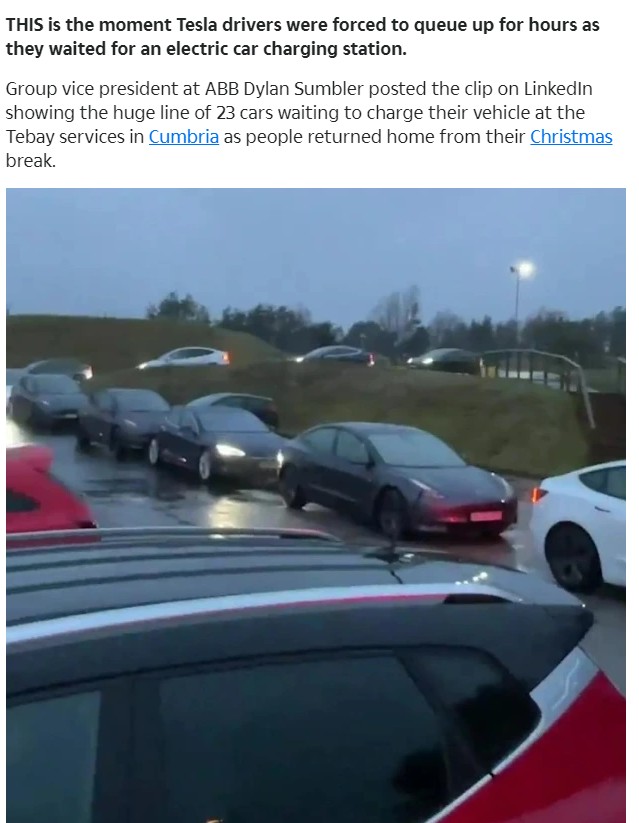
Yip, should've been more clear 👍 I am referring to the queue of cars, not the charging rate of the actual car as I could charge my EV to 80% in 30mins... at the moment, this is the reality where EV uptake was huge:


Shop now for Dell laptops and other devices (affiliate link).
jonathan18
7415 posts

Uber Geek
+1 received by user: 2850

ID Verified
Trusted

  #3050415 15-Mar-2023 14:14
Send private message

Not something we’ve seen much of here, luckily! The media was reporting this as a possible problem over Xmas, given the rise in EV sales hasn’t been matched by a growth in fast chargers, but AFAIK it didn’t really eventuate. I heard there were some longish wait times in key locations like Taupo (even though they have both Tesla and Chargenet setups), but new chargers in under- or un-served locations coming online will help with this.

As for for that SI trip - we had to wait exactly 0 times for a charger, including in places that were expected to be chokepoints (eg Kaikoura). Maybe we struck it lucky, but it’s also a matter of being sensible, ie ABC (including making the most of overnight charging even if that’s the most basic 10A 3-pin solution).

Scott3
4177 posts

Uber Geek
+1 received by user: 2990

Trusted
Lifetime subscriber

  #3050423 15-Mar-2023 14:20
Send private message

Batman:


if you drive a PHEV that is fully charged in EV mode and stop before it hits 0% charged the fuel consumption should be 0L/100km


Numerous PHEV's will start the engine when there is plenty of power in the battery. I havn't driven them, but I understand that the prius PHEV, Prius Prime & Rav4 prime will start the engine and burn fuel if you floor the accelerator, in order to provide more acceleration than the electric system alone (Rav4 prime is much faster than the normal rav4).


Some PHEV's will over-ride EV mode and start the engine at high speed's (135km/h for the prius prime)


Some EV's like Rav4 Prime, will start the engine if you decent a large hill with a full battery, to use the engine compression to slow the car. (no/minimal fuel used during this bit) Then at the end of the hill, the engine will keep running untill it's warm up cycle is complete.


Most PHEV's will start the engine if it hasn't been used in several weeks for a maintenance run, or to avoid the fuel in the tank going stale.


Only PHEV I have drive in a BMW i3 REx, so I don't have first hand experience with most of this. I used the REx enough I never saw a maintenance cycle. On that car, the REx would automatically start when I crossed 7% state of charge, to keep some buffer for hybrid operation / hill climbs etc. (Engine on that car is only thirty something horsepower, so climbing a big hill causes state of charge to drop a few percentage points, even if the engine is running flat out).


danielparker
251 posts

Ultimate Geek
+1 received by user: 102

Trusted
Lifetime subscriber

  #3050424 15-Mar-2023 14:22
Send private message

Silvrav:


Then started comparing costs for PHEV/hybrid/ICE and off all 3 dealers I spoke to and research online, not one recommended a PHEV/Hybrid due to my 95% motorway travel. PHEV (taking specifically the outlander) are excellent in town, short distance cars, but once you do long distance and the battery has drained, the fuel economy is horrendous. Towing was also a concern for me as I tow caravan, boat etc and the tow ratings for PHEV outlander in NZ is rated at 750kg load only due to NZ hills and I actually know of someone who had to get his brother to come fetch his boat as he couldnt get it up the hill.


I own the 2022 outlander PHEV. We regularly get 2500Km from a tank of Petrol. Often we can do a normal day on Battery alone. I have only towed 600Kg with it (Jetski) and couldn't really tell I was towing anything. I have done some long trips on Petrol only.. no complaints about fuel usage.. Certainly not horrendous. (Admittedly our last Outlander was a 3L V6). We have now done 30,000 KM in it.. Generally happy with it.


Batman
Mad Scientist
30015 posts

Uber Geek
+1 received by user: 6217

Trusted
Lifetime subscriber

  #3050538 15-Mar-2023 17:13
Send private message

danielparker:

Silvrav:


Then started comparing costs for PHEV/hybrid/ICE and off all 3 dealers I spoke to and research online, not one recommended a PHEV/Hybrid due to my 95% motorway travel. PHEV (taking specifically the outlander) are excellent in town, short distance cars, but once you do long distance and the battery has drained, the fuel economy is horrendous. Towing was also a concern for me as I tow caravan, boat etc and the tow ratings for PHEV outlander in NZ is rated at 750kg load only due to NZ hills and I actually know of someone who had to get his brother to come fetch his boat as he couldnt get it up the hill.


I own the 2022 outlander PHEV. We regularly get 2500Km from a tank of Petrol. Often we can do a normal day on Battery alone. I have only towed 600Kg with it (Jetski) and couldn't really tell I was towing anything. I have done some long trips on Petrol only.. no complaints about fuel usage.. Certainly not horrendous. (Admittedly our last Outlander was a 3L V6). We have now done 30,000 KM in it.. Generally happy with it.


But if you just count travelling on the open road at 100kph,what is the fuel consumption? Poster says 95% motorway travel.

 1 | 2 | 3
View this topic in a long page with up to 500 replies per page Create new topic


Geekzone Live »

Try automatic live updates from Geekzone directly in your browser, without refreshing the page, with Geekzone Live now.


Are you subscribed to our RSS feed? You can download the latest headlines and summaries from our stories directly to your computer or smartphone by using a feed reader.