Geekzone: technology news, blogs, forums
Guest
Welcome Guest.
You haven't logged in yet. If you don't have an account you can register now.


View this topic in a long page with up to 500 replies per page Create new topic
1 | ... | 27 | 28 | 29 | 30 | 31 | 32 | 33 | 34 | 35 | 36 | 37 | ... | 64
fastbike
447 posts

Ultimate Geek
+1 received by user: 320


  #3472672 23-Mar-2026 16:21
Send private message quote this post

fastbike:


... my wife's 85 year old mum traded her 2008 Corolla with a 1.8l engine (206g/km) in for a new 1.2l Swift (122g/km). 


I forgot to say this is the runout of the gen 3 which is a standard petrol engine running on RON 91.


The replacement model is a hybrid which requires RON95 - Whats the point ?


Do we know what proportion of the fleet requires 91 vs 95 - while I can imagine a 91 engine will run on 95 the opposite would not be true.


And what is the breakdown between 91 and 95 in the fuel stocks being bandied around by the gummint.


I notice MBIE fuel stock figures are still as at 15 March - 8 days out of date in the middle of a crisis. Why are they not reporting daily ?


Otautahi Christchurch


mattwnz
20515 posts

Uber Geek
+1 received by user: 4797


  #3472674 23-Mar-2026 16:21
Send private message quote this post

johno1234:


mattwnz:


 isn’t that new AI data centre only going to use power from the hydro station that was built for the smelter where there is an oversupply of electricity ? That is another can of worms though, seems to be very little benefit to NZ imo, apart from the initial short term one from building it.  


It will be very profitable and an export earner for Meridian and its shareholders - that includes you as the NZ government owns 50% and Kiwisaver and other wealth funds own plenty more.


 that all depends on what they are paying for the power and whether new generation is going to be needed which can have a big payback period. But it also carries risk if we can’t provide that power they need such as power plant failure. Or maybe they well setup their own generation and then there won’t be much benefit at all


gzt

gzt
18685 posts

Uber Geek
+1 received by user: 7826

Lifetime subscriber

  #3472675 23-Mar-2026 16:23
Send private message quote this post

deepred: If there are going to be new data centres, they should use their own self-contained power sources and refrigerants.

Like Musk's gas turbines hopefully not : ).

Self-contained might be a bit much to ask.

Contracts for 95% renewable supply might be more practical.


mattwnz
20515 posts

Uber Geek
+1 received by user: 4797


  #3472677 23-Mar-2026 16:24
Send private message quote this post

fastbike:


fastbike:


... my wife's 85 year old mum traded her 2008 Corolla with a 1.8l engine (206g/km) in for a new 1.2l Swift (122g/km). 


I forgot to say this is the runout of the gen 3 which is a standard petrol engine running on RON 91.


The replacement model is a hybrid which requires RON95 - Whats the point ?


Do we know what proportion of the fleet requires 91 vs 95 - while I can imagine a 91 engine will run on 95 the opposite would not be true.


And what is the breakdown between 91 and 95 in the fuel stocks being bandied around by the gummint.


I notice MBIE fuel stock figures are still as at 15 March - 8 days out of date in the middle of a crisis. Why are they not reporting daily ?


 shouldn’t all new vehicles now run on 91? 


richms
29104 posts

Uber Geek
+1 received by user: 10219

Trusted
Lifetime subscriber

  #3472679 23-Mar-2026 16:27
Send private message quote this post

mattwnz:


 shouldn’t all new vehicles now run on 91? 


Hell no, only low compression naturally aspirated stuff takes that. Most cars now are smaller engines and need all the things they can get to make more power.


Most will detune themselves reducing boost and running richer to help, both ruining economy and power output in order to not destroy themselves, but that's going to really mess up the efficiency vs what the cars stats state they get. IMO when that sort of thing is happening they should throw a check engine light so that it goes to a mechanic that can tell the person they are ruining it slowly, but that would make them seem unreliable so they just leave it till the EGR is all blocked up from being rich to do anything about it.


Richard rich.ms

wellygary
8813 posts

Uber Geek
+1 received by user: 5292


  #3472682 23-Mar-2026 16:29
Send private message quote this post

mattwnz:


 shouldn’t all new vehicles now run on 91? 


'95 is very big in Euro-land , 


European manufacturers tend to use higher compression ratios which need higher octane fuel ( mainly 95) 


Running these vehicles long term on 91 is generally very bad..


Shop now on Samsung phones, tablets, TVs and more (affiliate link).
Handle9
11926 posts

Uber Geek
+1 received by user: 9679

Trusted
Lifetime subscriber

  #3472750 23-Mar-2026 17:31
Send private message quote this post

fastbike:


I notice MBIE fuel stock figures are still as at 15 March - 8 days out of date in the middle of a crisis. Why are they not reporting daily ?


They have announced they will be moving to reporting twice a week. That's more than enough frequency to provide meaningful information.


Scott3

4177 posts

Uber Geek
+1 received by user: 2990

Trusted
Lifetime subscriber

  #3472751 23-Mar-2026 17:33
Send private message quote this post

fastbike:


I forgot to say this is the runout of the gen 3 which is a standard petrol engine running on RON 91.


The replacement model is a hybrid which requires RON95 - Whats the point ?


Do we know what proportion of the fleet requires 91 vs 95 - while I can imagine a 91 engine will run on 95 the opposite would not be true.


And what is the breakdown between 91 and 95 in the fuel stocks being bandied around by the gummint.


I notice MBIE fuel stock figures are still as at 15 March - 8 days out of date in the middle of a crisis. Why are they not reporting daily ?


On what's the point: Avoiding emissions fines is the point. (suspect even with the 95 RON price premium the new one is still cheaper to run anyway) 

Fuel consumption / emissions drop form 5.3 L/100km & 122g to 4.3 L/100km & 96g 3p-WLTP conversion.

The Swift's hybrid system is mild and disappointing, so I suspect most of this gain came from optimizing for higher octane fuel.


Although the government has watered down the clean car standard twice, Like all the OECD (excl Russia) we still have a fleet average emissions limit in place.

Government watered it down in July 2024. Finding it hard to find official sources on this, But I understand the limit for 2026 for cars (utes and large vans get a different limit) was increased from 84.5g CO2e/km to 108g CO2e/km in July 2024. Fines were then dropped by 80% in November 2025. And now there is talk of scrapping the whole thing. Limits set to continue to drop. Cars go to 103g next year (was going to be 63g before).


Automakers pay fines (or trade credits) for any excess emissions. Suzuki currently has no EV's / PHEV's in it's lineup to drag down the average, and it's hybrid tech is lagging well behind that of Toyota (Yaris hybrid at 71g/100km 3P-WLTP conversion). And popular vehicles like the 5 door Jiminy auto (179 g / 100km) will be blowing out their averages meaning they need to pay fines. Assume they committed to their orders before before the government cut the fine by 80%...

This means they will be doing whatever they can to drop fleet average emissions. Higher octane fuel engines, hybrid where-ever Suzuki global can supply etc.


Same reason Toyota NZ is going fully hybrid for everything but their GR line.


-----------

On Petrol octane breakdown, I don't think it is needed. Refinaries will continue to produce in the ratio's we currently buy, so we should get roughly the right mix.


As a general rule the cheaper 91 Octane seems to run dry first at petrol stations. Yes you are correct that cars that recommend 91 Octane can run higher octane with no negative effects (other than cost).


Should note that a decent chunk of cars that recommend 95 have a minimum rating of 91. (i.e they are capable of running in 91 in a limp mode which worsens economy & reduced power).

Some cars like the the GR86 Recommended 98 RON, and have a Minimum of 95 Ron. Running 91 Ron in these risks catastrophic engine damage.


mattwnz:


 shouldn’t all new vehicles now run on 91? 


95 Recommended is getting a heap more common. Most will run on 91 (avoiding damage in a limp mode, but with limited power and high fuel burn).


As mentioned the current 4th gen Suzuki swift is 95 Recommended. Had one as a rental while my leaf was at the panel beaters. Rental company had mislabeled the exterior of the fuel cap as Petrol 91. I noticed the 95 Ron sticker on the inside of the fuel cap, and put 98 to balance out the dregs in the tank. Marked increase in performance. Transformed the drive from Terrible to mildly disappointing...


New Rav4 is 95 Ron Recommended. It has a gasoline particulate filter, and had quite a power drop on the outgoing (91 recommended) car too. This is largely to meet the new Australian emissions standard.


-----------

In most of Europe, the lowest fuel grade available is 95 Ron. Automakers who want to compete seriously in the European market, have no need to consider lower grade fuels, so often optimize their engines for 95 RON Minimum. On some models NZ importers will get to choose between the higher preforming Euro engine setup, and a weaker USA version designed to run on 91 RON (The turbo VW beatle convertible I had as a rental in Hawaii was 91 RON min (87 in usa units)) , and sometimes there simply isn't a choice. VW doesn't design a VW polo to run on anything less than 95 RON.

Sadly some people assume that a non-performance hatchback means 91 RON, and it can end poorly:

https://www.stuff.co.nz/motoring/115903134/driver-put-wrong-grade-petrol-into-her-car-loses-compensation-bid


Scott3

4177 posts

Uber Geek
+1 received by user: 2990

Trusted
Lifetime subscriber

  #3472799 23-Mar-2026 17:47
Send private message quote this post

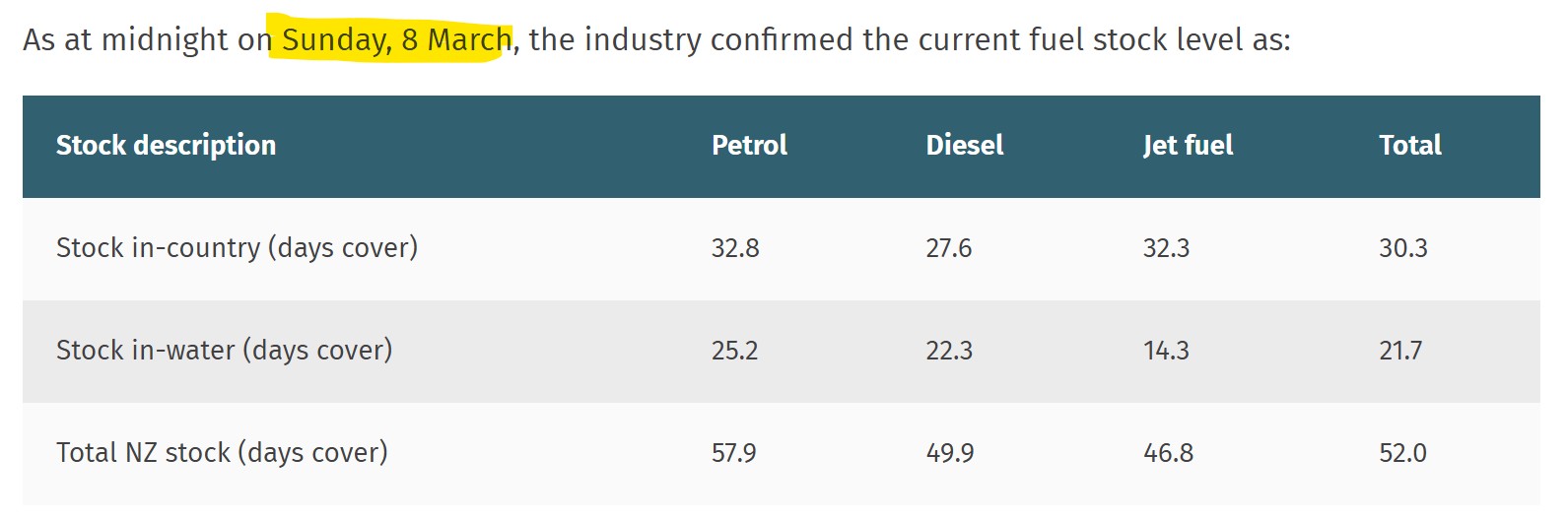
8 March


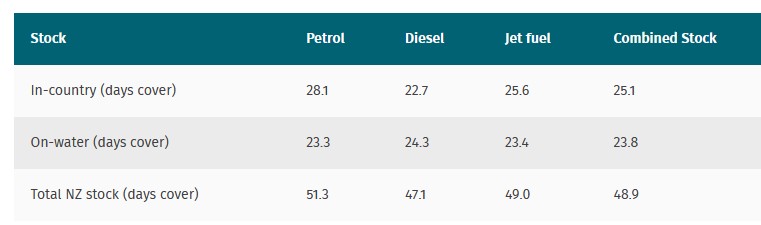
15 March


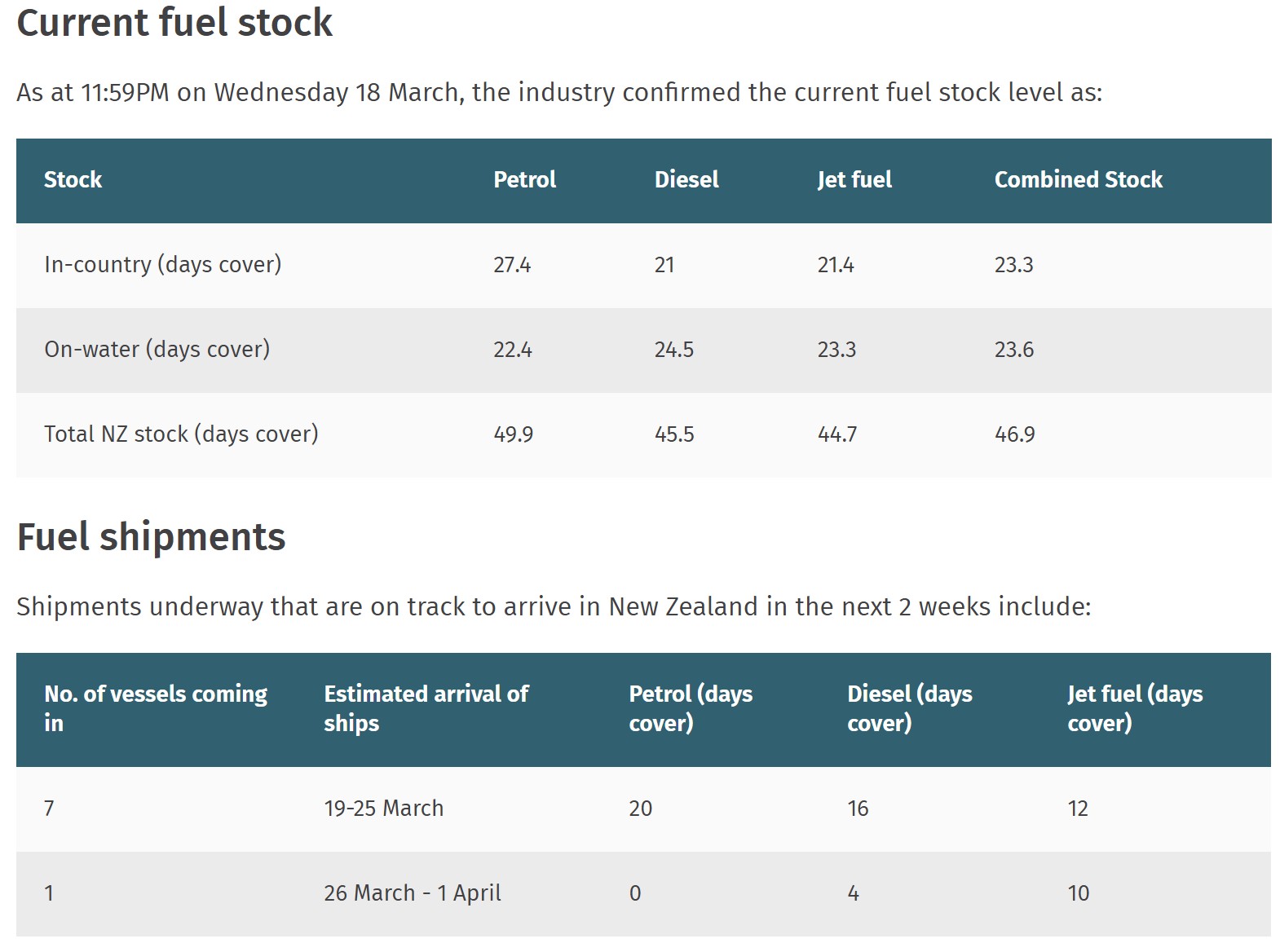
18 March


----

Again without knowledge of usual cadence of ships, it is hard to draw conclusions.

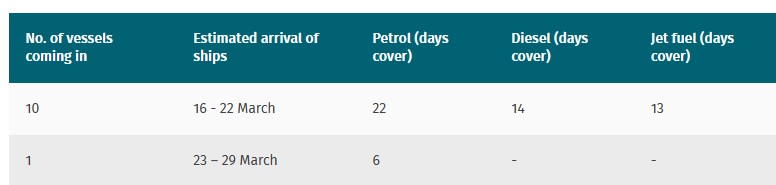
The ship with 6 days of petrol has now slipped into the 19 - 25 march delivery window - Still got quite a mountain of fuel to land in NZ in that window. Good as diesel stock in country have decreased by nearly a week since the 8th of march datapoint.


But yet another 7 day widow with just one ship predicted (noting it is only a 10 day trip from Singapore so it is possible other ships are coming that are yet to depart). Off the back of a 10 ship week, as a layperson this does seem oddly low. 


---------


News headlines in Austrailia is that 6 (of 81 typical monthly shipments) shipments have been canceled or deferred that were due to arrive mid April. (some have been replaced, but the quantity has not been specified)


fastbike
447 posts

Ultimate Geek
+1 received by user: 320


  #3472846 23-Mar-2026 17:52
Send private message quote this post

wellygary:


Scott3:


Wise proposal seems to be to allocate the available fuel on a per head of population basis. This would result in a vast flow of money from businesses to private citizens. Would be very nice for the population (and I assume taxable income), but could be enough to vastly change the cost structure of business, driving massive inflation.


Basically,  its a giant nationalisation of the Fuel system, 


But the government owns none of the fuel coming into the country ( it uses the Petroleum or Engine Fuel Monitoring Levy to buy tickets, but these are not stock, they are rights to stock.....) 


The Fuel companies own the petrol in tanks and on the water, so for the government to "give" this to households means they would have to buy it from the fuel companies first,??.. 


To then give rights to this stock to households who then sell bits they don't want'use on to businesses.... sounds like a rather expensive money and fuel go-round


Did you even read the article ? It is none of the above. It is a personal allocation of a right to purchase fuel. The seller still owns it and can charge what the market will bear. We have yet another market failure here so it needs a hand to allocate resources efficiently and fairly. If you don't need your allocation, give it, or sell it, to somebody who does.


On a related note the data I posted last week about the number of tankers arriving into the country in the next week and the week following has been updated today. It's actually worse than what was reported last week as the timeline has been pushed out and now we have 7 tankers in the week ending 25 March, and only one in the week ending 1 April. We are rapidly drawing down on our stocks and the government is frozen in the headlights - I can just imagine the dynamics in the Cabinet room between the realists (they are a couple) and the market fundamentalists.


Otautahi Christchurch


Scott3

4177 posts

Uber Geek
+1 received by user: 2990

Trusted
Lifetime subscriber

  #3472850 23-Mar-2026 17:55
Send private message quote this post

IEA has published guidelines for dealing with oil shocks

https://www.iea.org/news/new-iea-report-highlights-options-to-ease-oil-price-pressures-on-consumers-in-response-to-middle-east-supply-disruptions


https://www.iea.org/reports/sheltering-from-oil-shocks


Immediate actions to reduce demand:


1. Work from home where possible
Displaces oil use from commuting, particularly where jobs are suitable for remote work.


2. Reduce highway speed limits by at least 10 km/h
Lower speeds reduce fuel use for passenger cars, vans and trucks.


3. Encourage public transport
A shift from private cars to buses and trains can quickly reduce oil demand.


4. Alternate private car access to roads in large cities on different days
Number-plate rotation schemes can reduce congestion and fuel-intensive driving.


5. Increase car sharing and adopt efficient driving practices
Higher car occupancy and eco-driving can lower fuel consumption quickly.


6. Efficient driving for road commercial vehicles and delivery of goods
Better driving practices, vehicle maintenance and load optimisation can cut diesel use.


7. Divert LPG use from transport
Shifting bi-fuel and converted vehicles from LPG to gasoline can preserve LPG for cooking and other essential needs.


8. Avoid air travel where alternative options exist
Reducing business flights can quickly ease pressure on jet fuel markets.


9. Where possible, switch to other modern cooking solutions
Encouraging electric cooking and other modern options can reduce reliance on LPG.


10. Leverage flexibility with petrochemical feedstocks and implement short-term efficiency and maintenance measures
Industry can help free up LPG for essential uses while reducing oil consumption through quick operational improvements.


------------


Interesting the focus on LPG. Austrailia gets 80% from Natural gas, so I assume NZ and Aust are protected here.

Only 2, 4 & 6 cover diesel. 2 might be difficult. NZ already has a 90 km/h speed limit for truck's, so we would need to drop them below that to see any gains. (hope EV's aren't covered in any Speed limit reductions). 4 is quite radical taking half the cars off the road, so trucks can travel at a steadier speed... 6. Suggest most transport operators already do those things.


Move to New Zealand's best fibre broadband service (affiliate link). Free setup code: R587125ERQ6VE. Note that to use Quic Broadband you must be comfortable with configuring your own router.

gzt

gzt
18685 posts

Uber Geek
+1 received by user: 7826

Lifetime subscriber

  #3472874 23-Mar-2026 19:04
Send private message quote this post

mattwnz: shouldn’t all new vehicles now run on 91?

I'm guessing that common misconception arises from somewhere around the leaded to unleaded fuel transition for some reason. I can't quite put my finger on it.

gzt

gzt
18685 posts

Uber Geek
+1 received by user: 7826

Lifetime subscriber

  #3472876 23-Mar-2026 19:16
Send private message quote this post

Scott3: NZ already has a 90 km/h speed limit for truck's, so we would need to drop them below that to see any gains. (hope EV's aren't covered in any Speed limit reductions).

10kmh reduction resulting in 80kmh for HT and 90Kmh for cars. It would only be fair to require the same for EV - many EV have improved efficiency and increased range at that speed so it's not entirely without user benefit. The bigger problem for us would be our road capacity, but I'm guessing our traffic will reduce substantially anyway with the price increase, but also with WFH and alternative travel options in use. #4 just sounds entirely unworkable.

fastbike
447 posts

Ultimate Geek
+1 received by user: 320


  #3472893 23-Mar-2026 21:11
Send private message quote this post

gzt:
Scott3: NZ already has a 90 km/h speed limit for truck's, so we would need to drop them below that to see any gains. (hope EV's aren't covered in any Speed limit reductions).

10kmh reduction resulting in 80kmh for HT and 90Kmh for cars. It would only be fair to require the same for EV - many EV have improved efficiency and increased range at that speed so it's not entirely without user benefit. The bigger problem for us would be our road capacity, but I'm guessing our traffic will reduce substantially anyway with the price increase, but also with WFH and alternative travel options in use. #4 just sounds entirely unworkable.


Not just fair, but efficient/safe. Imagine a road with 80km/h for HGV, 90 for ICE and 100 for EV. You'd need to be giving additional $$ to ACC and HealthNZ.


Otautahi Christchurch


Wheelbarrow01
1784 posts

Uber Geek
+1 received by user: 2638

Trusted
Chorus

  #3472913 23-Mar-2026 22:58
Send private message quote this post

wellygary:


mattwnz:


 shouldn’t all new vehicles now run on 91? 


'95 is very big in Euro-land , 


European manufacturers tend to use higher compression ratios which need higher octane fuel ( mainly 95) 


Running these vehicles long term on 91 is generally very bad..


Even the just-launched 2026 Toyota RAV4 must be run on 95. The 2019-2025 models all ran on 91.


The new model runs a gas particulate filter (similar to a DPF in a modern diesel). Both the 95 octane and GPF were apparently required in order for the RAV4 to gain Euro6D emission compliance.


1 | ... | 27 | 28 | 29 | 30 | 31 | 32 | 33 | 34 | 35 | 36 | 37 | ... | 64
View this topic in a long page with up to 500 replies per page Create new topic


Geekzone Live »

Try automatic live updates from Geekzone directly in your browser, without refreshing the page, with Geekzone Live now.


Are you subscribed to our RSS feed? You can download the latest headlines and summaries from our stories directly to your computer or smartphone by using a feed reader.