|
|
|
A reduction in fuel tax will increase demand for fuel - the exact opposite thing we want to happen.
jameshammond:
A reduction in fuel tax will increase demand for fuel - the exact opposite thing we want to happen.
that is like saying people will waste fuel if it is cheaper. I haven’t noticed any changes in driver numbers and habits and just as many noisy boy racer cars that use a lot of fuel driving around
mattwnz:
jameshammond:
A reduction in fuel tax will increase demand for fuel - the exact opposite thing we want to happen.
that is like saying people will waste fuel if it is cheaper. I haven’t noticed any changes in driver numbers and habits and just as many noisy boy racer cars that use a lot of fuel driving around
I am getting to work in 25 mins instead of 45-50 - there is no queue on onewa road. Traffic volumes are down massivly. If the higher prices make stocks last longer then that is a good thing.
Stu1:
HelloThere: https://www.nzherald.co.nz/nz/politics/fuel-prices-government-to-announce-support-package-for-families-under-the-pump-as-petrol-hits-4-a-litre-in-some-areas/4IGEJBXRFZAUPOUCSWCB2ECOGA/
An extra $50 a week for approximately 140,000 families if they get the In Work Tax Credit.
Not good enough , would rather the tax drop 20c per litre. Doesn’t help students , pensioners , unemployed or middle class NZ
Veeery difficult to do this given how hard they screamed about Labour ruining the country after both COVID and the Ukraine invasion. Apparently there's a limit to how obvious their hypocrisy can be.
iPad Pro 11" + iPhone 15 Pro Max + 2degrees 4tw!
These comments are my own and do not represent the opinions of 2degrees.
richms:
I am getting to work in 25 mins instead of 45-50 - there is no queue on onewa road. Traffic volumes are down massivly. If the higher prices make stocks last longer then that is a good thing.
I guess it is very different in areas where there are no public transport options such as large rural towns. It is just as busy as ever.
mattwnz:
I haven’t noticed any changes in driver numbers and habits and just as many noisy boy racer cars that use a lot of fuel driving around
PT ridership is up in all the main centres, and I expect it will go higher,
Traffic congestion is down, so there is definitely changes going on (Economically it's called demand destruction)
wellygary:
mattwnz:
I haven’t noticed any changes in driver numbers and habits and just as many noisy boy racer cars that use a lot of fuel driving around
PT ridership is up in all the main centres, and I expect it will go higher,
Traffic congestion is down, so there is definitely changes going on (Economically it's called demand destruction)
Shows the money spent on bike lanes wasn't wasted after all. Wellington is on the way up now
Stu1:Not good enough , would rather the tax drop 20c per litre. Doesn’t help students , pensioners , unemployed or middle class NZ
mattwnz:
jameshammond:
A reduction in fuel tax will increase demand for fuel - the exact opposite thing we want to happen.
that is like saying people will waste fuel if it is cheaper. I haven’t noticed any changes in driver numbers and habits and just as many noisy boy racer cars that use a lot of fuel driving around
I suspect the elastically is higher if the change happens over a short duration. I.e. fuel jumping by $1 overnight may cause motivation to take off the unused roof rack, and pump up the tires (and perhaps cancel your plans of running the SUV down the length of Muriwai in the weekend), where a 2c / week increase over a year may not.
If we were looking to save 20% of fuel, we would need prices to roughly double.
Scott3:
If we were looking to save 20% of fuel, we would need prices to roughly double.
But it is complicated by the Petrol/Diesel Split,
Its almost impossible to reduce Diesel used in the commercial sector ( over a short time frame anyway )
Discretionary use of Petrol is much easy to reduce,
The COVID lockdowns showed that as long as "manufacturing, construction and agriculture" were operating, Diesel use is still 80-90%, but you can grind petrol down to 50%
We need refineries to prioritise turning the remaining crude sources into Diesel, which is essential for the "productive" sector..
"At level 3, when there were still recommended stay-at-home orders, but much of the manufacturing, construction and agriculture workforces returned, petrol demand was 45-55% of usual consumption, but diesel was still at 80-90%.
It was only under level 4, when only essential services were operating, that diesel consumption dramatically reduced, to 30-40% of normal use."
https://www.stuff.co.nz/politics/360954903/do-we-need-lockdown-dampen-diesel-demand
HelloThere: https://www.nzherald.co.nz/nz/politics/fuel-prices-government-to-announce-support-package-for-families-under-the-pump-as-petrol-hits-4-a-litre-in-some-areas/4IGEJBXRFZAUPOUCSWCB2ECOGA/
An extra $50 a week for approximately 140,000 families if they get the In Work Tax Credit.
I know this happened a few years back via petrol / RUC tax cuts, but I really dislike this:
Generally, using the in work tax credit means that those who are low income and working are covered. The likes of pensioners don't have the same commuting needs as workers. Students fall through the cracks, but this is nothing new.
PaknSave in Rotorua which was the cheapest in the Country has been closed for 2 months upgrading they are due to open this week. I wonder if they will be brave enough to have opening specials with cheap fuel . God help them if they do they will need tankers on standby and police to control the traffic./
Common sense is not as common as you think.
This is more than just normal price volatility. These are potentially black swan events, covid definitely was, as were events like WW2 . IMO what happened during Covid over fuel tax was the right move. The wage subsidy back then probably wasn’t. This negatively affects anyone on low income without kids. Some families on over $140k per year can even get it under WFF according to the interest.co.nz, as do families without a car, so it definately isn't targeted to those just on low incomes that will be worst affected by this. It is just an easy way for the government to show that they have done something, and very easy to administer. But it is such a small percentage of people that will benefit.
But not removing tax on fuel will increase inflation as it will add to the cost of everything people buy, not just the fuel itself. Whereas removing it reduces that somewhat. Lower income people benefit the most as a higher % of their earnings are spent on goods and services that will be affected by inflation increases.
wellygary:
We need refineries to prioritise turning the remaining crude sources into Diesel, which is essential for the "productive" sector..
Crude oil has a fixed percentage of its constituent fractions. Prioritising to particular fractions is about as viable as breeding cattle with higher sirloin content.
The exception is when heavier fractioned are cracked but this adds extra expense to the refining process so would have limited potential in controlling fuel price rises.
https://www.harmlesssolutions.co.nz/
wellygary:
Scott3:
If we were looking to save 20% of fuel, we would need prices to roughly double.
But it is complicated by the Petrol/Diesel Split,
Its almost impossible to reduce Diesel used in the commercial sector ( over a short time frame anyway )
Discretionary use of Petrol is much easy to reduce,
The COVID lockdowns showed that as long as "manufacturing, construction and agriculture" were operating, Diesel use is still 80-90%, but you can grind petrol down to 50%
We need refineries to prioritise turning the remaining crude sources into Diesel, which is essential for the "productive" sector..
"At level 3, when there were still recommended stay-at-home orders, but much of the manufacturing, construction and agriculture workforces returned, petrol demand was 45-55% of usual consumption, but diesel was still at 80-90%.
It was only under level 4, when only essential services were operating, that diesel consumption dramatically reduced, to 30-40% of normal use."
https://www.stuff.co.nz/politics/360954903/do-we-need-lockdown-dampen-diesel-demand
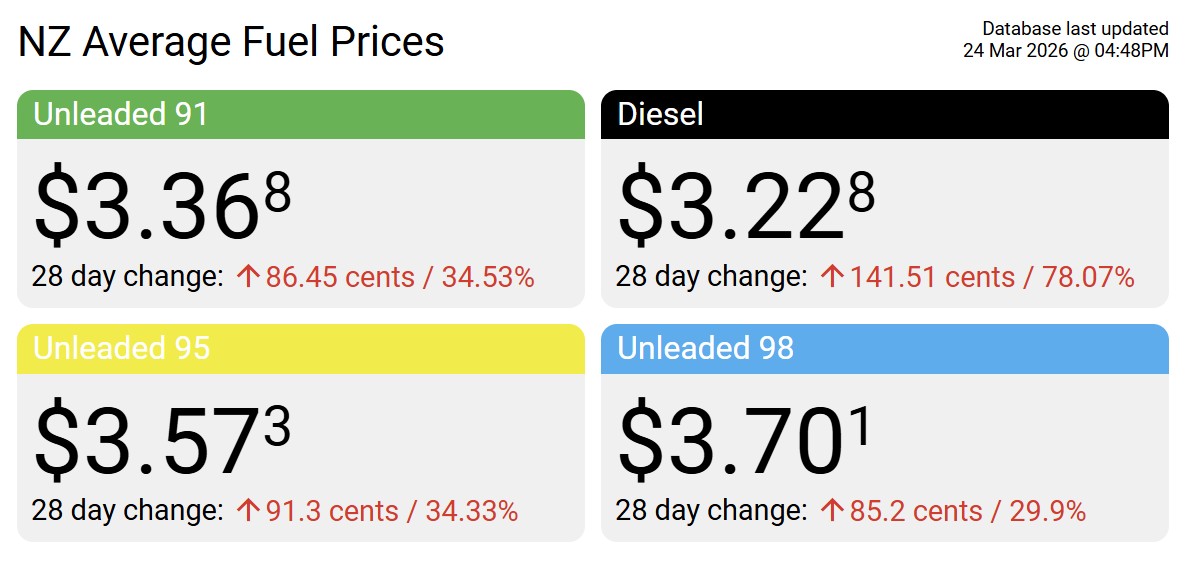
While I I don't have the elasticity values for each fuel, I note that diesel has had a much higher percentage increase than petrol. It is getting very close to 91 RON in price despite not having road user tax built in.
At this stage I think saving any fuel (without causing reduced economic output) is a good play. There is some limited fungibility between the fuels. Houses with a Camry and Hilux side by side in the garage etc.
If we get to a fuel supply crunch I would expect 100% of diesel would be allocated to critical & business use, with nothing left for private use. Diesel cars make up about 21% of our vehicle light fleet (and they are mostly utes and larger vans), so outside of applications that specifically require utes or vans, I imagine people will be able to make borrow / rent / carpool arrangement with those with non diesel vehicles (inconvenient of course).
I am already reading stories from the Philippines where people are leaving their diesel fortuners at home, and taking their Camry instead. (a lot of wealthy people own multiple vehicles in manila as they have a long running carless days program). Diesel is normally cheap their due to tax rates, so diesel vehicles were historically cheap to run, but current prices have flipped this.
|
|
|