|
|
|
Anecdotal I know, but the rebate pushed me to get a new Tesla Model 3 rather than the used BMW 330e I was looking at. With the way the government is double taxing PHEVs, I’m glad I did.
“We’ve arranged a society based on science and technology, in which nobody understands anything about science technology. Carl Sagan 1996
The extent of the increase in EV uptake that the CCR was responsible for will only able to be gauged in hindsight I would suggest. The purpose of the CCD scheme was to kickstart EV uptake which it appears to have been very successful in doing going by the nationwide sales statistics quoted earlier. It's just a pity that similar stimulation hasn't been implemented for domestic solar uptake in NZ. The success of this in Australia is obvious with over 1 in 3 houses now having PV installed, and the lack of EV incentives there see them only very recently purchasing EVs in any significant numbers. The synergy of EVs combined with PV is significant and both technologies should be incentivised in tandem for their individual advantages to be maximised.
EVs are still in the early stages of adoption in both NZ & AU, with NZ generally regarded as having moved beyond the 'early adopter' phase with us now moving into the 'early majority' stage of EVs' disruption of the domestic transport sector; a situation that may well have come about as a result of the CCD kickstart. The general availability of secondhand EVs together with new EVs reaching price parity with ICEV equivalents will be where the uptake curve steepens and the stimulus from the now discontinued CCD will flow through again as the EVs purchased already reach the used car market. The advent of the use of EVs being used in a V2G/V2H capacity in the coming years will also serve to raise their popularity and further stimulate sales of EVs.
https://www.harmlesssolutions.co.nz/
Sony Xperia XA2 running Sailfish OS. https://sailfishos.org The true independent open source mobile OS
Samsung Galaxy Tab S6
Dell Inspiron 14z i5
Technofreak: Stop talking rubbish. The government isn't double taxing PHEV's. In fact a smart PHEV owner using a PHEV as intended will pay the least of any vehicle owner.You do realise that the 'discounted' RUC rate for PHEVs is only a temporary measure until such time that NACT roll out distance based RUCs for all vehicles? At that point PHEVs will be paying the same RUC rate as any other vehicle and the economic disadvantage of a vehicle with battery degradation and ICE maintenance costs will cancel out their running cost advantage, as it will for hybrids in general to a large degree, particularly if a fossil fuel use disincentive is implemented in the form of an increased carbon tax to at least partly replace the removal of FET.
https://www.harmlesssolutions.co.nz/
Technofreak: Stop talking rubbish. The government isn't double taxing PHEV's. In fact a smart PHEV owner using a PHEV as intended will pay the least of any vehicle owner.
This is exactly the point I made in my earlier post. As for the Govt might enable later, I don't think there has been any policy announcements but whatever they decide is going to have a big IT component and not going to hold out hope they could bring in something that 1) works 2) is easy to use for all and 3) and is delivered in the term of the current Government.
This is an interesting and well thought out article on the matter of the issue to consider when thinking about a new way to charge for road usage
https://thestandard.org.nz/are-road-user-charges-for-every-vehicle-actually-fair/
Cool article especially the bit about more nuanced weighting of RUC for impact of the vehicle on road.
Suspect that'll mean that the equivalent vehicle type, EVs will get charged more because of the weight of batteries? e.g. see Table 2 of https://www.sciencedirect.com/science/article/pii/S0304389421015910?via%3Dihub
paulchinnz:
Cool article especially the bit about more nuanced weighting of RUC for impact of the vehicle on road.
they used to do it that way. former boss would get cheaper ruc for winter when we rarely had weight on the back of the utes. but they did away with that as it was to complicated and many people simple used the cheaper rates regardless. especially as enforcement is almost non-existent.
making ruc match the gvm may result in manufactures underspec their gvm depending on the market they want to sell to, which then gets ignored in practice. ie take a 3 ton gvm ute, class it as 2 ton gvm so the tax is only for a 2 ton, then people still use it as a 3 ton gvm. it becomes a mess really quickly and enforcement is almost non-existent and expensive to do.
Technofreak: Stop talking rubbish. The government isn't double taxing PHEV's. In fact a smart PHEV owner using a PHEV as intended will pay the least of any vehicle owner.
It’s not rubbish. In my use case (I did say it was anecdotal) my round trip to work is 100km. There is no ability to charge at work and the BMW has an all-electric range of 25km (at most). So 75% of the journey is on petrol at 10.9c/km for road tax (5.6c FET + 5.3c RUC). Note I’m only talking road tax here, not total running costs. So I refute your argument that a PHEV in electric mode will “pay the least of any vehicle owner” if you are just looking at the taxes. Any petrol car that uses less than 6.5l/100km will pay less road tax than a PHEV in battery mode.
So once the battery is depleted the PHEV will pay;
Two taxes. Double taxing. Triple taxing if you include the added GST.
“We’ve arranged a society based on science and technology, in which nobody understands anything about science technology. Carl Sagan 1996
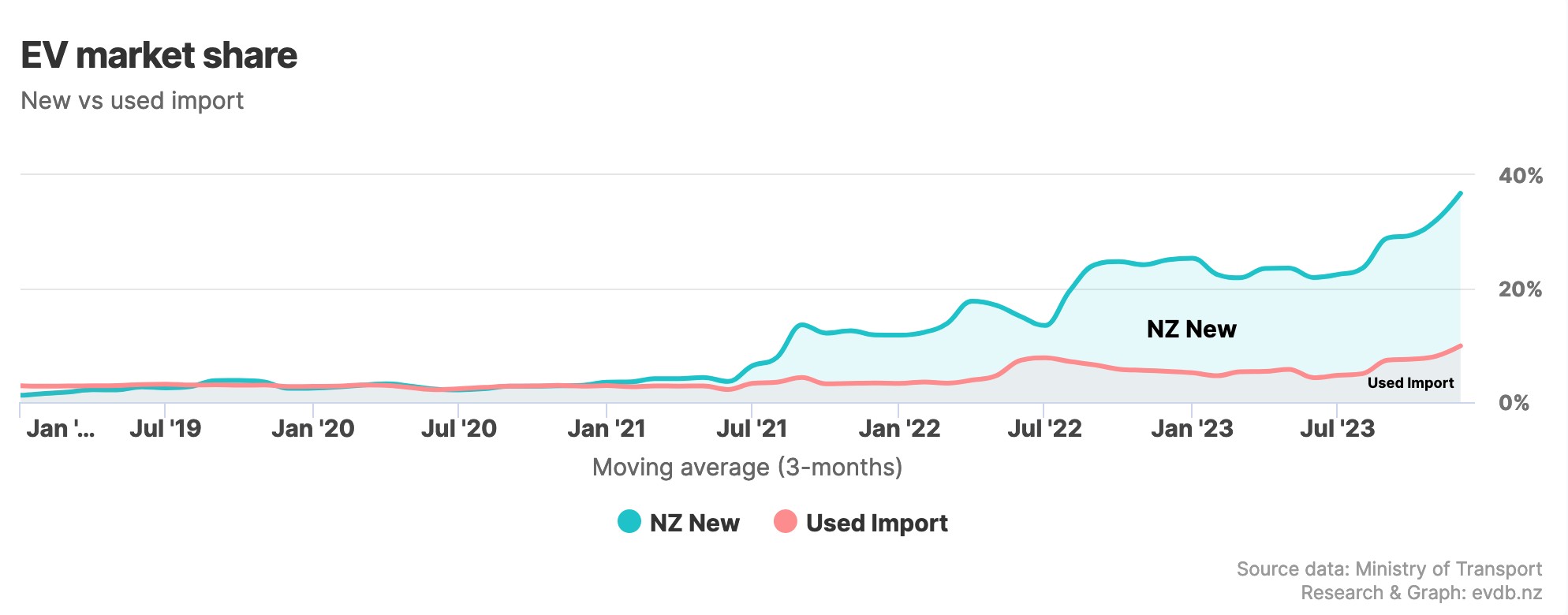
I'm interested to see what this graph would look like this time next year, to see the exact impact the removal of the CCD and application of RUCs has on the EV/PHEV community.

This graph below highlights the massive positive effect the CCD had on people deciding to choose a new EV over an ICE equivalent.
July 1st 2021 was when it was introduced.
I’m keen to know which, if any, iPhone GPS apps show speed in NZ. Google Maps doesn’t.
Sometimes I just sit and think. Other times I just sit.
eracode:If you're trying to check speedo accuracy in a vehicle there are other methods. We checked our Leaf by using our Garmin GPS to display speed (Leaf reads ~8% high). For the Polestar2 this isn't possible as the 12V 'cigarette lighter' socket is located in the rear of the cargo area and the Garmin's power lead won't reach that far (while still maintaining satellite visability) so we used the dashcam while driving at a set speed using CC (100kmh) and then reviewing the video (Polestar reads high by ~5%).
I’m keen to know which, if any, iPhone GPS apps show speed in NZ. Google Maps doesn’t.
https://www.harmlesssolutions.co.nz/
eracode:
I’m keen to know which, if any, iPhone GPS apps show speed in NZ. Google Maps doesn’t.
Waze will show you the speed.
Jarle Dahl Bergersen | Referral Links: Want $50 off when you join Octopus Energy? Use this referral code
Are you happy with what you get from Geekzone? Please consider supporting us by making a donation or subscribing.
Mehrts:
I'm interested to see what this graph would look like this time next year, to see the exact impact the removal of the CCD and application of RUCs has on the EV/PHEV community.
Thanks for the data from https://evdb.nz/ev-percentage-nz
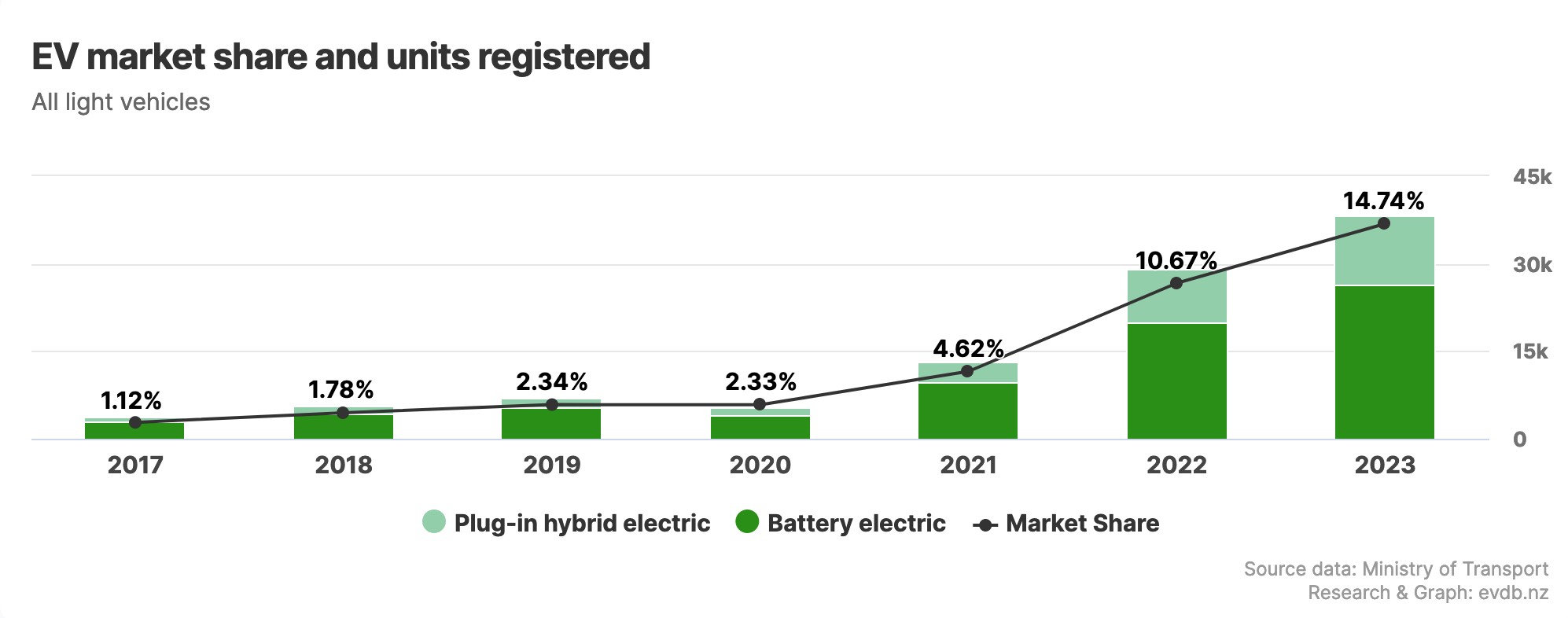
So 3685 and 5542 in 2017 and 2018, respectively, which is an 80% increase year on year, and 6965 in 2019 i.e. 26% increase vs 2018. All well before mid-2021 i.e. CCD. The point being there are other factors that lead to increasing EV uptake besides CCD, so we shouldn't be too quick to attribute the increases in 2021-2023 to the CCD. I'm not saying the CCD didn't do anything. I'm saying the contribution of the CCD is unclear (in the absence of more intricate analyses that tease apart the various contributing factors).
Silly analogy but heck I got my first EV in 2016, and my second end of 2019, and these purchases also coincided temporally to the two upticks 2017-2019 and 2020-2023. The likelihood that those two upticks in EVs had anything to do with my purchases is bugger all. Correlation isn't causation.
Also, to my point about the honeymoon hypothesis above, if the CCD had stayed, maybe 2024 would've been 14.7% like 2023, reflecting what happened in 2019-2020 where it was 2.3% both years after a few years of increase prior. Has anyone published any modelling/simulation projections of EV market share in NZ with/without CCD and ditto RUCs?
eracode:
I’m keen to know which, if any, iPhone GPS apps show speed in NZ. Google Maps doesn’t.
“Here WeGo” does. I believe it’s free.
Crazy that Google maps doesn’t, ridiculous in my opinion.
Sure Google maps use to as when was on bus use to see speed bus was going at, it looks like they have removed it on iPhones.
I went to settings, navigation, option wasn’t there for speed display iPhone Goggle Maps.
HarmLessSolutions:
eracode:If you're trying to check speedo accuracy in a vehicle there are other methods. We checked our Leaf by using our Garmin GPS to display speed (Leaf reads ~8% high). For the Polestar2 this isn't possible as the 12V 'cigarette lighter' socket is located in the rear of the cargo area and the Garmin's power lead won't reach that far (while still maintaining satellite visability) so we used the dashcam while driving at a set speed using CC (100kmh) and then reviewing the video (Polestar reads high by ~5%).
I’m keen to know which, if any, iPhone GPS apps show speed in NZ. Google Maps doesn’t.
Thanks but I know there are ‘other methods’. I have access only to an iPhone - don’t want to buy something else. That’s why I specified iPhone apps in my query.
Sometimes I just sit and think. Other times I just sit.
|
|
|