|
|
|
gzt: The Low Emissions Heavy Vehicle Fund is still running and will pay up to 25% of the retail price for an approved vehicle or conversion:
https://www.eeca.govt.nz/co-funding-and-support/products/low-emissions-heavy-vehicle-fund
Scroll the page to view approved vehicles.
A great fund, a bit of a process, but has delivered some very good early steps in the right direction. Some parts of the industry are more hesitant than others, unfortunately.
Zeon:
Just throwing an idea out there - what is the feasibility of reducing overall national diesel requirements by say switching, where feasible over to petrol or EV vehicles to perform the same task. For example could you replace delivery vans with a petrol or EV pulling a high-sided trailer with a tarpauline over the top and the goods inside? Perhaps the load limits would be less but it achieves the goal of moving goods from point A to B.
petrol vehicles pulling heavy loads drinks petrol like crazy. under high loads is where diesels shine and petrols suck. replacing an otherwise empty diesel ute with small petrol car or ev is a lot better.
last time we had a sudden big fuel price hike, people panicked and bought cheap to run vehicles that cost 10x more than the fuel cost they saved. family members sold their almost new small car back to the dealers for more than what they paid for it new, and then dealer on sold it for profit. the biggest cost of car ownership is typically buying the car in the first place.
wellygary:
Only if
demand[quantity demanded] falls,
Currently that doesn't appear to be the case ( although there are comments that Kms travelled might be lower.).. but so far we've seen no hard eveidence of this...
At the moment the govt's GST take on fuel is probably up by 60-100% depending on the fuel mix..
We can look at historic events, and current antidotes of reduced traffic congestion etc, to reach the conclusion that travel decreases with high fuel prices. Proper stats will come later.
Looking at GST on fuel in isolation is not picking up on the whole picture. A heap of people are spending less (and hence paying less GST) in other area's to pay for fuel.
cddt:
Except for the fact that petrol has very low elasticity, and diesel even less.
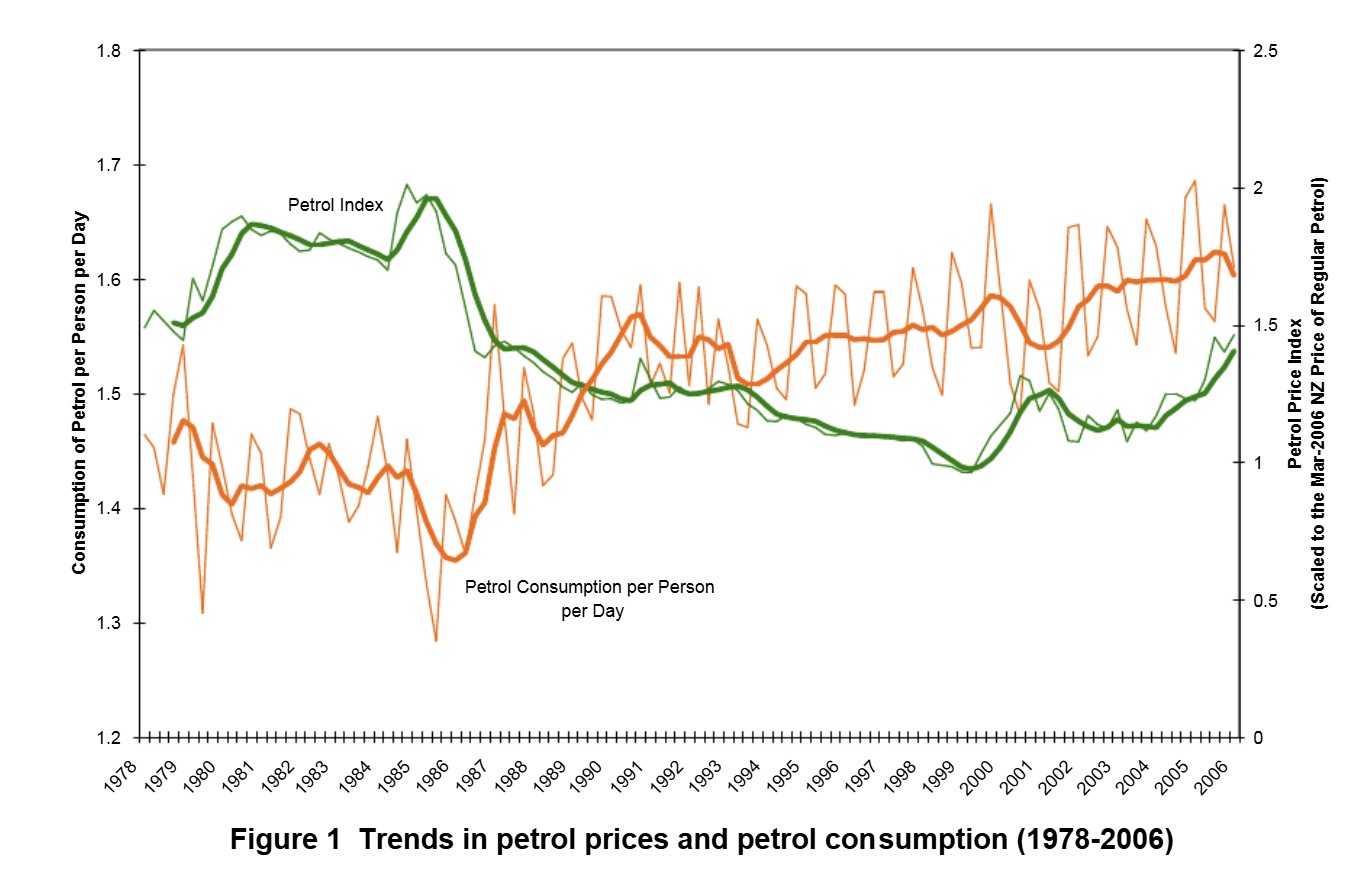
It's low, but not negligible As an example the below has derived at -0.15 elasticity for a short event and -0.20 for a long event. There is a clear inverse correlation shown on the below graph.

https://www.researchgate.net/publication/267782357_Impacts_of_Petrol_Prices_on_Consumption_and_Travel_Demand_-New_Zealand_Evidence
Frustratingly I have struggled to find research that breaks out Diesel and Petrol elasticities.
Interesting to hear that Japan are freezing retail prices as a reaction to this. I wonder if they could do that in NZ. We face huge inflation coming up as the government now has new inflation figures which they choosing not to suppply to the public
One thing I haven't heard anyone discuss is bunker fuel. Do NZ-bound ships refuel here, or do they tend to fuel up for the return trip where they leave from? Is there a shortage of bunker fuel? It might be less of an issue due it being the sludgy rubbish that's left over from everything else so there are potentially more sources of it. But I don't know.
iPad Pro 11" + iPhone 15 Pro Max + 2degrees 4tw!
These comments are my own and do not represent the opinions of 2degrees.
dafman:
Ok, what aspect of the scheme am I ignoring that assisted people experiencing cost of living financial hardship?
All the aspects I quoted above about all the other vehicles that got a rebate as well?
iPad Pro 11" + iPhone 15 Pro Max + 2degrees 4tw!
These comments are my own and do not represent the opinions of 2degrees.
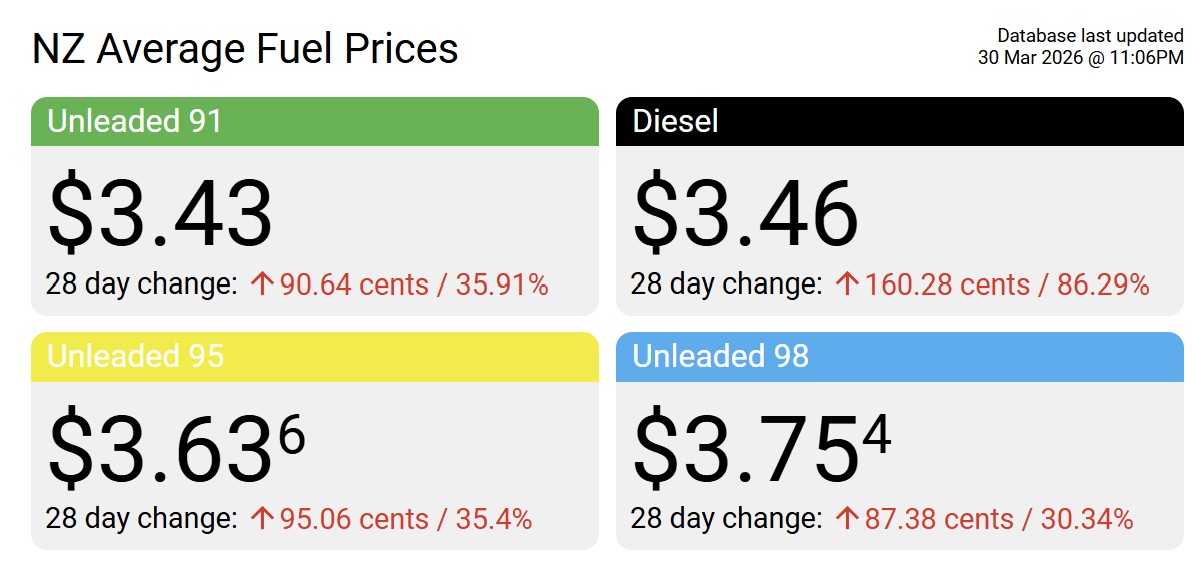
National Average cost of diesel now exceeds 91 RON. Note petrol included road tax. Diesel / Electric cars need to pay an additional 7.6c / km or road tax. 
Yet another sign of relative tightness of diesel supply.
To the person
Zeon:
Just throwing an idea out there - what is the feasibility of reducing overall national diesel requirements by say switching, where feasible over to petrol or EV vehicles to perform the same task. For example could you replace delivery vans with a petrol or EV pulling a high-sided trailer with a tarpauline over the top and the goods inside? Perhaps the load limits would be less but it achieves the goal of moving goods from point A to B.
If it is feasible then re-arranging fleets - helping brokerage of hiring private vehicles with towbars to distribution businesses, planning allocation of trailers, loosening laws that may hinder this (e.g. too-consdervative weight limits), introducing tough penalties for theft from unlocked trailers etc. - could we be getting started now?
I'm not sure how much diesel this kind of potentially substitutable transportation uses within the wider diesel use where substitution is impossible (e.g. farming equipment), but it could allow redirection to those types of industries who have no choice?
It seems that there aren't too many ideas beyond rationing being thrown around at the moment...
Of on road diesel use, something like 5 -10 % goes to light passenger vehicles and 20 - 25% to light commercial vehicles (I suspect half of which will be private use Utes and Vans).
Off road, most diesel use is commercial (but a little bit does go to recreational boating & the odd old diesel residential heating system_
I suspect at some point if this continues we will see a zero / near zero ration for private use diesel. Designate all our diesel to commercial uses. This should save somewhere in the area of 15% - 20% of consumption
Hopefully that is enough, but if not, then yeah looking for commercial substation would be the easiest pick.
Plenty of people riding around in work Ute (reasons such as Fringe benefit tax, blending in in rural area's, fleet uniformity, driver preference etc), which could easily be substituted for a hatchback with not other requirements.
Lots of urban smaller item delivery services / tradespeople who could work out of diesel Utes & vans that could at a pinch work from smaller vehicle (nv200 petrol or electric van, or a petrol or electric wagon / SUV).
While relatively rare, petrol ute's & larger vans do exist. Over 1000 petrol utes on trademe (Not quite sure if swapping to a v6 petrol Holden ute or ranger raptor is ideal in a fuel shortage, but does move the fuel consumption away from diesel. Similar deal with vans. 300+ petrol Hiaces on trademe, and there is stuff like Estima / previla, where you can rip the seats out and use it as a delivery van without to much issue.
On replacing trucking with light vehicles & trailers, while in a crisis we may try, it is super labor intensive. I could chuck a 1000L IBC on a trailer and tow it behind my model Y, but with a 1600kg tow rating, that is it roughly full. Would take a convoy of 18 such vehicles to replace a single regular fonterra milk truck and trailer, to get the milk from a farm to the dairy plant.
dafman:
Aussies halving fuel tax for three months to lower price.
I'm in Aust. Thoughts on the lower fuel tax are quite mixed
mattwnz:
NZ needs to follow IMO. The benefits will help all lower income people as most of their income is spent on consumables where most will increase as a direct result of fuel price rises. IMO it seems they would rather cherry pick their voter base by helping just a very small percentage of the population that are affected.
I strongly oppose NZ doing this.
Much more targeted ways of helping those with low income are available (current government has made a start, but it could be argued the scope is too narrow)
SaltyNZ:
dafman:
Ok, what aspect of the scheme am I ignoring that assisted people experiencing cost of living financial hardship?
All the aspects I quoted above about all the other vehicles that got a rebate as well?
At risk of laboring this point, so this will be my last comment on it.
The rebate scheme was solely directed to, and for the assistance of, people who had sufficient funds, or access to sufficient funds, to purchase a new or used vehicle. These people are not suffering financial hardship.
Contrast this with current situation where many people are working minimum wage jobs, rely on their ageing fuel-hungry vehicles to get to work (because the don't have the funds to replace them), and are suffering serious financial hardship without any access to subsidy or relief.
What particularly irks me is people who felt entitled to grab a $7,000 taxpayer subsidy to purchase a $70k Tesla, but now argue against assisting those in genuine financial stress under current circumstances. I'm not suggesting this is you @SaltyNZ, and yes I have been deliberately provocative with pulling out the Tesla example, but sometimes you need to be to get the point across.
dafman:
The rebate scheme was solely directed to, and for the assistance of, people who had sufficient funds, or access to sufficient funds, to purchase a new or used vehicle. These people are not suffering financial hardship.
Alright, I'll give you that. My objection was the emphasis on expensive cars to the exclusion of all else even though it also applied to a whole range of other vehicles - including those within the price range of low cost car buyers.
What particularly irks me is people who felt entitled to grab a $7,000 taxpayer subsidy to purchase a $70k Tesla, but now argue against assisting those in genuine financial stress under current circumstances. I'm not suggesting this is you @SaltyNZ, and yes I have been deliberately provocative with pulling out the Tesla example, but sometimes you need to be to get the point across.
The only person I've seen really making that argument is the PM. Who also blamed his wife for buying a Tesla. But yeah, that is a massively tone-deaf position to be taking. (Which is pretty on brand for Luxon so no real surprises there).
If this is their version of adequate support right now, god help us when the actual crisis hits.
Seymour was on RNZ this morning giving a snide 5-point speech emphasizing once again how badly Labour f'ed the country during COVID and that he certainly isn't going to let our kids get dumber by not going to school during this crisis. He has no plan on how those kids are going to get to school when their parents don't even have enough petrol to get to the supermarket so they don't starve, but by god he won't make the same mistake that Ardern woman did! Besides, if they go to school they can have a nourishing and delicious bowl of Seymour Slop so really he's killing two birds with one stone.
I will take some comfort from watching them swing from their own noose when they finally have to start making potentially life or death decisions with imperfect information on a timetable they can't set and circumstances they have not the slightest control over. But it's going to suck hard otherwise.
iPad Pro 11" + iPhone 15 Pro Max + 2degrees 4tw!
These comments are my own and do not represent the opinions of 2degrees.
I disliked the subsidy for the reason that it transferred tax paid by workers to better paid people to fund them into flash cars that those workers could not afford. However I don't blame anyone who could afford it for taking up the free money. To not take it up would be stupid.
There is public transport, needing more investment as Australia shows.
https://www.abc.net.au/news/2026-03-31/vline-overcrowding-fears-free-transport-victoria/106509860
""
From today, Victorians will not have to pay to travel on public transport as part of a state government initiative to help households grappling with rising fuel prices.
""
Some time back construction and trucking made submissions to Auckland that the almost all day long rush hour was creating huge cost in fuel grinding through traffic. Loss of productivity from trucks making fewer trips, slowing deliveries to major construction projects etc.
More public transport used by more as its low cost would save diesel and fuel for everyone else that has no choice.
For rural areas a larger stockpile of diesel that lasts longer, and maybe return of the school bus may also directly help them.
You save a bit here and a bit there, some carpooling, some work from home, alternative for school drop-offs, get a bit more long-distance freight on electric trains etc. Make sure public transport is fully utilized.
|
|
|