Geekzone: technology news, blogs, forums
Guest
Welcome Guest.
You haven't logged in yet. If you don't have an account you can register now.


rhy7s

673 posts

Ultimate Geek
+1 received by user: 147


#295212 13-Mar-2022 13:09
Send private message

My mother-in-law runs premium in her Corolla unnecessarily thanks to someone saying to do so for peace of mind back in the day and it stuck. Have recently come across a couple of others under similar delusions at a time when saving costs at the pump would you think have prompted people to question how they came to that belief. Does anyone know of a resource that could be used as a quick reference for manufacturer recommendations in this regard?



View this topic in a long page with up to 500 replies per page Create new topic
 1 | 2
Linux
12173 posts

Uber Geek
+1 received by user: 8469

Trusted
Lifetime subscriber

  #2885552 13-Mar-2022 13:11
Send private message

What year Corolla NZ new or import?


RunningMan
9184 posts

Uber Geek
+1 received by user: 4834


  #2885557 13-Mar-2022 13:46
Send private message

Check the owner's manual if you still have it.


Dingbatt
6804 posts

Uber Geek
+1 received by user: 3694

Lifetime subscriber

  #2885558 13-Mar-2022 13:49
Send private message

The inside of the fuel filler door sometimes has a placard with min fuel RON required.


“We’ve arranged a society based on science and technology, in which nobody understands anything about science technology. Carl Sagan 1996


wally22
504 posts

Ultimate Geek
+1 received by user: 128

Trusted
Lifetime subscriber

  #2885563 13-Mar-2022 14:02
Send private message

Dingbatt:


The inside of the fuel filler door sometimes has a placard with min fuel RON required.


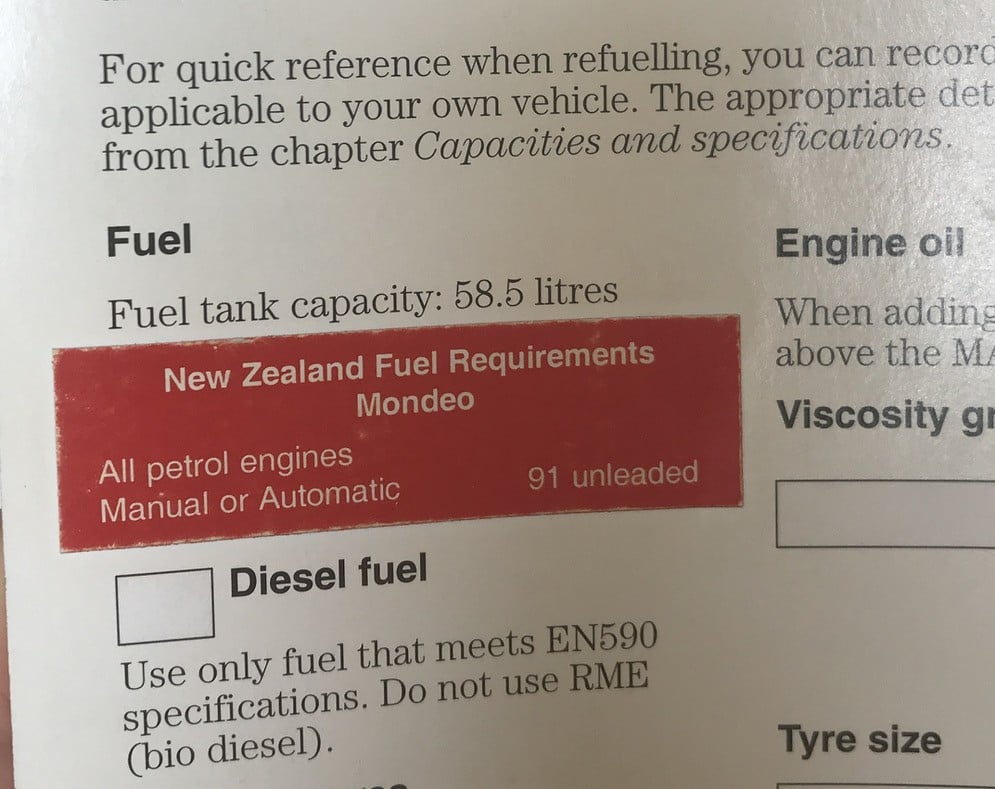
The old work Mondeo has a 91 sticker on the fuel flap but the manual stipulates 95RON minimum. I got caught out putting 91 in it it ignorance and the fuel card is locked to 95.


RunningMan
9184 posts

Uber Geek
+1 received by user: 4834


  #2885565 13-Mar-2022 14:07
Send private message

Dingbatt:


The inside of the fuel filler door sometimes has a placard with min fuel RON required.


The key with this is making sure it's the factory placard, not just a random fuel company sticker.


scuwp
3927 posts

Uber Geek
+1 received by user: 2510


  #2885566 13-Mar-2022 14:08
Send private message

Don't know of a universal list. I would guess that the variations per engine, country, models etc it would be massive.  Owners manual is the best place to start.   Even if you knew the make and model of the car, would would need to be pretty certain of the engine as these could vary between countries or even in the same model.  


I think there would be a significant number dropping to 91 when their engine really isn't designed for it.  Longer term consequences possible.   


Lazy is such an ugly word, I prefer to call it selective participation


Support Geekzone with one-off or recurring donations Donate via PressPatron.
Mehrts
1112 posts

Uber Geek
+1 received by user: 984

Trusted

  #2885569 13-Mar-2022 14:26
Send private message

wally22:


The old work Mondeo has a 91 sticker on the fuel flap but the manual stipulates 95RON minimum.


Which year Mondeo?

I've got a NZ new 2001 2.0 Zetec (Duratec HE engine), and the owner's manual looks like it originally stated 95, but has a sticker over it for "NZ requirements".


richms
29098 posts

Uber Geek
+1 received by user: 10208

Trusted
Lifetime subscriber

  #2885573 13-Mar-2022 14:31
Send private message

Its not if its a requirement or not for most cars, its about where it runs at its most efficient.


I know the lack of power at low revs with 91 in small cars makes them even worse to drive than they are with the good stuff.


Richard rich.ms

Inphinity
2780 posts

Uber Geek
+1 received by user: 1184


  #2885602 13-Mar-2022 16:40
Send private message

richms:


Its not if its a requirement or not for most cars, its about where it runs at its most efficient.


I know the lack of power at low revs with 91 in small cars makes them even worse to drive than they are with the good stuff.


That's not really how octane works. Octane rating is purely around how much compression the fuel can withstand before detonating, not amount of energy contained. If the compression of the engine only requires 91, it won't magically make more power running 95+. Conversely, though, if the engine is designed for 95+, it may still 'work' with 91, but will either retard timing and potentially other controllable factors to mitigate it, but with reduced performance (and potentially reduced efficiency), or (particularly with older cars) will start 'knocking' - detonating too early, also affecting performance nd efficiency and probably causing long-term damage to the engine. 


scuwp
3927 posts

Uber Geek
+1 received by user: 2510


  #2885606 13-Mar-2022 17:00
Send private message

https://www.stuff.co.nz/motoring/115903134/driver-put-wrong-grade-petrol-into-her-car-loses-compensation-bid


A woman who consistently put the wrong grade petrol in her car, causing serious engine damage, has lost a bid to make the dealer take the car back.


Suzanna Chan bought a 2010 Volkswagen Golf from Top Motors Plus in March 2018. A year later it suffered significant engine damage, and she tried to return the car to the dealer, saying the the vehicle had not been of acceptable quality.


Top Motors Plus agreed the car's engine needed expensive repairs, but it denied liability, claiming the damage was caused by Chan using the wrong fuel.


Lazy is such an ugly word, I prefer to call it selective participation


k1w1k1d
1711 posts

Uber Geek
+1 received by user: 1305


  #2885619 13-Mar-2022 17:31
Send private message

When I got my UK manufactured Toyota Avensis work car I checked the owners manual to find what fuel to use. The manual said to use 95, so that's what I did for several years.


About three years ago the lease company that manages our fleet advised our vehicle manager that my car can run on 91.


I was instructed to change to 91. I resisted, showed them the manual, and also the advice to only use 95 I was given by the service manager at the local Toyota dealer that services the car.


But there are some arguments you can't win, so it runs on 91 now. It isn't my problem if it ever stuffs the engine.


So far no problems, so the knock sensor must be working?  


Shop now for Lego sets and other gifts (affiliate link).
lxsw20
3689 posts

Uber Geek
+1 received by user: 2174

Subscriber

  #2885630 13-Mar-2022 17:41
Send private message

It's more down to the engine than the model of car. I can think of 2 Engines put into Corollas over the years that would want 95. (4A-GE, 2ZZ-GE). 


cyril7
9073 posts

Uber Geek
+1 received by user: 2499

ID Verified
Trusted
Subscriber

  #2885635 13-Mar-2022 18:29
Send private message

lxsw20:

It's more down to the engine than the model of car. I can think of 2 Engines put into Corollas over the years that would want 95. (4A-GE, 2ZZ-GE). 


Question I would ask is what state of tune for those models, I know my son's lowered BZ requires 95+, but more common models I expect will happily slurp on 91.

Cyril

Edit, most Euros require 95+, my Alfa states 96+ both in the manual and the fuel flap, it normally gets 95 and purhaps 98 on a long trip. Most Japanese and Korean models unless expressly higher performance take 91, well that's my experience, YMMV

lxsw20
3689 posts

Uber Geek
+1 received by user: 2174

Subscriber

  #2885643 13-Mar-2022 19:04
Send private message

It's more they are running a higher compression. You start running 91, you'll get detonation. Most Japanese performance stuff was designed to run on 100 originally. 


Mehrts
1112 posts

Uber Geek
+1 received by user: 984

Trusted

  #2885645 13-Mar-2022 19:10
Send private message

Basically it boils down to the compression ratio of the engine, or whether it's force-inducted (turbo/supercharged).

As the piston comes up to TDC, the massive amount of heat generated due to the compression of the air trapped inside the cylinder causes any fuel in the mix to pre-ignite (detonate) before the spark is introduced.

This is really bad, since now you've got a piston being driven upwards by the crankshaft, as well as it being driven downwards at the same time by the premature ignition. This has the potential to ruin bearings, conrods etc. This is also why knock sensors exist, in order to adjust the timing to compensate for pre-ignition.

Higher octane fuels have a higher auto-ignition point compared to lower octane ones, which effectively makes it harder for this fuel to be affected by the higher cylinder air temps in engines with high compression, or a lot air being rammed in via forced induction.

This is why it pays to check which engine you have, not just which year/model of vehicle you've got when pondering fuel options.


 1 | 2
View this topic in a long page with up to 500 replies per page Create new topic


Geekzone Live »

Try automatic live updates from Geekzone directly in your browser, without refreshing the page, with Geekzone Live now.


Are you subscribed to our RSS feed? You can download the latest headlines and summaries from our stories directly to your computer or smartphone by using a feed reader.