|
|
|
quickymart:
Perfect location to be on RBI wireless or Starlink.
Thank goodness you aren't running the roll out because that would increase the digital divide.
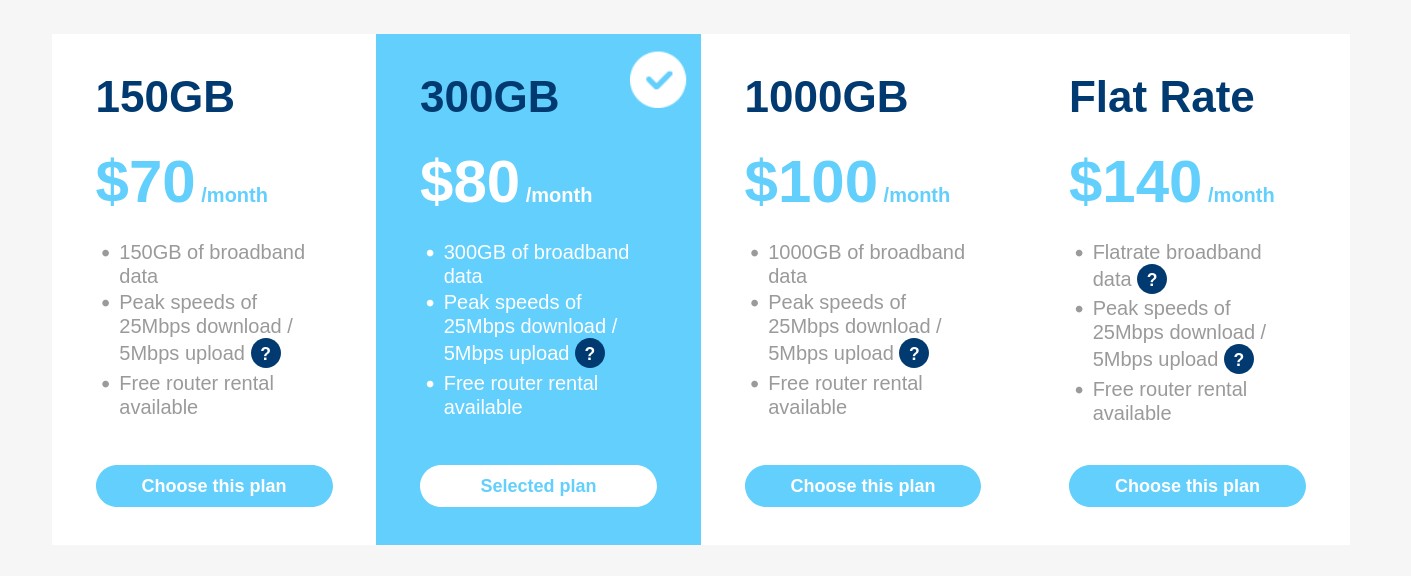
Here are the wireless plans from one of the larger ISP's in the area:

WFH Linux Systems and Networks Engineer in the Internet industry | Specialising in Mikrotik | APNIC member | Open to job offers | ZL2NET
MichaelNZ:
Thank goodness you aren't running the roll out because that would increase the digital divide.
I ask you again (as in the other thread), where do you think the funding for a potential 100% of fibre rollout to the entire country going to come from? There's never going to be a viable ROI for that to happen.
quickymart:
I ask you again (as in the other thread), where do you think the funding for a potential 100% of fibre rollout to the entire country going to come from? There's never going to be a viable ROI for that to happen.
I never said that, lol.
My position was, and is, they need to keep on rolling it because while they have mostly done a good job so far, its not finished.
I live in Tararua region and specifically listed Norsewood, Ormondville, Pongaroa and Porangahau as examples of local townships/settlements which should be included under a UFB3 rollout. Plenty of precedence for this demographic dots the country from one end to the other.
I encourage anyone who is interested to have a look at the Broadband Map
WFH Linux Systems and Networks Engineer in the Internet industry | Specialising in Mikrotik | APNIC member | Open to job offers | ZL2NET
This was discussed in the other thread, and the numbers were broken down for you.
To copy the quote from @Jase2985:
Hokio Beach Population 190 (June 2024)
Pukawa Population 50 (June 2024) Location is super close to Omori 260 Population, which likely made it easier/cheaper to install.
Kuaotunu Population 230 (June 2024)
Tapu Population 260 (June 2024
Waiomu Population 370 (June 2024)
Puriri Population 240 (June 2024)
Maungatapere Population: 350 (Jun 2023)
Then let's look at the numbers @raytaylor quoted:
You said: We are in the township and surrounded by neighbours. I haven't counted but I think there would be 50 connections within their likely initial roll out.
Ray said: There is only about ~21 connections active on vdsl in the township. All get over 40mbits, most get over 100mbits.
So, 21 (let's say 25) connections in a town of about 200.
The other towns you quoted - Ditto for Ormondville (population 70), Tikokino (population 230) and Pongaroa (population 80), and maybe Porangahou (population 160).
Ormondville and Pongaroa are probably going to net no more than 10-15 connections going on Ray's figures. But I can assure you it would cost many hundreds of thousands of dollars to roll out fibre to those towns, and there is no way putting fibre into all of those places will ever be viable - especially for only 10-15 connections in an entire township.
Sorry, but - as stated previously - there has to be a cutoff to the rollout somewhere as there isn't unlimited money, and all of those places are outside the cutoff. Yes you would like fibre (can't say I blame you), but I doubt enough other people in your town or the ones around you feel the same way to make it worth it. The people doing the rollout would have crunched the numbers already to determine this.
quickymart:
This was discussed in the other thread, and the numbers were broken down for you.
I know the exact numbers for this area and your quoted "stats" are off. Also those areas were just ones I found in a quick search to use as an example.
Doing the numbers is a lot of work and I am not going to do this for multiple different examples to try and prove some point to someone posting on a forum. The only numbers which matter are the ones for our local area.
There are dozens of places which are not even towns and they have UFB. I look at them too and go "wow, they got lucky". Are they exactly the same - well, of course not. But they are close enough.
WFH Linux Systems and Networks Engineer in the Internet industry | Specialising in Mikrotik | APNIC member | Open to job offers | ZL2NET
MichaelNZ:
I know the exact numbers for this area and your quoted "stats" are off. Also those areas were just ones I found in a quick search to use as an example.
And yet in the other thread when Ray told you how many people were on fast connections in Norsewood (only), you said: That was a bit lower then I thought but its possible it could be a case of sample bias on my part. I don't know everyone in the township and it could be the people I do know of represent an outsized sample of those who have connections.
Sadly "sample bias" doesn't determine where fibre is rolled out to. This is why I suggested a townwide survey could be a much more useful barometer as to measuring interest in your area.
MichaelNZ:
There are dozens of places which are not even towns and they have UFB. I look at them too and go "wow, they got lucky".
I saw your examples in the other thread and I believe @Jase2985 has answered this already - but essentially it comes down to those places having a higher population density and/or larger population.
@MichaelNZ you fail to address who is paying for this? this is the crux of it. Chorus want everyone they can on there network as its more money for them, and their network is the best out of all the choices, fixed wireless, starlink, rbi etc, its more reliable and less prone to congestion etc, so It's what most people should get. but some are on a budget so they go for the cheapest option, which usually isnt fibre.
Chorus doesnt want to expand too much further as the ROI just isnt there, and the government will be getting advice similar to that saying that its not worth investing in fibre to those places and to put the money into RBI where its cheaper to get more coverage per person
As pointed out there are very few connections in your town, and when/if push comes to shove, and they remove copper and if they add fibre, how many will take up fibre or take up a cheaper wireless connection (yes with a data cap)? it would take very many years to make that investment back.
i can walk 5 minutes in any direction and see double or triple the connections in your town, and they all connect through one cabinet back to the exchange about 3km away, one cabinet hundreds of connections to one exchange with thousands of connections economies of scale at work here. Very few people are still on copper, as it hasn't been removed from our cabinet yet, and id say maybe less than 1/4 of people are on a wireless connection. Much easier to recoup your investment when the density is there.
The fact of the matter is 100% of NZ isnt going to get fibre, there are other options out there for those what arent covered. You should be trying to get the government to reduce the cost/increase the cap of those plans.
Jase2985:
@MichaelNZ you fail to address who is paying for this? this is the crux of it.
[...]
The fact of the matter is 100% of NZ isnt going to get fibre, there are other options out there for those what arent covered. You should be trying to get the government to reduce the cost/increase the cap of those plans.
Happy to pay for our fibre if the city you live in pays for their roads without relying on export earnings from the rural sector.
New Zealand Exports By Category
It sounds like you resent the fact a lot of rural towns and townships have UFB but this is irrelevant to the fact it has happened and continues to happen. Along with a bunch of areas around rural Auckland. Must be a few people in the right places living there. How convenient for them. And around the Kaipara where people have holiday homes. You may sincerely believe this shouldn't happen but its too late lol.
And governments on both sides know this and will keep on handing out stuff (despite your view) to rural and provincial electorates to get votes.
The Provincial Growth Fund for one example of many.
WFH Linux Systems and Networks Engineer in the Internet industry | Specialising in Mikrotik | APNIC member | Open to job offers | ZL2NET
MichaelNZ:
Jase2985:
@MichaelNZ you fail to address who is paying for this? this is the crux of it.
[...]
The fact of the matter is 100% of NZ isnt going to get fibre, there are other options out there for those what arent covered. You should be trying to get the government to reduce the cost/increase the cap of those plans.
Happy to pay for our fibre if the city you live in pays for their roads without relying on export earnings from the rural sector.
New Zealand Exports By Category
It sounds like you resent the fact a lot of rural towns and townships have UFB but this is irrelevant to the fact it has happened and continues to happen.
And governments on both sides know this and will keep on handing out stuff (despite your view) to rural and provincial electorates to get votes.
The Provincial Growth Fund for one example of many.
Unfortunately that's not now it works, Governments and councils allocate funds where they are most needed and best spent. But you cant seem to see that when it comes to fibre. You want it and you cant explain how its going to be paid for.
io have zero issues with anyone and everyone getting fibre, as long as it makes financial sense, the country having to stump up 25k for each rural connection vs 2k for one in an urban setting makes zero sense. there comes a point where the ROI isnt there and thats when the fibre rollout should stop. We are nearing that point and as its been continually mentioned to you there are other technologies you can use to get internet that provide high speeds and large data caps. These other technologies are suited for the rural environment and as ive stated lobby your local MP to try and get change to RBI data caps and prices.
Chorus is a private company and needs to get a decent ROI on their infrastructure build or else its not worth their while, or they need a loan from the government.
End of the day, you are unlikely to get fibre unless there is another larger investment in the UFB rollout, or you stump up the cost yourself/go in with your community.
MichaelNZ:
It sounds like you resent the fact a lot of rural towns and townships have UFB but this is irrelevant to the fact it has happened and continues to happen.
This is not my sentiment at all - my mother lives very rurally and I would dearly love her to get fibre. But I know it's not going to happen in her lifetime - we both understand she lives well outside the cutoff area for the rollout, so if funding permitted, I would happily pay for her to get fibre installed tomorrow. But I do understand it comes at a cost. Yes she only has 3 neighbours and doesn't have to put up with city traffic etc - but she is okay with this, in return for sacrificing some services (eg, decent broadband).
Otherwise, as soon as she is notified her copper is going to be switched off, I will be moving her to a wireless solution as soon as possible.
quickymart:
And yet in the other thread when Ray told you how many people were on fast connections in Norsewood (only), you said: That was a bit lower then I thought but its possible it could be a case of sample bias on my part. I don't know everyone in the township and it could be the people I do know of represent an outsized sample of those who have connections.
Sadly "sample bias" doesn't determine where fibre is rolled out to. This is why I suggested a townwide survey could be a much more useful barometer as to measuring interest in your area.
At the time I posted that I hadn't done the numbers so I assumed "21 connections" was right and this was lower then I expected. But I have now done the actual numbers and 21 is indeed an under-estimate.
I have now also done the actual numbers for Ormondville (a neighbouring township) and these turned out a lot lower then I expected. So they are probably a weak case compared to where we are.
Norsewood has ADSL and VDSL available and the penetration of these connections at real addresses* is greater then 1-in-3. Ormondville has ADSL and their numbers are less then 1-in-10. This is mildly interesting. I had always assumed the numbers would be similar and they clearly aren't.
But there is no reason to believe Ormondville has any less interest in internet then here so I would attribute this difference to the faster connections available via VDSL. Faster connections equals more attraction to fixed cable services as opposed to fixed wireless.
*Real addresses refers to places someone on the ground would see. For some reason Chorus has a lot of invalid information.
WFH Linux Systems and Networks Engineer in the Internet industry | Specialising in Mikrotik | APNIC member | Open to job offers | ZL2NET
It could also indicate that the fixed wireless options are better in Ormondville - a WISP, closer/faster cellsite, something else.
Proportion of permanent residences vs bach/airbnb/unoccupied could b important.
SomeoneSomewhere:
It could also indicate that the fixed wireless options are better in Ormondville - a WISP, closer/faster cellsite, something else.
Proportion of permanent residences vs bach/airbnb/unoccupied could b important.
An unscientific view is they probably have more fixed wireless through cellular. This is based on the complaints I have seen in local groups. In regards to reception, its my view Norsewood is ahead of Ormondville for coverage although both used the same cellsite. But then I could also stand outside the Norsewood cafe and speedtest 90mbps on my S24 while others were claiming there was no reception there.
Anyway, its largely irrelevant now as Norsewood now has an RCG cellsite which was put up a couple of weeks ago. Which Ormondville may benefit from 6km away. I am not aware of any movement for them to get a cellsite.
Baches aren't really a thing here. Its a farming area and nowhere near any beach. But we do have great hiking and hunting.
WFH Linux Systems and Networks Engineer in the Internet industry | Specialising in Mikrotik | APNIC member | Open to job offers | ZL2NET
I presume we're all in agreement that 100% coverage of UFB isn't viable... Assuming that's the case, we're only arguing about how subsidised the last connections should be.
If we (NZ) decide that the last subsidised connection can lose 10's of thousands of dollars per property passed, with no hope of ever returning even enough to cover upkeep - then that's fine, but personally, I don't want my tax dollars going to pay tens of thousands of dollars for a fibre connection when it instead could be used for healthcare or education.
Maybe the country as a whole has a different opinion. But I doubt it.
To the people in this thread - what's your personal $ value for the most subsidised per connection you'd be happy with? $5k, $20k, $100k?
Cheers - N
Please note all comments are from my own brain and don't necessarily represent the position or opinions of my employer, previous employers, colleagues, friends or pets.
Talkiet:
To the people in this thread - what's your personal $ value for the most subsidised per connection you'd be happy with? $5k, $20k, $100k?
Its my understanding the connections in the city were subsidised around $1,500 but this could be out of date.
I would think areas like ours a bit more - probably around $2,500.
But it may shock you the number is not that important. A small group of locals campaigned and got Norsewood an RCG cellsite costing I believe around $250k.
But I am willing to pay to get connected. The problem is people who live in areas they got "free" installs don't realise how much different the situation is for "custom" installs. (ie: paid). The way the custom install thing works strongly incentivises everyone to wait until someone else blinks (rarely happens) or until Chorus decides to roll out an area or they have to because of the Commerce Commission
And before people start posting their opinions about this point here is a quote:
"Chorus can only stop supplying copper services where households can access the same services over the fibre network. In areas where fibre is not currently available, Chorus must continue to supply copper services."
So again, the cost is largely irrelevant.
There are whole towns where Chorus rolled out part of the town and not the rest for reasons which are a mystery. And yet they are having to continue to provide DSL services to the whole town to cater for those not covered by UFB yet. And in some examples (Hastings - 4 areas and Fielding Manawatu in this part of the country) they are now going back to finish off the job.
WFH Linux Systems and Networks Engineer in the Internet industry | Specialising in Mikrotik | APNIC member | Open to job offers | ZL2NET
|
|
|