|
|
|
There are 2 socket passthru keystones for this exact reason, so you can put a plug in the back crimped onto stranded cable, and then it looks nice and proper from the front where you can put a patch cable in the other socket on the passthru.
I have never had good luck punching down stranded cable, it will depend on the cables construction how bad it will be, and as the insulation shifts over time it may move the cables out of the slot. Its not like when you IDC onto a solid cable and its held in place by the tension of the terminal, the strands can move around.
richms: I have never had good luck punching down stranded cable, it will depend on the cables construction how bad it will be, and as the insulation shifts over time it may move the cables out of the slot. Its not like when you IDC onto a solid cable and its held in place by the tension of the terminal, the strands can move around.
What type of IDC were you using? Krone claimed that the 45⁰ angle of their blades compared to the slot gave a better connection than 110 and also allowed for 7x.2 stranded. The Dynamix keystone has a similarly angled connector. The insulation is gripped either side of the IDC.
geekIT:
LOL. Only problem turned out to be the Dynamix 1.5m Cat5e cable that I connected to the keystone on the first try. I didn't even stop to think - just connected the keystone via the 568B diagram on the back of the socket and...no continuity. The Dynamix cable 1.5m patch cable is wired 568A! Rewired a new keystone to 568A and all good. Piece of Christmas cake :-)
If you read earlier, your issue wasnt because you used a 568A cable. they are compatible as long as both ends are the same. by you reterminanting to 568A you either had a bad connection at that end or the other end of the in wall was also 568A.
Jase2985: or the other end of the in wall was also 568A.
That's what he said. I originally thought geekIT had inherited a house wired with stranded cable but I think he's used a patch cord and cut the plug off one end and had to match the remaining plug.
geekIT: [snip]
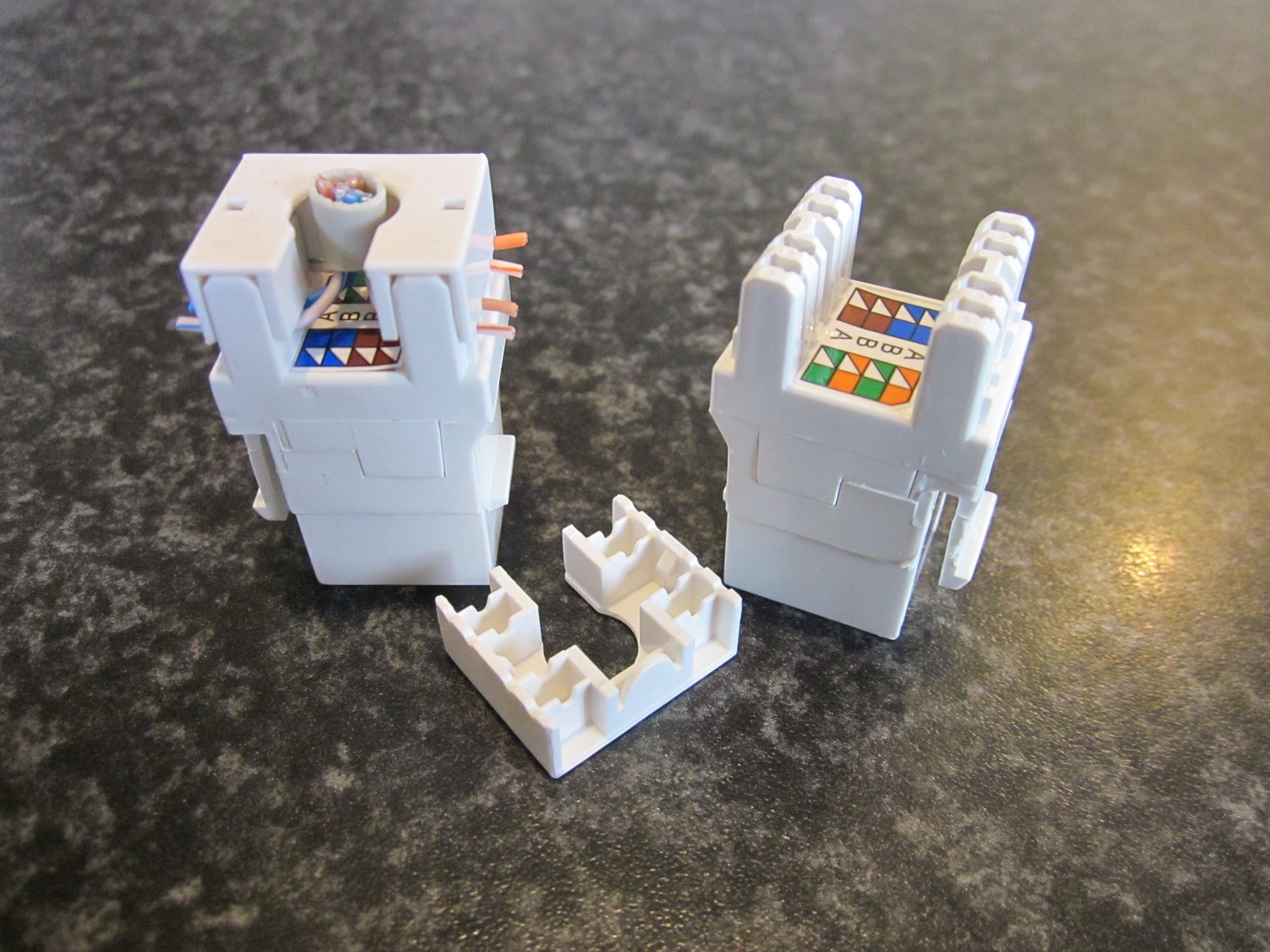
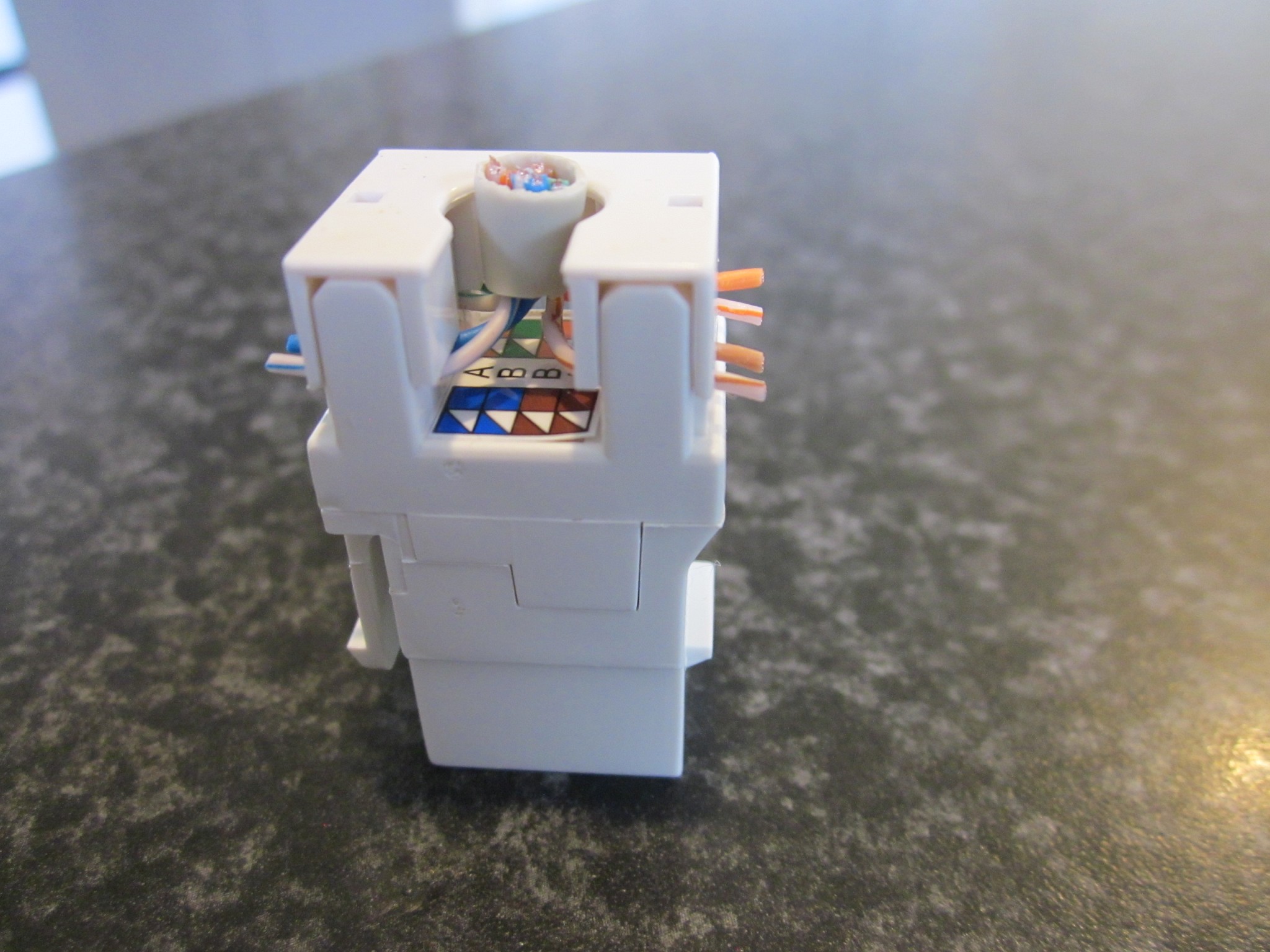
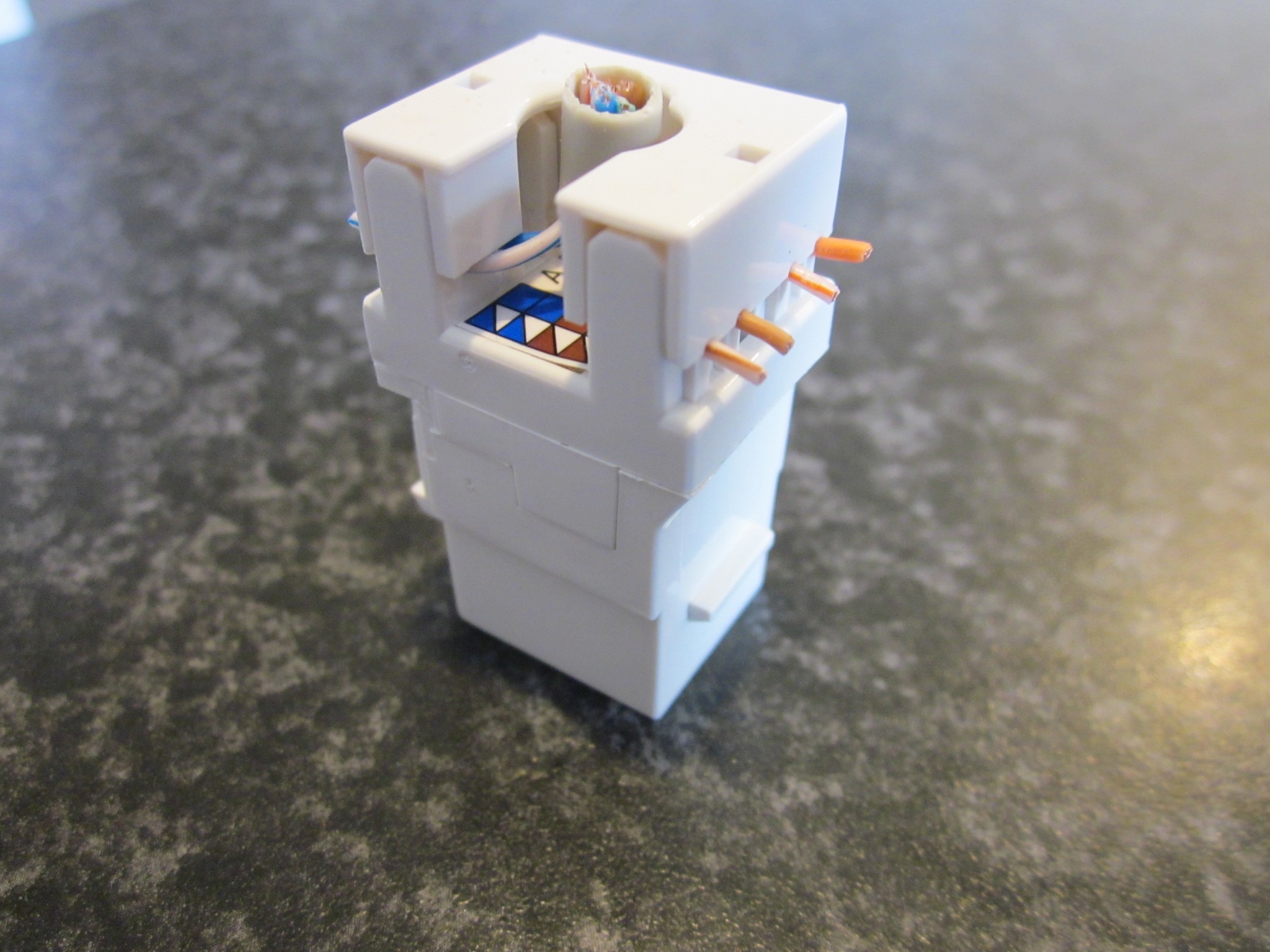
I didn't need any special tools, just a pair of scissors and a nail file. Pushed the (stranded) wires into the Dynamix keystone socket, lightly at first then firmly with the nail file. The sockets come with a locking cap that has to be forced on last thing and this action makes sure that all the wires are fully down into their slots.
This method really is asking for trouble. By not using the correct punchdown tool, the result is the conductor isn't properly vertically guided into the IDC and it spreads the 2 blades into a slight V shape which means there's an obvious path for migration to the wider section and failure of joint. It doesn't take much - thermal expansion and contraction with normal temperature variation can be enough to start it moving. This is especially important when using stranded cable into an IDC that accepts it as the narrower conductors end up held less securely than the single (fatter) solid conductor.
It was commonplace to see with with DIY on BT phone jacks in analogue days, but the result wasn't so catastrophic - a bit of crackle on the line just put down to normal operation, but an intermittent fault with phyiscal ethernet will cause all sorts of hard to spot network issues.
The correct tools can be had for under $20 locally, or cheaper if you're prepared to wait from overseas. The thing to watch for is Krone vs 110. Two common styles avaiable; the connector will generally tell you which one you need. These tools will cleanly punch the conductor into the IDC and trim the excess to the correct length without disturbing the joint that has just been made all in one movement.
All I can say is that the stranded wires look to be very tightly anchored, especially after the lockdown cap is added. Re tools, I've always gone for the best. Some of the gear from my building days is now over 60 years old and still functioning. However, I wanted to get this job done yesterday, and my closest tool source is 50k away so I improvised.
BTW, perhaps one of you should let Computer Dynamics know that they're selling gear that might not stand the test of time? Actually, I might suggest they check out this thread.
Here's a few pics. The shorn-off cable is in the 568B-configured socket that I discarded :


Trump crowned? No faux King way!
geekIT:
BTW, perhaps one of you should let Computer Dynamics know that they're selling gear that might not stand the test of time? Actually, I might suggest they check out this thread.
Really don't understand this at all. What makes you think their products won't stand the test of time?
They work fine on solid core cable, and I have many many dynamix ports around the place because they're the easiest to get that are known quality.
The issue is using them on cables they were not designed for and not using the correct tools for the job. This reminds me of a friend and his father who would refuse to get the correct tools and just force a hex key into a torx and abuse a slotted screwdriver into other fasteners and then wonder why they had so much trouble getting things done on their car.
Also in those pictures that are of the aborted attempt at putting a plug on there is way too much hanging out the end of the punch down. It should be cut flush with the side of the plastic, which if you used the right punch down tool would be cut flush with the edge.
richms:
They work fine on solid core cable, and I have many many dynamix ports around the place because they're the easiest to get that are known quality.
The issue is using them on cables they were not designed for and not using the correct tools for the job.
From Dynamix's data sheet for the jack
"Dual type IDC connector can accept 22-26 AWG solid & stranded cables
Terminate using 110 or Krone type punch down tools"
They are designed for both types of cable. If you have experience that despite that they don’t work that’s a different thing.
Actually, shearing off the surplus wire with a punch-down tool would, in this case, be counterproductive, because the locking cap would have nothing to lock down against. As you can see in the photos, simply trimming the wire ends with scissors after the cap is placed is all that's required.
Trump crowned? No faux King way!
If ya slapped it and pulled it and then said “that ain’t going nowhere”….then we forgive you for using scissors.
|
|
|