|
|
|
Haven't seen that one, but will subscribe now - thanks
Just to follow up on this. I ended up buying the 1500W Mill panel heater from Bunning (link in my OP).
It turned out to be a great little heater. It has a proper PID controller which works really well.
It also has a local-only API which Home Assistant uses to give full control and monitoring of the device.
Very happy with it and would recommend it to anyone wanting a smart heater with HA integration.
SumnerBoy:And the Mill heaters sound like they have a nice PID control system.
Handle9:
PID is utterly irrelevant for space control. The time constant of the space is minutes so D has no use. I only helps if you have some way to modulate, which you don’t with a low power space heater. It’s on or it’s off.
You need a thermostat (or a relay with a temperature sensor) with 2K hysteresis. That’s all.
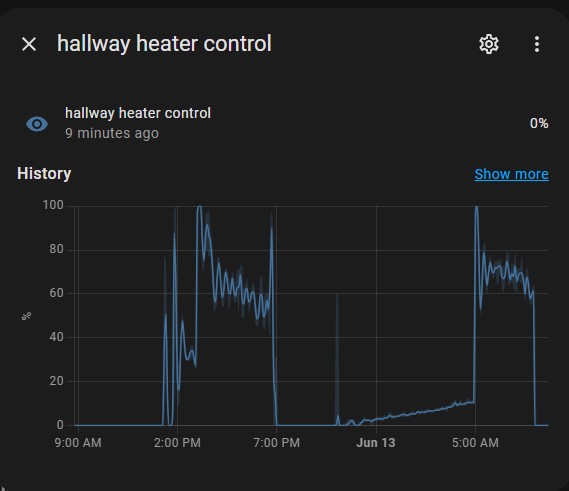
The Mill is able to modulate. It has a control signal it uses to vary the output of the heater. Below is a screenshot of the HA integration showing the control signal (0-100%) over the course of the last 24hrs. That modulates the heat out from 0W - 1500W.

SumnerBoy:
Handle9:
PID is utterly irrelevant for space control. The time constant of the space is minutes so D has no use. I only helps if you have some way to modulate, which you don’t with a low power space heater. It’s on or it’s off.
You need a thermostat (or a relay with a temperature sensor) with 2K hysteresis. That’s all.
The Mill is able to modulate. It has a control signal it uses to vary the output of the heater. Below is a screenshot of the HA integration showing the control signal (0-100%) over the course of the last 24hrs. That modulates the heat out from 0W - 1500W.
it would be interesting to see the circuit it uses. a lot of power to go through a compact controller.
however, while the pid gives much finer control (less hysteresis) most people can't tell a difference in room temp of a degree or two, therefore its a lot of extra stuff to go wrong for little benefit. however if your someone who is sensitive to temp changes then the pid setup is a good feature.
btw the manufactures claim of it being more economical is complete bs. but then again no one buys resistance heaters for the efficiency.
I can certainly tell the difference between the aircon being set to 22 or 23. I know of someone that changed theirs to Fahrenheit as that gives them finer control of it whereas in Celsius they only get full degree steps without the .5 that you usually see on cars etc.
richms:
I can certainly tell the difference between the aircon being set to 22 or 23. I know of someone that changed theirs to Fahrenheit as that gives them finer control of it whereas in Celsius they only get full degree steps without the .5 that you usually see on cars etc.
aircon can be a little bit trickier because humidity plays a big role. dropping the temp down a bit also drops the humidity, and the effect of both together can be quite noticeable depending on circumstances.
the other factor is if someone is in the airflow or not.
richms:I can certainly tell the difference between the aircon being set to 22 or 23. I know of someone that changed theirs to Fahrenheit as that gives them finer control of it whereas in Celsius they only get full degree steps without the .5 that you usually see on cars etc.
SumnerBoy:
Handle9:
PID is utterly irrelevant for space control. The time constant of the space is minutes so D has no use. I only helps if you have some way to modulate, which you don’t with a low power space heater. It’s on or it’s off.
You need a thermostat (or a relay with a temperature sensor) with 2K hysteresis. That’s all.
The Mill is able to modulate. It has a control signal it uses to vary the output of the heater. Below is a screenshot of the HA integration showing the control signal (0-100%) over the course of the last 24hrs. That modulates the heat out from 0W - 1500W.
Edit: deleted picture for brevity
richms:
I can certainly tell the difference between the aircon being set to 22 or 23. I know of someone that changed theirs to Fahrenheit as that gives them finer control of it whereas in Celsius they only get full degree steps without the .5 that you usually see on cars etc.
When we wired up the heaters in a school there were 2 thermostats, one that was hidden and did the actual control and another that was obvious and was unconnected. EVERYONE thought it was great they could set the temperature to "What they liked" and it was always good for them.
|
|
|