Another option I'm looking at using is this, of which there are large numbers of clones on Ali. It uses pressure-based sensing so no need for calibration or problems due to reflectivity of ultrasonics.
Another option I'm looking at using is this, of which there are large numbers of clones on Ali. It uses pressure-based sensing so no need for calibration or problems due to reflectivity of ultrasonics.
That's the type of sensor Smartwater use on their senders, of which I have 2 of, although mine are about 7 years old so not the wifi enabled versions. The sensors work well, no issues since install.
Another option I'm looking at using is this, of which there are large numbers of clones on Ali. It uses pressure-based sensing so no need for calibration or problems due to reflectivity of ultrasonics.
If it's what I think it is (I'm getting page not found), ie. a hydrostatic pressure sensor, that was my first choice. But they seemed to be about $80ea from Ali last I looked, whereas sealed ultrasonic transducer modules are a few bucks. Yeah, there are shortcomings but I'm going to give it a good go before switching.
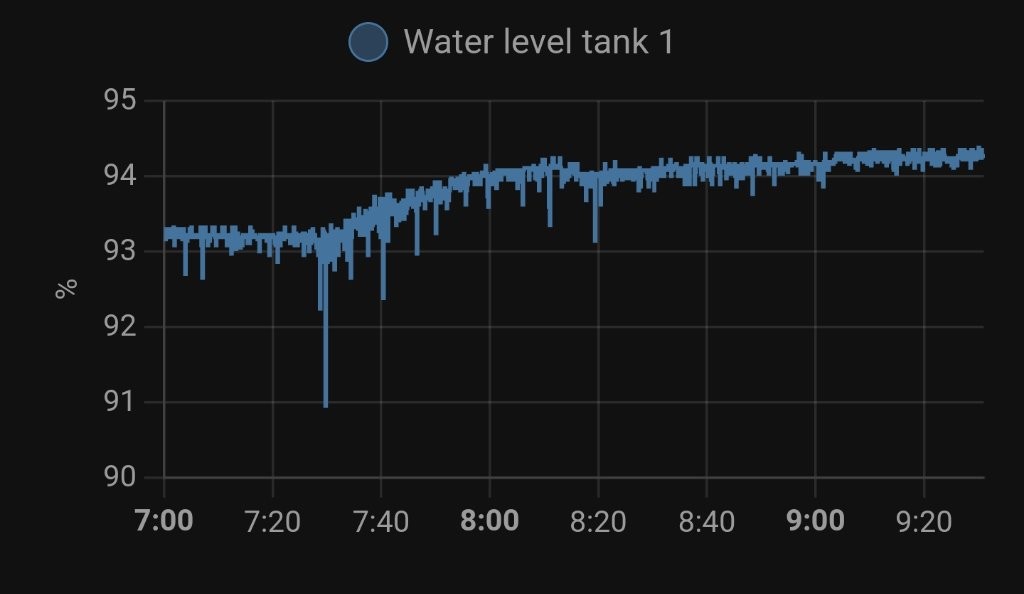
So far it's been pretty good. We had a bit of rain the other day, and it was great to see it go up and taper off over time:
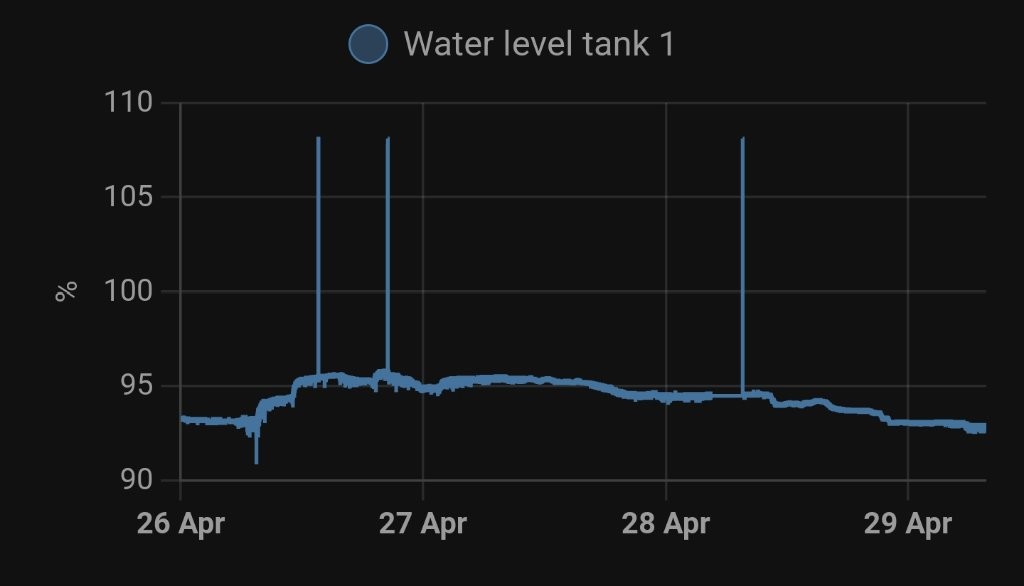
As you can see, there's a bit of variability there especially from waves on the surface when the water started coming in. Not a major problem, however a bigger problem came from the placement of the transducer. As you can see in the earlier photos it was right next to the inlet pipe: in hindsight that was an obviously poor choice, as it means that occasionally I get a spike when it detects incoming water much closer than the surface:
(EDIT: wrong pic)
I can move it well away from the inlet but there are some complications with doing that, eg. extending the cable. A software solution might be more appropriate. I'm still mulling that one over.
Those spikes aren't just waves, they're caused by condensation on the sensor and/or the inherent instability of the sensor itself so you will still get them when the water is calm. You can eliminate them by taking multiple readings and using the median of the most reliable values. Then you can get 10 litre accuracy in a 25,000 litre tank (roughly 1mm distance accuracy over 2.5m).
pih: If it's what I think it is (I'm getting page not found), ie. a hydrostatic pressure sensor, that was my first choice. But they seemed to be about $80ea from Ali last I looked, whereas sealed ultrasonic transducer modules are a few bucks. Yeah, there are shortcomings but I'm going to give it a good go before switching.
The pressure-sensor ones are complete units that you can add as another Modbus drop which is why I went with them, it's not just the standalone sensor. From a discussion on an embedded-control forum they're the most reliable/consistent in terms of measurements, although I'm not that fussed since all I really need is something like full, half full, quarter full, nearly empty.
Are you subscribed to our RSS feed? You can download the latest headlines and summaries from our stories directly
to your computer or smartphone by using a feed reader.





 Trusted