Geekzone: technology news, blogs, forums
Guest
Welcome Guest.
You haven't logged in yet. If you don't have an account you can register now.


MikeAqua

8024 posts

Uber Geek
+1 received by user: 3817


#276004 21-Sep-2020 11:50
Send private message

I need a slow blow 20A fuse as part of an install I'm doing at the moment.  It's for a BEP Surge Protection Module https://www.bepmarine.com/en/80-707-0004-00 


I'm struggling to find a fuse and matching surface mount holder.  Many of the holders seem to be PCB mount.


Surface mounted because it will be installed on a DC distribution panel.  The purpose of the fuse as I understand it is to convert excess energy into heat.  Therefore, I've it would get hot and I've ruled out enclosed holders.


Ideally I'd like a single fuse holder.



Mike


Create new topic
elpenguino
3576 posts

Uber Geek
+1 received by user: 2938


  #2569130 21-Sep-2020 12:05
Send private message

https://nz.element14.com/w/c/circuit-protection/fuses-fuse-accessories/fuse-holders/prl/results?st=panel%20mount%20fuse%20holder


There's over 100 to choose from.


Yes, the job of the fuse is to convert electricity into heat, but only once.


BTW: The user manual doesn't show a fuse in use. https://www.bepmarine.com/en/~/media/inriver/350782-34855.pdf


Most of the posters in this thread are just like chimpanzees on MDMA, full of feelings of bonhomie, joy, and optimism. Fred99 8/4/21


richms
29098 posts

Uber Geek
+1 received by user: 10207

Trusted
Lifetime subscriber

  #2569274 21-Sep-2020 13:22
Send private message

A fuse running near its breaking capacity will put out considerable heat, since they are there to protect the wiring they shouldn't be near their limit very often, but 18A thru an automotive 20A blade type fuse all day will quickly make the holder go crispy.


Richard rich.ms

MikeAqua

8024 posts

Uber Geek
+1 received by user: 3817


  #2569342 21-Sep-2020 14:27
Send private message

elpenguino: BTW: The user manual doesn't show a fuse in use. https://www.bepmarine.com/en/~/media/inriver/350782-34855.pdf


It’s definitely in the installation instructions.


Mike


elpenguino
3576 posts

Uber Geek
+1 received by user: 2938


  #2569346 21-Sep-2020 14:37
Send private message

MikeAqua:
elpenguino: BTW: The user manual doesn't show a fuse in use. https://www.bepmarine.com/en/~/media/inriver/350782-34855.pdf


It’s definitely in the installation instructions.


I see that in the instructions but not in that summary I linked to. Does this module have an indicator to show it is connected. You want to be sure you are aware of when the device has blown the fuse and no protection is then provided.


The fuse should not be carrying much current in normal circumstances, assuming the system voltage is not regularly higher than 17v.


Most of the posters in this thread are just like chimpanzees on MDMA, full of feelings of bonhomie, joy, and optimism. Fred99 8/4/21


SomeoneSomewhere
1882 posts

Uber Geek
+1 received by user: 1086

Lifetime subscriber

  #2571589 21-Sep-2020 23:06
Send private message

A 20A MCB is also an option. Mains rated ones are generally also rated for around 48-72VDC at the same fault current, at least for the DIN rail mount versions. I'm not sure about the plug-in ones.


MikeAqua

8024 posts

Uber Geek
+1 received by user: 3817


  #2571780 22-Sep-2020 09:27
Send private message

elpenguino:


Does this module have an indicator to show it is connected. You want to be sure you are aware of when the device has blown the fuse and no protection is then provided.


The fuse should not be carrying much current in normal circumstances, assuming the system voltage is not regularly higher than 17v.


Under normal operating circumstances, system voltage won't exceed 13.7v. Any spikes above that will be transitory, likely caused by a motor (starter or capstan) fault.  


If 17v voltage is exceeded the module closes a latching relay, which stays on until the module is power cycled. The relay outputs will be connected to a flashing warning LED on the dash.


All the electronics on the boat are rated up to 24v.


Mike


Want to support Geekzone and browse the site without the ads? Subscribe to Geekzone now (monthly, annual and lifetime options).
elpenguino
3576 posts

Uber Geek
+1 received by user: 2938


  #2571784 22-Sep-2020 09:30
Send private message

Yes, I got that. But the unit also discharges brief transients without latching. 


What I'm getting at is that if the unit never latches and flashes the LED via the relay does that mean it is not detecting any transients? Or does it mean the fuse is blown?


You need another LED across the supply after the fuse labelled 'when indicator not lit, fuse is blown'.


Most of the posters in this thread are just like chimpanzees on MDMA, full of feelings of bonhomie, joy, and optimism. Fred99 8/4/21


MikeAqua

8024 posts

Uber Geek
+1 received by user: 3817


  #2571795 22-Sep-2020 09:39
Send private message

SomeoneSomewhere:


A 20A MCB is also an option. Mains rated ones are generally also rated for around 48-72VDC at the same fault current, at least for the DIN rail mount versions. I'm not sure about the plug-in ones.


If I can use an MCB, that would be great as I have an 3 x MCB housing in the same range (contour lock) as the Surge Protection Module and adjacent master switch.  They would all clip together very tidily.  


But ... do MCBs replicate the slow blow of the fuse?


I'm guessing the SPM stores excess energy in some way (?capacitor?), and then slowly releases it to the fuse, to be dissipated as heat.  I'm concerned that an MCB that immediately tripped, wouldn't dissipate much energy before it tripped.


This is mostly guesswork on my part (I'm a biologist by trade) so please correct me if I am wrong.


Mike


SomeoneSomewhere
1882 posts

Uber Geek
+1 received by user: 1086

Lifetime subscriber

  #2571803 22-Sep-2020 09:54
Send private message

The energy is dissipated in the SPM itself. If it's anything like AC mains versions, the fuse is only there to disconnect the SPM if it fails (as they tend to fail to a short circuit condition). No energy is intentionally dissipated in the fuse.


The reason for a slow-blow fuse is so that it doesn't immediately blow when the SPM draws huge amounts of current to clamp the voltage.


You would ideally use a D-curve breaker as these are equivalent to a slow-blow fuse.


MikeAqua

8024 posts

Uber Geek
+1 received by user: 3817


  #2571805 22-Sep-2020 09:54
Send private message

elpenguino:


Yes, I got that. But the unit also discharges brief transients without latching. 


What I'm getting at is that if the unit never latches and flashes the LED via the relay does that mean it is not detecting any transients? Or does it mean the fuse is blown?


You need another LED across the supply after the fuse labelled 'when indicator not lit, fuse is blown'.


I could use the fuse circuit to control an NC relay which powers an LED. If the fuse blows the relay closes and the LED comes on.


Mike


MikeAqua

8024 posts

Uber Geek
+1 received by user: 3817


  #2571861 22-Sep-2020 10:53
Send private message

SomeoneSomewhere:


You would ideally use a D-curve breaker as these are equivalent to a slow-blow fuse.


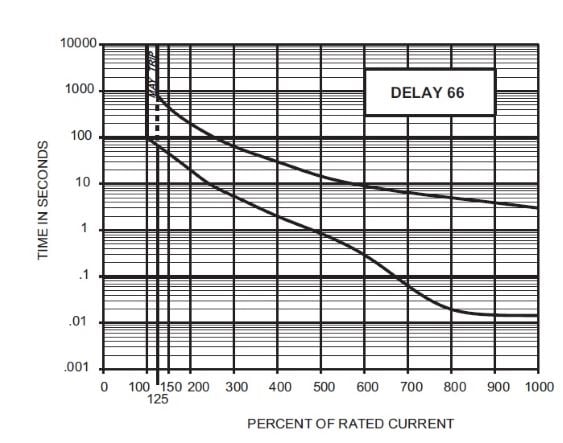
After some research the MCBs have quite a slow trip profile.  They are Airpax IAG units and meet their D66 delay profile which is designed for motors.


These are the curves


Mike


Create new topic


Geekzone Live »

Try automatic live updates from Geekzone directly in your browser, without refreshing the page, with Geekzone Live now.


Are you subscribed to our RSS feed? You can download the latest headlines and summaries from our stories directly to your computer or smartphone by using a feed reader.