Geekzone: technology news, blogs, forums
Guest
Welcome Guest.
You haven't logged in yet. If you don't have an account you can register now.


ashtonaut

631 posts

Ultimate Geek
+1 received by user: 120

ID Verified

#323805 17-Jan-2026 16:03
Send private message quote this post

I'm working on a hobby project looking at predicting rain events at my home location. I am curious about the way that the Metservice scales the rain radar images:


How am I supposed to interpret the intensity scale on the RHS?
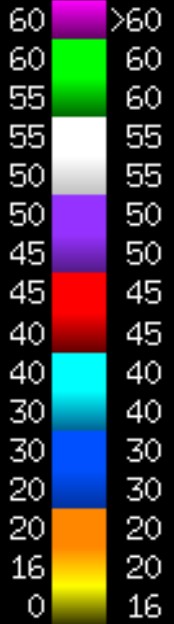


Specifically, while I get the intensity values increase as you move up the scale through the colours, why are there different numbers on each side? Why are some of them the same LHS and RHS, and sometimes they are different?


This is important as I want to correctly map the DBZ value of specific pixels in the radar image to DBZ reflectivity, and I'm not sure how I should be reading the scale and therefore calibrating the lookup tables.


Any ideas?


Create new topic
Jase2985
13730 posts

Uber Geek
+1 received by user: 6202

ID Verified
Lifetime subscriber

  #3453820 17-Jan-2026 16:13
Send private message quote this post

The bottom of each colour(Gradient) seems to be a range of DBZ, ie the yellow-orange is 16-20DBZ whereas the solid orange is 20DBZ - 20DBZ


tweake
2641 posts

Uber Geek
+1 received by user: 1137


  #3453825 17-Jan-2026 17:29
Send private message quote this post

where did you get the scale from? thats not on their site afaik.


ashtonaut

631 posts

Ultimate Geek
+1 received by user: 120

ID Verified

  #3453827 17-Jan-2026 17:48
Send private message quote this post

https://www.weatherwatch.co.nz/maps-radars/radar/canterbury-rain-radar-realtime


weather watch, which uses the same source, but makes a larger image available.


ashtonaut

631 posts

Ultimate Geek
+1 received by user: 120

ID Verified

  #3453828 17-Jan-2026 17:49
Send private message quote this post

Jase2985:


The bottom of each colour(Gradient) seems to be a range of DBZ, ie the yellow-orange is 16-20DBZ whereas the solid orange is 20DBZ - 20DBZ


yeah, and the scale is also non linear…


tdgeek
30048 posts

Uber Geek
+1 received by user: 9455

Trusted
Lifetime subscriber

  #3453836 17-Jan-2026 19:18
Send private message quote this post

I find MS rain radar is super accurate.


Oddly, I follow MS and YR forecasts, they always vary a bit but in the last year they are often miles apart


jonherries
1433 posts

Uber Geek
+1 received by user: 316

Trusted
Subscriber

  #3453859 17-Jan-2026 21:37
Send private message quote this post

I was thinking of having a go at this myself, in the UK and Ireland I used to get these sort of alerts on my Apple watch which were pretty good.


I assume, you are going to run a scraper of the images as I didn’t think there was an api?


Then use that to map pixels and colours to an array of lat longs and overlay with your current location?


Trickier question is how you might anticipate rain, there is some interesting math required I would guess to know that in 7.5 mins time the rainy patch is going to be where you are, some sort of linear calculus which works ok if the rain moves consistently/is the same size as it goes (which isn't really true coz hills make it worse)?


Jon


Website: herri.es


Linkedin: jonherries


Shop now for Lenovo laptops and other devices (affiliate link).
ashtonaut

631 posts

Ultimate Geek
+1 received by user: 120

ID Verified

  #3453864 17-Jan-2026 22:20
Send private message quote this post

In a nutshell, yes. I’m learning how I go with Claude AI. Not yet coded a single line but we’ve had some fun traversing a range of topics well over my head and it’s probably written 3,000 lines of code in the process. Currently re-doing the whole rain movement part of the code to use someone else’s much more sophisticated approach I found online.


If it ends up working in a semi-useful way I’ll post the code somewhere and share.


mentalinc
3384 posts

Uber Geek
+1 received by user: 1023

Trusted

  #3453883 18-Jan-2026 09:24
Send private message quote this post

Have you looked at accuweather? Likely already solved the challenge, could look for api maybe to get what you want? 


CPU: AMD 5900x | RAM: GSKILL Trident Z Neo RGB F4-3600C16D-32GTZNC-32-GB | MB:  Asus X570-E | GFX: EVGA FTW3 Ultra RTX 3080Ti| Monitor: LG 27GL850-B 2560x1440


Quic: https://account.quic.nz/refer/473833 R473833EQKIBX 


ashtonaut

631 posts

Ultimate Geek
+1 received by user: 120

ID Verified

  #3453974 18-Jan-2026 10:14
Send private message quote this post

As with many things like this, it’s not about ‘what is the easiest way to get this?’, it’s about ‘could I do this myself, and what might I learn along the way?’ 😀


The challenge (hyperlocal rain prediction) has already been solved, but I want to see how well I can do with a system tuned and designed specifically for my home setup, so I can integrate it into HA and my smart home exactly how I want to.


jonherries
1433 posts

Uber Geek
+1 received by user: 316

Trusted
Subscriber

  #3456250 26-Jan-2026 22:06
Send private message quote this post

Does anyone know if there are base reference images I can use as a mask?


Website: herri.es


Linkedin: jonherries


ashtonaut

631 posts

Ultimate Geek
+1 received by user: 120

ID Verified

  #3456255 26-Jan-2026 22:37
Send private message quote this post

If you feed ai a series of images where rain is in different locations (or none at all) you can extract the base image without too much trouble.


Shop now for Dell laptops and other devices (affiliate link).
jonherries
1433 posts

Uber Geek
+1 received by user: 316

Trusted
Subscriber

  #3456256 26-Jan-2026 22:39
Send private message quote this post

Yeah - that is now on my todo list lol. A clear day would have been easier though…


Website: herri.es


Linkedin: jonherries


Create new topic


Geekzone Live »

Try automatic live updates from Geekzone directly in your browser, without refreshing the page, with Geekzone Live now.


Are you subscribed to our RSS feed? You can download the latest headlines and summaries from our stories directly to your computer or smartphone by using a feed reader.