Geekzone: technology news, blogs, forums
Guest
Welcome Guest.
You haven't logged in yet. If you don't have an account you can register now.


Wara

43 posts

Geek
+1 received by user: 7


#324114 2-Mar-2026 11:14
Send private message quote this post

I recently obtained 2 Degrees fixed wireless broadband.  There is unusual behaviour of both the 2 Degrees App and the NX620v2 modem.


1.  The app started recording broadband data usage correctly for a day and a bit then stopped for a couple of days after which the cumulative usage for the missing days was allocated to the second day.  The app then stopped recording usage and hasn't restarted  after 5 days.


Uninstalling and reinstalling the app hasn't helped.  The app is working correctly otherwise. The mobile tab in the app for my prepay phone updates data usage immediately.  Logging into My2Degrees confirms the missing broadband usage.


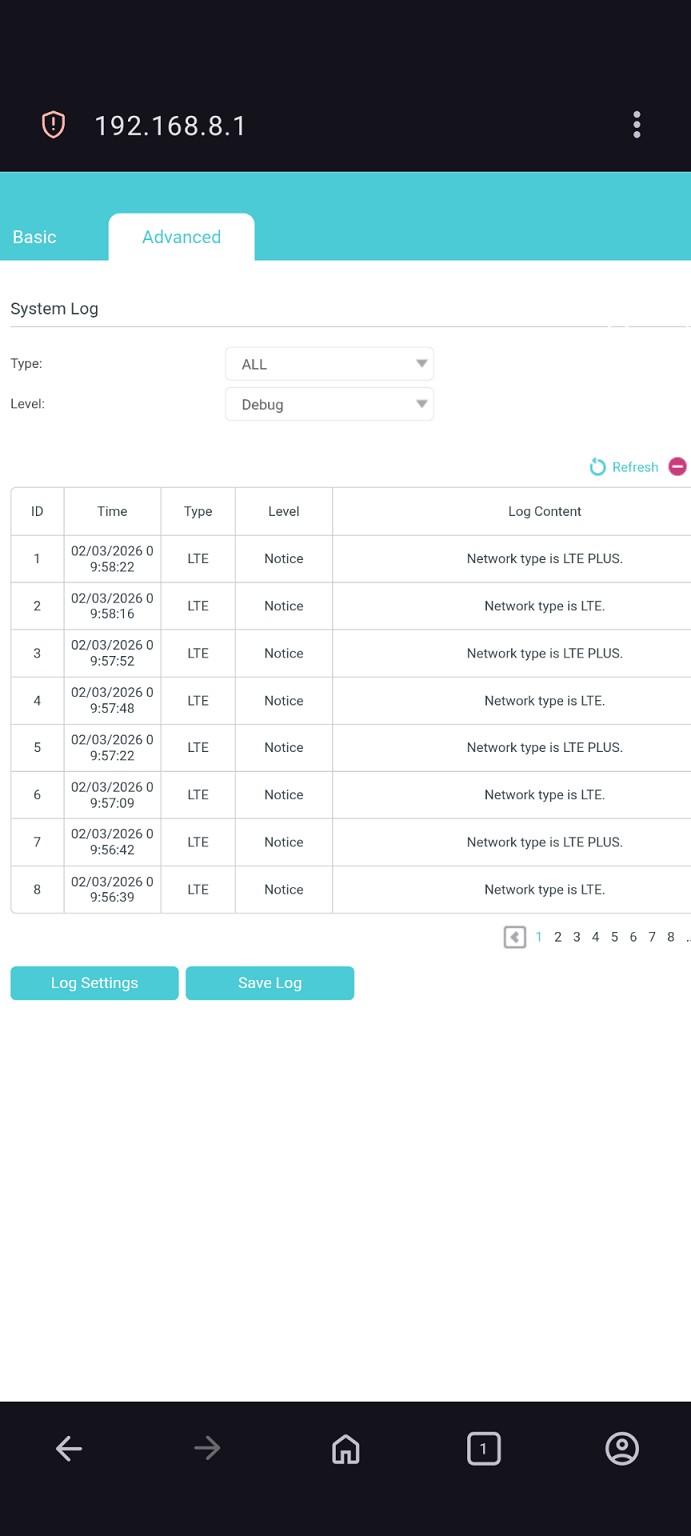
2.  The modem system log shows the network type switching between LTE and LTE Plus every few seconds and has done so since the beginning.  The modem status tab, however, constantly shows LTE Plus with bands B1,B3,B28,B8.  Signal strength 100%, RSRP -88, RSRQ -7, SNR 19.


Does the log suggest a modem hiccup with carrier aggregation and might it be affecting the recording of the broadband data usage?


screenshot of system log.  


Create new topic
Wara

43 posts

Geek
+1 received by user: 7


  #3466557 3-Mar-2026 17:24
Send private message quote this post

I overlooked the following thread:


https://www.geekzone.co.nz/forums.asp?forumid=81&topicid=323568


It explains the first item in my post.  In summary, 2 Degrees generates records at the end of a data session and these can run for days or weeks, resulting in missed days, data-empty days and inaccurate usage/day.  Not particular useful but it is what it is.


In reference to my second item, I suppose being 2km from the tower might result in the modem system log recording rapid switching between LTE and LTE PLUS.  Again, it is what it is.  Interestingly, for actions such as a new client on the network or swapping between the options for "5G/4G/3G" and "4G only", the modem will remain fixed on LTE PLUS for several minutes before reverting to more rapid oscillation - all without apparent impact on download speeds.


grantius
88 posts

Master Geek
+1 received by user: 53


  #3466590 3-Mar-2026 22:40
Send private message quote this post

LTE plus just means carrier aggregation (multiple bands at once)- if you did a sustained speed test does it stay using it? Otherwise, it's just using CA when it needs to. All phones and stuff do this also, dropping the extra bands except when it's needed to save on power usage.


https://www.rcrwireless.com/20140509/carriers/lte-carrier-aggregation-testing


Wara

43 posts

Geek
+1 received by user: 7


  #3466622 4-Mar-2026 09:32
Send private message quote this post

I'm aware that this topic is about carrier aggregation.  The question is about the rapidity of switching between aggregation and non-aggregation as recorded in the system log.  In my posted example, the gaps between switching are 3sec, 27sec, 13sec, 26sec, 4sec, 24sec, 6sec.


The system log is swamped with these notices.  A typical 1 hour period this morning had 160 switches.  If it's a power saving activity then it doesn't sound efficient.


Do all fixed wireless modems with carrier aggregation record similar rapid switching in the system log?


Linux
12173 posts

Uber Geek
+1 received by user: 8469

Trusted
Lifetime subscriber

  #3466627 4-Mar-2026 09:41
Send private message quote this post

@Wara I take you don't live in a Fibre location?


Wara

43 posts

Geek
+1 received by user: 7


  #3466629 4-Mar-2026 09:47
Send private message quote this post

Correct.  No fibre


Wara

43 posts

Geek
+1 received by user: 7


  #3466742 4-Mar-2026 16:47
Send private message quote this post

@grantius Thanks for the hint.  You are right.  I have run some tests with streaming while watching the log.  The modem stays fixed to CA during streaming and goes back to rapid oscillation when the stream stops.


I don't know why it doesn't remain in non-CA mode for the minutes/hours that it is idle.  Is it so the CA setup remains within reach and can respond to new data flows in an instant?


Shop now on AliExpress (affiliate link).
Linux
12173 posts

Uber Geek
+1 received by user: 8469

Trusted
Lifetime subscriber

  #3466746 4-Mar-2026 16:53
Send private message quote this post

@Wara Simple background data from your machine. It is working as designed so I have no idea why you are even worried about it handing between LTE & LTE+


grantius
88 posts

Master Geek
+1 received by user: 53


  #3466816 4-Mar-2026 19:14
Send private message quote this post

Wara:


@grantius Thanks for the hint.  You are right.  I have run some tests with streaming while watching the log.  The modem stays fixed to CA during streaming and goes back to rapid oscillation when the stream stops.


I don't know why it doesn't remain in non-CA mode for the minutes/hours that it is idle.  Is it so the CA setup remains within reach and can respond to new data flows in an instant?


The link I posted kinda explains it, but most likely when it's keeping it there's power budget on the tower that second so it keeps it active (or it's expecting you to have more traffic). I'm sure the towers themselves have a whole logic built in for it. As long as it kicks on when needed no harm :)


Create new topic


Geekzone Live »

Try automatic live updates from Geekzone directly in your browser, without refreshing the page, with Geekzone Live now.


Are you subscribed to our RSS feed? You can download the latest headlines and summaries from our stories directly to your computer or smartphone by using a feed reader.
