|
|
|
Time to find a new industry!
Rubicon:webwat: Thinking about the CFH requirement for local fibre co's to provide emergency 111 services... Is there a cheap ONT that can supply only POTS to the household? I presume Telecom wouldn't be interested in keeping phone lines going forever in case a customer gets disconnected when they cant pay their provider.
If the Fibre Co has an obligation to provide emergency telephone services, it seems unlikely that they would go to the effort of replacing a standard ONT (presumably 1-2 RJ11 POTS, 4 RJ45 Ethernet connections) with a POTS-only ONT. I imagine the value of the recovered ONT would be less than the cost of a technician's visit. The technician would probably need internal access to the premises to replace the equipment, which may be difficult to obtain if the customer is upset about being disconnected.
The Fibre Co may simply regard their ONTs the same way that a Power Line Company treats electricity meters - disconnect the service, but leave the equipment in place. In this regard, the Fibre Co may charge the cost of the ONT up-front as part of the installation cost, even though they retain ownership of the equipment.
As for supplying emergency phone services, it should be relatively easy for the Fibre Co to run a PBX system which allows the user to dial 111, even if they no longer have a phone number assigned by Telecom. Presumably, the Fibre Co would receive compensation from the Government for running such a service.
Time to find a new industry!
optimumtact:
To the fibre problems, I personally would be prepared to pay up to 80$ a month for a decent plan (i.e solid up/down speeds and a reasonable data cap). IPTV sounds like an interesting idea, especially the ability to watch content on demand, I can't see why a ISP couldn't partner with a TV company to provide this service alongside the Internet connection, perhaps as part of a comprehensive home deal where the ISP, in co-operation with other partners and via the fibre network, provides all the services such as TV, Internet e.t.c. This would definitely be a tempting option.
Edit:Cleaning up some grammar and spelling.
kyhwana2:optimumtact:
To the fibre problems, I personally would be prepared to pay up to 80$ a month for a decent plan (i.e solid up/down speeds and a reasonable data cap). IPTV sounds like an interesting idea, especially the ability to watch content on demand, I can't see why a ISP couldn't partner with a TV company to provide this service alongside the Internet connection, perhaps as part of a comprehensive home deal where the ISP, in co-operation with other partners and via the fibre network, provides all the services such as TV, Internet e.t.c. This would definitely be a tempting option.
Edit:Cleaning up some grammar and spelling.
I'd pay the $99 for 30mbit up/down on xnets fibre fusion plan, if I could get it :|
Oh well.
...


Oh, by the way... CFH did fix the proposed regime to require outdoor ONTs on single dwellings, and the ONT would not be cheap. It would not likely be owned directly by the fibreco either, being layer 2 or 3 equipment. Fibreco only provides dark fibre (ie. no phone service without an ONT) so the requirement for emergency service would make things really awkward unless customer has signed up with an ISP or some other retailer.


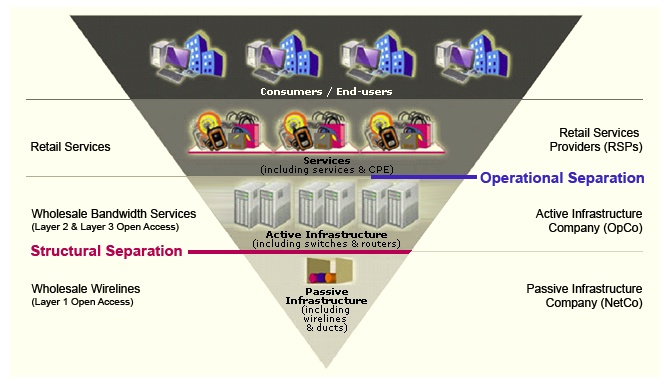
Ragnor: Have you seen the Singaporean model?
Time to find a new industry!
Rubicon:Ragnor: Have you seen the Singaporean model?
That model looks workable. Specifically, the Retail Service Providers don't have direct access to the Layer 1 level of the network. I've been looking at the MED's Invitation to Participate http://www.med.govt.nz/ultra-fast-broadband and to me, it seems that this separation of retailers from Layer 1 of the network isn't required. The Invitation provides for the LFC to offer Layer 1 services to Access Seekers. However, I can't find any requirement that there must be operational or structural separation between an 'Access Seeker' and a Retail Service Provider.
To me, it seems that a Retail Service Provider who is also an Access Seeker could monopolise the fibre connection to an end user's premise. A situation like this would stifle competition.
Time to find a new industry!
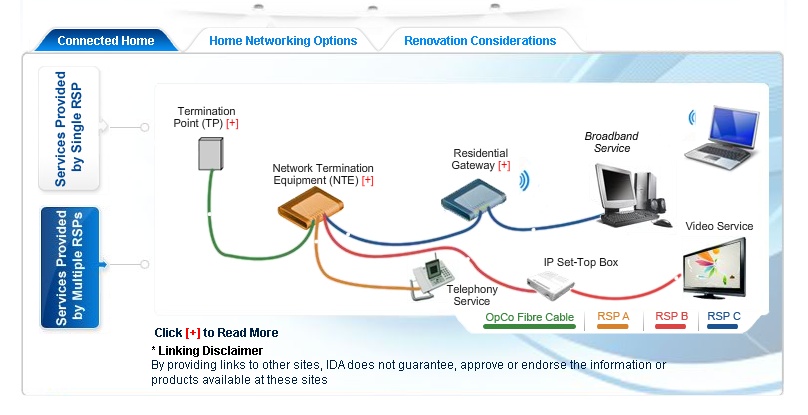
Instead, if the LFC was required to provide Ethernet transport services, the following would happen:
1) Customer arranges a fibre connection from the LFC, which also provides an ONT, cost $2000.
2) Customer arranges TV connection. Telstra patches into the LFC's equipment at the point of interconnect and provides the customer a set-top box to convert the Ethernet stream into a video signal suitable for their TV.
3) Customer contacts Orcon. Orcon patches into the LFC's equipment and a port on the ONT starts listening for PPPoE or DHCP requests. Orcon may send the customer a router.
4) Customer contacts Telecom. Telecom patches a VoIP service into the LFC's equipment and sends the customer an analogue telephone adaptor to convert the VoIP signal to POTS.
richms: There are already too many requirements when building new houses. I dont think data/tv wiring should be one of them. I do think that the laws about not preventing tennents having stuff installed to the place need to be made clearer to people as I have just heard of someone who had all sorts of issues with more phonelines to their place because the LL was being a dick about it.


|
|
|