Geekzone: technology news, blogs, forums
Guest
Welcome Guest.
You haven't logged in yet. If you don't have an account you can register now.
Filter this topic showing only the reply marked as answer View this topic in a long page with up to 500 replies per page Create new topic
1 | ... | 151 | 152 | 153 | 154 | 155 | 156 | 157 | 158 | 159 | 160 | 161 | ... | 165
dantheperson
235 posts

Master Geek
+1 received by user: 65


  #3487827 5-May-2026 18:30
Send private message quote this post

Paul1977:


After getting solar, how long until the novelty wears off and I stop checking the app every 5 minutes to see how it's doing?


I was taking wagers over the dinner table, best guess how much we generated that day till about April.


sen8or
1955 posts

Uber Geek
+1 received by user: 1454


  #3487970 6-May-2026 08:08
Send private message quote this post

Paul1977:


After getting solar, how long until the novelty wears off and I stop checking the app every 5 minutes to see how it's doing?


And here I was thinking it was just me. 


I'm still tweaking some of the settings and our house to maximise solar use / minimise import (time hot water comes on and time that heat pumps come on in the afternoon to warm up the house), but I suspect getting solar installed just as we enter late autumn isn't really a fair assessment.


So far this month - 


Solar Generation  V Grid Import


1/5 - 43.2kw / 16.9kw


2/5 - 36.5kw / 24.4kw


3/5 - 44.4kw / 22kw


4/5 - 11kw / 38kw


5/5 - 23kw / 19.6kw


Monday was a bad day in Christchurch, grey all day. I was a little surprised to have generated any solar energy at all. Each day there is also 9 / 10kw coming from the battery (which has been charged by solar) so not sure if this is in addition to the solar generation (i.e just the way the Sigen app displays?)


CYaBro
4738 posts

Uber Geek
+1 received by user: 1202

ID Verified
Trusted

  #3487976 6-May-2026 08:38
Send private message quote this post

Paul1977:


After getting solar, how long until the novelty wears off and I stop checking the app every 5 minutes to see how it's doing?


8 months in and no change yet...


Opinions are my own and not the views of my employer.


fastbike
536 posts

Ultimate Geek
+1 received by user: 406


  #3487980 6-May-2026 09:01
Send private message quote this post

sen8or:


Paul1977:


After getting solar, how long until the novelty wears off and I stop checking the app every 5 minutes to see how it's doing?


And here I was thinking it was just me. 


I'm still tweaking some of the settings and our house to maximise solar use / minimise import (time hot water comes on and time that heat pumps come on in the afternoon to warm up the house), but I suspect getting solar installed just as we enter late autumn isn't really a fair assessment.


So far this month - 


Solar Generation  V Grid Import


1/5 - 43.2kw / 16.9kw


2/5 - 36.5kw / 24.4kw


3/5 - 44.4kw / 22kw


4/5 - 11kw / 38kw


5/5 - 23kw / 19.6kw


Monday was a bad day in Christchurch, grey all day. I was a little surprised to have generated any solar energy at all. Each day there is also 9 / 10kw coming from the battery (which has been charged by solar) so not sure if this is in addition to the solar generation (i.e just the way the Sigen app displays?)


Yes we are in the "dark quarter" where PV output falls off dramatically and we get more grey days so total output takes a hammering.
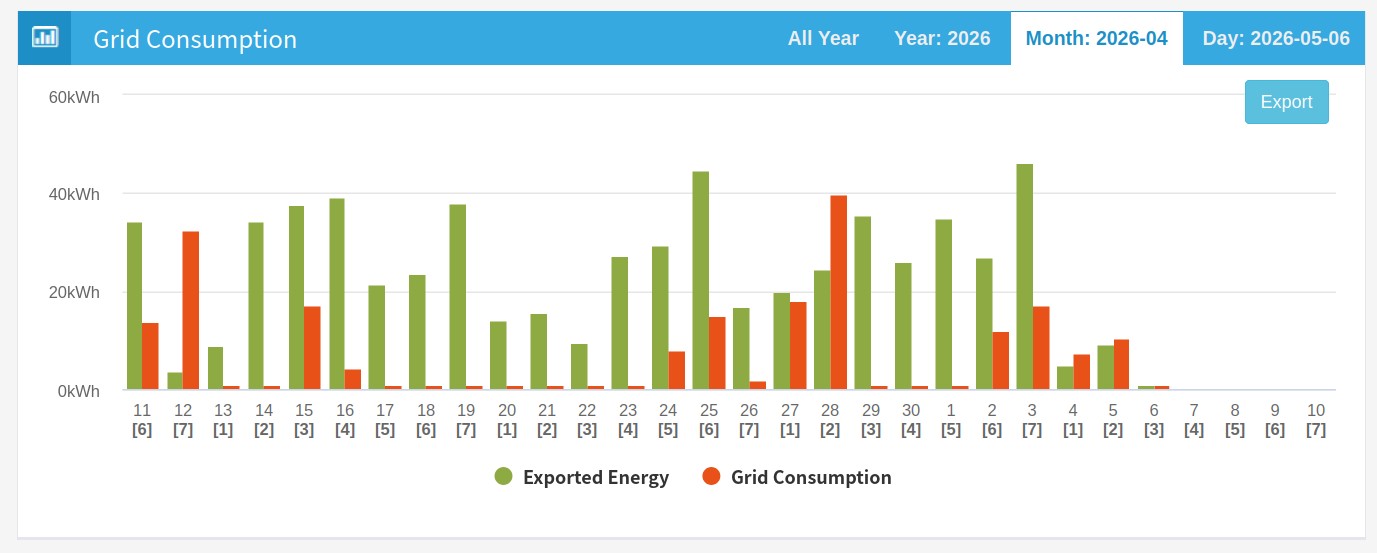
I'm in Chch, here's my month so far (it aligns to the billing cycle which runs from 11th April). My exports in summer are over 100kWh and imports almost zero (looks like some night time car charging imports in the chart)


Also just a small thing - an easy mistake to make - your figures are total energy (not power = flow rate of energy) so are expressed as kWh i.e. one kiloWatt of power for one hour = 1kWh of energy


Otautahi Christchurch


kangaroo13
106 posts

Master Geek
+1 received by user: 101


  #3487991 6-May-2026 09:29
Send private message quote this post

sen8or:


I'm still tweaking some of the settings and our house to maximise solar use / minimise import (time hot water comes on and time that heat pumps come on in the afternoon to warm up the house), but I suspect getting solar installed just as we enter late autumn isn't really a fair assessment.


...


Autumn is probably a good time to tweak the system, as solar resource is more scarce, so aligning generation and usage is more critical. 


Regarding hot water timing: I would suggest some sort of smart sensor to control the hot water cylinder.  If your system is relatively large, so most days your generation peak is greater than your cylinder rating (e.g. 8kWp into a 3kW HWS), then you can fit a simple switch with a clamp sensor monitoring export (such as a CatchRelay or something based upon a Shelly relay).  CatchRelay comes with access to the SolarAnalytics web site which is great for monitoring things.   If your solar capacity doesn't have as great overhead compared to your HWS, then a diverter may be more suited (e.g. Kiwi made SunStash is cost effective).   Both will work much more effectively than a simple timer in terms of matching generation with usage, and both (Catch & Sunstash) will 'top-up' using off-peak power should there be insufficient solar.  I have no personal experience with Shelly - they are extremely cost effective, but I figure you'll need some other 'intelligence' in the system such as HomeAssistant.


Paul1977
5251 posts

Uber Geek
+1 received by user: 2231


  #3488001 6-May-2026 10:11
Send private message quote this post

sen8or:


And here I was thinking it was just me. 


I'm still tweaking some of the settings and our house to maximise solar use / minimise import (time hot water comes on and time that heat pumps come on in the afternoon to warm up the house), but I suspect getting solar installed just as we enter late autumn isn't really a fair assessment.


So far this month - 


Solar Generation  V Grid Import


1/5 - 43.2kw / 16.9kw


2/5 - 36.5kw / 24.4kw


3/5 - 44.4kw / 22kw


4/5 - 11kw / 38kw


5/5 - 23kw / 19.6kw


Monday was a bad day in Christchurch, grey all day. I was a little surprised to have generated any solar energy at all. Each day there is also 9 / 10kw coming from the battery (which has been charged by solar) so not sure if this is in addition to the solar generation (i.e just the way the Sigen app displays?)


Did you end up with 470W, 480W, or 490W panels? We're in Christchurch as well, but didn't go for a battery so not a lot of point comparing our import. Other than the battery we are similarly specced, but our orientations are different - we have 12 x 490W NNE and 12 x 490W WNW. I suspect at this time of year you aren't getting much from your ENE array which would explain why most of our numbers are a little higher - I'd imagine this will be a different story in Summer.


Solar Production


1/5 - 47.22kWh


2/5 - 37.17kWh


3/5 - 47.38kWh


4/5 - 9.54kWh


5/5 - 27.95kWh


sen8or
1955 posts

Uber Geek
+1 received by user: 1454


  #3488016 6-May-2026 11:03
Send private message quote this post

480w panels. Still waiting on Genesis to confirm we've been configured for export (email rec'd last week saying it was in their system and would be either 1 or 6 weeks depending on if they needed a tech to come out to swap over meter or do it remotely). 


sen8or
1955 posts

Uber Geek
+1 received by user: 1454


  #3488019 6-May-2026 11:12
Send private message quote this post

kangaroo13:


sen8or:


I'm still tweaking some of the settings and our house to maximise solar use / minimise import (time hot water comes on and time that heat pumps come on in the afternoon to warm up the house), but I suspect getting solar installed just as we enter late autumn isn't really a fair assessment.


...


Autumn is probably a good time to tweak the system, as solar resource is more scarce, so aligning generation and usage is more critical. 


Regarding hot water timing: I would suggest some sort of smart sensor to control the hot water cylinder.  If your system is relatively large, so most days your generation peak is greater than your cylinder rating (e.g. 8kWp into a 3kW HWS), then you can fit a simple switch with a clamp sensor monitoring export (such as a CatchRelay or something based upon a Shelly relay).  CatchRelay comes with access to the SolarAnalytics web site which is great for monitoring things.   If your solar capacity doesn't have as great overhead compared to your HWS, then a diverter may be more suited (e.g. Kiwi made SunStash is cost effective).   Both will work much more effectively than a simple timer in terms of matching generation with usage, and both (Catch & Sunstash) will 'top-up' using off-peak power should there be insufficient solar.  I have no personal experience with Shelly - they are extremely cost effective, but I figure you'll need some other 'intelligence' in the system such as HomeAssistant.


Thanks.


For now I'm happy with the flexibility within the Sigen app, I can set the sigen app / shelley relay to only use excess solar power or power once the battery reaches a certain level, but for now its on system level control, drawing from either solar, battery or grid depending on availability. Outside of hot water, the house is only drawing 0.5 - 1.2kWH at any given time during the day when no one is home depending on if washing machine / dishwasher is on.


Our generation seems to peak between 12 and 3 for now (highest I've seen it go is just under 8kHW) but from 10-12 and 3 - 5 floats up around 5, still plenty of headroom for our hot water heating and then heat pumps in the afternoon when hot water is done.


HarmLessSolutions
1264 posts

Uber Geek
+1 received by user: 884

Subscriber

  #3488029 6-May-2026 11:35
Send private message quote this post

sen8or:


kangaroo13:


Autumn is probably a good time to tweak the system, as solar resource is more scarce, so aligning generation and usage is more critical. 


Regarding hot water timing: I would suggest some sort of smart sensor to control the hot water cylinder.  If your system is relatively large, so most days your generation peak is greater than your cylinder rating (e.g. 8kWp into a 3kW HWS), then you can fit a simple switch with a clamp sensor monitoring export (such as a CatchRelay or something based upon a Shelly relay).  CatchRelay comes with access to the SolarAnalytics web site which is great for monitoring things.   If your solar capacity doesn't have as great overhead compared to your HWS, then a diverter may be more suited (e.g. Kiwi made SunStash is cost effective).   Both will work much more effectively than a simple timer in terms of matching generation with usage, and both (Catch & Sunstash) will 'top-up' using off-peak power should there be insufficient solar.  I have no personal experience with Shelly - they are extremely cost effective, but I figure you'll need some other 'intelligence' in the system such as HomeAssistant.


Thanks.


For now I'm happy with the flexibility within the Sigen app, I can set the sigen app / shelley relay to only use excess solar power or power once the battery reaches a certain level, but for now its on system level control, drawing from either solar, battery or grid depending on availability. Outside of hot water, the house is only drawing 0.5 - 1.2kWH at any given time during the day when no one is home depending on if washing machine / dishwasher is on.


Our generation seems to peak between 12 and 3 for now (highest I've seen it go is just under 8kHW) but from 10-12 and 3 - 5 floats up around 5, still plenty of headroom for our hot water heating and then heat pumps in the afternoon when hot water is done.


You're struggling with the appropriate units by the looks of your posts.


kW are the rate at which you are generating, charging or consuming electricity, or the capacity of panels or inverters to process/generate under peak production. Sort of similar to speed.


kWh is a measure of the volume of electricity you have generated or the storage capacity of batteries. kWhs are the units that your electricity provider charges you for supply (or pays you for export). Sort of similar to distance travelled.


For example say you have 10 x 500W (10 x 0.5 kW) panels supplying a 5kW inverter at maximum capacity that 5kW of generation will result in 5 kWh per hour, or for 8 hours at that rate 40 kWh.


Hope this helps clarify things 😎


https://www.harmlesssolutions.co.nz/


Paul1977
5251 posts

Uber Geek
+1 received by user: 2231


  #3488037 6-May-2026 12:02
Send private message quote this post

HarmLessSolutions:


You're struggling with the appropriate units by the looks of your posts.


kW are the rate at which you are generating, charging or consuming electricity, or the capacity of panels or inverters to process/generate under peak production. Sort of similar to speed.


kWh is a measure of the volume of electricity you have generated or the storage capacity of batteries. kWhs are the units that your electricity provider charges you for supply (or pays you for export). Sort of similar to distance travelled.


For example say you have 10 x 500W (10 x 0.5 kW) panels supplying a 5kW inverter at maximum capacity that 5kW of generation will result in 5 kWh per hour, or for 8 hours at that rate 40 kWh.


Hope this helps clarify things 😎


I was trying to explain this to my partner. I still don't think she gets it.


HarmLessSolutions
1264 posts

Uber Geek
+1 received by user: 884

Subscriber

  #3488039 6-May-2026 12:08
Send private message quote this post

Paul1977:


HarmLessSolutions:


You're struggling with the appropriate units by the looks of your posts.


kW are the rate at which you are generating, charging or consuming electricity, or the capacity of panels or inverters to process/generate under peak production. Sort of similar to speed.


kWh is a measure of the volume of electricity you have generated or the storage capacity of batteries. kWhs are the units that your electricity provider charges you for supply (or pays you for export). Sort of similar to distance travelled.


For example say you have 10 x 500W (10 x 0.5 kW) panels supplying a 5kW inverter at maximum capacity that 5kW of generation will result in 5 kWh per hour, or for 8 hours at that rate 40 kWh.


Hope this helps clarify things 😎


I was trying to explain this to my partner. I still don't think she gets it.


At least she's not alone. Our media continually confuse the two in reports about solar farms and other renewable generation content. Hopefully the way I've laid it out above is relatively easy to understand.


https://www.harmlesssolutions.co.nz/


EgorNZ
66 posts

Master Geek
+1 received by user: 23

Subscriber

  #3488042 6-May-2026 12:30
Send private message quote this post

It might help to think of it by analogy to speed and distance, concepts familiar to anyone who drives a car:


  • 100km/h = speed (at a moment in time)
  • 100km = distance recorded

If you drive at a constant speed of 100km/h for 1 hour you will have travelled a total of 100km.


Likewise:


  • 10kW = power (at a moment in time)
  • 10kWh = usage recorded

If you use a constant 10kW of power for 1 hour you will have consumed a total of 10kWh.


The thing that possibly trips people up is how the 'hour' unit appears in the opposite place for power/usage than for speed/distance, and as a multiplier rather than a divisor. That's because a kilowatt is already a momentary unit of rate (equal to 1000 joules per second in energy terms) whereas a kilometre is not.


fastbike
536 posts

Ultimate Geek
+1 received by user: 406


  #3488061 6-May-2026 12:59
Send private message quote this post

EgorNZ:


It might help to think of it by analogy to speed and distance, concepts familiar to anyone who drives a car:


  • 100km/h = speed (at a moment in time)
  • 100km = distance recorded

If you drive at a constant speed of 100km/h for 1 hour you will have travelled a total of 100km.


Likewise:


  • 10kW = power (at a moment in time)
  • 10kWh = usage recorded

If you use a constant 10kW of power for 1 hour you will have consumed a total of 10kWh.


The thing that possibly trips people up is how the 'hour' unit appears in the opposite place for power/usage than for speed/distance, and as a multiplier rather than a divisor. That's because a kilowatt is already a momentary unit of rate (equal to 1000 joules per second in energy terms) whereas a kilometre is not.


Except it is back to front ! compared to speed / distance. One is the differential compared to speed, the other is an integral.


Otautahi Christchurch


HarmLessSolutions
1264 posts

Uber Geek
+1 received by user: 884

Subscriber

  #3488067 6-May-2026 13:48
Send private message quote this post

Woohoo 😁 Following on from a series of failed attempts to reeducate our Fronius inverter to export beyond 5 kW it appears yesterday's attempt has been successful. Not a great day for maintaining peak generation but I've seen up to 7.5 kW being exported at times in the last hour. Great when a plan comes together and top marks to our installer for his continued efforts on this issue.


https://www.harmlesssolutions.co.nz/


kangaroo13
106 posts

Master Geek
+1 received by user: 101


  #3488078 6-May-2026 14:09
Send private message quote this post

fastbike:


EgorNZ:


It might help to think of it by analogy to speed and distance, concepts familiar to anyone who drives a car:


  • 100km/h = speed (at a moment in time)
  • 100km = distance recorded

If you drive at a constant speed of 100km/h for 1 hour you will have travelled a total of 100km.


Likewise:


  • 10kW = power (at a moment in time)
  • 10kWh = usage recorded

If you use a constant 10kW of power for 1 hour you will have consumed a total of 10kWh.


The thing that possibly trips people up is how the 'hour' unit appears in the opposite place for power/usage than for speed/distance, and as a multiplier rather than a divisor. That's because a kilowatt is already a momentary unit of rate (equal to 1000 joules per second in energy terms) whereas a kilometre is not.


Except it is back to front ! compared to speed / distance. One is the differential compared to speed, the other is an integral.


They are both integrals, but the aspect that could cause confusion is that speed is expressed as a compound unit, whereas power is normally expressed using a fundamental unit


Distance = integral of speeed over time, so unit is  km/h * h  = km.


Energy = integral of power over time, so unit is         kW * h = kWh


(Alternatively:  J/s * h ->  J which can equivalently be expressed in Wh   with some appropriate scaling factors and unit conversions, which probably complicates rather than adds clarity)


1 | ... | 151 | 152 | 153 | 154 | 155 | 156 | 157 | 158 | 159 | 160 | 161 | ... | 165
Filter this topic showing only the reply marked as answer View this topic in a long page with up to 500 replies per page Create new topic


Geekzone Live »

Try automatic live updates from Geekzone directly in your browser, without refreshing the page, with Geekzone Live now.


Are you subscribed to our RSS feed? You can download the latest headlines and summaries from our stories directly to your computer or smartphone by using a feed reader.