|
|
|
Due to the 7-14 day incubation period, you really need to wait another week before expecting to see a large change in the line on the graph. And in addition to that perhaps even longer so it looks like its heading in another direction.
Factors contributing to the high CFR in Italy relative to Germany
As per my early post, data for 24 March shows a large disparity between the age profiles of confirmed COVID-19 cases in Italy and Germany. It is also widely known that the medical system in Italy has been overwhelmed by the numbers of cases there which has resulted in many old people not receiving life saving treatment due to lack of resources.
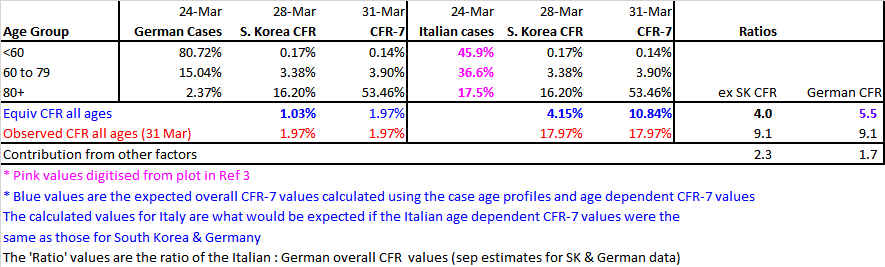
The following is an evaluation of the relative contribution of these two factors to the large difference in overall CFR-7 values for the two countries seven days later (31 Mar); ie. Germany CFR = ~2%, Italy 18%. The per capita rate of testing in Italy is not much lower than in Germany so that seems unlikely to be a major factor.
Ideally, age and gender would have been jointly evaluated but it is difficult enough locating age and gender profiles of cases separately, let alone finding consistent data for age profiles for each gender. Note that the relatively coarse age group divisions used here reflect the age group categories used for some of the German data. The effect should be relatively small though; eg. the '<60' age group contributes a very small component of the overall CFR values.
CFR-7 used here is the number of deaths divided by the number of confirmed cases 7 days prior, sometimes abbreviated as simply 'CFR'. Note that this different from, and higher than the Infection Fatality Rate (IFR) which is the number of deaths divided by the total number of infections, which at this point in not reliably known (and probably never will for data as at today's date). However, the objective here is to assess the disparity in the overall CFR values and therefore use of age dependent CFR-7 values is appropriate (ie. are not trying to derive accurate IFR values).
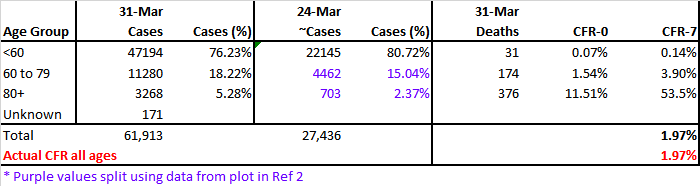
CFR-0 (deaths divided by current confirmed cases) is included in the table below because many people persist in defining CFR that way. At the current time when the numbers of cases in Germany are still increasing near exponentially, CFR-0 is fairly unhelpful/meaningless as it (incorrectly) assumes zero average lag between case confirmation and death.
The Table below shows the derivation of age dependent CFR-7 values for Germany based on currently available data. These are then used in the second plot, along with similar data from South Korea, to assess the contribution of the case age profile disparity to the difference between the overall CFR-7 values for Italy and Germany. Data from South Korea are included as the situation there is more evolved and the numbers of new cases are small compared to the total number of cases. Consequently the South Korean CFR values are less sensitive to the lag between case confirmation and death.


As shown, the German CFR-7 values for the <60 and 60-79 age groups are not that different from the corresponding South Korean values. However, the German value for the 80+ age group (53.5%) seems very high, and a lot higher than the South Korean equivalent. It seems unlikely this would be due to the higher per capita testing rate in South Korea. If anything that would be expected to impact the youngest group most as on average the symptoms for that group are less severe and consequently more likely to be missed or not tested due to being too mild. Two possible explanations may be the higher proportion of females infected in South Korea and/or that the lag between confirmation and death is less than 7 days for the 80+ age group? Very unlikely to be less than 5 days average (or even 5 days) though. Being more mature the South Korean data should be relatively unaffected - 5 or 7 days would make little difference to their values.
The Ratios in the second plot indicate that the difference between the age profiles is the main contributor to the disparity between the observed overall CFR values for Italy & Germany as at 31 Mar. That is, based on the difference between the age profiles alone, the overall CFR for Italy would be expected to be 4 to 5.5 times higher than the German CFR value. The residual factor of ~2 difference is probably mainly due to overwhelmed hospitals in Italy.
As per the second table above, the South Korean data do not well explain the observed overall CFR-7 value for German cases as at 31 Mar. Nevertheless, the ratios calculated for the impact of the difference between the age profiles of Italian & German cases are not that different for SK & German CFR's, indicating that the estimates of relative contributions of age profile discrepancy and overwhelmed hospitals in Italy are reasonably robust (or at least not highly sensitive to the CFR for the 80+ age group).
Two other observations:
==
Now going out on a limb!
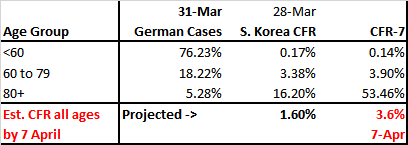
Based on their current (31 Mar) age profile, the table below forecasts a likely jump in the overall CFR for Germany from its current 2% to about 3.6% by 7 April ... Time will tell?
References:
Ref 1: https://www.rki.de/DE/Content/InfAZ/N/Neuartiges_Coronavirus/Situationsberichte/2020-03-24-en.pdf?__blob=publicationFile
Ref 2: https://www.rki.de/DE/Content/InfAZ/N/Neuartiges_Coronavirus/Situationsberichte/2020-03-31-en.pdf?__blob=publicationFile
Ref 3: https://towardsdatascience.com/why-are-covid-19-statistics-so-different-for-germany-and-italy-ee5bf376f461
Ref 4: https://www.cdc.go.kr/board/board.es?mid=a30402000000&bid=0030


If there's enough interest in these I'll post them to the 450+ page main thread, although I think they'll get swamped there pretty quickly, that's running more like IRC than a web forum.
@neb: Yes, I am seeing the increasing trend in my data. There are reasons for it. I haven't looked at Austria but in the case of Germany, as per my previous post, by 7 Apr the number of deaths is likely to be about three times what they were on 31 Mar. That is basically locked in now; ie. due to a higher proportion of older people infected over the last week or so and all the new confirmed cases over that time cases (due to near exponential growth, about 2.25x as many cases than there were 7 days prior).
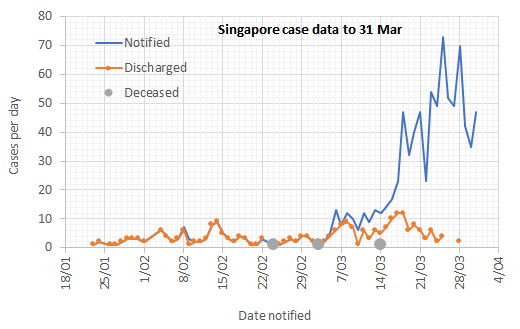
Did little smile seeing Singapore in the plots, as they had no new deaths since 14 Mar. Hence flat lining along the zero axis. But they are also going to see more. Have some interesting info/data for Singapore. Hopefully will post a bit later tonight, though I really need to try & hit the sack a bit earlier than I have been!
Really good detailed data available for Singapore (https://experience.arcgis.com/experience/7e30edc490a5441a874f9efe67bd8b89). Advantage over the equivalent NZ data ex MOH as the individual case data include outcomes etc that enable a lot more info to be extracted. Similar data for any other countries?
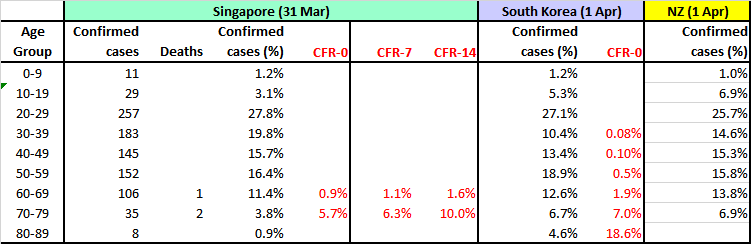
A few examples of interesting info on Singapore response and case profiles ... (data to 31 May. Still evaluating)
Very high (100%?) hospitalisation of confirmed cases. Out of 926 confirmed cases from 23 Jan - 31 May, over 45% are still in hospital (22 critical), 260 discharged to isolation, 240 discharged, 3 deaths. Seems like all confirmed cases are initially sent to hospital presumably for evaluation. Seems Singapore is taking no chances and throwing all at it in terms of medical support. By comparison NZ currently has 13 of 797 in hospital!
As per plot, a few are discharged between 1 - 2 weeks after confirmation, and all but a handful discharged within about a month. Sixty two percent of the remaining 683 cases are still in hospital (38% in isolation)! Of course it no doubt helps having a GDP per capita of over US$100,000. And those discharged to isolation - that means either non-medical care in nominated hospitals or in an isolation facility (so are effectively still in 'hospital'). To quote: "Patients who are clinically well enough to be discharged from medical care but still test positive for COVID-19 will be isolated and care for at Concord International Hospital, Mount Elizabeth Hospital, Gleneagles Hospital and the Community Isolation Facility".

Mean lag from test confirmation to death ~19 days (range 15 - 26). A lot longer than the often assumed figure of 7 days I have modelled. But only three deaths so wide uncertainty. Also reflects the medical resources that can thrown at each case. I imagine the corresponding figure for Italy and Spain is shorter.
Age distribution: Quite similar to South Korea and NZ, but fewer and 10-19 and especially fewer over 70 (annoyingly the NZ data do not split out 70-79 and 80+ which is where the best resolution is needed. Singapore provides actual ages so can cut it however needed)
CFR: with only three deaths the Singapore data are not reliable in this respect but they are surprisingly not that different from the latest data for South Korea (which have been creeping up, esp for 80+). This is one area where having actual case by case data (per Singapore) is important as most summarised age dependent CFR data (per South Korea) ignore the lag between exposure and death (ie. are CFR-0 values). Being still in near exponential growth in cases CFR-0 is not good for forecasting / modelling. No way this type of info will be able to be extracted from the NZ data (with only 1 death not relevant at this point though).

Overseas travel: Much seems to be made on GZ re the high overseas travel component in the NZ data. However, the latest (effectively 1 Apr) NZ data shows 51% of cases from overseas travel, which is identical to the figure for Singapore (31 Mar = 51% imported). In Taiwan, the proportion of cases imported is much higher.
Asymptomatic cases: Yet to run the data but spot checks of the case data confirm a number of asymptomatic cases tested positive; eg. on 4 Feb, three of six new cases were asymptomatic when tested positive (2 ex Wuhan, 1 a local tour guide with no overseas travel but contact with tourists and two local cases). All returnees from Wuhan were tested, symptomatic or not. And some of those tested positive.
Edit: slight tidy up
I'm not here to discuss anything as for every expert that says something another expert says otherwise. But out local university is wanting to get hold of the virus and do research. I wish them every success in the multiverse.
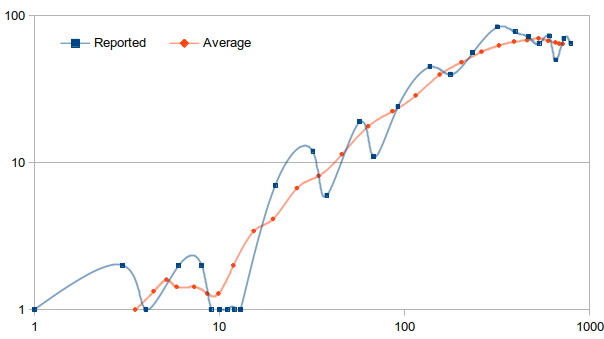
Log-log graph of new cases vs total cases for NZ, up to 1st April as reported by MoH. See https://aatishb.com/covidtrends/ for the rationale for this type of graph. A rising line is bad, in that it's exponential growth. Horizontal is OK, implying some degree of control. Descending is what we want.
I've added probable to confirmed, just because I think it gives a fuller picture. I've left out 2 April, because it's partial data (7 new cases reported). Moving average is over for 7 days, centred on each date.

@frankv: Yes, it is a useful way of plotting the data. I have not plotted data that way yet due to other distractions. But have been 'intending to'.!
Peak new cases (so far!) appears to have occurred around 27 Mar, three days after lockdown but the comparatively small drop off was possibly due to travel restrictions implemented several days earlier (plus reduction in incoming passengers after the lockdown). I would have guessed the travel restrictions might have bitten harder if our cases were so heavily import dominated? I see the imported proportion of our cases has now dropped to 49% though so would have been an even smaller component of new cases in the last couple of days.
There is an interesting plot for Taiwanese imported vs local cases I will post a bit later for comparison sake.
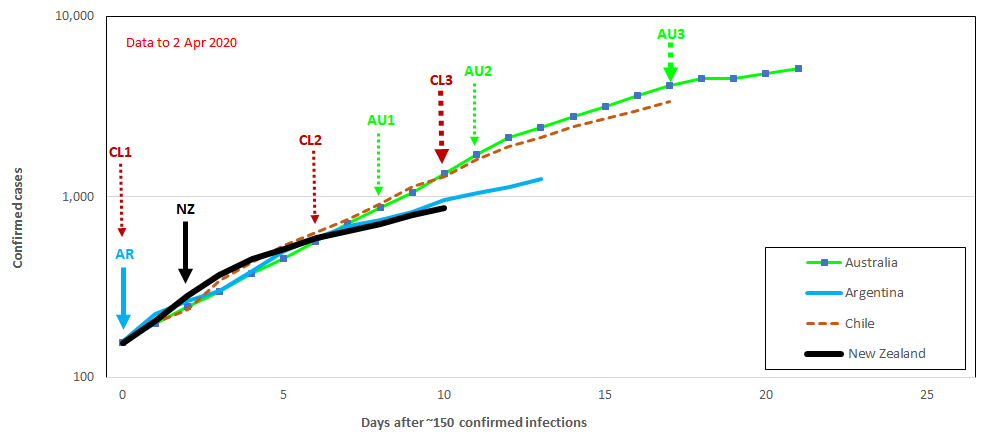
@davidcole: Plot following up on your suggestion re lockdowns for other jurisdictions. Have only done for southern hemisphere countries to save time, especially as in many / most places various increasing restrictions were implemented over time (typically starting with travel related ones). But interesting nevertheless. Only AR & NZ implemented 'full' lockdowns, AR a couple of days before NZ. Both had prior travel restrictions but they are off the L of the plot. For AU & CL three of the more significant restrictions implemented are shown. These are:
AU1 : Borders close (20/3)
AU2 : Places of social gathering closed - cafes & restaurants takeaway only (23/3)
AU3 : Lockdown excluding work and education (29/3)
CL1 : Borders close (16/3)
CL2 : Nighttime curfew (~22/3)
CL3 : Regional lockdowns start (26/3)
Noticeable that the two with 'full' lockdowns (AR & NZ) implemented at an earlier stage show quicker roll off from exponential growth. And both following a fairly similar trend. Not certain the lockdowns (11 & 8 days ago) will have kicked in much so far. Hopefully will see bigger effect over the next several days. Perhaps so far the earlier stage has been a more important factor?
For CL, not a big impact yet from there regional lockdowns.

Infection to test confirmation lag
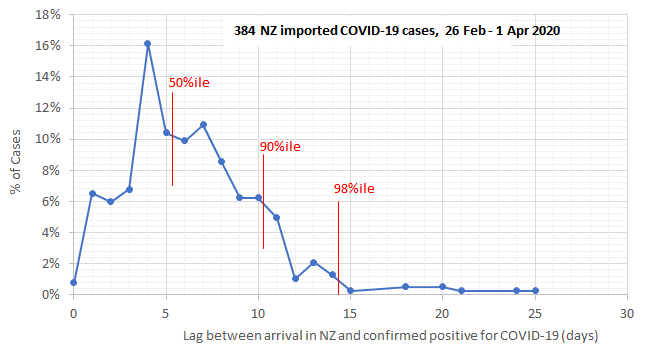
Plot below for NZ data imported cases to 1 April. Shows distribution of lag time between arrival in NZ until positive test result reported by MOH. Should in theory provide a lower bound estimate of lag from infection to test confirmation being reported by MOH.
Median time ~5 days, 98 percentile ~14 days. And 1%, 20 - 25 days! Suggests a bit of delay in getting tested (or test results)?
Would be more useful if the NZ data included time of first symptoms.

Previously known as psycik
Home Assistant: Gigabyte AMD A8 Brix, Home Assistant with Aeotech ZWave Controller, Raspberry PI, Wemos D1 Mini, Zwave, Shelly Humidity and Temperature sensors
Media:Chromecast v2, ATV4 4k, ATV4, HDHomeRun Dual
Server Host Plex Server 3x3TB, 4x4TB using MergerFS, Samsung 850 evo 512 GB SSD, Proxmox Server with 1xW10, 2xUbuntu 22.04 LTS, Backblaze Backups, usenetprime.com fastmail.com Sharesies Trakt.TV Sharesight
DS248: ... lag from infection to test confirmation being reported by MOH.Median time ~5 days, 98 percentile ~14 days. And 1%, 20 - 25 days! Suggests a bit of delay in getting tested (or test results)?
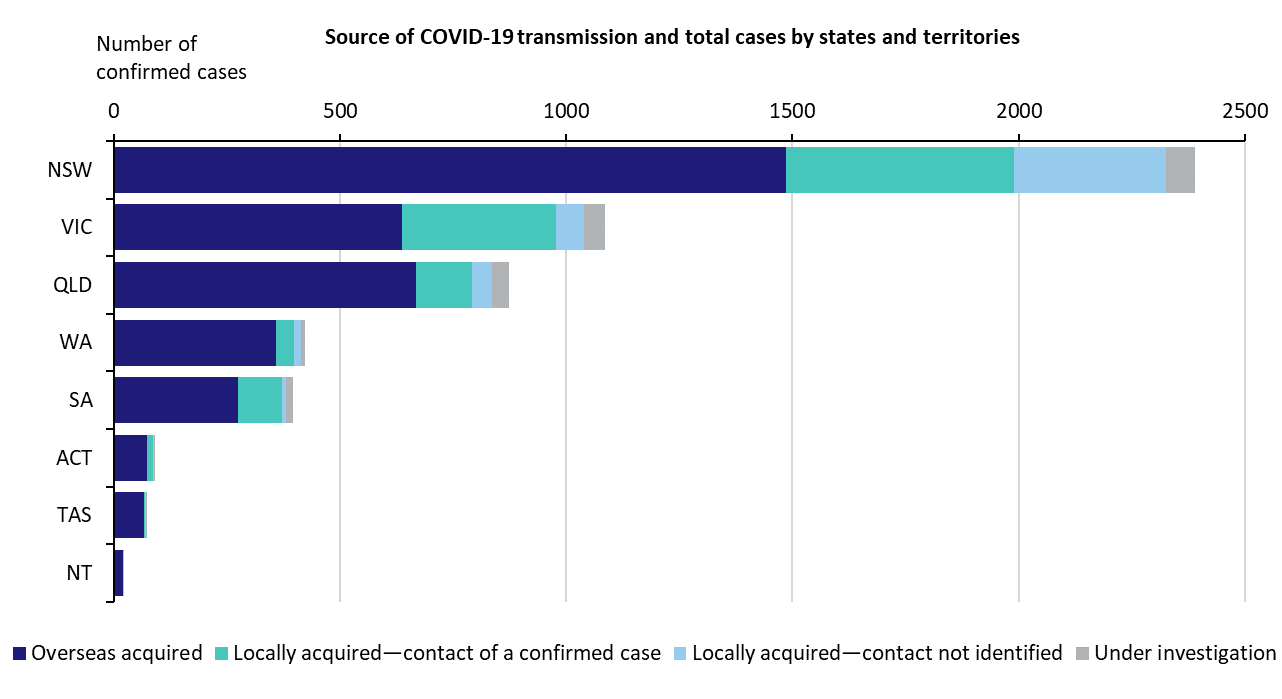
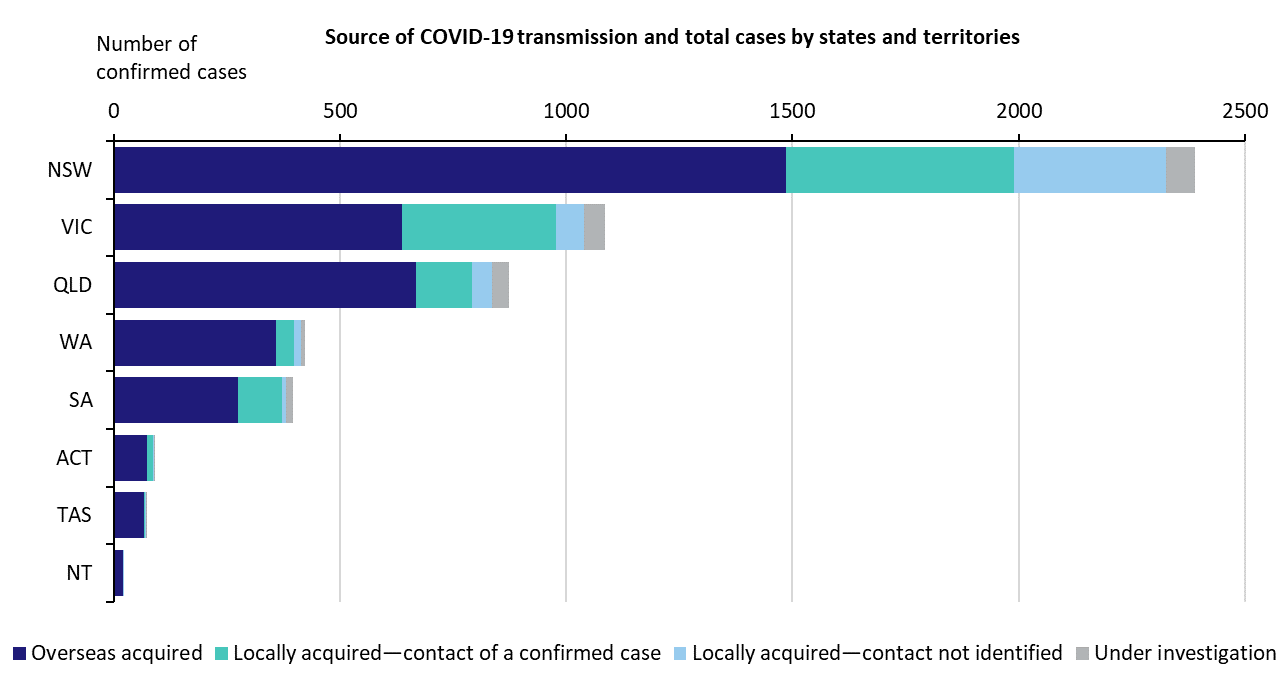
On the theme of cases imported, plot below is Australian data from https://www.health.gov.au/sites/default/files/documents/2020/04/covid-19-cases-in-australia-by-state-and-source-of-transmission-covid-19-cases-in-australia-by-state-and-source-of-transmission_2.png
Eye balling that, approximately 70% of there cases are imported, so quite a bit up on NZ's rate. Unfortunately they do not appear to release digital case by case data to the public.

Just for explanation why older people in Germany seems to be more affected. Most fatalities of age 80+ are direct hits in senior homes with a high concentration of elder people on a single spot. In general this is quite devastating especially when they are dement people you can't just evacuate.
The care personnel was lacking masks and protection gear as well hence they brought in the virus from the outside as well as visitors. Clinics and hospitals have been served first due to their high demand. At the time being the senior homes are completely locked but people are very depressed due to the lack of social contact to their relatives. At least they got iPads now for video calls to their beloved.
- NET: FTTH & VDSL, OPNsense, 10G backbone, GWN APs
- SRV: 12 RU HA server cluster, 0.1 PB storage on premise
- IoT: thread, zigbee, tasmota, BidCoS, LoRa, WX suite, IR
- 3D: two 3D printers, 3D scanner, CNC router, laser cutter
Tinkerisk:
Just for explanation why older people in Germany seems to be more affected. Most fatalities of age 80+ are direct hits in senior homes with a high concentration of elder people on a single spot. In general this is quite devastating especially when they are dement people you can't just evacuate.
The care personnel was lacking masks and protection gear as well hence they brought in the virus from the outside as well as visitors. Clinics and hospitals have been served first due to their high demand. At the time being the senior homes are completely locked but people are very depressed due to the lack of social contact to their relatives. At least they got iPads now for video calls to their beloved.
This is a concern. I wonder if NZs retirement workers are all wearing masks etc? Anyone know?
|
|
|