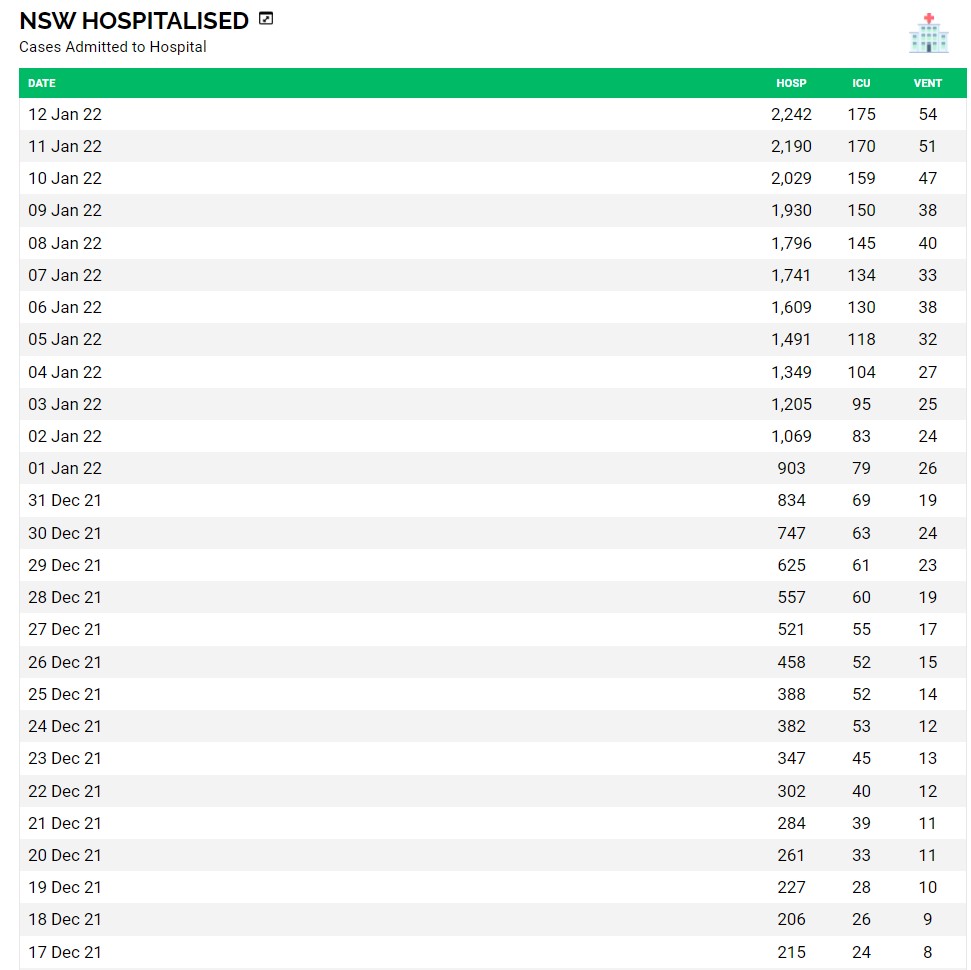
The US are seeing record admissions and staff absences. So in the key metrics Omicron is certainly far worse in a poorly managed system, poorly meaning low vaccine walls and a lack of will to commit to consistent health restrictions.
This certainly clarifies the situation as far as milder Covid 19 goes. In totality it is not milder, it is worse, however global immunity, the knowledge we have around how to treat this disease in hospital, the affinity for the upper respiratory tract, means that on an individual basis per case it is possibly marginally less harmful.
But most of all we have learned how to apply health restrictions that are effective, and here in our country we are some of the best at doing that, so we will not see an all t once melt down here.
I think we will of course see some big numbers here. I hope people do not forget what was gained once cases hit the tens of thousands here, I hope they don't just slag off the health response without giving the situation some context.
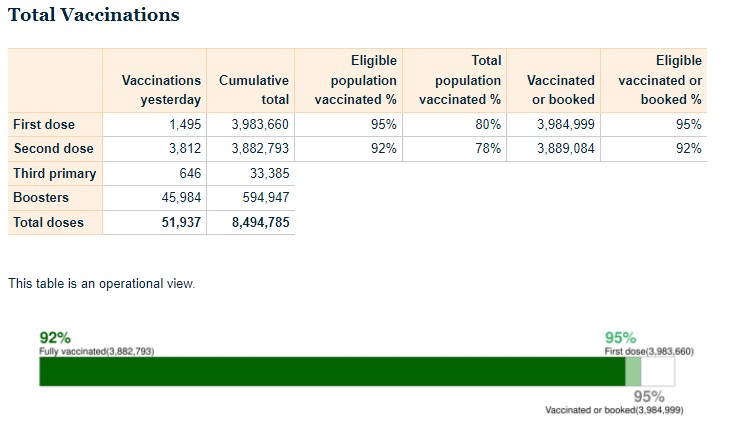
There is nothing we can do about the bad stats that are coming from the unvaccinated and the pressure that group will place on testing and hospitals...short of a vaccine mandate for all.
We will need to be surgical about how we recommend testing and that advice is bound to upset a few people, but in essence the unvaccinated must take priority. If you want to manage a big crises, you have to be pragmatic about how you use your resources.
There is no system in the world big enough to keep ahead of omicron. Omicron is like trying to stop the wind blowing. We will likely see our current settings being adjusted as we have seen elsewhere, including the close contact rule, going to to work if you are asymptomatic, which of course will fuel spread, but it is the pragmatic way to keep society running.
We cannot just self isolate a hundred thousand workers and expect the wheels of the machine to turn on their own. Which is why the recent data out of Japan, showing that Omicrons period of infectiousness lasts up to day ten, is scientifically helpful, but not helpful in the real world.
Calls for the CDC to roll back the self isolation settings of close contacts and the infected are blinkered, I am afraid we need to accept that with omicron, living with the virus becomes literal.
Would we rather run the gauntlet of infected check out operators...or see no supermarkets for ten days to a few weeks?
In a wide spread omicron outbreak there will be infected people in the super market aisles, does it really make a difference if some of them are wearing uniforms?
Surviving a pandemic is about adaptation. A change of mindset, time over again, doing what is best in snap shots in time in an evolving crises. People on the whole do not like that uncertainty, however perhaps in time people will finally start to understand that looking ahead, and getting ready to pivot, to do whatever it takes, is really how you thrive in a crises.


 ID Verified

 Retired Mod
 Trusted