|
|
|
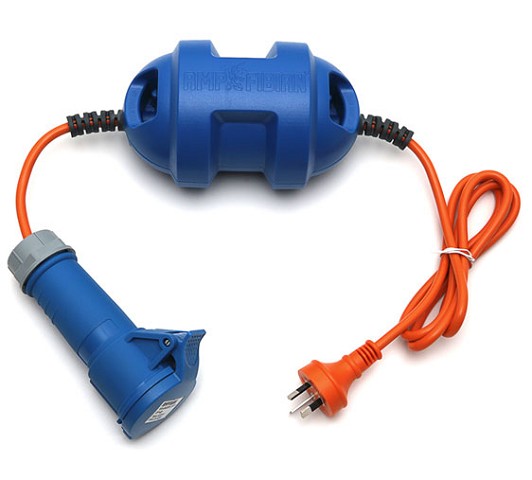
$1000 for a basic cable??? ouch!
Seems simple enough for any decent sparky to make up for 1hr labour + parts
PhantomNVD:
$1000 for a basic cable??? ouch!
Seems simple enough for any decent sparky to make up for 1hr labour + parts
No, its not a simple cable, it is a complete EV charger in cable form. There is negotiation between the car and the charger to set the charge current and cut it out if any number of faults occur. While a car may charge if you just whack 240v into its socket (not sure, not tried it) that would not be an ideal situation.
Linuxluver:
For optimum versatility you should have that european plug swapped out for a Caravan style plug (16A rated), and get one of these below overload (10A MCB / RCD integrated) protected adapters.

That way you can take advantage of the 16A charge capability. And charge at either standard domestic outlets or caravan outlets (say while you have a soak in the Marinda hot pools).
As I have mentioned before (along with others), almost all power outlets in NZ are on shared circuits so no circuit breakers will trip if 16A is accidentally drawn through that 10A rated travel adapter & 10A wall outlet (say because of setting changed by playing child).
I would assume that your vendor no longer sells these cables like that (It is illegal to sell in NZ simply because of the euro plug).
PhantomNVD:
$1000 for a basic cable??? ouch!
Seems simple enough for any decent sparky to make up for 1hr labour + parts
Yip, EVSE's (Electric vehicle supply equipment) aren't cheap
That said the "Charge amps spark" is a premium product (features like 16A ability, long, flexible cable, settable current & security features add to the cost). A basic 8A cable to charge off a standard wall outlet runs at around $700
The EVSE has a lot of smart's built into it. It needs to be safe to use by people with no electrical or EV knowledge, no knowledge of the wiring feeding the EVSE, and safe to be played with by children, and for use in driving windblown rain.
Also the system has to be setup to handle many thousands of plug/unplug cycles, handle high currents, and have a low insertion/removal force (and no locking rings) so it can be operated by a physically frail person.
The standards envision most charging being done via a hardwired, permanently installed EVSE box. All upstream wiring is generally installed to relevant local standards, and of a capacity to handle the maximum current of the EVSE. (some EVSE's have internal jumpers so the electrician can set the box to suit available electrical capacity).
The wire between the box and the car has 5 wires (or 7 for three phase). 2 thin wires for communication, 1 fat wire for earth, and the remaining wires are fat for power.
When a user plugs in their car, the box tells the car it's maximum capacity. If it's not enough for the car, the car will refuse to charge or reduce its charge rate to suit. The car will then check the earth is good. Only once all parameters are met, will the car instruct the EVSE to turn on the power (with a relay) to the car so it can start charging (charger itself is built into the car). If somebody pulls the plug while changing, the shorter comms pins break contract first, and power is immediately shut off (prevents arcing and pin damage when main pins are removed).
All this means that the cable has no power unless it is plugged into a car, making it safe to use in the rain, drop in puddles etc. Even if the cord is cut by vandals, or plug is crushed by a bulldozer, the cord poses no safety risk to the public.
Portable EVSE's are allowed, and generally have a brick located near the wall plug, everything downstream of the brick has the same protection as above. No protection applies upstream, keep this end dry etc.
The Charge Amp's Spark is unusual, and integrates the EVSE into the plug handle to avoid having a brick. This makes the wire thinner (no comms lines), but mean's if for example the plug handle is crushed, no protection is offered. For this reason it is not allowed to be sold in the USA. The product has now been retired, to be replaced with the "Ray" (with brick near plug).
You can build your own EVSE if you have the skills (or have a sparkey do it), but budget on $450+ in parts (the cable/plug costs in particular costs a lot), plus most of the day for the build. Google "Open EVSE" for instructions.
richms:
PhantomNVD:
$1000 for a basic cable??? ouch!
Seems simple enough for any decent sparky to make up for 1hr labour + parts
No, its not a simple cable, it is a complete EV charger in cable form. There is negotiation between the car and the charger to set the charge current and cut it out if any number of faults occur. While a car may charge if you just whack 240v into its socket (not sure, not tried it) that would not be an ideal situation.
No that cable is not a Charger. Charger is inside the car. The cable does have a small circuit built-in. I've made this video about Leaf charger for engineers whith whom I was discussing the possibility of using it stand alone and then discarded the idea. I did not put sound as it is self-explanatory for EE. Built-in Leaf charger has classic design of the SMPS: Leaf Charger Tear Apart Again - cable is not a charger.
Scott3:
.......
The EVSE has a lot of smart's built into it. ......
.....
You can build your own EVSE if you have the skills (or have a sparkey do it), but budget on $450+ in parts .....
Ha ha ha, I guess "smart's" mean different things for different people. For some "abacus" is a rocket science....
$450 is over estimated, mate....
RUKI:
Ha ha ha, I guess "smart's" mean different things for different people. For some "abacus" is a rocket science....
$450 is over estimated, mate....
Well, it is smart compared to a $20 bunnings cord.
Take pity on me, I am but a feeble Mechanical engineer, subjects like earth continuity testing are like a strange form of voodoo to me.
Found a 50A kit for USD239. convert to nzd = NZ$340. Add say $60 for international freight (around 3kg), and if you get charged for GST, total cost would come out at $460.
They didn't have a smaller kit, but I'm sure you could get the price quite a bit (and under the GST threshold) by buying 16A rated parts. You could drop the price still further by sourcing parts from china.
SumnerBoy:
My OBD dongle arrived from China today (very quick delivery - 7 days from order to arrival!). Plugged it in and my batteries are at 90% SOH. Not quite what I was hoping for but not too bad. The car has done 13,000kms so will be interesting to see when that first bar (of 12) drops off.
I have only installed the Leaf View (Lite) to check it was working. What do I get by buying the full/pro versions? At $17/$25 it is not the cheapest app on my phone!
From the app description it looks like the Pro version allows you change auto-door lock/unlock settings (what is this?), read DTCs (but not reset them yet), and register tire positions (not sure why you would want to do this?).
Is it worth the extra money for the PRO version?
carlbarlev:
SumnerBoy:
My OBD dongle arrived from China today (very quick delivery - 7 days from order to arrival!). Plugged it in and my batteries are at 90% SOH. Not quite what I was hoping for but not too bad. The car has done 13,000kms so will be interesting to see when that first bar (of 12) drops off.
I have only installed the Leaf View (Lite) to check it was working. What do I get by buying the full/pro versions? At $17/$25 it is not the cheapest app on my phone!
From the app description it looks like the Pro version allows you change auto-door lock/unlock settings (what is this?), read DTCs (but not reset them yet), and register tire positions (not sure why you would want to do this?).
Is it worth the extra money for the PRO version?
Hi SumnerBoy,
Who did you buy the OBD dongle from?
I followed an aliexpress link in this thread, but it said the item was no longer available.
Searching for "KONNWEI KW902" returns many alternatives, but I'm wary of buying one that may have an ELM 327 chip. I have already wasted money and time buying several of these on Trademe that don't work with Leaf Spy.
Thanks for your help!
If you're in CHCH, I can loan you my one.
Hi Guys and Gals
Took my 2016 Tekna 30kwh for a test. Full charged at home (Hamilton) To Rotorua Left with 191km showing arrived with 62km showing Topped up in Haupapa Street 91% 195Km showing
Headed to Tauranga, arrived with 135km showing (Downhil) Topped up at Bayfair (Only did 80% did not know how to do more) Stopped at a friends in the Mount then headed for home 154lms showing, Headwind up the Kaimais
Indicated dropped like lead, picked up a bit going down the other side 75 kms (My GPS on the phone) to go showing 74kms. strong head wind most of the way. Started to sweat Bugger noticed my seat heater was on No wonder I was hot,
got to Camdridge on the Waikato expressway Warnings flashing on and off down to 25 kms finally all bars gone. kept my speed down to around 70 - 80 Managed to get home Lesson learned Need a full charge at The Mount. to get back to Hamilton.
Questions are quick charges likely to diminish the batteries capacity over time.
Real learning experience Still Love my Leaf after a week or so.
Comments and advice welcome
Cheers
Hope you are enjoying your new car.
gulfa:
Questions are quick charges likely to diminish the batteries capacity over time.
The answer is yes, but not enough to worry about (especially in the NZ climate, and in regards to the post 2013 cars)
If you were driving a first generation (pre 2013) leaf as a taxi in Palm Springs (or somewhere else super hot), and fast charging 3 times a day, then you should be concerned. Occasional fast charging when you take a long trip is not problematic.
Hi folks
another question has anyone managed to get the maps, navigation system to work in NZ this relates to the Uk imports?
Any info greatly appreciated
Thanks
gulfa:
Hi folks
another question has anyone managed to get the maps, navigation system to work in NZ this relates to the Uk imports?
Any info greatly appreciated
Thanks
There were no official maps from Nissan last time I've checked online. There is no market in NZ or in Russia for that kind of development. Russia is one of the biggest importing countries for JDM cars and that is why the solutions for some JDM imports do exist. If the car is popular in Russia (e.g. Mark II, Land Cruiser etc) then you would expect the development to take place. Leafs are out of scope.
Scott3:SumnerBoy:Just took a 2014 Leaf for a test drive. Very nice car. I can see myself spending some money very shortly...
Can someone explain the model numbering - S, X, G - what is what, what features are where, etc?
Japanese Leaf's have heaps of options available, so even within spec's there is quite a lot of variation:
Full spec sheets (in Japanese) here and here, and the launch description for Updated (Gen2) leaf is here (in English)
Summary (Gen2 leaf's only):
Japan "S" Spec (Base spec)
- 16" Steel wheels
- Din Standard Stereo (Not linked to Heater, air-con, charge timer etc), can be swapped for an NZ unit without loosing any functionality
- Heated seats
- Resistive heater
- Fog lamps (Option)
- Charge & Cabin Pre-heat / Pre-cool timer
- Rear view camera(Option)
- Tonneau cover (Option)
Japan "X" Spec (Mid spec)
- Integrated stereo (in Japanese)
- Heat pump for Heater (more efficient than resistive heater in S)
- Rear view camera(Standard)
- 16" Alloy Wheels (Option)
- LED headlights (Option)
- Fog lamps (Option)
- B-mode
- Leather (Option)
- Bose audio (Option)
- Rear view camera(Option)
- Around View Cameras (Option)
- Tonneau cover (option)
Japan "G" Spec (Top spec)
- 17" Alloys
- LED headlights (standard)
- Rear roof spoiler with solar panel (charges accessory battery only)
- Fog lamps (standard)
- B-mode
- Rear view camera(Standard)
- Leather (Option)
- Bose audio (Option)
- Around View Cameras (Option)
- Tonneau cover (Standard)
Note all Japanese Leaf's have the 3.6kw Charger (no faster AC option available)
UK Spec's are way easier, Read it yourself in English here or here. Far fewer options (more stuff standard on top spec). Faster AC 6.6kW charger, Solar spoiler & Privacy glass (on mid spec Acenta) are the only options. Of course the dash is in english to.
I now have my 2016 LEAF "Tekna" with the 30kw battery and 6.6kw internal AC charger. It took 3 months to arrive from the UK and get through the biosecurity and compliance process, but I'm now driving it.
I went for a cruise down to the Port, then up SH16 to Wellsford and then down to Silverdale. I arrived on 9%. I charged at Silverdale for just under 15 mins (got to 50%), then drove home to Greenlane via Glenfield and NorthCote . I arrived home on 23%, but hadn't made made any effort at all to drive efficiently. I had the aircon on, just for fun.
Later, I went to the 50kw Vector chargers at Mcdonalds in Greenlane and left the LEAF charging while I walked over to Countdown to pick some things up and then walked over to McD's to pick up supper.
In those 28 mins, the LEAF charged from 23% to 93%. The 30kw LEAFs clearly fast-charge much more rapidly than the 24kw LEAFs.
I topped it off at home and the GOM now says I have 210km estimated range.
That will do nicely. I'm very glad I stepped up to the 30kw LEAF.
:-) 
_____________________________________________________________________
I've been on Geekzone over 16 years..... Time flies....
|
|
|