|
|
|
HarmLessSolutions:
Also Dingbatt's FHEV running cost estimate assumes that hybrids escape a potential distance based RUC charge which I think may be a bit optimistic.
Yes, I was only working on existing costs and what has already been signalled (RUC-wise). My comparison between my Model 3 and my old Camry Hybrid worked out to a difference of 1.95c/km. But that was before the 30c fuel excise increase in June. And the comparison was for DC fast charging costs, as alasta has no way to charge at home. Home charging is essentially a quarter as expensive.
I know there is work being done by IRD at the moment for the best system to pay for our roads and how to separate that from emissions taxes. The main sticking point is, it is much easier to get fuel excise out of the petrol companies than it is to get RUCs out of Joe Public.
If there is a per km charge put on pure hybrids without an equivalent reduction in the fuel excise, it may cause ‘problems’.
“We’ve arranged a society based on science and technology, in which nobody understands anything about science technology. Carl Sagan 1996
johno1234: Ford Mach-e now for sale online with late Q2 delivery.
The base model is $79990 and they state it is eligible for the clean car rebate but i can’t see anywhere that states ORC is included. I guess it must be.
I would assume that the invoice you are presented with in order to claim the rebate will be for $79990.
Toyota make things easy by having a “Toyota Driveaway Price” (TDP) with none of the ORC BS.
“We’ve arranged a society based on science and technology, in which nobody understands anything about science technology. Carl Sagan 1996
alasta:
I have no ability to charge a car at home and only use the car for trips out of town
Petrol for you my friend.
Batman:
alasta:
I have no ability to charge a car at home and only use the car for trips out of town
Petrol for you my friend.
And after 2035 or 2040 or whenever petrol becomes impossibly expensive or unobtainable, if you're still in the same position I expect that you will rent a BEV for those trips out of town. And/or make fewer private trips.
I expect that lifestyles in the mid twenty-first century are going to be different to now, particularly as regards longer distance transport. I rather suspect that people then will look back to the period from 2000 to 2020 as a Golden Age of cheap long distance mass transport. "Imagine being able to drive in a private car from Auckland to Wellington for less than half a day's wages, or fly all the way to the USA for only a fortnight's salary. Those were the days alright." π
Fortunately for me, it'll be my children or granschildren making these unfortunate comparisons, and I will either be 'enjoying' the Shady Acres Home for the Elderly and Confused, or pushing up daisies. π
PolicyGuy:
And after 2035 or 2040 or whenever petrol becomes impossibly expensive or unobtainable, if you're still in the same position I expect that you will rent a BEV for those trips out of town. And/or make fewer private trips.
I expect that lifestyles in the mid twenty-first century are going to be different to now, particularly as regards longer distance transport. I rather suspect that people then will look back to the period from 2000 to 2020 as a Golden Age of cheap long distance mass transport. "Imagine being able to drive in a private car from Auckland to Wellington for less than half a day's wages, or fly all the way to the USA for only a fortnight's salary. Those were the days alright." π
Fortunately for me, it'll be my children or granschildren making these unfortunate comparisons, and I will either be 'enjoying' the Shady Acres Home for the Elderly and Confused, or pushing up daisies. π
yes. agree.
OP can still get a BEV or P/HEV but i don't see the cost benefit, but if they still wanted a BEV then it's up to them. let it sit at 50% and charge it up before tripping. for Nissan Leafs whether you drive or charge or don't charge the battery still degrades, not sure how other BEVs hold up.
HarmLessSolutions:
Our Polestar2 is returning 18kWh/100km which at ) 80c/kWh is 14.4c/km. Add 7.6c/km (if that diesel rate carries through to EVs) that totals to 22c/km which is just below the petrol cost for an equivalent ICE (i.e. 2022 Volvo XC60 B6 rated for 8.7 L/100km using $3/litre which it was when I last visited a petrol station) 26c/km. The much lower maintenance costs for an EV of course add to that differential.
Incidentally most of our charging is PV supplied so the 11c/kWh (for now) export rate equates to ~2c/km for the most part.
Also Dingbatt's FHEV running cost estimate assumes that hybrids escape a potential distance based RUC charge which I think may be a bit optimistic.
I paid $2.19 yesterday though generally about $2.25. I'm quite happy with my 3.6 V6 which comes in around 18c/km for fuel plus about 3.5c/km for servicing. ICE servicing costs aren't the big deal everyone goes on about. Even more happy that I got it before the "Ute tax" was applied.
Edited to add: The actual ICE component of a service is probably about 1.5c/km. All the other stuff included like cabin filters etc apply no matter whether ICE or BEV.
Sony Xperia XA2 running Sailfish OS. https://sailfishos.org The true independent open source mobile OS
Samsung Galaxy Tab S6
Dell Inspiron 14z i5
Technofreak:
I paid $2.19 yesterday though generally about $2.25. I'm quite happy with my 3.6 V6 which comes in just under 20c/km for fuel plus about 3.5c/km for servicing. ICE servicing costs aren't the big deal everyone goes on about. Even more happy that I got it before the "Ute tax" was applied.
Edited to add: The actual ICE component of a service is probably about 1.5c/km. All the other stuff included like cabin filters etc apply no matter whether ICE or BEV.
for me EV for town, ICE for out of town, much simpler that way currently.
In relation to a maximum level clean car fee being set.
Batman:
ah, election year
maybe so it doesn't affect commercial vehicles like courier vans and trucks?
Shouldn't impact the common vans. Cap only kicks in above 261 g/km CO2
Biggest auto Hiace is rated at 251 g/km co2.
Staria Load is 216g auto / 213 g Manual.
Sprinter 317 LWB Van EC 2022 - 2023 125kW auto: 232g/km Co2.
Fiat Dicato comes in over 3500kg GVM, so not covered by this.
Trucks tend to come in over 3500kg GVM, so this fee doesn't apply to them. Just a handful of exception like used market Nissan Atlas..
alasta:
I have no ability to charge a car at home and only use the car for trips out of town so I'm struggling to figure out how someone in my position is supposed to react to the policy changes. As I see it my options are:
- Full Electric or Plug-in Hybrid : Capital outlay is too high to be financially viable for my use case even with the subsidy.
- Petrol Hybrid : Options seem limited as Toyota have a waiting list out to 2024, Kona is too small and I don't want to take a punt on something Chinese. That really only leaves the Niro, but it's not ideal as it's front wheel drive and the variants with decent spec are expensive even with the subsidy so I'm unsure about the economic payback.
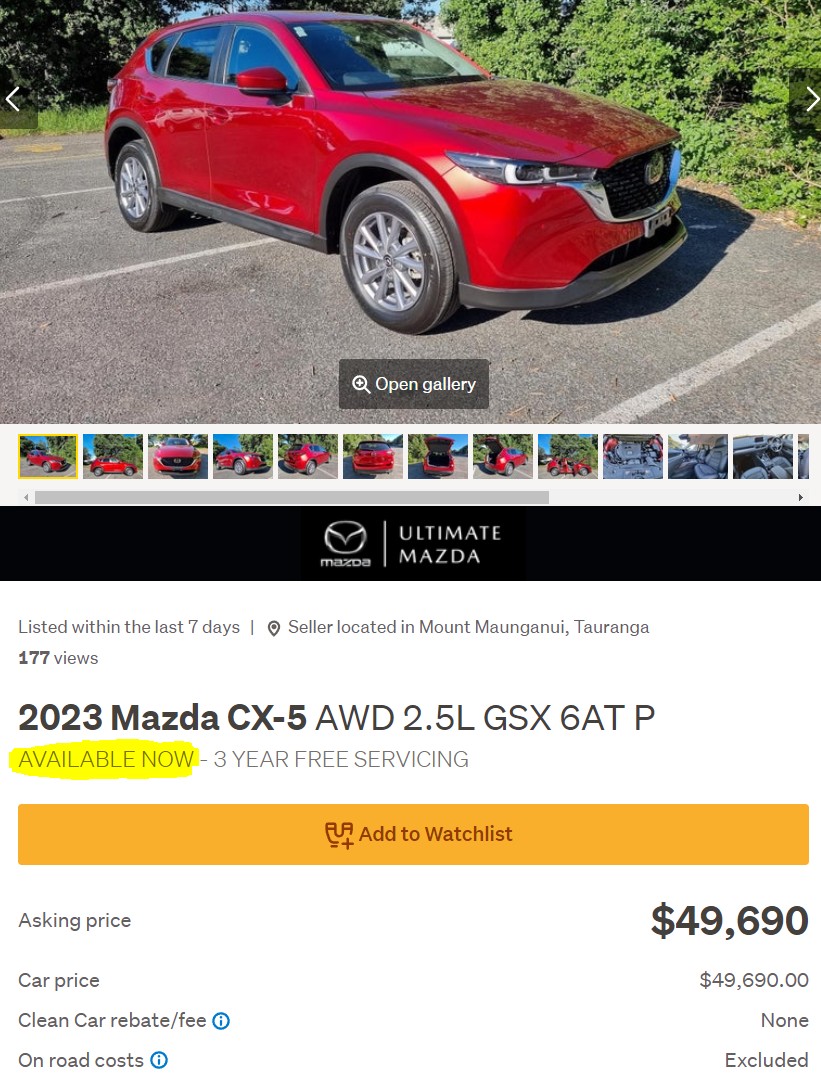
- Replace my existing CX-5 with another one and suck up the $3k ute tax.
- Downsize to a CX-30 and get the ute tax down to about $1.5k. This is probably my preferred option at this stage.
Whatever I do it looks like I'm going to end up with a substantial increase in TCO.
I wonder if this will reduce sales of new cars and consequently increase values in the used market? That might increase the value of my trade-in, hence partially offsetting the ute tax.
Consider the below an analysis of your situation, as more an academic exercise of what similar people might do, and hence the impact on the car market. No idea what your mobility needs / tastes / budget is.
Note that in its current form, the Clean car discount scheme has had the government inject around $300m into the New / Used car market. Re-balancing the scheme to get rid of this $300m subsidy from general taxes (and make it self funding as it was ment to be) is absolutely going to have an impact on the car market overall. With the exception of Used EV's & mobility cars, everything else is getting more expensive than it is today as a result of this change. And this burden isn't born evenly.
Cars like the Suzuki swift hybrid will get especially hit, at 106g co2/km previously got a $3160 rebate, but now gets nothing as it doesn't meet the 100g eligibility criteria is an example of a model which will be hard hit.
Likewise, the 2.5L AWD CX-5 at 191g/km CO2 sat exactly at the top of the old free band, and now get's hit with a $2932.50 fee
Demand for the remaining non plug in cars which are eligible for a rebate will spike (Just the Yaris hybrid, and corolla wagon hybrid?), at the expense of stuff like the swift hybrid.
And demand cars in the likes of the Medium SUV sector that land in the free band will spike at the expense of stuff like the 2.5L AWD CX-5.
Options in your situation (again for academic purposes only):

Note a lot of the above is psychological. The Rav4 Hybrid is loosing a $2,387.24 rebate, so both cars are going to have a jump in cost just $500 apart from this change. $500 likely isn't enough to sway a buyer decision. But the principal of having to pay thousands in extra tax to register a high (by new criteria) emitting vehicle is...
Over the whole market, I think we will see a blend of all the bullet points above. Overall I think the impact will be less than what we expect (while there was a surge in ute sales before the original ute tax was applied, it's existence has hardly crashed their sales). But for some model's, impact will be large. Toyota is going to be able to sell massive volumes of hybrids (especially yaris, Corolla wagon, Rav4 & Highlander).
Going to be hard for the importers who have already committed to orders, and haven't had a chance top re-balance their offering to suit this change.
SaltyNZ:
MoT are looking for feedback on their EV charging strategy. How to serve people who have no off-street parking, who live in multi-unit dwellings or otherwise don't have ready access to a charging point at home is one of their study issues.
For others who stumble accross the feedback link, here is the draft document they are looking for feedback on:
And the Discussion document:
Thanks Scott. Good analysis, and it will be very interesting to see how this plays out in terms of importer and buyer behaviour.
Scott3:
With the exception of Used EV's & mobility cars, everything else is getting more expensive than it is today as a result of this change.
Toyota is going to be able to sell massive volumes of hybrids (especially yaris, Corolla wagon, Rav4 & Highlander).
Yeah, that's the point. :-)
Going to be hard for the importers who have already committed to orders, and haven't had a chance top re-balance their offering to suit this change.
Yes, that's annoying but it's a one-off blip. And as you pointed out above, the fees hardly choked the life out of Ford Ranger sales (unfortunately).
iPad Pro 11" + iPhone 15 Pro Max + 2degrees 4tw!
These comments are my own and do not represent the opinions of 2degrees.
SaltyNZ:
Yeah, that's the point. :-)
Yeah, no way to unwind an unintended $300m subsidy of an industry without making stuff more expensive.
Still (other than Mobility vehicle & Used EV buyers), every new / Fresh import buyer is going to be disappointed by this change....
- New EV's getting $1500 more expensive
- New PHEV's getting more expensive.
- The likes of a swift hybrid / Rav4 hybrid getting $2500 more expensive
- CX-5 AWD covered above getting about $3000 more expensive
- Diesel utes & vans getting more expensive (in the area of $2500
Not ideally politically. And the government in power is going to have to repeat this process every year or two (making cars more expensive across the board, to unwind an unintended subsidy) if the current trend of our fleet getting cleaner continues.
Yes, that's annoying but it's a one-off blip. And as you pointed out above, the fees hardly choked the life out of Ford Ranger sales (unfortunately).
Buyers who want a diesel ute (say for looks, payload, or tow rating), effectively have no other option but to pay a decent fee, as all the diesel ute brands have similar emissions.
In other sectors (like the CX-5 AWD we looked at above), buyers have other options to avoid the nerly $3000 fee. Main ones are:
So the likes of cars with lower emissions alternatives (like the CX-5 AWD), than stuff with minimal alternatives like the Ranger. (yeah I know about the LDV eT60, but factors like being RWD only, Low payload, Low tow rating, and extremely basic trim level for price limit appeal).
But yes it is a one off blip. Mazda NZ could stop future CX-5 AWD orders from their parent, and just sell what turns up from existing orders at a slower rate as they do now. (and it might even be much different, all the competitors on the list are about to jump in price too.). Storage costs are fairly low.
---------
One more thing I just thought of.
We are going to see a massive uptick in the number of Demo car's being registered.
If you a car importer with stock on hand (like Mazda), It would make sense to register everything you don't think you can sell by July 1 as a demo car (and send to dealer for that purpose). You need to declare that they "are not intended to be sold, and are not intended to be offered for sale, within three months of first registration", but that is fairly easy to comply with. If you registered the cars today, don't sell them until July 4.
Lexus UX300e gets a battery upgrade. Entry trim rebate eligbale. Top trim $90k
315km WLTP range to 450km WLTP range. Now operating in the same ballpark as other cars towards the upper end of the $80k rebate limit.
Fast charging is improved, but it is still poor by modern standard (50kW Max)
A very well appointed car (even the entry trim)
https://evsandbeyond.co.nz/big-battery-updated-for-lexus-ux300e/
Entry trim:
https://www.lexus.co.nz/en/models/ux/ux-300e.html
Top Trim:
https://www.lexus.co.nz/en/models/ux/ux-300e-limited.html#specifications
Very competitive with the likes 64kWh Kona, and the Higher trim E-niro
Could be a good option for somebody who wants a very well appointed EV, or one that is smaller and easier to park than a Model Y or EV6. (Assuming they aren't going to be heaps of 400km+ a day road trips)
MG4 pricing announced
52k 55k - 64kWh
64k - 77kWh
|
|
|