Geekzone: technology news, blogs, forums
Guest
Welcome Guest.
You haven't logged in yet. If you don't have an account you can register now.


View this topic in a long page with up to 500 replies per page Create new topic
1 | ... | 660 | 661 | 662 | 663 | 664 | 665 | 666 | 667 | 668 | 669 | 670 | ... | 771
Scott3
4177 posts

Uber Geek
+1 received by user: 2990

Trusted
Lifetime subscriber

  #3229347 12-May-2024 18:42
Send private message quote this post

richms:


If they cant convert it then they should be sold with the disclaimer that they are not going to be chargeable in most places.


Next we might see used teslas coming in from elsewhere and then people will expect public NACS charging to be a thing here. That would be an even bigger nightmare.


They should be able to swap the CCS1 out for a CCS2 connector for AC charging, as thats electrically similar but may have problems with the catch being the other way around, but replacing the chademo for a ccs2 combo isn't going to happen.


We already have NACS tesla's in NZ (ex japan). For example:

https://www.trademe.co.nz/a/motors/cars/tesla/model-s/listing/4693468238


gallery carousel 17


These can be converted by Drive EV ($9k-10k) for the full conversion to NZ configuration, which can change on CCS2 via an adaptor.

It's wrong to say they can't be charged in most places. Tesla has an official adapter's to allow CHAdeMO & J1772 (type 1 AC) charging. There is an unofficial (but simple and cheap) adapter which allows type 2 AC charging, and DC supercharging at the tesla supercharger stations with duel cords.


richms:


Plenty of cars from Japan are not able to come over now because they do not meet NZ's radio frequency plans for things on them. Charging is a similar issue to that in that we have standards that need to be followed and overseas places have different ones.


The closest thing we have to standards of which type of fast charging are the government guidelines for public charging, which currently include CHAdeMO

https://nzta.govt.nz/planning-and-investment/planning/transport-planning/planning-for-electric-vehicles/national-guidance-for-public-electric-vehicle-charging-infrastructure/charging-point-connectors-and-socket-outlets/


Sure we could change this, but I think we are too far down the road with duel DC charging connectors to change now. (32% of our BEV's are CHAdeMO, and about a quarter of registrations last month were for CHAdeMO cars).


Scott3
4177 posts

Uber Geek
+1 received by user: 2990

Trusted
Lifetime subscriber

  #3229424 12-May-2024 22:05
Send private message quote this post

For some history on EV charge ports in NZ:


  • Prior to 2011 we had a just a handful of converted EV's (professionally covered like the Hyundai Getz, or homebrew like Kiwi EV). No standard connector
  • The first mass market plug in car's to NZ were the Nissan leaf J1772 (type 1) + CHAdeMO & Holden volt J1772 (type1) only, both were more than $70k, which was a lot of money then, so appeal was niche
  • ~2013: Used import Nissan leaf's, i-miev, minicab, nv200e started turning up. The start of volume EV sales in NZ.
  • Given the configuration of the above cars, NZ largely adopted the US style tethered J1772 (type 1) plugs for public fast charging.
  • Home charging was largely dealt with ex japan EVSE cords with the plug smashed off (to preserve the thermal probe), and replaced with a blue caravan socket (as they drew ~14 amps). An tiny internal transformer needed to be swapped as the ex japan one would burn out on NZ 230v power. This was was allways electrically non compliant (as the EVSE's wernet rated for 230v), but has subsequently been declared electrically unsafe.
  • 2014 grey market import Model S started turning up (a single roadster was registered in 2012). These were the first of the long range EV's in NZ, but very expensive. At that time there was no local support or supercharging network in NZ, but CHAdeMO adapters were available. Mostly these cars were sourced via Australia.
  • 2015: Spured by the volume of grey market imports, Tesla officially released the model S in NZ.
  • At this point all long trips in EV's involved multi hour charging sessions in campgrounds. Campgrounds because the defacto EV charging network, and there were few enough EV's that most were happy to charge them a few dollars to charge and use their facilites as they relax / wait. 
  • October 2015: Charge.net installs its first DC fast charger. A 50kW unit (dual CCS1 & Chademo Cords). Configuration was not a surprise given we were largely following the US at this point, there were no CCS1 cars on NZ road's yet, but some brands had made it clear they weren't keen on CHAdeMO. 
  • Charge.net continues to role out charges with CCS1 & Chademo configuration for the next few years.
  • Other brands start launching EV's in NZ. The BMW i3 is the most notable. Initially was only sold in the Range Extender configuration. It was the first (and only) EV in NZ to use the CCS1 fast charging standard.
  • Late June 2016 Brexit referendum results announced late June. GBP plummets and the UK becomes a credible source for used EV's. Ex UK leaf's were available with things like 6.6kW chargers (vs 3.6kW on ex japan leaf')
  • July 2016: Renault NZ launch Zoe & Kangoo van (3 phase charging capable with type 2 sockets)
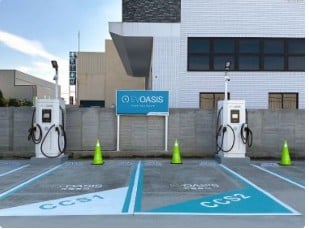
  • An active EV community became concerned that we were approaching the point of no return when it came to EV charging formats, and were very close to adopting the "wrong" formats. Given three phase electricity is fairly available in NZ (and high current i.e. ~80A single phase is less common), the correct EV AC plug format to for NZ to adopt was type 2 (J1772 / type 1 is single phase only), But at that time, manufactures using the type 2 plug generally favored CCS over Chademo. We risked either losing the advantages of 3 phase AC charging, and access to fast charging on non Nissan ex UK used imports, or ending up in the situation Taiwan is in juggling CCS1 & CCS2:


  • Mid-Late 2016: The government announced guidelines on public fast charging. I don't think they changed between then and the capture by the wayback machine web crawl linked below.

    https://web.archive.org/web/20170421201944/https://www.nzta.govt.nz/planning-and-investment/planning/planning-for-electric-vehicles/national-guidance-for-public-electric-vehicle-charging-infrastructure/charging-point-connectors/

    In short, we opted to copy the european approach.


    • Type 2 socket for AC public charging (BYO cord) - This enables both type 1 & and type 2 EV's to charge from the same public AC chargers. Also means that the public chargers are tidier when not in use (no cord attached), and eliminates the risk of cord damage / vandalism taking a charger offline (no cord to damage when not in use, and when in use that risk is carried by the person charging).
    • Dual cord CCS2 & Chademo for fast charging (plus a type 2 Socket for Zoe's, a guideline that was subsequently dropped). Dual cord chargers were available to purchase, and the cost as a percentage was a manageable amount above a single cord charger. This meant we could fast charge used imports from both Japan and the UK, and the type 2 AC port would become the defacto standard for all NZ new cars from brands not fond of Chademo.
  • My understanding is only a handfull of CCS1 cars (BMW i3 range extender) had been sold at this point. No idea if they got the ports swapped, so simply can't fast charge anymore.
  • Chargenet started installing new fast chargers with CCS2 & CHAdeMO (but chose not to add the Type 2 AC port for fear of slow charge only EV's occupying their fast chargers for hours). Ultimately they swapped the CCS cords on the existing chargers to CCS2.
  • Initially CHAdeMO is absolutely dominant, driven by the popularity of used import EV's from japan. It wasn't until late 2019 that we started getting sub $100k long range NZ new EV's (Hyundai Kona, Tesla model 3). Both of these were were fitted with CCS2 ports. Partially Noteworthy for the Tesla as the Model S & Y did not have CCS, and could be fast charged either at Tesla super chargers, or via a CHAdeMO adapter. Notiable as tesla started adding CCS2 cords to their superchargers to accommodate these cars.
  • Generally DC fast chargers of this era were 50kW dual cord units, which could charge one EV at a time (although some lines companies included a 44kW AC cord, or the AC socket as per the guidelines).
  • Aug 2020: First Tesla Hypercharger opened in Bombay, starting the trend of bias towards CCS2. At the time it had 4 CCS2 ports and 2 CHAdeMO. (Subsequently, this has been upgraded to 8 CCS2 & 4 CHAdeMO) - this ratio seems reasonable given 1/3rd of the BEV fleet is now CHAdeMO. And critically there is more than 1 CHAdeMO port meaning a single breakage doesn't take the charger down.
  • Increasing availability of NZ New EV's, and the boost from the clean car car discount (Mid 2021 - end 2023) saw NZ new EV's surpass sales volumes of used imports. Given most NZ new EV's use CCS (excl Nissan Leaf, Lexus UX300 & Mitsubishi PHEV's).
  • Mid 2022: 50:50 point between CCS2 & Chademo reached.
  • Sept 2023: Tesla opens some (initially 3) supercharger sites to any CCS2 EV (previously they were software locket to Tesla only)
  • Current day


    • ~32% of the EV fleet is CHAdeMO. Many of them are aging leaf's that rarely venture out of town (but require frequent charging if they do), but include decent numbers of stuff like Non CCS2 compatible tesla's, BMW i3, late model leaf's (incl the 62kWh version), Jaguar i-pace etc.
    • ~25% of EV registrations last month were ex japan (likely CHAdemo)
    • Bulk of NZ New EV's are CCS, but Nissan leaf, Lexus UX300e & Mitsubishi PHEV's use CHAdeMO.
    • Tesla supercharging network has grown to 22 stations, 19 of which are open to any CCS2 EV
    • Dual CCS2 & Chademo chargers which can charge both sides at the same time (at a reduced rate) are becoming more common - CHAdeMO has never been offered on superchargers.
    • Chargenet generally building new hyperchargers at a 2:1 ratio
    • BP generally building out 3 CCS2 & 1 CHAdeMO to a site. Generally 2x 150kW chargers each sharing power across two spaces (but a max of 62.5kW for the CHAdeMO)
    • Jolt installing at 1:1 ratio (25kW max)
    • Z: varies by site. Many are 3 CCS & 1 CHAdeMO (fairly fast), Some sites have multiple 200kW CCS2 and a token 25kW CHAdeMO. And some sites (i.e. Bombay, Ngatea) have multiple CCS2, but no CHAdeMO. These do have signs of another pending install, but have been this way for months.
    • Public AC charging is about 50:50 tethered and tethered. About half of public AC charge sites have followed the guidelines, the rest (knowing that a decent number of EV owners don't spring the $270 for a BYO charge cord) ignore them and provision a mix of type 1 & type 2 tethered EVSE's across multiple spaced (or like the Auckland fishmarket or the crossing mall in Tauranga, just provide type 2 cords).

HarmLessSolutions
1230 posts

Uber Geek
+1 received by user: 812

Subscriber

  #3229427 12-May-2024 22:33
Send private message quote this post

Thanks for the in depth history of charging. Great effort but please note that two cords are 'dual', whereas a duel is a fight.


https://www.harmlesssolutions.co.nz/


Scott3
4177 posts

Uber Geek
+1 received by user: 2990

Trusted
Lifetime subscriber

  #3229428 12-May-2024 23:07
Send private message quote this post

HarmLessSolutions:


Thanks for the in depth history of charging. Great effort but please note that two cords are 'dual', whereas a duel is a fight.


Thanks. I was still in the edit window so have fixed.


Very grateful for everybody involved in the switch from CCS1 to CCS2 for NZ. Without that change at that time EV charging in NZ would have been a mess:


  • the people who lobbied for the government to set a guideline / standard for public charging
  • The government of the time for actually doing it quickly, incl the people behind this work.
  • Charge.net for respecting the guideline (even though it wasn't mandatory), and ultimatly swapping out all of their CCS1 cords (even though the government was ~2 years late to the party).
  • The handful of orphaned BMW i3 owners for not kicking up a stink about it.


Along with losing 3 phase charging ability, the big issue with CCS1, with hindsight is Tesla. To my knowledge, they don't naively do CCS1, and at the launch of the model 3 didn't do it with an adapter either. This means they would have likely launched the CCS2 model 3 here, and given their brand dominance (and supercharger network), today we would have roughly 1/3 CHAdeMO, 1/3rd CCS1 & 1/3rd CCS2 in our BEV fleet. A much worse situation than the current 1/3rd : 2/3rd's CHAdeMO : CCS 2 split.


SaltyNZ
8867 posts

Uber Geek
+1 received by user: 9550

Trusted
2degrees
Lifetime subscriber

  #3229459 13-May-2024 08:23
Send private message quote this post

Scott3:


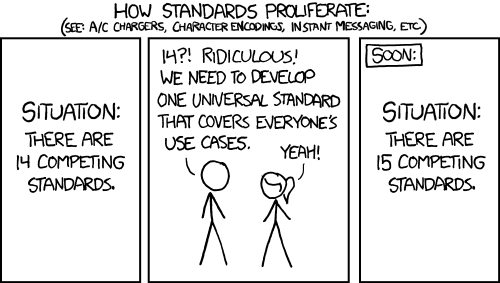
How amazing would it have been if the auto industry got together  ~3 years before the release of the first wave of modern EV's (Nissan leaf & GM Volt in 2011. Model S & Renault Zoe in 2012), and come up with a charge connector that accommodated global use cases for the next ~30 years (80A single phase capability for North America & japan, 32A three phase capability + ~350kW DC capability). Plus a means (likely a separate plug) to handle Trucks, ferries etc. (perhaps 1MW DC).

Would have avoided format war's, and made international interoperability much easier.


iPad Pro 11" + iPhone 15 Pro Max + 2degrees 4tw!


These comments are my own and do not represent the opinions of 2degrees.


Scott3
4177 posts

Uber Geek
+1 received by user: 2990

Trusted
Lifetime subscriber

  #3229531 13-May-2024 09:33
Send private message quote this post

SaltyNZ:


There was an opportunity in about 2008 - 2009, when it was clear that a new wave of of EV's were coming where regulators in key markets (EU, USA, Japan, China) could have set a standard and it would have become the the global standard.

At least NZ has been able to restrict to two fast charging plug types (which can reasonably be accommodated on chargers), unlike the USA (CCS1, CHAdeMO, NACS) & Taiwan (CCS1, CCS2 & CHAdeMO) who are both juggling three standards. For the USA the format war is largely over (CHAdeMO is going to slowly die out, as there are no longer enough CHAdeMO EV's for the critical mass needed. Most CCS1 car brands have aggreed to change over to NACS in a couple of years), but this has created un-needed mess. Especially given many brands have announced changing to NACS but havn't actually done it.Will be a contributor to the USA EV surplus this year. Not really attractive to buy a brand new car with an obsolete port.


HP


Shop now for HP laptops and other devices (affiliate link).
wellygary
8813 posts

Uber Geek
+1 received by user: 5293


  #3229551 13-May-2024 09:51
Send private message quote this post

Scott3:


How amazing would it have been if the auto industry got together  ~3 years before the release of the first wave of modern EV's (Nissan leaf & GM Volt in 2011. Model S & Renault Zoe in 2012), and come up with a charge connector that accommodated global use cases for the next ~30 years (80A single phase capability for North America & japan, 32A three phase capability + ~350kW DC capability). Plus a means (likely a separate plug) to handle Trucks, ferries etc. (perhaps 1MW DC).


I think you really expect too much from an Industry that still argues about which side the stalks for indicators should be on.. :) 


richms
29104 posts

Uber Geek
+1 received by user: 10219

Trusted
Lifetime subscriber

  #3229612 13-May-2024 10:34
Send private message quote this post

The chances of a single global plug are not going to happen because of the fundamental difference in the power grid between 120/240v splitphase and the 230/400v three phase parts of the world. Tesla/nacs has the advantage over CCS 1 in the USA that they are specced up to 277 volt which is what one phase of their 480v commercial properties supplies give them, so no large stepdown transformer is needed which they have to have for all their 120/240v loads.


Having an incompatible plug because you bought something early on and need to use an adapter is just part of early adopter life. Plasma TVs before HDMI was a thing, buying a 4k TV and not having the right or any HDR are other cases of where this has happened, its just a cost of being first to jump onto a product.


Richard rich.ms

Obraik
2167 posts

Uber Geek
+1 received by user: 1347


  #3229840 13-May-2024 16:17
Send private message quote this post

Scott3:


I agree that three DC fast charging standards is nonviable, but two is (as evidenced by our DC charge network over the past decade). I don't think there has been much ChaoJi adoption in Japan, but we can tackle that in the event it does become mainstream (status quo is that there is no provision in NZ and it is not covered in the government public charging guidelines). - Ignoring the Tesla property type 2 charger on S & X for this answer (technically this is a 3rd fast charge format, but all of these cars can charge from CHAdeMO via adaptor, and the more recent or upgraded ones via CCS2 with adapter).

The issue is the capacity allocation between different plug types.

The Z station pictured a few pages ago, has 4% of its charge capacity allocated to CHAdeMO vehicles. Given 32% of the BEV fleet (plus many PHEV)'s have CHAdeMO connectors, clearly this is problematic. While this number is falling (25% of BEV registrations last month were CHAdeMO) it is still a decent chunk of our EV fleet.

The situation is even worse when you consider the impact of Tesla superchargers. I get these are primary built to serve Tesla brand vehicles, so (unless mandated) will never have ports not fitted to tesla cars. But many are open to other brand CCS2 cars. And even if they are not, enough of our EV fleet are Tesla's that they attract many CCS2 cars (model 3 & Y) away from other brand fast chargers.

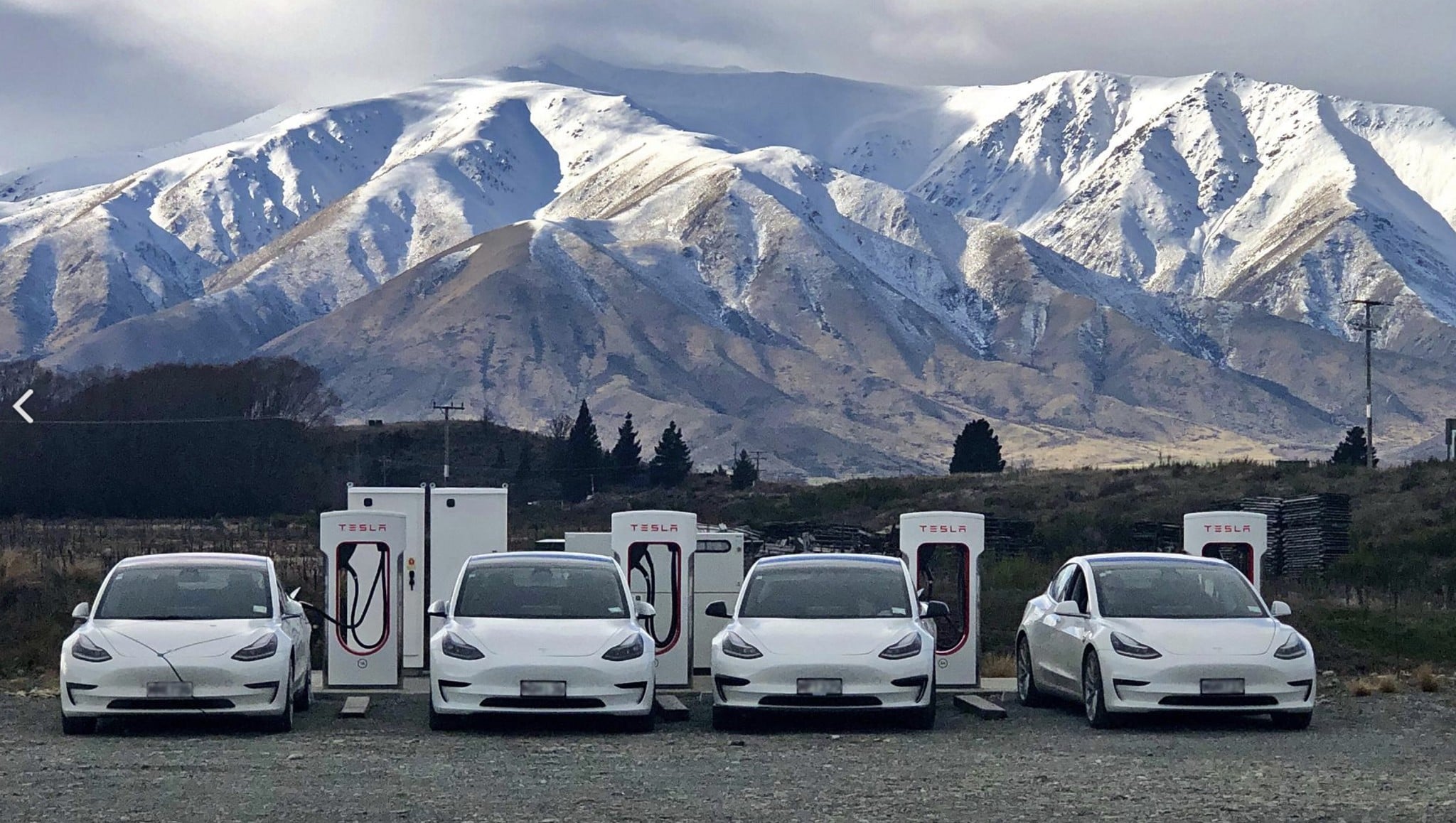
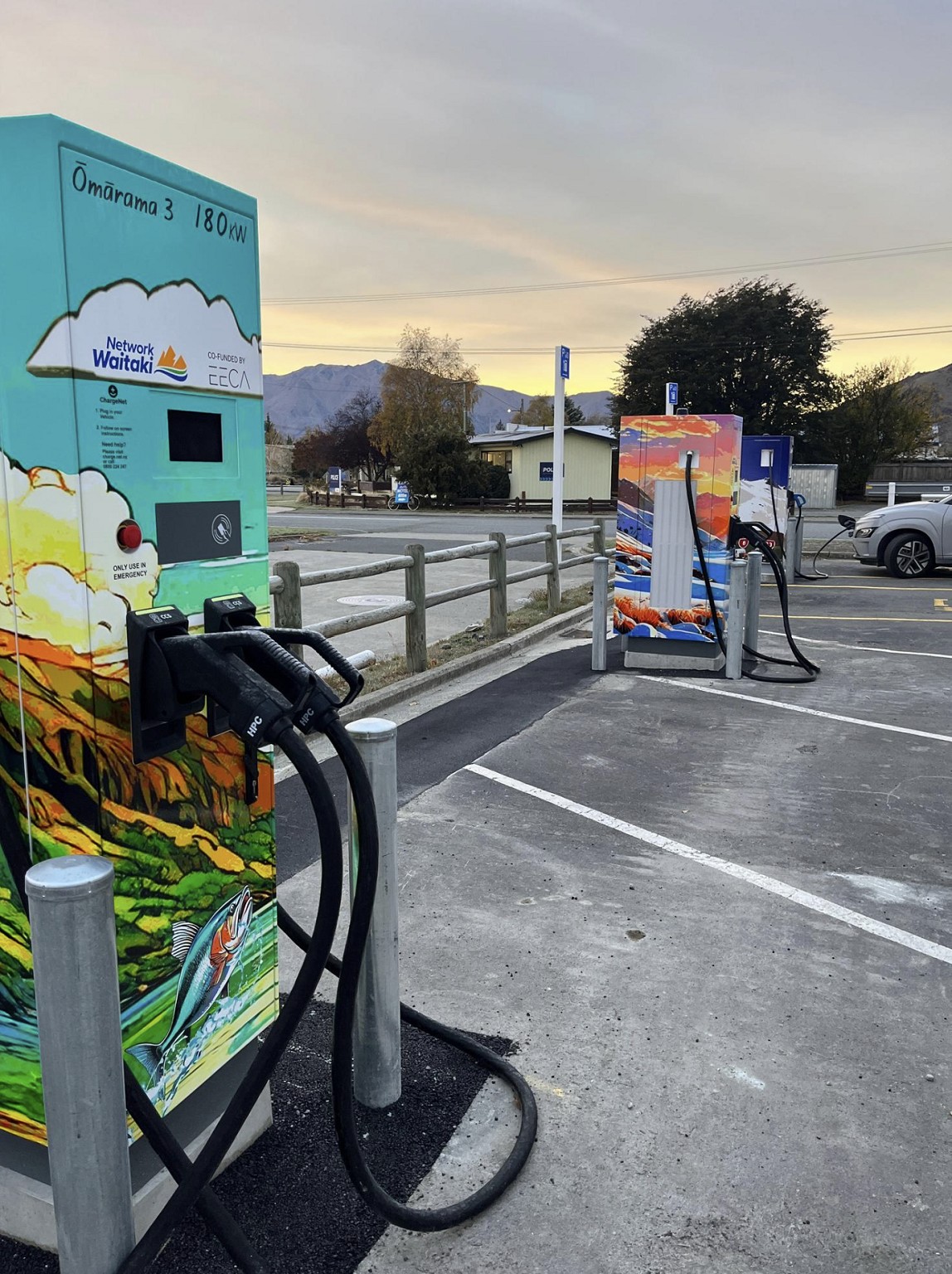
Combined with aggressive bias to CCS from other providers, it creates situations like Omarana. Town has a 4 stall Tesla supercharger (this one is open to CCS2 cars from other brands). Network Waikiki has a DC charge station with 5 CCS ports and 1 CHAdeMO port. Means the entire town has 9% of it's charge ports to serve 32% of the EV market.

Beyond equity, having a single port sucks. A single breakage is all it takes to cause drama.


I would ignore the Tesla Model S & X connector which at this point is now legacy - no new S & X are being made with that anymore. They are essentially Chademo vehicles (pre-retrofit) or CCS2 vehicles (post-retrofit). I'm not sure how the Supercharger network is making things worse though? Having multiple charging networks isn't an issue as more competition is better for consumers.


The lack of Chademo chargers being installed on new sites is part of the consumer issue that I'm talking about and why I think importers need to be held accountable for making their vehicles "NZ ready". DC chargers are expensive, so charging networks are going to favour the majority. ChaoJi is coming to Japan, especially if they want faster charging EVs and it is going to start becoming an issue in New Zealand within a few years of vehicles hitting the market there. 


Scott3:


<snip>


I get you feel that impact phasing out CHAdeMO is worth it to unify public fast-charging in NZ to CCS2, but I think the impact of doing so outweighs the gains.

Should note that there are already ~25,000 CHAdeMO EV's on the roads in NZ + all the the Mitsubishi PHEV's. Phasing out CHAdeMO is sure not going to make it easier for the current (or future) owners of those vehicles. - Can't realistically mandate they be converted.

And NZ is such a small market manufacturers aren't going to build special cars for us. So Nissan NZ & Lexus NZ would likely simply pull the leaf & UX300e from our market. Mitsubishi might simply delete (or disable) fast charging abilities on their PHEV's. All up it means less choice for the consumer.


Having those cheap import EVs on the market is somewhat meaningless if there is no easy means of charging them, which is my main point. The only way these cheap EVs are going to be able to exist in NZ is if the consumer only ever AC charges them or if charging networks are required to continue supporting two (and soon three) DC standards. That might mean cheaper cars but we're all going to have to pay for that with higher public charging costs to recoup the increased network costs. The reality is that we have importers trying to sell cheap cars that were originally designed for the Japanese market and leaving it up to the consumer to deal with the complications that creates. If the true cost of those vehicles is actually $5-$10k more then that's the reality of the business. 


We're moving out of the "early adopters" phase of EVs in NZ but that's going to be difficult to do if charging becomes a mishmash of "will this charging site have the plug I need"


Looking to buy a Tesla? Use my referral link and we both get credits


Scott3
4177 posts

Uber Geek
+1 received by user: 2990

Trusted
Lifetime subscriber

  #3229911 13-May-2024 18:48
Send private message quote this post

I didn't mean Tesla superchargers are making things worse in an absolute sense. More fast chargers are better.

What I was trying to get at, is that the impact the CCS to CHAdeMO ratio in key area's, meaning that non tesla branded stations will pick up more CHAdeMO cars than the fleet average.


Take Omarama as an example. The Network Waitaki’s station has 5 CCS2 and 1 CHAdeMO port. The tesla supercharger has 4 CCS2 ports.

If we say 55% of CCS2 cars & 100% of CHAdeMO cars use the Network Waitaki station, this means that the Network serves a market 42.35 percentage points of the EV fleet via CCS and 32% of the EV fleet with CHAdeMO. Clearly we are going to run into issues when 17% of plugs, but 48% of users are CHAdeMO. Not a hypothetical situation either:


I don't think ChaoJi is a thing yet. I don't think it is worth considering.


My point is that there should be an easy means of charging CHAdeMO car's. They make up a third of the market (excl EV)'s, and antidotally as a CHAdeMO car owner, the CHAdeMO ports at fast chargers seem to be often occupied.

I think it is fairly telling that NZ's biggest charge network is sticking with the 2:1 ratio for their hyper charger installs. They should have the best data of anybody on actual utilization.

I am concerned some other providers are treating CHAdeMO as a token effort. In Europe or the USA this is justified, but in NZ the volume of JDM EV's means that CHAdeMO cars are becoming underserved.


Mehrts
1112 posts

Uber Geek
+1 received by user: 984

Trusted

  #3230216 14-May-2024 11:40
Send private message quote this post

Scott3:


For some history on EV charge ports in NZ:..


Thanks @Scott3 for that info. I found it quite interesting to see this, as I was a relative late-comer to the EV world (purchased last year).

I'm glad the standards were set relatively early too, because as was already mentioned, it would be an absolute mess if NZ continued to support CCS1 vehicles along with CCS2 and CHAdeMO.


HP


Shop now for HP laptops and other devices (affiliate link).
ANglEAUT
altered-ego
2436 posts

Uber Geek
+1 received by user: 842

Trusted
Lifetime subscriber

  #3242752 30-May-2024 15:56
Send private message quote this post

Interesting statistic from The availability of EV and hybrid vehicle insurance may have come a long way, ... - interest.co.nz


In interest.co.nz’s car insurance survey undertaken during March, 10.7% of respondents said they owned an EV and 8.4% owned a hybrid.
Of the province base of EV and hybrid owners across the country, 36.7% of EV owners in the survey and 36.2% of hybrid owners were based in Auckland.
Interestingly, Canterbury had a slightly higher percentage of fully EV vehicle owners than Wellington but Wellington had more hybrid owners.
In Christchurch, 16.7% of responses were from EV owners, with 10.6% coming from hybrid owners. In comparison, in Wellington, 15% of responses were from EV owners, while 17% were from hybrid owners.


Please keep this GZ community vibrant by contributing in a constructive & respectful manner.


Scott3
4177 posts

Uber Geek
+1 received by user: 2990

Trusted
Lifetime subscriber

  #3242777 30-May-2024 17:09
Send private message quote this post

ANglEAUT:


Interesting statistic from The availability of EV and hybrid vehicle insurance may have come a long way, ... - interest.co.nz


In interest.co.nz’s car insurance survey undertaken during March, 10.7% of respondents said they owned an EV and 8.4% owned a hybrid.
Of the province base of EV and hybrid owners across the country, 36.7% of EV owners in the survey and 36.2% of hybrid owners were based in Auckland.
Interestingly, Canterbury had a slightly higher percentage of fully EV vehicle owners than Wellington but Wellington had more hybrid owners.
In Christchurch, 16.7% of responses were from EV owners, with 10.6% coming from hybrid owners. In comparison, in Wellington, 15% of responses were from EV owners, while 17% were from hybrid owners.


Seems intrest.co.nz readership leans to earily adoptors.

Many of the comments on insurance are missing context.

The Nissan Leaf & Chevy Volt launched in NZ in 2011 (both were very expensive and sold in low volumes). Around 2013 we started having reasonably priced used EV's turn up from Japan, and decent volumes flowed from that point, also was around than that Nissan NZ started selling ex aussie leaf's at about $40k which was a massive price cut from the $70k of the prior batch. NZ's first fast charger was installed in 2014.

I got my first EV in 2016 (a BMW i3 REX). Zero issue's with insuring it. Roughly double the insurance cost of my corolla which I though was reasonable given the car was worth 8x as much. & Leaf's were somewhat common at that point.

I'm guessing they may have been Tesla's. Tesla didn't launch in NZ until 2017, but grey market tesla's were basically the only long range EV at the time. I can see why insures might be gun-shy on cars of a brand with no local support, and which at that stage had major issues around parts availability.


In terms of modern EV insurance pricing, What we have for the leaf seams reasonable, but I guess the impression comes down to:


  • Many EV's are very high performance compared to what (especially environmentally concerned) people previously had. Higher performance is associated with increased insurance risk. (This could be heighted when a buyer is changing from a Prius to a high performance car)
  • They are often fairly expensive cars
  • Tesla's (despite now establishing a presence in NZ) make up a decent chunk of or EV fleet and are still associated with slow & expensive repairs. Cost & availability of parts & approved repairers is an issue.

HarmLessSolutions
1230 posts

Uber Geek
+1 received by user: 812

Subscriber

  #3243384 31-May-2024 16:17
Send private message quote this post

This news report out of Australia seems to be one of the best researched comparisons between EVs vs ICEVs' lifetime emissions I've come across and is easily relatable to NZ conditions (i.e. high %age of renewables in our electricity grid). 


Nice to think that our Polestar2 at 25,000km travelled has surpassed the equity sweet spot based on NZ's grid and being predominantly charged from our own solar.


https://www.harmlesssolutions.co.nz/


deepred
622 posts

Ultimate Geek
+1 received by user: 528

ID Verified
Trusted

  #3243457 31-May-2024 22:57
Send private message quote this post

ANglEAUT:


Interesting statistic from The availability of EV and hybrid vehicle insurance may have come a long way, ... - interest.co.nz


In interest.co.nz’s car insurance survey undertaken during March, 10.7% of respondents said they owned an EV and 8.4% owned a hybrid.
Of the province base of EV and hybrid owners across the country, 36.7% of EV owners in the survey and 36.2% of hybrid owners were based in Auckland.
Interestingly, Canterbury had a slightly higher percentage of fully EV vehicle owners than Wellington but Wellington had more hybrid owners.
In Christchurch, 16.7% of responses were from EV owners, with 10.6% coming from hybrid owners. In comparison, in Wellington, 15% of responses were from EV owners, while 17% were from hybrid owners.


Just several months ago I proudly became one of that 8.4%.


"I regret to say that we of the F.B.I. are powerless to act in cases of oral-genital intimacy, unless it has in some way obstructed interstate commerce." — J. Edgar Hoover

"Create a society that values material things above all else. Strip it of industry. Raise taxes for the poor and reduce them for the rich and for corporations. Prop up failed financial institutions with public money. Ask for more tax, while vastly reducing public services. Put adverts everywhere, regardless of people's ability to afford the things they advertise. Allow the cost of food and housing to eclipse people's ability to pay for them. Light blue touch paper." — Andrew Maxwell


1 | ... | 660 | 661 | 662 | 663 | 664 | 665 | 666 | 667 | 668 | 669 | 670 | ... | 771
View this topic in a long page with up to 500 replies per page Create new topic


Geekzone Live »

Try automatic live updates from Geekzone directly in your browser, without refreshing the page, with Geekzone Live now.


Are you subscribed to our RSS feed? You can download the latest headlines and summaries from our stories directly to your computer or smartphone by using a feed reader.