Geekzone: technology news, blogs, forums
Guest
Welcome Guest.
You haven't logged in yet. If you don't have an account you can register now.


View this topic in a long page with up to 500 replies per page Create new topic
1 | ... | 4 | 5 | 6 | 7 | 8 | 9 
Scott3
4177 posts

Uber Geek
+1 received by user: 2990

Trusted
Lifetime subscriber

  #3273319 18-Aug-2024 23:43
Send private message

tweake:


Technofreak:


Those specs often vary by country/jursidiction. Towing limitations are prime examples. Before you use any specs found on line you need to verify which country they apply to.


not that hard unless its some weird obscure make/model.


however another way around that is to make it so you can't go over tow bar rating. tow bar is rated to the car, trailer to the tow bar. that makes it a manufactures problem rather than end user. also its easy just to make all trailers above 700kg have brakes as almost nothing is rated for above 700kg unbraked trailer.


I disagree on the first point.

On the second point, below is an example of a 600kg, 60kg max vertical load rated towbar for a Nissan leaf (a car which famously has a zero tow rating).

https://shop.driveev.co.nz/products/nissan-leaf-600kg-towbar


pdh

pdh
443 posts

Ultimate Geek
+1 received by user: 290


  #3273322 19-Aug-2024 01:57
Send private message

Direct suggestion to the OP...


For the money you are going to sink into this, please invest in a test drive or a course with similar gear.
If the guys building the caravan have one similar, get them to hook it up to a Ranger and show you.
Better yet, get them to let you drive it... back it up, reverse park it.


I coached my wife into learning all this with a similar rig (somewhat bigger truck).
So, of course you can learn to do it - but just find out if you'll love it or hate it.


K8Toledo
1018 posts

Uber Geek
+1 received by user: 311


  #3273323 19-Aug-2024 01:58
Send private message

SomeoneSomewhere:


Same thing? Downforce is putting weight on the towing vehicle?


If that downforce is far behind the rear axle(s), it causes the nose and steer tyres to lift. If it's over or forward of the rear axles, it puts more weight onto the steer tyres.


Of course some weight will be moved to the steers but the bulk of it is on the driving axles which are rated to 13T.


And it's nothing to do with downforce. 


A fifth wheel is designed to transfer weight from a 30T trailer onto a 12T Tractor unit tracto so the tractor unit then weighs ~20T and the trailer weighs 20T.


Sure I could tow a 30T trailer behind a 12T tractor unit using a towbar, but would I want to? Hell no, because the tractor unit would weigh 12T.


Scott3
4177 posts

Uber Geek
+1 received by user: 2990

Trusted
Lifetime subscriber

  #3273349 19-Aug-2024 08:58
Send private message

K8Toledo:


SomeoneSomewhere:


Same thing? Downforce is putting weight on the towing vehicle?


If that downforce is far behind the rear axle(s), it causes the nose and steer tyres to lift. If it's over or forward of the rear axles, it puts more weight onto the steer tyres.


Of course some weight will be moved to the steers but the bulk of it is on the driving axles which are rated to 13T.


And it's nothing to do with downforce. 


A fifth wheel is designed to transfer weight from a 30T trailer onto a 12T Tractor unit tracto so the tractor unit then weighs ~20T and the trailer weighs 20T.


Sure I could tow a 30T trailer behind a 12T tractor unit using a towbar, but would I want to? Hell no, because the tractor unit would weigh 12T.


You are both talking about the same thing, which is labeled hitch force in below diagram,

Literally the down force on the tow ball (but it suspect the term is causing some confusion, as in motorsport, the term downforce is used to refer to aerodynamic downforce, rather than gravity derived downforce).

The force labeled has hitch force below gets called lots more things also: Tow ball Down Weight, Tow ball Weight, Tow ball mass, tow bar vertical load, tow ball download, ball weight, tongue load, trailer nose weight.

Here's The Physics Behind Tongue Weight And Why Some Trailers Sway Out Of  Control - The Autopian


Deal is similar with a 5th wheel setup. In both cases the trailer is applying a force vector downwards on the tow vehicle (this is the weight transfer to the tow vehicle), but in a 5th wheel setup the force is applied just slightly forwards of the rear axle(s) center, which means most of the weight transferred goes onto the rear axle(s), and a little bit to the front axle. A much better situation than a rear mounted towbar, where say 125% goes to the rear axle, and -25% goes to the front axle. As such 5th wheel trailers can be set up with a heap more nose weight (or weight transfer), which is good for dynamic stability.


tweake
2648 posts

Uber Geek
+1 received by user: 1139


  #3273522 19-Aug-2024 15:55
Send private message

Scott3:

On the second point, below is an example of a 600kg, 60kg max vertical load rated towbar for a Nissan leaf (a car which famously has a zero tow rating).

https://shop.driveev.co.nz/products/nissan-leaf-600kg-towbar


which is a whole lot safer than the unbraked 2000kg they are currently allowed to tow.


tweake
2648 posts

Uber Geek
+1 received by user: 1139


  #3273525 19-Aug-2024 16:04
Send private message

the big advantage with 5th wheel setups is with side to side movement. with a tow ball, its so far from the rear wheels it allows the trailer, especially big caravans, to push the vehicle around due to wind and also corners etc. especially under braking.


light vehicles have most of the braking done at the front of the vehicle which makes it far more unstable under braking. the fix for that is to have the trailer do braking, which means the trailer needs to have brakes to start with and that it can brake more than the tow vehicle (which keeps it straight and stable). utes today have big twin pot brakes with stability control and abs, but the trailer has brakes out of the 1960's. this mismatch makes it unstable.


Shop now on Samsung phones, tablets, TVs and more (affiliate link).
K8Toledo
1018 posts

Uber Geek
+1 received by user: 311


  #3273538 19-Aug-2024 16:47
Send private message

Scott3:


You are both talking about the same thing, which is labeled hitch force in below diagram,

Literally the down force on the tow ball (but it suspect the term is causing some confusion, as in motorsport, the term downforce is used to refer to aerodynamic downforce, rather than gravity derived downforce).

The force labeled has hitch force below gets called lots more things also: Tow ball Down Weight, Tow ball Weight, Tow ball mass, tow bar vertical load, tow ball download, ball weight, tongue load, trailer nose weight.

Here's The Physics Behind Tongue Weight And Why Some Trailers Sway Out Of  Control - The Autopian


Deal is similar with a 5th wheel setup. In both cases the trailer is applying a force vector downwards on the tow vehicle (this is the weight transfer to the tow vehicle), but in a 5th wheel setup the force is applied just slightly forwards of the rear axle(s) center, which means most of the weight transferred goes onto the rear axle(s), and a little bit to the front axle. A much better situation than a rear mounted towbar, where say 125% goes to the rear axle, and -25% goes to the front axle. As such 5th wheel trailers can be set up with a heap more nose weight (or weight transfer), which is good for dynamic stability.


No we are not talking about the same thing. I am referring specifically to Weight Distribution.


A 44T B-Train does not require "down force". It already weighs 44T.


I drove class 5 trucks for 13 years, so I should know how 5th wheels and kingpins work and a little about the dynamics of trailers.


pdh

pdh
443 posts

Ultimate Geek
+1 received by user: 290


  #3273555 19-Aug-2024 18:22
Send private message

>I drove class 5 trucks for 13 years, so I should know how 5th wheels and kingpins work and a little about the dynamics of trailers.


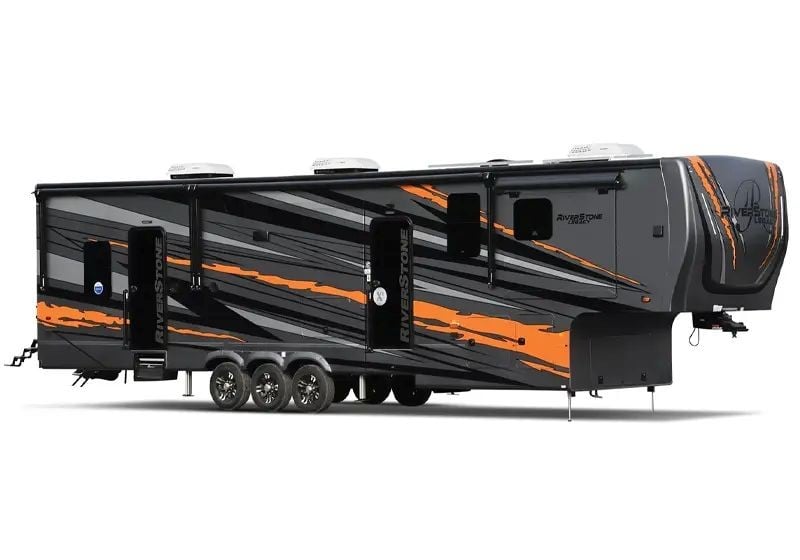
In the world of recreational towing, '5th wheel' means this:


Yes, all of the trailer weight that is carried by the tow vehicle is now located between the TV's axles - distributing itself to both.
The TV doesn't squat like a frog and the steering wheels aren't jacked up in the air. 
Any yawing of the trailer is now better controlled by all tyres on the TV.
It is hugely more stable (than the same trailer wight as a bumper-pull) - both theoretically and in practice..
The 5er stability characteristics don't have much similarity to a commercial trailer whose axles are at the ends (rather than in the middle).
Porpoising and yaw remain considerably more of an issue.


If you want to make a heavy bumper-pull trailer (recreational) behave better, you use a weight distributing hitch like a Reece.
It allows you to push some tow ball weight to the front axle (of the tow vehicle) and some back to the trailer axle(s).
It is also often integrated with a frictional sway damper.
If you're towing a 3T (or 6T !) caravan in big, gusty side-winds or meeting big trucks with closing speeds of 250 kph, you love them.
I've only ever seen one in NZ.  


1 | ... | 4 | 5 | 6 | 7 | 8 | 9 
View this topic in a long page with up to 500 replies per page Create new topic


Geekzone Live »

Try automatic live updates from Geekzone directly in your browser, without refreshing the page, with Geekzone Live now.


Are you subscribed to our RSS feed? You can download the latest headlines and summaries from our stories directly to your computer or smartphone by using a feed reader.