|
|
|
Looks like your options are
Stick with 100mbps VDSL (you are lucky and will get at least another 6 years out of it)
Go to Fixed wireless and have poorer service I would NOT recommend you do that, speeds are so variable
Go to Starlink and pay more
Any views expressed on these forums are my own and don't necessarily reflect those of my employer.
The Commerce Commission have responded today with a link on their website which includes the following confirming my understanding.
So further to the earlier post linking to the Chorus website, their claim seems premature unless they are going to hurry up the pace of UFB rollout.
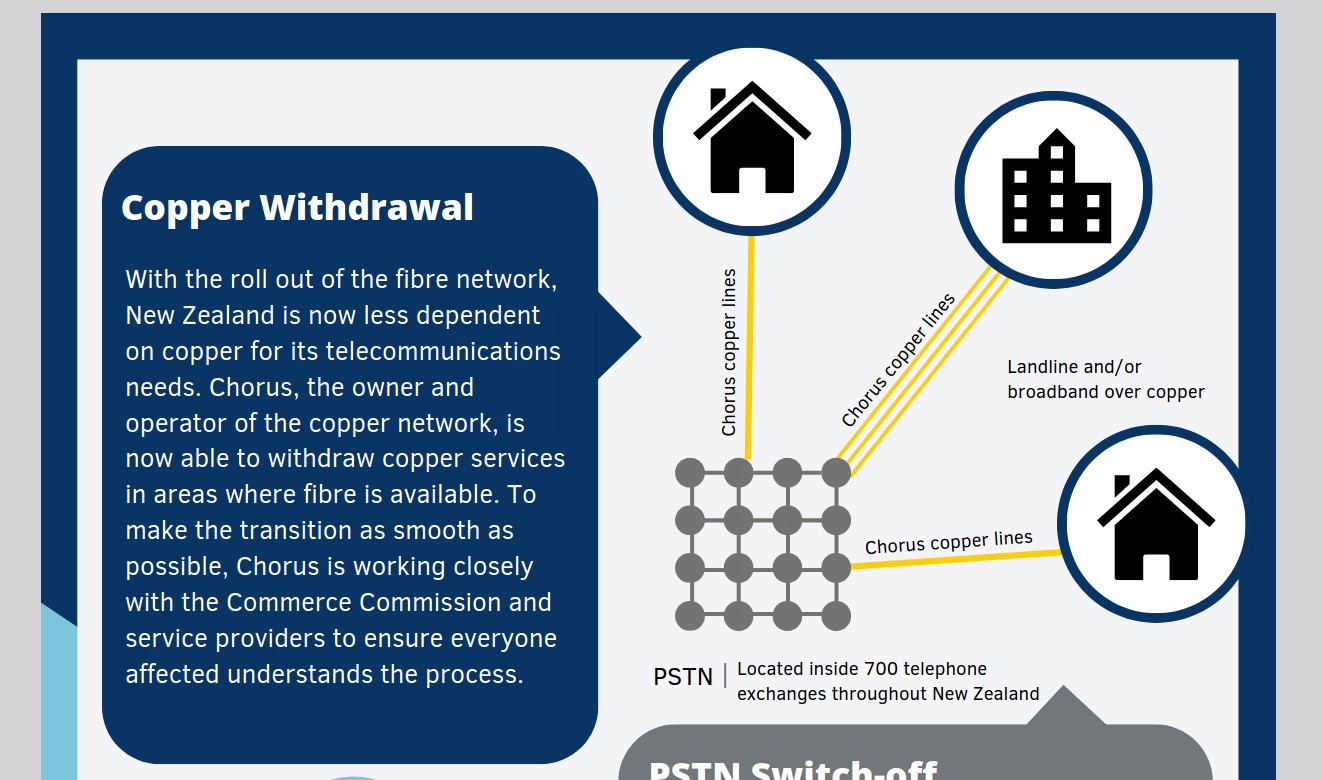
"Chorus is retiring its copper network – which means we are phasing out the availability of broadband and phone services that use the copper network. We started with areas where fibre is available in 2021 and are intending to retire the entire network by 2030." (emphasis added)
Chorus: What is copper network retirement?
In context this is still 5 years away and I don't have a crystal ball.

WFH Linux Systems and Networks Engineer in the Internet industry | Specialising in Mikrotik | APNIC member | Open to job offers | ZL2NET
Wheelbarrow01:
but for the bulk of them, their options are likely to be either a satellite or WISP solution with a VOIP service layered on top. Some customers with reasonable mobile coverage at their property may choose to forego a landline altogether - indeed some affected customers have already chosen this option.
Not expecting you to know the answer to this @wheelbarrow01 but what does this mean for those without Mobile phone coverage in a blackout? DIY VOIP over WISP/Starlink is not covered by the 111 Contact code
For example, the VOIP provider can't be expected to provide a UPS for the WISP/Starlink equipment and WISPs/Starlink isn't going to provide a UPS for another providers VOIP equipment
Catch 22 here
Any views expressed on these forums are my own and don't necessarily reflect those of my employer.
We paid $25k for a NGA UFB install.
We had an original quote of over $95k before the exchange had the OLT and Line cards installed. So would guess the $15k is just for connecting you to the existing equipment. I had a quote of around $100 per meter for a 2km extension for a friend so at $100 per meter that alone would be $23k for your 230m.
Would I pay $25k again not sure, but at $15k it is a bargain in my view and I would pay. However you have very good VDSL and I only had ADSL at about 1.8Mbps
MichaelNZ:
Over the last few days Chorus has been rolling out "custom" UFB for an RCG cellsite at the Norsewood township. This does not go past our place, however, I have noted a couple of things:
- They appear to be building something which they intend to do more with at some stage judging by the amount of cabling they are installing. This is a new pit. See photo.
- Their estimate for a custom UFB install to our place has dropped from ~$55k to ~$15k. The network extension to our boundary is around 230m.
- If they rollout UFB here our address would certainly be included.
So for the dilemma. Do I pay $15k (which is an amount I still need to think about) or hold out for a rollout? There was no way it was going to happen at $55k but at $15k I am thinking a bit too much about it.

Godfrey
Auckland/Coroglen, New Zealand
Quic Broadband - 4G Hyperfibre
Referral Link:
Quic (use R71004E9PVBJ on checkout for free setup)
godber:
We paid $25k for a NGA UFB install.
We had an original quote of over $95k before the exchange had the OLT and Line cards installed. So would guess the $15k is just for connecting you to the existing equipment. I had a quote of around $100 per meter for a 2km extension for a friend so at $100 per meter that alone would be $23k for your 230m.
That's great information, thanks very much.
How long did they take to do the install?
WFH Linux Systems and Networks Engineer in the Internet industry | Specialising in Mikrotik | APNIC member | Open to job offers | ZL2NET
nztim:
Not expecting you to know the answer to this @wheelbarrow01 but what does this mean for those without Mobile phone coverage in a blackout? DIY VOIP over WISP/Starlink is not covered by the 111 Contact code
For example, the VOIP provider can't be expected to provide a UPS for the WISP/Starlink equipment and WISPs/Starlink isn't going to provide a UPS for another providers VOIP equipment
Catch 22 here
I suspect there are probably a few people quietly hoping that over the next few years "Mobile to satellite" voice becomes a thing and all they will need to do is post out a bunch of compatible phones with a USB battery bank...
They are waiting for it to be provided for free.
They might be waiting an awfully long time
nztim:
Not expecting you to know the answer to this @wheelbarrow01 but what does this mean for those without Mobile phone coverage in a blackout? DIY VOIP over WISP/Starlink is not covered by the 111 Contact code
For example, the VOIP provider can't be expected to provide a UPS for the WISP/Starlink equipment and WISPs/Starlink isn't going to provide a UPS for another providers VOIP equipment
Catch 22 here
Hey mate, I'm not at the coal face of the CMAR withdrawal process, although I was involved with some of the early planning work. But I do know of one vulnerable consumer with a number of health issues who we've already encountered as part of CMAR exit. In that case Chorus worked directly with the customer to find a satisfactory solution. That customer already lived entirely off grid apart from the landline - no mains power, just a meagre DIY solar setup for daily use and a rarely used generator for emergencies, but I understand the customer is happy with the solution we implemented.
It's worth noting that the 111 Contact Code doesn't guarantee a free back up calling solution to every fibre or wireless consumer, but rather for consumers who are “at particular risk of requiring the 111 emergency service”. By the definition in the code itself, this means "a consumer who is more likely than other consumers to require the 111 emergency service because of a specific circumstance applicable to that consumer".
There's some context and nuance to all this. For the past few years, we've seen ever higher fault rates for CMAR, and in many cases it can take weeks to be fixed, as solid state equipment often has to be sent to Auckland for a specialist to diagnose and then scavenge replacement parts, before sending the unit back to where it came from for reinstallation. This can happen multiple times to the same customer (or group of customers) in relatively quick succession - for example, lightning strikes in particular regions play absolute havoc with these radio systems, which by their very design are usually located on high ground). For these reasons, many CMAR customers have already adapted to uncertain periods of no service and have their own emergency procedures in place should the need arise. In some cases where a customer with a CMAR fault is medically dependent or particularly isolated, our regional managers have delivered a satellite phone handset for emergency use during the fault. Obviously that's not sustainable as a permanent solution but we are gradually coming up with a toolbox of potential solutions as we encounter different situations.
The views expressed by me are not necessarily those of my employer Chorus NZ Ltd
Wheelbarrow01:
our regional managers have delivered a satellite phone handset for emergency use during the fault. Obviously that's not sustainable as a permanent solution but we are gradually coming up with a toolbox of potential solutions as we encounter different situations.
Thanks for sharing this interesting background.
That sounds like low hanging fruit compared to copper withdrawal because CMAR only services a handful of lines for people who live in very remote places and who have low expectations.
Whereas DSL has whole townships full of people who expect broadband which is fast, affordable and reliable.
And given the normal rural-to-urban shift for people potentially in need of emergency services, I can see the bar is quite a bit higher for this objective.
From my experience working at an ISP the DSL to UFB migration is an easy sell. We just advise clients its available, its better and there is no charge to upgrade. And importantly everything will be the same and better.
But if we lose the ability to service them through the Chorus network this is a whole new challenge I am not thrilled about. It leaves me in a position I either have to not help them, or if I do, risk being blamed for any problems. And if they are on VoIP and have numbers to port the headache is way bigger again.
WFH Linux Systems and Networks Engineer in the Internet industry | Specialising in Mikrotik | APNIC member | Open to job offers | ZL2NET
MichaelNZ:
We are in the township and surrounded by neighbours. I haven't counted but I think there would be 50 connections within their likely initial roll out.
There is only about ~21 connections active on vdsl in the township. All get over 40mbits, most get over 100mbits.
It seems that although vdsl is very fast in the township,
- people are price sensitive and choosing a cheaper alternative like 4g, even if slower
- speed is not important in their buying decision,
- just dont want to spend money on a fixed line internet subscription.
Ray Taylor
There is no place like localhost
Spreadsheet for Comparing Electricity Plans Here
MichaelNZ:
I enquired about that awhile ago. It apparently ends here, at Norsewood. Its over $70k to connect.
I think yeah, nah.
I was recently quoted a directional drilling job (would be required due to concrete driveways, footpaths in the village) which was about 600 metres. Quote came back at $85k and similar to other quotes i have had in the past for a similar job.
It was also only one street, in a straight line and i was supplying materials - it was simply to install a 32mm duct.
Ray Taylor
There is no place like localhost
Spreadsheet for Comparing Electricity Plans Here
raytaylor:
There is only about ~21 connections active on vdsl in the township. All get over 40mbits, most get over 100mbits.
It seems that although vdsl is very fast in the township,
- people are price sensitive and choosing a cheaper alternative like 4g, even if slower
- speed is not important in their buying decision,
- just dont want to spend money on a fixed line internet subscription.
This is why I suggested looking into a community upgrade. While I have no doubt the OP would love to get a fast fibre connection available at his address - how many other people in the township feel the same?
If there's only 20-odd connections, I imagine there would be a fairly high outlay for a low population base (assuming everyone got fibre installed if available).
quickymart:
If there's only 20-odd connections, I imagine there would be a fairly high outlay for a low population base (assuming everyone got fibre installed if available).
That was a bit lower then I thought but its possible it could be a case of sample bias on my part. I don't know everyone in the township and it could be the people I do know of represent an outsized sample of those who have connections.
WFH Linux Systems and Networks Engineer in the Internet industry | Specialising in Mikrotik | APNIC member | Open to job offers | ZL2NET
raytaylor:
I was recently quoted a directional drilling job (would be required due to concrete driveways, footpaths in the village) which was about 600 metres. Quote came back at $85k and similar to other quotes i have had in the past for a similar job.
It was also only one street, in a straight line and i was supplying materials - it was simply to install a 32mm duct.
That sums up their point of view as well. Even though its a short run it was going to be too expensive.
Also a combination of high price, single supplier risk and IP resources to maintain, my only real option there was Chorus. Granted those are rare considerations but in this instance it also aligns with whats best for the average user which is reasonable price, high reliability, marketplace choice and ease of use.
The Chorus UFB network is a compelling proposition compared to the landscape in many comparable countries.
I suspect the price you were quoted includes a substantial loading compared to what Chorus would pay (or is theirs inhouse?)
WFH Linux Systems and Networks Engineer in the Internet industry | Specialising in Mikrotik | APNIC member | Open to job offers | ZL2NET
MichaelNZ:
I suspect the price you were quoted includes a substantial loading compared to what Chorus would pay (or is theirs inhouse?)
We were trying to beat chorus by meeting them at a pit rather than having them come to our customer site. Turns out that it was almost the exact same pricing chorus gave. We had gone to a couple of chorus subcontractors for a quote directly.
Ray Taylor
There is no place like localhost
Spreadsheet for Comparing Electricity Plans Here
|
|
|