|
|
|
hotsupes:
Not sure who told you 5G is worse for speed than 4G, but this is entirely incorrect. 5G is much better and if attainable, the more desirable option.
One of the arguments I've heard for this is because 5G's range is so poor, you end up with more handover, both when you're moving between 5g and 4g towers, and when you're getting ping-ponging between two 5g towers. Even though 5G standards say the handover latency is something like 0-5ms (4g is closer to 50ms), that can still add up if it's happening frequently. Additionally, handover failures are about 6%, and increase with distance, so having to repeat a handover or bounce between 4g and 5g and back, means you're looking at latencies of 200+ms where there's no data transfer at all.
Unrelatedly, I'm still loving my pixel, though I'm less impressed with the camera on the non-Pro this time around. Maybe I haven't learned how to use it well yet, but I think I liked the default colour balance and interpolation on photos I took with the Pixel 2 more, particularly when zooming in. The magic eraser is amazing, though.
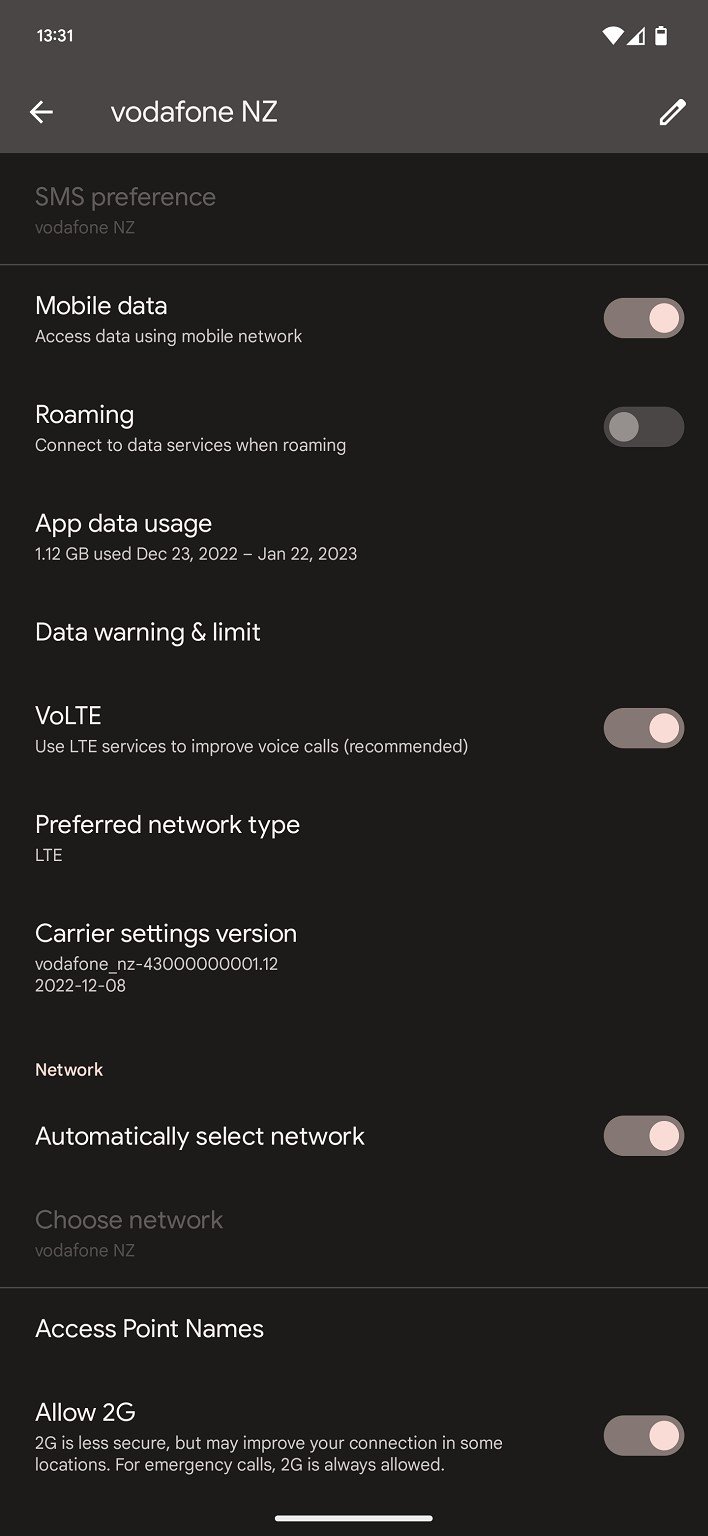
mrvtec: On pixel 7 pro qpr beta2 volte has been enabled for Vodafone NZ now google has finally listened
Well that's great news for you vodafone folk! How's the beta? I've been tempted to swap onto it from release, but wiping my phone is stressful these days lol.
the difference between nerds & geeks is that geeks get it done!
There are some situatios where 4G speeds could be better than 5G due to network configuration. Spark in Auckland is a good example. At most sites they have deployed new equipment for 5G NR at 3500 MHz and 4G LTE only at 2100 MHz using equipment from their new equipment vendor (Ericsson?). Their network is configured so that 5G phones attach to the single 4G LTE carrier at 2100 MHz and aggregate with the 5G NR carrier for download at 3500 MHz with a total download bandwidth of 75 MHz. Meanwhile 4G 5CA capable phones attach to any of the five the exisiting carriers at 700 / 1800 / 2300 / 2300 / 2300 / 2600 MHz (presumely still Huawei gear not yet replaced) with the 5CA carrier aggregation providing up to 100 MHz of bandwidth.
Vodafone/2degrees on the other hand seem to be able to aggregate most if not all 4G and 5G carriers. 2degrees seems to be replacing all their gear site by site so all 4G and 5G radio gear are from the same vendor at all 5G sites. Vodafone has been lucky sticking with the same vendor for 5G they used for 4G. 2degrees typically provides at best 10+20+10+60=100 MHz (LTE 700/1800/2100 + NR 3500) on my S21. I haven't had much opportunity to observe Vodafone's 5G NR (my Vodafone SIM is usually in a non-5G phone) but from memory they also seem to aggregate 15+20+15+15+60=125 MHz (LTE 700/1800/2100/2600 + NR 3500).
To be fair the 3G/4G transition saw situations where the exisiting 3G network performed better than the incoming 4G network. In the early days of LTE I observed speed tests where Dual Carrier UMTS 850/900 MHz was faster than single carrier LTE 1800 especially in places where the 1800 MHz signal was weak. Nowadays with LTE carrier aggregation, stronger signal and much more spectrum (especially the lower bands) LTE is performing much better than UMTS ever did in its heydays. This also will happen for 5G NR in good time.
Arun, "Mrwhostheboss" on YouTube puts it into better framing than I do... https://www.youtube.com/watch?v=SRz6Kc_aqEg
the difference between nerds & geeks is that geeks get it done!
m2geek:
Arun, "Mrwhostheboss" on YouTube puts it into better framing than I do... https://www.youtube.com/watch?v=SRz6Kc_aqEg
Interesting video, but also includes some not very accurate info. Part of it is oversimplfiying but also some balantly incorrect info e.g. he at times seem to imply 5G only operates at very high frequencies limiting its range (which is not true, 5G can operate at the same frequencies 4G operates on today so there is a nice migration path from e.g. 4G 700 to 5G 700 including even running both 4G and 5G simultaneously in the same lower frequency bands).
This is the same thing that happened with the 3G and 4G migrations. People complained about the range of 3G 2100, but once 3G 850/900 came online that all disappared and we now have people saying 3G provides the better coverage. Then the same complaints about 4G 1800, but once 4G 700 came online complaints has almost disappeared in most places. It'll be excatly the same old merry go round with this 5G migration.
One thing I do agree with him though 5G is way overhyped (especially the crap about remote surgey and all that). I really wish they'd stop with that crap (especially Spark here in NZ which seems to be the worst of the NZ networks at overhyping 5G).
The simple reality is 5G just enables more efficent use of radio spectrum in the exisiting radio bands and opening up more capacity in radio bands not currently used for mobile/wireless broadband. There is an ongoing tend of $/GB going down which obviously increases the demand for data. The introduction of fixed wireless broadband is also adding more pressure to demand. The mobile networks have to provide capacity for the increased demand in data which will come. 5G in the long term will bring more capacity to our mobile networks allowing it to support the demand of tomorrow's customers who will likely be on cheap unlimited/uncapped data plans and possibly even using wireless to replace more wired (especially with fixed wireless broadband very likely to replace most rural DSL connections). It's very boring tech but we will benefit from it.
KiwiSurfer:
m2geek:
Arun, "Mrwhostheboss" on YouTube puts it into better framing than I do... https://www.youtube.com/watch?v=SRz6Kc_aqEg
Interesting video, but also includes some not very accurate info. Part of it is oversimplfiying but also some balantly incorrect info e.g. he at times seem to imply 5G only operates at very high frequencies limiting its range (which is not true, 5G can operate at the same frequencies 4G operates on today so there is a nice migration path from e.g. 4G 700 to 5G 700 including even running both 4G and 5G simultaneously in the same lower frequency bands).
This is the same thing that happened with the 3G and 4G migrations. People complained about the range of 3G 2100, but once 3G 850/900 came online that all disappared and we now have people saying 3G provides the better coverage. Then the same complaints about 4G 1800, but once 4G 700 came online complaints has almost disappeared in most places. It'll be excatly the same old merry go round with this 5G migration.
One thing I do agree with him though 5G is way overhyped (especially the crap about remote surgey and all that). I really wish they'd stop with that crap (especially Spark here in NZ which seems to be the worst of the NZ networks at overhyping 5G).
The simple reality is 5G just enables more efficent use of radio spectrum in the exisiting radio bands and opening up more capacity in radio bands not currently used for mobile/wireless broadband. There is an ongoing tend of $/GB going down which obviously increases the demand for data. The introduction of fixed wireless broadband is also adding more pressure to demand. The mobile networks have to provide capacity for the increased demand in data which will come. 5G in the long term will bring more capacity to our mobile networks allowing it to support the demand of tomorrow's customers who will likely be on cheap unlimited/uncapped data plans and possibly even using wireless to replace more wired (especially with fixed wireless broadband very likely to replace most rural DSL connections). It's very boring tech but we will benefit from it.
I'm in Whanganui, 5G is really spotty - even if we had access to it on the Pixel lol..
the difference between nerds & geeks is that geeks get it done!
mrvtec: On pixel 7 pro qpr beta2 volte has been enabled for Vodafone NZ now google has finally listened
Theres a patch a Korean dev uploaded onto Github if you don't want to beta test.
He says 5G patch could be available which I think would be faster than Google patch.
https://github.com/kyujin-cho/pixel-volte-patch/blob/main/README.en.md
Can anyone write a summary answer for this 12 page thread?
I'd like to look at geting the Pixel 8 later this year, but only if it "just works". If it only works on one telco that's fine, it's easy to change telcos. VoLTE is essential, VoWifi is fairly important for many.
timmmay:
Can anyone write a summary answer for this 12 page thread?
If you're on Spark - congrats, you have VoLTE built in.
For any other provider there's non-root workarounds to get VoLTE (as per recent replies).
VoWiFi not supported yet on Spark or anyone else, but have seen it also enabled through said workarounds - although haven't tried myself to see if it actually works.
5G is still a WIP for a workaround as far as I know.
Not ideal but the phones can be rooted to get all of them anyway.
m1dday:
VoWiFi supported yet on Spark or anyone else, but have seen it also enabled through said workarounds - although haven't tried myself to see if it actually works.
Nice, thanks :) Did you mean "VoWiFi not supported"?
timmmay:
m1dday:
VoWiFi supported yet on Spark or anyone else, but have seen it also enabled through said workarounds - although haven't tried myself to see if it actually works.
Nice, thanks :) Did you mean "VoWiFi not supported"?
Whoops yes, definitely not supported yet.
How hot do you find your Pixel 7s get?
I'm interested in getting one but have read about major heating when using mobile data, especially 5G, and things like the camera or Android Auto.
|
|
|