|
|
|
ToU pricing is annoying. We had it with flick for a while that we got sick of having to look at the time before we used power. The only way we would consider that again is if it was a large saving with a really good solar feed-in rate.
timmmay:
ToU pricing is annoying. We had it with flick for a while that we got sick of having to look at the time before we used power. The only way we would consider that again is if it was a large saving with a really good solar feed-in rate.
Completely the opposite with me with batteries...
True. We didn't get a battery because the feed and rate is so close to the power rate the payback time for a battery is huge for us.
chimera:
The EA recently approved new rules that require large retailers (those with > 5% market share) to offer time-varying (TOU) pricing plans by 30 June 2026.
According to the EA, most consumers currently do not have access to TOU plans, only a minority of retailers offer them now, and often to only a specific group (eg: EV owners)
That's strange, when I did my shopping a while back most providers did offer TOU. And most TOU plans are open to all -- only some are EV only. Contact is a good example of a company offering a range of TOU plans to suit.
The only issue with TOU plans was none of them worked for us. Not even one offerd cheaper prices for us. The most expensive plan in my calculations was a Contact TOU plan at over $600 a month (followed by various retailers offering TOU plans costing $500, $400, etc) vs $250-300 for non-TOU plans with almost every provider.
The issue is not the lack of TOU plans, the issue is most people use power at the times TOU plans offer the most expensive pricing. I'm not cooking dinner at 9pm as that's my bedtime. I'm gonna do my hot shower after I wake up and befoer I go to work. Our hosuehold doesn't have the luxury of timeshifting as we already are efficent at minimising our power off-peak, and it's really peak usage that we struggle to shift away as it causes pratical issues for us.
EA seems to have things back to front IMHO. They need to fix the demand side before they can fix the supply side IMHO. Otherwise they risk introducing TOU plans with very low uptake and putting retailers in a position where they have to cross-subside to keep their TOU plans afloat.
Well that's straight from the horses mouth so to speak (sparky mate is getting his solar accreditation stuff at a course he's doing, got told that by the instructor) so no offence, but I'll take that info over your shopping experience.
Not relevant to everyone of course, and agree they do seem to ream you on those that do offer TOU, increasing the non-TOU rate so it's a bit of a have if you have to alter your lifestyle to make use of it then end up paying the same anyway.
TOU will work perfect for me - again, due to batteries though
Be interesting to see the detail from the EA around this
chimera:
The EA recently approved new rules that require large retailers (those with > 5% market share) to offer time-varying (TOU) pricing plans by 30 June 2026.
According to the EA, most consumers currently do not have access to TOU plans, only a minority of retailers offer them now, and often to only a specific group (eg: EV owners)
https://www.ea.govt.nz/documents/8427/Time-varying_price_plan_requirements_-_Retailer_Guidance.pdf
The bare bones of it for us is that we self consume to a high degree so our daily import has averaged about 6 kWh for the past few months. If that is all we will be drawing from a battery it will take a hell of a long time for ROI. There's about a 20c/kWh difference between peak supply rate and FIT so for 6 kWh that runs to about $1.20/day benefit - Big deal!
Additionally with Ecotricity our FIT during peak hours (7:00 - 11:00am) is just over 24c/kWh, for >200 kWh in each of the past two months, and 18.4c/kWh for remaining export. Our still to arrive account for November should run at ~$180 credit.
Being immune to power outages would be nice but I'm waiting for V2G functionality for one or both of our EVs to serve that purpose rather than spend the bucks on a static battery set-up with a fraction of the capacity of our EVs' batteries.
https://www.harmlesssolutions.co.nz/
HarmLessSolutions:
Being immune to power outages would be nice but I'm waiting for V2G functionality for one or both of our EVs to serve that purpose rather than spend the bucks on a static battery set-up with a fraction of the capacity of our EVs' batteries.
I'm just installing another battery so will end up with 68kWh of usable battery capacity, so looking forward to some competition in the FIT space. Orion have a deal where they can pay 60c during peak demand times, so will be having that convo soon.
Otautahi Christchurch
fastbike:We generated 2,010 kWh in November, exported 1,370 kWh and imported 195 kWh. We really don't import enough to make batteries worthwhile.
HarmLessSolutions:
Being immune to power outages would be nice but I'm waiting for V2G functionality for one or both of our EVs to serve that purpose rather than spend the bucks on a static battery set-up with a fraction of the capacity of our EVs' batteries.
I'm just installing another battery so will end up with 68kWh of usable battery capacity, so looking forward to some competition in the FIT space. Orion have a deal where they can pay 60c during peak demand times, so will be having that convo soon.
https://www.harmlesssolutions.co.nz/
I am waiting to see if we get battery subsidies like they got in AU. Till then I will just make do with my small system that doesnt see me exporting anything except on an odd weekend where I sleep in and therefore the hot water is not heating at peak solar production time.
HarmLessSolutions:
We generated 2,010 kWh in November, exported 1,370 kWh and imported 195 kWh. We really don't import enough to make batteries worthwhile.
Interesting. Our house (11.88kW PV )generated 1,955, the garage (5kW PV) another 900. For the current billing period which ends tonight, we have used 10 units, and exported 2,014. The battery is handy in summer as it stops us going over the retailer's export cap so we export (empty the battery) between 7am and 9am and it then soaks up the excess during the day. With two batteries I will be able to export in the evening as well.
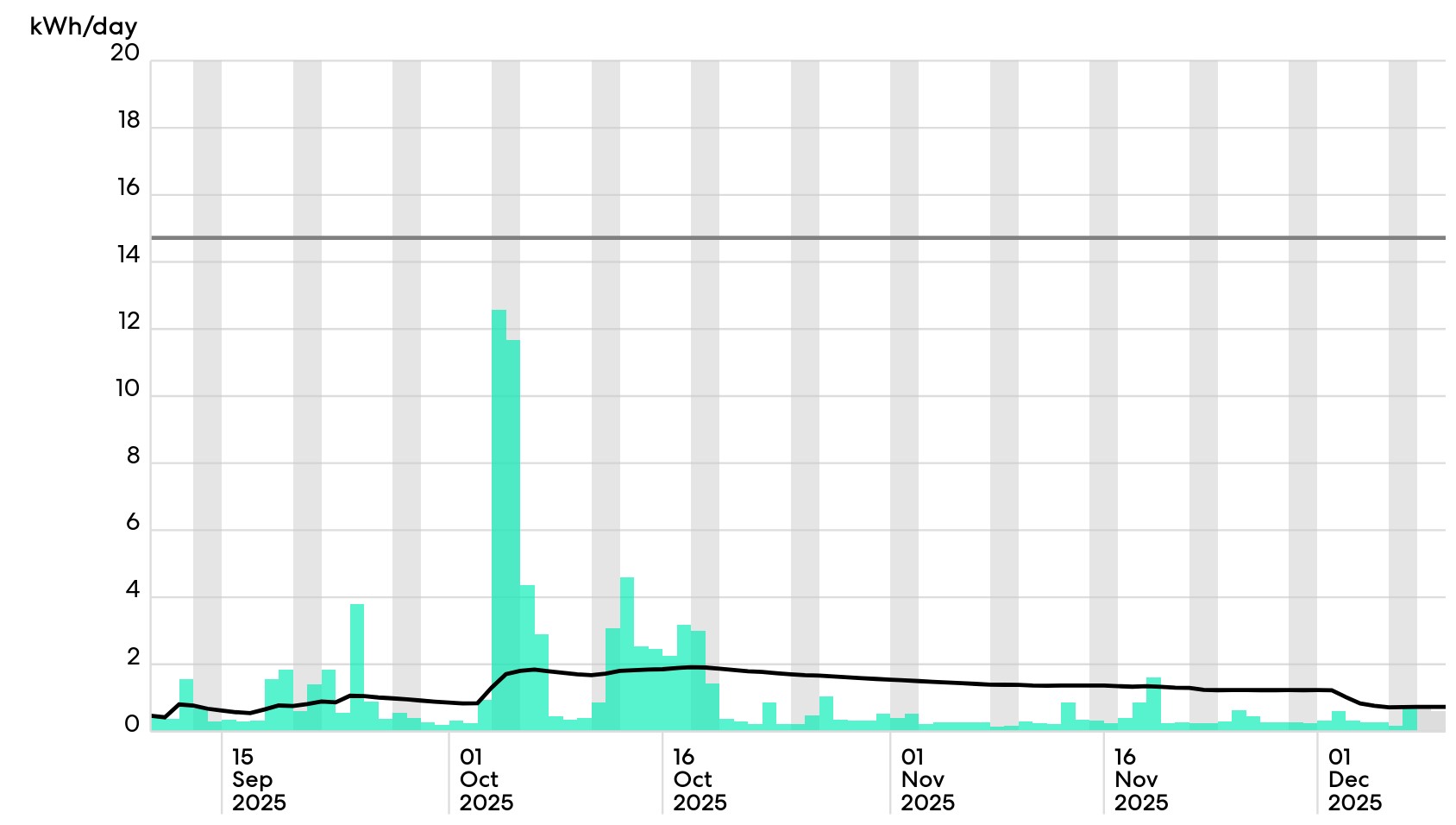
Here's the graph from the power co for grid usage over the last 3 months - the import near the start of October was charging the car overnight.

Come winter time I will use the grid to charge the battery overnight, and will not need to import any peak rate electricity - yay !
The larger capacity will also mean I don't need to start using grid power at 9pm when our our peak tariff starts - I can imagine there is a fair surge at that time which will be supplied with coal, which is a pretty stupid thing for our country to be doing.
The batteries are repurposed EV units, the total installed cost is just a little more than a home battery that Elon would like to sell to you but we have over 4 times the capacity. And the control system can be set to keep it between something like 10% and 85% which provides a much longer lifetime at the cost of slightly smaller capacity. Google Battery Emulator or flick me a PM if you want to know more.
Edit: added chart
Otautahi Christchurch
richms:
I am waiting to see if we get battery subsidies like they got in AU. Till then I will just make do with my small system that doesnt see me exporting anything except on an odd weekend where I sleep in and therefore the hot water is not heating at peak solar production time.
Sounds like the way to go for you. When people ask me for advice I tell them each person's situation is different and what works for our house/lifestyle may not work for them. A colleague is currently getting quotes but it is complicated by the fact that he installed (bottled) gas hot water 13 years ago so is also getting a quote to have that replaced with an electric storage HWC.
Regarding battery subsidies, I do not see it happening anytime soon. The current administration would rather poke themselves in the eye than help the country decarbonise and increase security of supply, and even if the Greens or TOP were part of a government their policies would not incentivise storage. IIRC Greens would help with rooftop PV, and while TOP have not said anything they would probably do the same thing.
Labour had their pumped storage system which is in effect a very large scale battery albeit with a longer charge/discharge period than the average house battery setup.
I see that a private consortium is now investigating a commercial model to build the Lake Onslow scheme which together with wind/solar would change the electricity model in NZ.
The cost was estimated at $16B (incl an operating model) for 5TWh of storage, so unless my maths is wrong that looks like around $3.20 per kWh of storage which is incredibly cheap.
To put that into perspective 15 years ago Nissan budgetted $1k per kWh for their Leaf battery, current EV storage is now less than $50/kWh, commercial storage considerable less. A Tesla home storage unit is still around the $1k / kWh !
So no government in their right mind would subsidise home batteries.
Otautahi Christchurch
In some parts of Aussie solar uptake is so high, at various times they charge consumers for exporting to the grid, primarily because solar owners are overloading the grid mostly around midday (voltage spikes, reverse power flows etc), plus their grid needs upgrading in a lot of areas. So they're discouraging by charging for export.
Our uptake (and likely due to our climate vs aus and also coz we tend to get reamed on anything with a dollar sign in it here) is a lot lower than Aussie obviously.
It will be interesting to see how people with large PV systems go when (hopefully) better TOU options come out.
At the moment, I'm never really using anything but PV and battery, with the only grid use is battery top-up at the $0.165715 night rate. Usually my peak is $0.33143 and off-peak $0.23943. And now I've added an extra battery (46kwh total) I've got to do the math on moving from high to low user rate, coz it's the daily fixed charge that's reaming me.
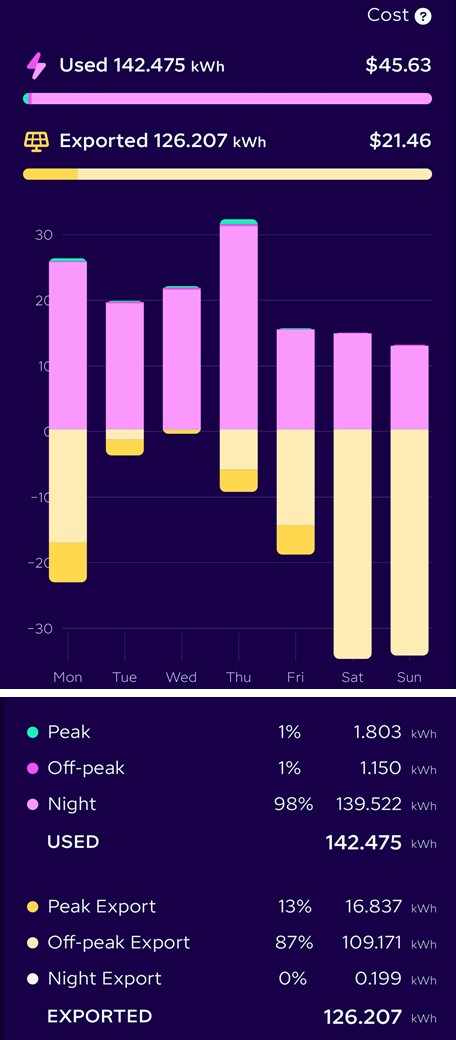
I produced 295kwh in PV and house used 296kwh in power from 1st to 7th Dec. This is Octopus usage report...

@steve98 That sounds reasonable for a 12.5 kW system. My only reservation would be putting a "basic HWC timer" into the mix rather than a diverter such as a Paladin. A timer will make your HWC draw its maximum demand for as long as it takes to reach the thermostat setting. This can be a distinct disadvantage on partly cloudy or low light days where the shortfall between generation level and element demand is imported from the grid.
For a diverter the HWC draw will track the levels of your otherwise exported generation, up to the ~3 kW rating of the HWC element. Our Paladin is probably the best single component in our solar set-up and its ability to follow our generation minus consumption to within 10-20W is very satisfying to see and justifies the extra cost over a timer. It is also more reactive than our Evnex EVSE's solar diversion and usually gets first dibs on 'excess' generation as a result.
https://www.harmlesssolutions.co.nz/
A diverter is useful if your feed in rate is low, otherwise a basic timer is ok, the grid acts as a battery. A battery useful if you have regular power cuts or low feed in rate, check if it will work during power cuts though. We didn't bother with a battery, the payback time is huge given we pay 22c and get 18c for power in Wellington with Meridian.
|
|
|