|
|
|
some houses just arent made for solar
Hi All,
Quick couple of questions... I've had a quote for solar and it's not very clear. There's only four line items as below:
The total is $36k. I've had a several other quotes which are a bit cheaper, but they all spec other, perhaps less established, brands.
Is there anything missing from the quote that I should question? Is that a reasonable deal (I'm in Auckand)? Can anyone recommend another company who could quote on similar gear (I won't touch Tesla)?
That battery is a killer do you really need one , 8.64 is not a massive sized system . You will still save a lot of money without a battery
Twincamr2:
Hi All,
Quick couple of questions... I've had a quote for solar and it's not very clear. There's only four line items as below:
- AIKO INFINITE 480W ALL BLACK ULTRA X 18 = 8.64 KW.
- FRONIUS PRIMO 8.0 GEN24 SINGLE PHASE UPGRADABLE HYBRID INVERTER
- GIVENERGY 13.5KWH AC COUPLED PREMIUM BATTERY SOLUTION
- Fronius Smart Energy Meter 63A-1
The total is $36k. I've had a several other quotes which are a bit cheaper, but they all spec other, perhaps less established, brands.
Is there anything missing from the quote that I should question? Is that a reasonable deal (I'm in Auckand)? Can anyone recommend another company who could quote on similar gear (I won't touch Tesla)?
Aiko and Fronius are both premium brands. You could probably get the same, or almost the same, performance from other brands for considerably less.
I had quotes from Harrisons, and they offered an upgrade to Aiko panels over their base quote, but the premium was not worth the extra 25W peak per panel they may have provided in terms of RoI. Circumstances vary - if you had limited roof space, then higher output panels may be more worthwhile. FYI - I didn't go for either Harrisons quote as another installer provided a better deal.
You could consider over-specing your panels more than 8%, as you will rarely operate near your inverter capacity over winter (especially if your panels are not all ideally orientated). This may be a better investment than battery.
Using an AC-coupled battery with a hybrid inverter to me seems like an odd choice - is there a reason for this?
The quote should make it clear that installation is included - both electrical and mechanical. Fine print should define exclusions (e.g. an unanticipated upgrade to your switchboard, additional cable runs, etc.).
kangaroo13:
Aiko and Fronius are both premium brands. You could probably get the same, or almost the same, performance from other brands for considerably less.
I had quotes from Harrisons, and they offered an upgrade to Aiko panels over their base quote, but the premium was not worth the extra 25W peak per panel they may have provided in terms of RoI. Circumstances vary - if you had limited roof space, then higher output panels may be more worthwhile. FYI - I didn't go for either Harrisons quote as another installer provided a better deal.
You could consider over-specing your panels more than 8%, as you will rarely operate near your inverter capacity over winter (especially if your panels are not all ideally orientated). This may be a better investment than battery.
Using an AC-coupled battery with a hybrid inverter to me seems like an odd choice - is there a reason for this?
The quote should make it clear that installation is included - both electrical and mechanical. Fine print should define exclusions (e.g. an unanticipated upgrade to your switchboard, additional cable runs, etc.).
Thanks so much for the feedback - all good points. Unfortunately that is the maximum area of panels we could possibly fit. Our roof is exactly north-facing but relatively small. Pretty much the entire roof is covered. I could ask to down-spec the inverter, but that doesn't seem like a good option.
Yeah, the AC coupled battery is a bit of a head scratcher for me. They've assured me it's a good fit and the efficiency loss will be minimal. I assume it's their only option beyond the powerwall. Are there any other problems we might have?
I've asked them to flesh out the quote. Will see what they come back with.
Twincamr2:
Yeah, the AC coupled battery is a bit of a head scratcher for me. They've assured me it's a good fit and the efficiency loss will be minimal. I assume it's their only option beyond the powerwall. Are there any other problems we might have?
I don't expect so - but I'm far from expert on this. Just seems strange to pay for a hybrid inverter, and then specify an AC-coupled battery. It seems you could either save by specifying a simpler inverter, or benefit from the extra efficiency of a DC-coupled battery system.
There is a recent piece on Solarquotes (australia) about AC vs DC coupling, which makes the case for both. May be worth reviewing.
kangaroo13:
I don't expect so - but I'm far from expert on this. Just seems strange to pay for a hybrid inverter, and then specify an AC-coupled battery. It seems you could either save by specifying a simpler inverter, or benefit from the extra efficiency of a DC-coupled battery system.
There is a recent piece on Solarquotes (australia) about AC vs DC coupling, which makes the case for both. May be worth reviewing.
That's great - I'll have a read. I was just reading their article on BYD vs Powerwall which goes over a lot of the same territory. Speaking of BYD, I like their product, especially as it integrates with the Fronius and it seems to be slightly cheaper than the givenergy, but I'm sure the devil is in the detail. Harrisons don't deal with BYD, so if we took this route, we would have to find another supplier to install it separately. Has anyone done something like that? Amy recommended BYD suppliers/installers
Can the Fronius Gen24 itself cover whole house backup like the GivEnergy AIO?
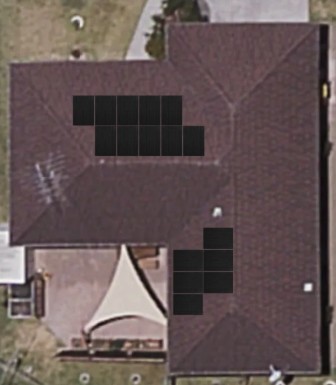
Hi all, revisiting this for 2026, my house is north facing and wondered (where I need your help) if this is the most efficient use of my roof for panel placement. Originally got 2 quotes (last Feb 2025), 1st was a 10 panel day system (10 at the top) and then a 16 panel system, shown below. I want to install as many panels as I can efficiently and wondered if this could not have been done a little better?

Lally:Assuming that north is straight up in this plan I'd be looking at utilising the northern face on the top RHS with panels running horizontal which may fit a 3,2,1 configuration on that pitch. Also by running the panels horizontally it looks to me like there is room for maybe 4 runs of 4 panels. That totals up at possibly 22 panels so close to 10 kW.
Hi all, revisiting this for 2026, my house is north facing and wondered (where I need your help) if this is the most efficient use of my roof for panel placement. Originally got 2 quotes (last Feb 2025), 1st was a 10 panel day system (10 at the top) and then a 16 panel system, shown below. I want to install as many panels as I can efficiently and wondered if this could not have been done a little better?
I'm not sold on the viability of the 6 panels on the SW face. Morning and/or winter performance would be significantly compromised.
https://www.harmlesssolutions.co.nz/
HarmLessSolutions:
Assuming that north is straight up in this plan I'd be looking at utilising the northern face on the top RHS with panels running horizontal which may fit a 3,2,1 configuration on that pitch. Also by running the panels horizontally it looks to me like there is room for maybe 4 runs of 4 panels. That totals up at possibly 22 panels so close to 10 kW.
I'm not sold on the viability of the 6 panels on the SW face. Morning and/or winter performance would be significantly compromised.
Your assumption is correct, nth is straight up, appreciate the reply, I wondered the same thing with regards to horizontal layout and whether the SW face would be beneficial.
I definitely need to ask more questions when they come out to quote. Do you think it worth using the other directly north facing section to place additional panels?
They don't like doing landscape as much as its more rail for the number of panels they fit.
They would have quoted the easiest job which is portrait You could get a third row there it looks like, or else 3 easily landscape. The putting the images on a photo from google is not exact. My shed was measured up like that and 2 rows was fine, but when they came out to assess to actually do it it was not fine as they are limited how close to the top and bottom they can go and it was just over that limit unless I add purlins or go landscape and deal with fewer panels.
Some people will run rails vertically for landscape panels, but that results in a lot of force on the brackets and most roof mounts are not specified for it.
Lally:That northern most triangular north facing pitch was what I meant for a horizontal 3,2,1 array. 3 across above the gutter, 2 above and another one at the peak, in a pyramid shape.
HarmLessSolutions:
Assuming that north is straight up in this plan I'd be looking at utilising the northern face on the top RHS with panels running horizontal which may fit a 3,2,1 configuration on that pitch. Also by running the panels horizontally it looks to me like there is room for maybe 4 runs of 4 panels. That totals up at possibly 22 panels so close to 10 kW.
I'm not sold on the viability of the 6 panels on the SW face. Morning and/or winter performance would be significantly compromised.
Your assumption is correct, nth is straight up, appreciate the reply, I wondered the same thing with regards to horizontal layout and whether the SW face would be beneficial.
I definitely need to ask more questions when they come out to quote. Do you think it worth using the other directly north facing section to place additional panels?
This is a good example of using a 'landscape' orientation to maximise roof capacity.
https://www.harmlesssolutions.co.nz/
HarmLessSolutions:
That northern most triangular north facing pitch was what I meant for a horizontal 3,2,1 array. 3 across above the gutter, 2 above and another one at the peak, in a pyramid shape.
This is a good example of using a 'landscape' orientation to maximise roof capacity.
Also looks like a great area to put some solar carports over those poor unprotected cars. In the process of cabling that they could sort out the lack of charging to those carparks.
richms:Those townhouses are a social housing development so a different set of parameters than for a private situation.
HarmLessSolutions:
That northern most triangular north facing pitch was what I meant for a horizontal 3,2,1 array. 3 across above the gutter, 2 above and another one at the peak, in a pyramid shape.
This is a good example of using a 'landscape' orientation to maximise roof capacity.
Also looks like a great area to put some solar carports over those poor unprotected cars. In the process of cabling that they could sort out the lack of charging to those carparks.
https://www.harmlesssolutions.co.nz/
Those places were never designed for solar, if they were, they would have had mono pitch roofs to align to the north. Fundamental design flaw.
|
|
|